Home Workout Plan for Indians 2026: No Gym, Real Results (Beginner to Advanced)
No gym? No problem. A complete home workout guide for Indians — fat loss, muscle building, HIIT, yoga, PCOS-friendly routines, and equipment under ₹5,000. Beginner to advanced, proven progressions.

Medical Safety Note: This article is for general educational purposes only and is not a substitute for professional medical advice, diagnosis, or treatment. If you are pregnant, managing a condition like diabetes, PCOS, or thyroid disorder, or taking medication, please consult a qualified doctor or registered dietitian before changing your diet, supplements, or exercise routine.
Affiliate Disclosure: As an Amazon Associate I earn from qualifying purchases. This post contains affiliate links. If you buy through them, we may earn a small commission at no extra cost to you — this never affects our recommendations. We only suggest products we believe in. Read our full affiliate disclosure.
Affiliate Disclosure: This post contains affiliate links. If you buy through our links, we may earn a small commission at no extra cost to you. We only recommend products we genuinely trust.
Medical Disclaimer: This content is for educational purposes only and is not a substitute for professional medical advice. If you have any health condition — heart disease, diabetes, hypertension, PCOS, thyroid issues, or joint problems — please consult your doctor before starting any new exercise programme.
Why Home Workouts Actually Work (And Why Most Indians Never Start)
Let me be honest with you — I avoided the gym for years. The cost, the commute, the awkward feeling of not knowing what I was doing surrounded by guys lifting triple my weight. Sound familiar?
Here is what I eventually figured out: the gym is not where fitness happens. Consistency is where fitness happens. And consistency is a lot easier when your "gym" is 10 steps from your bedroom.
Gym memberships in India cost ₹800–₹3,000 per month. Add commute time, changing time, and the very real mental barrier of being surrounded by experienced lifters — and it's no surprise most Indians never start, or quit within three months.
The truth is, for fat loss, endurance, and beginner-level muscle building, your living room is as effective as any gym. The exercises that build the most functional strength — squats, push-ups, lunges, planks — require nothing but your bodyweight and a 6×6 foot patch of floor.
And "no excuses" really does mean no excuses — bad weather included. If you're worried that four months of Indian monsoon will wreck your routine, it won't have to.
📖 Read Also:
Monsoon Fitness India (2026): Complete Workout, Diet & Immunity Guide for Rainy SeasonA complete guide to staying consistent with home workouts, diet, and immunity through the rainy season — when humidity, joint stiffness, and reduced outdoor activity make training feel harder.
This guide gives you everything: why it works, the complete plan, progressions for beginners through advanced, specific routines for fat loss, muscle building, women, 40+, and PCOS, the most common mistakes, and how to know when you're ready for the gym.
Recommended Gear for This Goal
A full equipment breakdown is further down this guide, but if you want to skip ahead, these are the most useful starting points:
📖 Read Also:
5 Best Resistance Bands for Home Workout in India (2026)The single most versatile piece of home gym equipment — tested across price ranges so you know exactly which one to buy.
📖 Read Also:
Best Home Gym Under ₹5000 in India (2026): Complete Beginner Equipment GuideA complete budget setup — mat, bands, rope, and dumbbells — for less than one month's gym membership.
📖 Read Also:
10 Gym Essentials Every Indian Beginner NeedsBeyond the basics — the gear that makes a home workout routine feel less improvised and easier to stick to.
📖 Read Also:
15 Resistance Band Exercises You Can Do at Home in IndiaOnce the bands arrive — a full-body routine and 4-week progression, with 13 of the 15 exercises needing no door anchor or bench.
Part 1: What Home Workouts Can (and Can't) Do
What Can You Actually Achieve With Home Workouts?
✅ Significant fat loss (combined with diet) ✅ Improved cardiovascular fitness and stamina ✅ Core strength and stability ✅ Flexibility and mobility ✅ Upper and lower body strength (beginner to intermediate level) ✅ Athletic conditioning and endurance ✅ Better posture and reduced desk-job back pain ✅ Hormonal improvements — better sleep, reduced stress, regulated insulin sensitivity
What Requires Equipment or a Gym
For serious muscle mass (bodybuilder-level hypertrophy), you eventually need progressive overload beyond bodyweight — which means weights. However, most people's actual goal isn't competitive bodybuilding; it's looking toned and feeling strong. For that goal, home workouts are completely sufficient for 12–18 months. Most Indians never even hit that ceiling.
Part 2: The Principles Behind Effective Home Workouts
What Is Progressive Overload?
Your body adapts to stress. If you do 10 push-ups every day for a month, your body stops changing after week 2 because it has adapted. You must continuously increase the challenge.
Ways to progress at home:
- More reps: 3×10 → 3×15 → 3×20
- More sets: 3 sets → 4 sets
- Slower tempo: Normal push-up → 3-second lowering phase push-up
- Harder variation: Push-up → Decline push-up → Pike push-up → Pseudo planche
- Less rest: 90 sec rest → 60 sec → 45 sec
- More volume per week: 3 sessions/week → 4 sessions/week
Without progressive overload, you're just maintaining — not improving.
Compound Movements First
Focus on exercises that work multiple muscle groups simultaneously. These give you the most return for your time:
← Swipe to compare →
| Movement | Muscles Worked |
|---|---|
| Squat | Quads, glutes, hamstrings, core |
| Push-up | Chest, shoulders, triceps, core |
| Lunge | Quads, glutes, hamstrings, balance |
| Plank | Full core, shoulders, glutes |
| Glute bridge | Glutes, hamstrings, lower back |
| Mountain climber | Core, shoulders, cardio |
| Burpee | Full body + cardiovascular system |
Consistency > Intensity
Three moderate workouts per week for 6 months beats one brutal workout per week for 6 weeks. The best workout program is the one you'll actually stick to. Start with something that feels slightly too easy — you can always add more.
If you want proof that an unglamorous, repeated-every-single-day structure is what actually builds results, look at how India's most disciplined athletes train.
📖 Read Also:
Virat Kohli's 4:45 AM Daily Routine (2026): Exact Time Table, Diet Plan & The 2018 Turning PointA look at the hour-by-hour structure behind one of cricket's fittest careers — useful proof that consistency, not intensity spikes, is what actually compounds over time.
Part 3: Home Workout Plans by Goal
Plan A: Fat Loss (Beginner, 4 Weeks)
Schedule: 3–4 days per week, 25–35 minutes per session Rest: 45–60 seconds between exercises Goal: Build the habit, improve cardiovascular fitness, begin fat loss
Workout 1 — Full Body (Day 1, 3)
← Swipe to compare →
| Exercise | Sets × Reps | Notes |
|---|---|---|
| Jumping jacks (warm-up) | 2 × 30 sec | Steady pace |
| Bodyweight squats | 3 × 12 | Chest up, knees over toes |
| Push-ups (knees if needed) | 3 × 8–10 | Full chest to floor |
| Reverse lunges | 3 × 10 each leg | Back knee just off ground |
| Plank | 3 × 20 sec | Straight line head to heels |
| Glute bridges | 3 × 15 | Squeeze glutes at top |
| Mountain climbers | 3 × 20 sec | Controlled, not sprinting |
Workout 2 — Cardio + Core (Day 2, 4)
← Swipe to compare →
| Exercise | Sets × Reps | Notes |
|---|---|---|
| High knees | 3 × 30 sec | Drive knees to hip height |
| Butt kicks | 3 × 30 sec | Heels to glutes |
| Squat jumps (or regular squats) | 3 × 10 | Land softly |
| Push-up to downward dog | 3 × 8 | Flow smoothly |
| Bicycle crunches | 3 × 15 each side | Slow and controlled |
| Dead bug | 3 × 10 each side | Lower back pressed to floor |
| Cool-down walk | 5 min | Do not skip this |
After 4 weeks, add one more set to each exercise, or increase reps by 2–3. If everything feels comfortable, progress to the intermediate plan or the 30-Day Challenge.
➡️ Full beginner plan with exercise descriptions: 7-Day Beginner Home Workout Plan ➡️ Ready for a challenge: 30-Day Home Fitness Challenge
Plan B: HIIT for Fast Fat Burning
HIIT (High-Intensity Interval Training) alternates maximum-effort bursts with short rest. It burns more calories in less time than steady-state cardio, and your metabolism stays elevated for 14–36 hours after the session due to the EPOC (Excess Post-exercise Oxygen Consumption) effect. A 70kg person burns approximately 280–350 calories in a well-executed 20-minute HIIT session.
Beginners: Do not start with HIIT in Week 1. Build 2–3 weeks of base fitness with Plan A first. HIIT on an untrained body is a fast path to burnout and injury.
20-Minute HIIT Structure:
- 40 seconds work / 20 seconds rest
- 5 exercises × 4 rounds
- Rest 90 seconds between rounds
Exercise Rotation:
← Swipe to compare →
| # | Exercise | Beginner Modification |
|---|---|---|
| 1 | Burpees | Squat thrusts (no jump) |
| 2 | Jump squats | Regular squats |
| 3 | Push-ups | Knee push-ups |
| 4 | High knees | Marching in place |
| 5 | Plank to shoulder tap | Hold plank only |
Give maximum effort during the 40-second work intervals. If you can't maintain intensity by round 3, reduce to 30 seconds work / 30 seconds rest.
If pure HIIT circuits feel repetitive, dance-based cardio is a genuinely effective alternative that burns a comparable number of calories while feeling far less like a chore — see our Zumba for beginners guide for a home-friendly starting routine.
➡️ Full HIIT plan with modifications: HIIT Workout for Beginners at Home India
Plan C: Muscle Building at Home
Building muscle at home requires higher volume and creative progression. This plan uses advanced bodyweight variations. Adding resistance bands unlocks significantly more upper body and leg exercises — making this the single most impactful equipment investment for home training.
Sample Weekly Split: Push / Pull / Legs (3 days)
Day 1 — Push (Chest, Shoulders, Triceps)
← Swipe to compare →
| Exercise | Sets × Reps | Notes |
|---|---|---|
| Wide push-ups | 4 × 12–15 | Hands wider than shoulder width |
| Diamond push-ups | 3 × 8–12 | Hands form a diamond shape |
| Pike push-ups | 3 × 10 | Hips high, head toward floor |
| Chair dips | 3 × 10–12 | Two sturdy chairs |
| Decline push-ups | 3 × 10 | Feet elevated on chair |
Day 2 — Pull (Back, Biceps)
← Swipe to compare →
| Exercise | Sets × Reps | Notes |
|---|---|---|
| Inverted rows (under table) | 4 × 10–12 | Chest to table edge |
| Towel rows | 3 × 12 | Anchor towel in door |
| Resistance band pull-aparts | 3 × 15 | Squeeze shoulder blades |
| Resistance band bicep curls | 3 × 12 each arm | Slow and controlled |
Day 3 — Legs (Quads, Hamstrings, Glutes)
← Swipe to compare →
| Exercise | Sets × Reps | Notes |
|---|---|---|
| Bulgarian split squats | 4 × 10 each leg | Rear foot on chair |
| Jump squats | 3 × 15 | Land with soft knees |
| Single-leg glute bridges | 3 × 12 each | Full hip extension at top |
| Wall sit | 3 × 45 sec | Thighs parallel to floor |
| Lateral band walks | 3 × 15 each direction | Band above knees |
A good resistance bands set is the one piece of equipment that delivers the most value per rupee for home training. It unlocks the entire pull day and makes leg day significantly more challenging.
Boldfit Loop Resistance Bands Set — 5 Bands
Five resistance levels from extra-light to heavy — covers the full intermediate plan. Banded squats, glute bridges, lateral walks, shoulder activation, and more. No gym needed. Durable latex, comes with carry bag.
➡️ Deep dive: Build Muscle at Home Without Gym
Part 4: Home Workouts for Specific Goals
For Belly Fat Reduction
Let's kill the most common fitness myth right now: you cannot spot-reduce fat. Doing 200 crunches every morning does NOT specifically burn belly fat. Belly fat reduces as overall body fat drops — which only happens through a consistent calorie deficit.
What ab exercises actually do: they strengthen the core muscles underneath. So when the fat comes off, you have definition to show. But the crunches alone won't get you there.
The real belly fat formula: calorie deficit + HIIT 3x/week + core strengthening
Best exercises for core strength: plank and all plank variations, hollow body hold, dead bug, bicycle crunches, leg raises, reverse crunches.
Diet is responsible for approximately 70% of fat loss results. Don't out-train a bad diet.
➡️ Deep dive: 15-Minute Home Workout for Belly Fat
For Women — Tone and Strengthen
A lot of Indian women are afraid of "bulking up" from strength training. Let's clear this up: women produce 10–20 times less testosterone than men. That hormonal difference makes it biologically very difficult to develop large muscles accidentally. What strength training actually does is create the lean, toned look most women are genuinely looking for.
The real goal is muscle definition, not muscle mass — and that comes from losing fat while building strength underneath.
Lower body focus: Squats, glute bridges → single-leg glute bridges, lunges → Bulgarian split squats, step-ups, lateral band walks (resistance band above knees)
Upper body focus: Push-ups (wall → knee → full, progressively), tricep chair dips, overhead press with water bottles or resistance bands, band pull-aparts for posture
Sample Women's Weekly Schedule:
← Swipe to compare →
| Day | Focus | Duration |
|---|---|---|
| Monday | Lower body strength | 35 min |
| Tuesday | Rest or 30-min walk | — |
| Wednesday | HIIT + Core | 25 min |
| Thursday | Rest | — |
| Friday | Full body strength | 35 min |
| Saturday | Yoga / flexibility | 25 min |
| Sunday | Complete rest | — |
➡️ Deep dive: Strength Training for Women India ➡️ Beginner guide: Female Fitness Beginner Guide
For PCOS — Gentle but Effective
PCOS affects approximately 1 in 5 Indian women of reproductive age, and exercise is one of the most effective non-medication interventions available. Low-to-moderate intensity strength training and yoga improve insulin sensitivity, help regulate hormones, and support weight management in women with PCOS.
If you have PCOS, please consult your gynaecologist or endocrinologist before starting a new exercise programme. The advice below is general guidance, not medical treatment.
Extreme daily HIIT can temporarily spike cortisol, which may worsen symptoms in some women. Start gentle and build up.
PCOS-Friendly 3-Day Weekly Plan:
Day 1 — Lower Body (30 min)
← Swipe to compare →
| Exercise | Sets × Reps |
|---|---|
| Bodyweight squats | 3 × 12 |
| Glute bridges | 3 × 15 |
| Reverse lunges | 3 × 10 each leg |
| Lateral band walks | 3 × 15 each direction |
| Hip circles + stretching | 5 min |
Day 2 — Upper Body + Core (30 min)
← Swipe to compare →
| Exercise | Sets × Reps |
|---|---|
| Wall push-ups → full push-ups | 3 × 10 |
| Band pull-aparts | 3 × 15 |
| Dead bug | 3 × 10 each side |
| Plank | 3 × 25 sec |
| Child's pose cool-down | 3 min |
Day 3 — Yoga + Mobility (25 min)
- Surya Namaskar: 4–6 rounds
- Seated forward fold, pigeon pose, cat-cow, deep breathing
As your fitness improves over 6–8 weeks, gradually increase intensity and add a fourth training day.
For Older Adults (40+)
After 40, the priorities shift — joint health, balance, and maintaining muscle mass (which naturally declines at 0.5–1% per year after 35) become critical. Low-impact home workouts are ideal and genuinely effective.
Recommended: Walking 8,000+ steps daily + bodyweight strength training (squats, wall push-ups, seated leg raises) + stretching and yoga daily.
High-impact movements like jump squats and burpees are fine once you've built a 4–6 week base. Start without the jump and add impact when your joints are ready. If you have knee pain, hypertension, or diabetes — please consult your doctor first. None of these mean you cannot exercise; they just mean you need a tailored approach.
➡️ Deep dive: Fitness After 40 — Beginner Guide
Part 5: Yoga and Flexibility at Home
Yoga gets underestimated as a fitness tool. People think of it as gentle stretching — but Surya Namaskar done properly is a full cardiovascular and strength session.
Surya Namaskar (Sun Salutation) is one of the most complete home workouts available:
- 12 poses targeting every major muscle group
- Cardio + strength + flexibility in a single sequence
- 10–12 rounds = a complete 20–25 minute workout
- A 60kg person burns approximately 150–200 calories in 12 rounds
Beyond fat burning, yoga reduces cortisol (the stress hormone that promotes belly fat storage), improves sleep quality, and builds functional flexibility that protects your joints during strength training.
Start with 4–6 rounds if you're new to Surya Namaskar, and build to 12 rounds over 4 weeks.
➡️ Deep dive: Surya Namaskar for Weight Loss ➡️ Beginner yoga: Beginner Yoga Poses for Stress Relief and Flexibility
Part 6: Equipment Worth Buying (Under ₹5,000)
You don't need equipment to start. But once you're 4–6 weeks in and consistent, a few affordable items dramatically expand your home workout options and keep progress moving.
← Swipe to compare →
| Equipment | Cost | What It Adds |
|---|---|---|
| Resistance bands set | ₹400–700 | Pull exercises, leg isolation, mobility |
| Yoga mat | ₹400–900 | Joint protection, yoga, floor exercises |
| Jump rope | ₹150–300 | High-intensity cardio in minimal space |
| Pull-up bar (door-frame) | ₹600–1,200 | Back and bicep development |
| Adjustable dumbbells | ₹1,500–3,000 | All upper body + loaded leg exercises |
Why Are Resistance Bands the Best Home Workout Investment?
If you are going to buy just one thing, make it a resistance bands set. Five bands at different resistance levels give you an enormous variety of exercises — pull-aparts, banded squats, glute bridges, lateral walks, rows, bicep curls — that bodyweight alone cannot replicate. They weigh almost nothing, fit in a bag, and cost under ₹700.
Boldfit Loop Resistance Bands Set — 5 Bands
Five resistance levels from extra-light to heavy — covers the full intermediate plan. Banded squats, glute bridges, lateral walks, shoulder activation, and more. No gym needed. Durable latex, comes with carry bag.
Yoga Mat — For Your Joints, Not Just Yoga
A proper yoga mat is not a luxury — it's joint protection. Doing push-ups, planks, and glute bridges on a hard floor puts unnecessary stress on your wrists, knees, and spine. A 6mm mat fixes this completely.
Boldfit Yoga Mat 6mm — Anti-Slip
Non-slip 6mm yoga mat ideal for all bodyweight exercises, floor work, and yoga. Lightweight, easy to roll and store. Suitable for all home workout routines. Comes with carrying strap.
📖 Read Also:
Best Yoga Mat in India (2026): 5 Mats Tested & RankedChoosing between 6mm and thicker mats? Our full mat comparison covers grip on Indian tile floors, material differences, and the right pick for each training style.
Jump Rope — The Most Underrated Cardio Tool
A jump rope gives you gym-quality cardio in the space of a single tile. 10 minutes of jumping rope burns approximately 100–130 calories for a 70kg person. It improves coordination, calf strength, and cardiovascular fitness simultaneously. And it costs ₹150–300.
Boldfit Aluminium Skipping Rope for Men, Women & Children
Lightweight adjustable skipping rope with foam handles for grip. Tangle-free, suitable for beginners and intermediate fitness enthusiasts. Perfect for HIIT circuits and cardio sessions at home.
Pull-Up Bar — When You're Ready for Back Development
The one genuine weakness of pure bodyweight training is back development. A door-frame pull-up bar solves this completely. If you're 2–3 months into training and want to take upper body seriously, this is the next buy.
Boldfit Pull Up Bar — Door Frame, No Screw
Fits standard Indian door frames (60–100cm). Supports up to 150kg. Multi-grip positions for wide pull-ups, chin-ups, and neutral grip rows. No drilling or screws needed. Easy to install and remove.
➡️ Deep dive: Build a Home Gym Under ₹5,000
📖 Read Also:
Dumbbells vs Resistance Bands — Which is Better for Home Workouts in India?The most common equipment question we get. Muscle building, cost per year, space, and progression compared head-to-head — with a clear answer on which one to buy first.
Part 7: Indian Diet + Home Workout — What to Eat
Diet is responsible for approximately 70% of fat loss results. You cannot out-train a bad diet — and this is especially true for Indians, because our traditional food, while nutritious in many ways, is often calorie-dense (ghee, refined flour, sugar in chai).
This is not about giving up Indian food. It's about small, strategic adjustments.
Daily Protein Target
Research consistently shows 1.6–2.0g of protein per kg of bodyweight is optimal for body composition. For a 65kg Indian, that's 104–130g daily. Most Indians consume 40–60g — a significant gap.
Best Indian protein sources:
← Swipe to compare →
| Food | Protein per 100g |
|---|---|
| Soya chunks (dry) | 52g |
| Chicken breast (cooked) | 31g |
| Paneer | 18g |
| Moong dal (dry) | 24g |
| Eggs | 13g (whole egg) |
| Hung curd / Greek-style curd | 10–17g |
Pre-Workout (30–45 min before)
Something light with carbohydrates: a banana, 2–3 dates, a small bowl of oats, or a roti with a little peanut butter. Avoid training completely fasted for strength sessions — you'll perform better with some fuel.
Post-Workout (within 45–60 min after)
Your muscles are most receptive to protein after training. Aim for 25–35g: eggs and roti, paneer bhurji, curd with fruit, or the classic dal-chawal — which is actually an excellent post-workout meal with a good carb-to-protein ratio.
➡️ Deep dive: Muscle Gain Diet Plan for Indians ➡️ Related: 1200-Calorie Indian Diet Plan for Weight Loss
Part 8: The Biggest Home Workout Mistakes
Mistake 1: No Structure or Plan
Randomly doing exercises you "feel like" that day produces inconsistent results. Pick a program, follow it for 4–6 weeks, then reassess. The program matters less than the consistency.
Mistake 2: Skipping Warm-Up
Cold muscles tear more easily. A 5-minute warm-up — jumping jacks, arm circles, leg swings, hip rotations — dramatically reduces injury risk and means your first working set actually feels good. Do not skip this.
Mistake 3: Never Changing the Routine
If you've done the same workout for 6+ weeks, you've adapted. Swap exercises, increase reps, reduce rest time, or try a harder variation. Change something every 4–6 weeks or you're just maintaining.
Mistake 4: Ignoring Form for Reps
10 perfect squats build more strength than 30 sloppy ones, and they don't injure your knees. When you're fatigued and form breaks down — that's when injuries happen. Reduce reps before you reduce quality. Record yourself occasionally to check honestly.
Mistake 5: No Rest Days
Muscles grow during rest, not during exercise. Training 7 days a week without rest leads to overtraining — fatigue, declining performance, and increased injury risk. Schedule 2–3 rest days per week. Active recovery — a gentle walk, yoga, stretching — is perfect for those days.
Mistake 6: Workout Sabotaged by Diet
This is the India-specific one. Someone trains hard for 40 minutes, then rewards themselves with a 700-calorie snack. Exercise burns 200–400 calories per session. A single samosa, butter naan, or large sweet chai can undo an entire session. Training and diet are inseparable.
➡️ Deep dive: Common Home Workout Mistakes Beginners Make
Part 9: When to Move to a Gym
Consider a gym when:
- You've been training consistently at home for 6–12 months
- Your bodyweight feels too easy and you want heavier resistance
- You want to build significant upper body muscle mass beyond intermediate level
- You want coaching — a good trainer can compress years of progress
- You want the external accountability of a paid commitment and fixed schedule
A gym is not a prerequisite for fitness — but it's a useful next step for specific goals. Most Indians' actual targets — losing weight, getting fit, building some definition, feeling healthier — are completely achievable at home.
➡️ When you're ready: 30-Day Gym Workout Plan for Beginners
FAQs
How long before I see results from home workouts?
2–3 weeks: Improved energy, better sleep, reduced soreness 4–6 weeks: Noticeable strength gains, clothes fitting slightly better 8–12 weeks: Visible body composition changes (with proper diet)
Results require diet alongside training. Working out without addressing nutrition delivers roughly 30–40% of your potential results. The two work together — not separately.
Can I lose weight with just home workouts and no diet changes?
Possible, but slow. Exercise alone burns 200–400 calories per session — roughly 1,400–2,800 calories per week, which is about 0.2–0.4 kg of fat. Combining with diet changes multiplies results 3–4x.
How many days per week should I work out?
Beginners: 3 days/week with rest days between sessions Intermediate: 4 days/week (push/pull/legs or upper/lower split) Advanced: 5 days/week with planned deload weeks every 4–6 weeks
Can home workouts replace the gym for Indians?
For 12–18 months of beginner-to-intermediate training, yes — completely. Home training delivers equivalent fat loss, cardiovascular improvement, and conditioning results at zero cost. The gym becomes necessary only for building serious muscle mass beyond the intermediate level.
Which is better for weight loss: HIIT or Surya Namaskar?
Both are effective. HIIT burns more calories per session — approximately 280–350 calories in 20 minutes for a 70kg person versus 150–200 calories for 12 rounds of Surya Namaskar. But Surya Namaskar adds flexibility and stress reduction that HIIT does not. Use HIIT 3 days a week and Surya Namaskar on lighter days.
Is home workout effective for PCOS?
Yes — it is one of the most evidence-backed lifestyle interventions for PCOS. Low-to-moderate strength training and yoga improve insulin sensitivity, support hormonal balance, and help with weight management. Start with 3 sessions per week and build gradually. Avoid extreme daily HIIT early on.
What if I have no space at home?
All exercises in this guide can be done in a 2×2 metre space. You need room to lie down and stand up — that's enough.
What is the best first piece of equipment to buy in India?
A resistance bands set (₹400–700) and a yoga mat (₹400–600). Together they cost under ₹1,300 and unlock 80% of all home workout exercises. After 2–3 months of consistent training, add a pull-up bar for back development.
How long should a home workout be?
25–40 minutes is optimal for most beginners. Quality and focus beat session length every time. A sharp 25-minute session beats a distracted 60-minute one. As your fitness improves, sessions naturally grow as you add volume.
Is walking enough exercise?
Walking is excellent and genuinely underrated — especially 8,000+ steps daily. But for body composition (fat loss while preserving muscle), combining walking with strength training delivers far better results than walking alone.
➡️ Combine it: Walking for Weight Loss — Complete Guide
References
- Schoenfeld, B.J. (2010). The mechanisms of muscle hypertrophy and their application to resistance training. Journal of Strength and Conditioning Research. PubMed
- Bahr, R. (1992). Excess post-exercise oxygen consumption — magnitude, mechanisms and practical implications. Acta Physiologica Scandinavica. PubMed
- Randeva, H.S. et al. (2012). Exercise and PCOS — hormonal and metabolic effects. Journal of Clinical Endocrinology & Metabolism. NIH
- WHO Global Action Plan on Physical Activity 2018–2030. WHO
- Morton, R.W. et al. (2018). A systematic review, meta-analysis and meta-regression of the effect of protein supplementation on resistance training-induced gains in muscle mass. British Journal of Sports Medicine. PubMed
Free Tools to Help You
Put this article into action — use our free calculators to get your personalized numbers.
Was this article helpful?
Want More Tips Like This?
Join 1,000+ readers getting weekly fitness, diet, and wellness tips + FREE meal plan
No spam, ever. Unsubscribe anytime.

About the Author: Ashwani
Fitness influencer and wellness writer helping Indians build healthier lifestyles.
Read more about us →Comments
Leave a Comment
Your email will not be published. Comments are reviewed before appearing.
You Might Also Like
Continue your wellness journey
26 min read
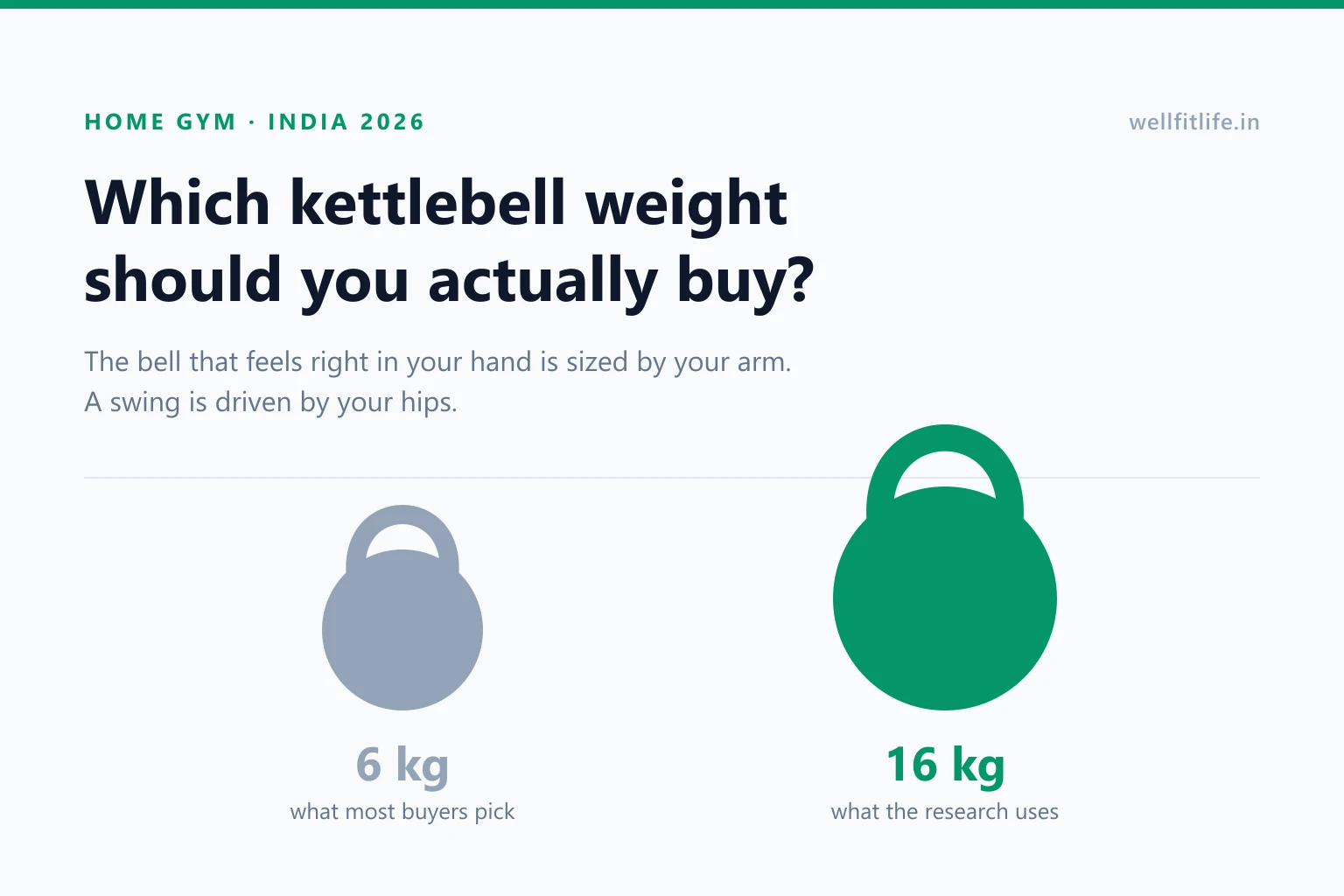
Best Kettlebells for Home Gym in India (2026): Which Weight to Buy
Almost every kettlebell sold in India is lighter than the ones the research is done with. The weight that feels right when you pick it up is roughly half the weight your hips need — and that single mistake is why most kettlebells end up under a bed.
15 min read
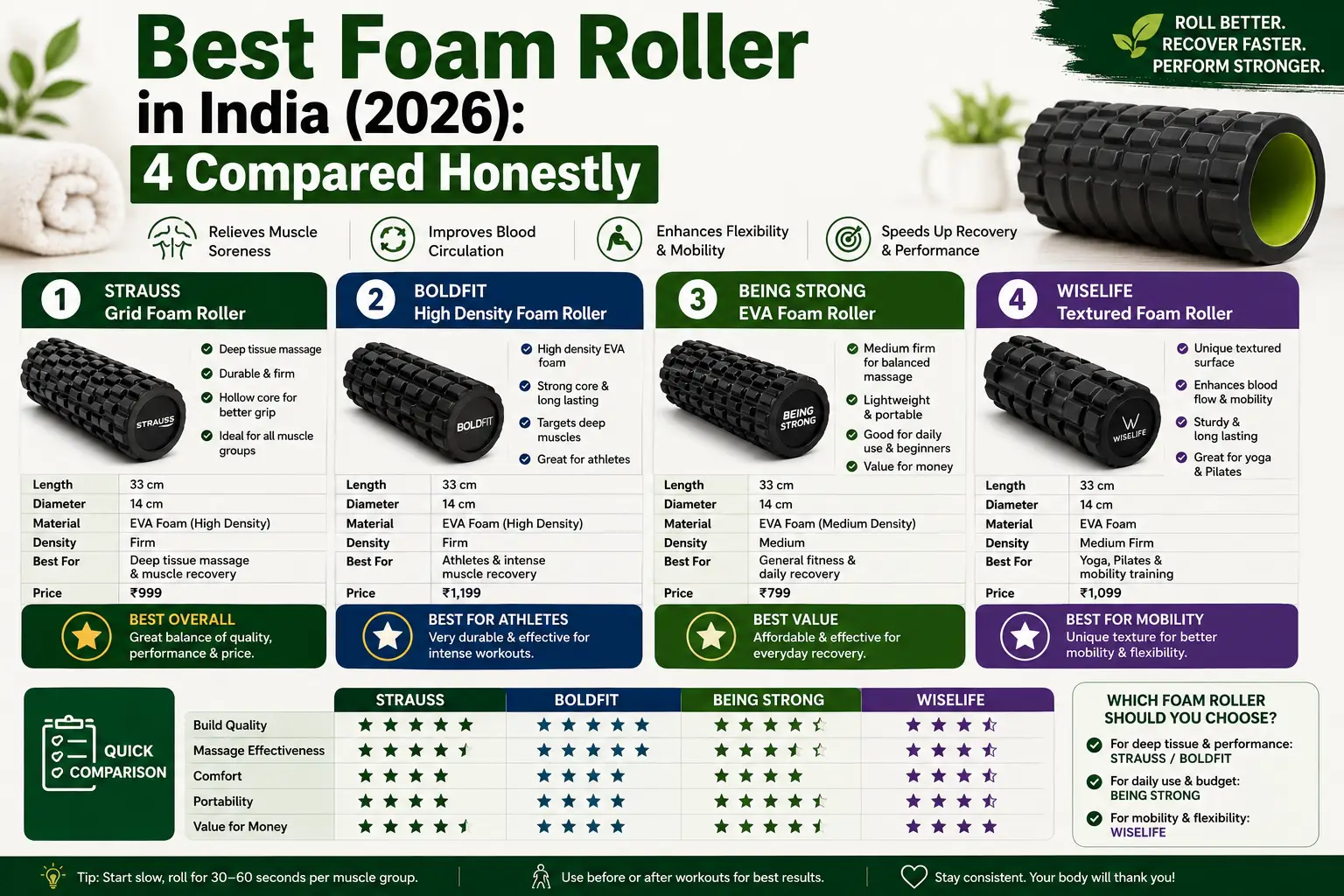
Best Foam Roller in India (2026): 4 Compared Honestly
Boldfit and Strauss foam rollers compared on density, size and rating data — plus what foam rolling actually does for sore muscles, and what it definitely does not.

18 min read
Amazon Great Indian Festival 2026: Home Gym Deals Worth Buying (and What to Skip)
The Great Indian Festival starts on 8 October 2026. The percentage off on a fitness listing is measured against MRP, which is a legal ceiling rather than a real price, so that number tells you very little. What tells you whether a deal is real is the price history and the bank offer. Here is the short list of home gym equipment worth buying in the sale, and how to check each deal before you pay.