The Complete Fat Loss Guide for Indians (2026): Science-Based Plan That Works
The only fat loss guide you need as an Indian. Covers calorie deficit, Indian food strategy, workout routine, hormones, supplements, and the exact mistakes stopping your progress.

Medical Safety Note: This article is for general educational purposes only and is not a substitute for professional medical advice, diagnosis, or treatment. If you are pregnant, managing a condition like diabetes, PCOS, or thyroid disorder, or taking medication, please consult a qualified doctor or registered dietitian before changing your diet, supplements, or exercise routine.
Why Most Indians Struggle to Lose Fat
You've tried cutting rice. You've done 30-minute walks after dinner. You've skipped meals, swapped sugar for jaggery, and bought protein powder that still sits unopened.
Yet the fat hasn't moved.
You're not failing because you lack willpower. You're failing because nobody gave you a clear, India-specific plan built on how fat loss actually works — not how fitness influencers say it works.
This guide fixes that. Everything here is science-backed, practical within an Indian diet, and written for real people with regular schedules — not elite athletes or people with personal chefs.
📖 Read Also:
Indian Diet Plan for Weight Loss: The Complete 2026 GuideFor calorie targets, 7-day meal charts, and 1200/1500 calorie options that put this fat loss framework into a daily plan, see our complete Indian diet guide.
Part 1: Understand Fat Loss (The Foundation)
Fat Loss vs Weight Loss — They Are Not the Same
Before you do anything else, understand this distinction.
Weight loss = losing any combination of fat, water, and muscle. Fat loss = specifically reducing body fat while keeping muscle intact.
Most crash diets cause weight loss, not fat loss. You lose water weight and muscle tissue, your metabolism slows, and the weight returns — usually as fat. This is why people who "lose weight" repeatedly end up fatter than when they started.
➡️ Deep dive: Fat Loss vs Weight Loss — Know the Difference
The One Principle That Drives All Fat Loss
You must eat fewer calories than your body burns.
This is called a calorie deficit. It is the only non-negotiable requirement for fat loss. Every strategy in this guide serves this single principle.
Your body burns a certain number of calories daily — this is your TDEE (Total Daily Energy Expenditure). Eat 300–500 calories below that number consistently, and fat loss happens automatically.
Use our free TDEE Calculator to find your exact daily calorie target right now. Not sure where you're starting from? Check your BMI and body fat percentage first — knowing both gives you a much clearer picture than the scale alone.
➡️ Deep dive: Calorie Deficit Explained Simply
How Much Fat Can You Realistically Lose?
Realistic fat loss for most Indians:
- Week 1–2: 0.5–1.5 kg (mostly water weight + some fat)
- Ongoing: 0.3–0.7 kg fat per week (sustainable rate)
- Monthly: 1.5–3 kg of actual body fat
Anyone promising 5–10 kg in a month is either selling a crash diet or lying. Real fat loss takes 3–6 months to become visually obvious. That is not slow — that is how biology works.
Part 2: The Indian Diet Strategy for Fat Loss
Why Do Standard "Diet Rules" Fail Indians?
Most fat loss advice is written for Western eating patterns: chicken + broccoli, protein shakes, meal prep on Sundays. That doesn't work for a family eating dal-chawal together every day.
The good news: Indian food is excellent for fat loss when structured correctly. The problem is the proportions, not the food itself.
The 3 Changes That Move the Needle
Change 1: Fix Your Protein
Over 70% of Indians are protein deficient. This is the single biggest dietary issue for fat loss because:
- Protein keeps you full longer than carbs or fat
- It preserves muscle while you lose fat
- Digesting protein burns more calories than digesting carbs (thermic effect)
Target: 1.6–2.0g of protein per kg of body weight daily.
For a 70kg person, that's 112–140g of protein per day. Most Indians eat 40–60g. The gap is massive.
How to close it with Indian food:
← Swipe to compare →
| Food | Protein per 100g |
|---|---|
| Chicken breast (cooked) | 31g |
| Paneer | 18g |
| Moong dal (cooked) | 7g |
| Eggs (2 whole) | 12g |
| Greek yogurt / hung curd | 10g |
| Tofu | 8g |
| Roasted chana | 19g |
Start by adding one protein source to every meal. Dal at lunch. Eggs or paneer at dinner. Curd with every sabzi.
➡️ Deep dive: Best Protein Foods for Indians
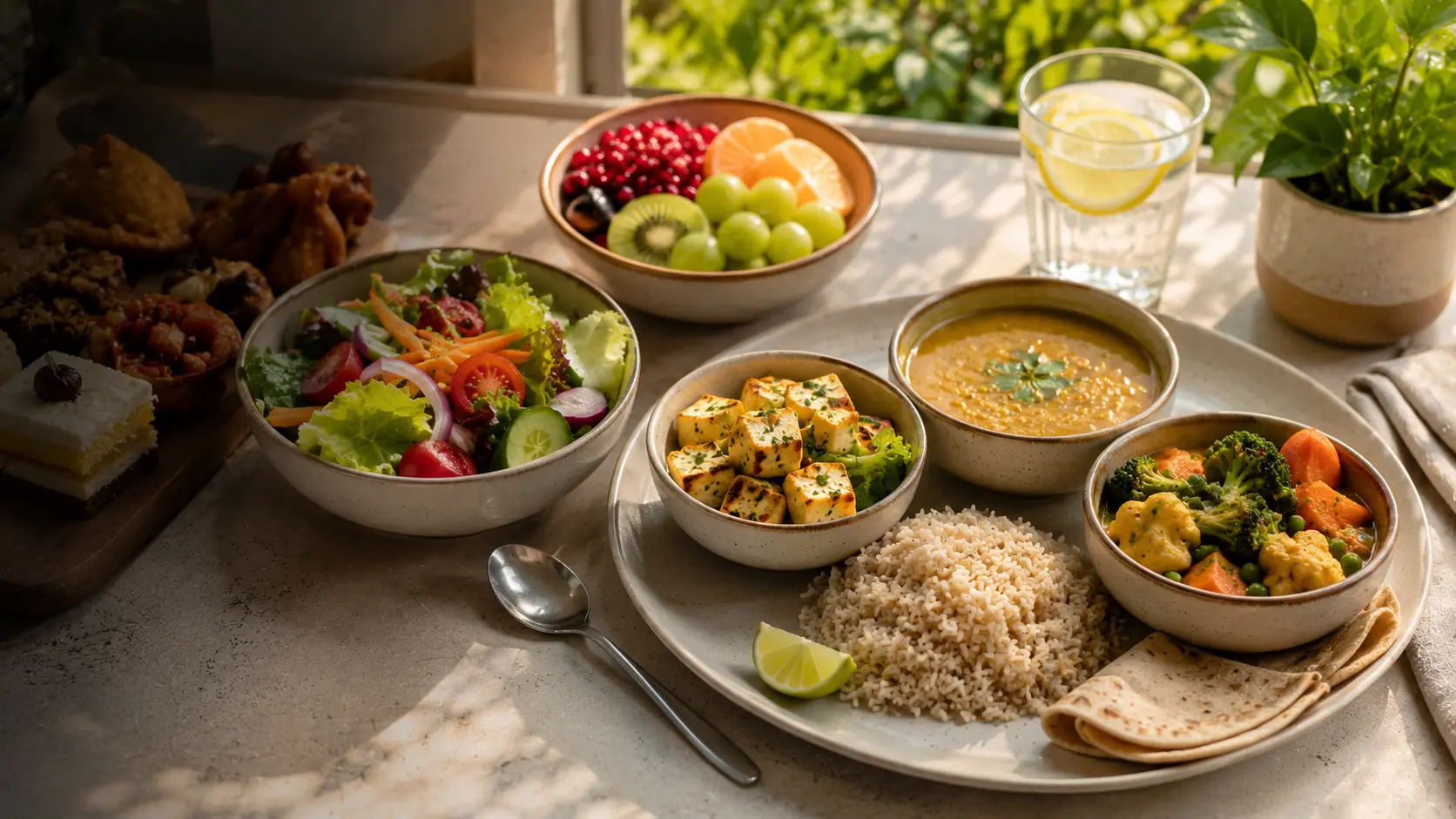
Change 2: Fix Your Plate Proportions
The typical Indian plate is 60–70% carbohydrates (rice, roti, bread). Restructure it:
- ½ plate: vegetables (sabzi, salad, cooked greens)
- ¼ plate: protein (dal, paneer, chicken, eggs, fish)
- ¼ plate: carbs (rice or 1–2 rotis)
This simple visual change reduces calories by 300–500 per day without counting a single number.
➡️ Deep dive: The Healthy Indian Meal Plate Blueprint
Change 3: Fix Your Eating Frequency
Stop snacking on biscuits, namkeen, and chai with 3 teaspoons of sugar throughout the day. These invisible calories add up to 400–700 extra calories daily without you realising it.
Structured eating (3 meals + 1 planned snack) is more effective for fat loss than frequent grazing because it gives your insulin levels time to drop between meals — which is when fat burning happens.
Roti vs Rice — Which Is Better for Fat Loss?
Both are fine. Neither one is making you fat. The question is quantity, not type.
One standard chapati = ~80 calories. One katori of cooked rice = ~130 calories.
If rice makes you feel hungrier faster (due to higher GI when eaten plain), switching to brown rice, or mixing with dal and sabzi, slows digestion and reduces hunger. But if you genuinely prefer roti, eat roti. Don't remove foods you love — reduce portions.
➡️ Deep dive: Roti vs Rice for Weight Loss
Should You Try Intermittent Fasting?
Intermittent Fasting (IF) works for fat loss because it helps you eat fewer calories, not because of any metabolic magic. The 16:8 method (fast for 16 hours, eat in an 8-hour window) is the most practical for Indians.
It works well for people who skip breakfast naturally or prefer larger meals. It doesn't work if you're hungry by 9am, have low blood pressure, or a history of disordered eating.
It's a tool — not a requirement.
➡️ Deep dive: Intermittent Fasting for Beginners — India Guide
Part 3: The Fat Loss Workout Plan
Do You Need to Exercise to Lose Fat?
No — fat loss is driven primarily by diet. You can lose fat without exercising at all.
But exercise dramatically improves results:
- Burns additional 200–400 calories per session
- Preserves muscle while you're in a calorie deficit
- Improves insulin sensitivity (easier to stay in deficit)
- Maintains and builds strength so you look toned, not just "thin"
Think of diet as the engine and exercise as the turbocharger.
What's the Minimum Effective Workout for Fat Loss?
You don't need 2-hour gym sessions. This combination works:
3–4 days/week strength training (30–45 min): Bodyweight or gym — build and preserve muscle tissue. Muscle is metabolically active, meaning more muscle = higher resting calorie burn.
2–3 days/week cardio (20–30 min): Walking, cycling, HIIT, or jogging. Creates additional calorie deficit and improves cardiovascular health.
Daily NEAT (Non-Exercise Activity Thermogenesis): Taking stairs, walking to the market, standing while working. These "invisible" movements can burn an extra 200–500 calories per day for active people vs sedentary ones.
➡️ Deep dive: 7-Day Beginner Home Workout Plan ➡️ Deep dive: HIIT Workout for Beginners at Home
Walking: The Most Underrated Fat Loss Tool
A 30-minute brisk walk after dinner:
- Burns 150–200 calories
- Dramatically lowers post-meal blood sugar spikes
- Reduces cortisol (stress hormone that promotes belly fat)
- Requires zero equipment or gym membership
If you do nothing else after reading this guide, add a 30-minute walk every day.
➡️ Deep dive: Walking for Weight Loss — Complete Guide
Part 4: The Biggest Fat Loss Mistakes Indians Make
Mistake 1: Eating "Healthy" Foods in Unhealthy Quantities
Ghee is healthy. Nuts are healthy. Avocado is healthy. But all three are calorie-dense. Eating unlimited quantities of healthy food still causes fat gain.
2 tablespoons of ghee = 240 calories. A handful of cashews = 160 calories. These add up.
Use the free Protein Calculator and TDEE calculator to understand how your actual food intake compares to your needs.
Mistake 2: Compensating Exercise with Food
"I did a workout today so I can eat the gulab jamun." This is called exercise compensation and it ruins most fat loss attempts.
A 30-minute walk burns roughly 150 calories. Two gulab jamuns = 300 calories. You cannot out-exercise a poor diet.
Mistake 3: Believing Fat Loss Myths
❌ "Eating after 8pm causes fat gain" — False. Total daily calories matter, not when you eat them. ❌ "Detox drinks burn fat" — False. Your liver and kidneys detox your body 24/7. ❌ "Carbs make you fat" — False. Excess calories make you fat. ❌ "Fat-free = healthy" — False. Fat-free products often add more sugar to compensate.
➡️ Deep dive: Fat Loss Myths Indians Believe — Debunked
Mistake 4: Not Sleeping Enough
Poor sleep (under 7 hours) raises cortisol and ghrelin (hunger hormone) while lowering leptin (satiety hormone). The result: you're hungrier the next day and store more fat, especially around the belly. Fat loss slows dramatically.
Sleep is not passive — it's active recovery and hormone regulation.
➡️ Deep dive: Sleep, Recovery & Fat Loss Guide
Mistake 5: Chronic Stress
Cortisol — the stress hormone — directly promotes belly fat storage. Indian lifestyles often carry high chronic stress (work pressure, family responsibilities, poor sleep cycles). Stress management isn't "soft" advice — it's a fat loss requirement.
➡️ Deep dive: Stress and Weight Gain — The Connection
Part 5: The Metabolism Factor
Can You Boost Your Metabolism?
Yes — but not with green tea or lemon water. Real metabolism boosters:
- Build muscle: Muscle tissue burns 3x more calories at rest than fat tissue
- Eat enough protein: Digesting protein burns 25–30% of its calories (vs 6–8% for carbs)
- Don't crash diet: Eating below 1,000 calories drops metabolism by 15–25%
- Stay active throughout the day: NEAT adds up more than most people realise
➡️ Deep dive: Metabolism Boosting Foods — Indian Diet
Morning Habits That Support Fat Loss
Certain morning routines consistently correlate with easier fat loss:
- Protein-rich breakfast (prevents overeating later in the day)
- 10-minute morning movement (activates metabolism, raises NEAT)
- Not checking phone for 30 minutes (reduces cortisol spike from notifications)
- Drinking 500ml water on waking (mild thermogenic effect + reduces hunger)
➡️ Deep dive: Morning Habits for Fat Loss
Part 6: Your 4-Week Fat Loss Starter Plan
Week 1: Build Awareness
- Calculate your TDEE using our free calculator
- Log everything you eat for 3 days (no changes — just observe)
- Identify where your excess calories are coming from (usually chai, snacks, late-night eating)
- Add a 20-minute walk every day
Week 2: Fix the Plate
- Restructure every meal using the ½-¼-¼ plate formula
- Add protein to breakfast (eggs, paneer, curd)
- Eliminate liquid calories: sweetened chai, juice, cold drinks, biscuits with tea
Week 3: Add Movement
- Start the 7-Day Home Workout Plan
- Keep the daily walk
- Aim for 8,000+ steps per day
Week 4: Tighten Nutrition
- Hit your protein target every day (calculate it here)
- Control portions using the plate method
- Weigh yourself once per week (morning, after bathroom, before eating)
📖 Read Also:
High-Protein Diet on Ozempic/GLP-1: The India GuideUsing or considering GLP-1 medication for weight loss? Here's why protein becomes non-negotiable and how to build an Indian diet around it.
FAQs
How fast will I lose fat following this guide?
At a 300–500 calorie daily deficit, expect 0.3–0.7 kg of actual fat loss per week. Scale weight may fluctuate ±1–2 kg due to water, digestion, and hormones — don't panic. Measure monthly, not daily.
Can I eat rice and roti while losing fat?
Yes. Both are fine in controlled quantities. The plate restructuring in Part 2 shows exactly how to fit them into a fat loss diet.
Do I need to count calories?
Not necessarily. The plate method and protein focus achieve a natural deficit without tracking. However, if progress stalls after 3 weeks, tracking for 2–3 days reveals hidden calories instantly.
What about fat loss supplements?
No supplement is required. Whey protein (if you can't hit protein targets with food), creatine (for muscle preservation), and vitamin D (most Indians are deficient) are the only evidence-backed supplements worth considering.
Is this guide different for women?
The principles are identical. Women have slightly different hormonal considerations — especially around PCOS, thyroid, and menstrual cycle phases — but the calorie deficit, protein target, and workout strategy are the same.
For women with PCOS: PCOS Weight Loss Guide For thyroid issues: Thyroid Diet Plan — Indian Foods
References
The guidance in this article is based on the following peer-reviewed research and public health guidance. Always discuss changes to your diet, supplements, or medication with a qualified doctor or registered dietitian.
- World Health Organization. Physical Activity — Fact Sheet
- Leidy HJ, et al. The role of protein in weight loss and maintenance. Am J Clin Nutr (2015)
- Morton RW, et al. A systematic review, meta-analysis and meta-regression of the effect of protein supplementation on resistance training-induced gains in muscle mass and strength. Br J Sports Med (2018)
- National Institute of Nutrition (ICMR), Hyderabad — Dietary Guidelines for Indians
- World Health Organization. Healthy Diet — Fact Sheet
Free Tools to Help You
Put this article into action — use our free calculators to get your personalized numbers.
Was this article helpful?
Want More Tips Like This?
Join 1,000+ readers getting weekly fitness, diet, and wellness tips + FREE meal plan
No spam, ever. Unsubscribe anytime.

About the Author: Ashwani
Fitness influencer and wellness writer helping Indians build healthier lifestyles.
Read more about us →Comments
Leave a Comment
Your email will not be published. Comments are reviewed before appearing.
You Might Also Like
Continue your wellness journey

28 min read
1200 Calorie Indian Diet Plan (2026): 7-Day Veg & Non-Veg Meal Plan for Weight Loss
Complete 1200 calorie Indian diet plan for weight loss — non-veg and veg breakfast options with exact calories, 7-day meal plans, Indian food calorie chart, and safe diet guidelines.

14 min read
Indian Festive Eating: Enjoy Diwali & Navratri Without Weight Gain
Diwali sweets, Navratri fasting, Holi bhaang, Eid biryani — Indian festivals are built around food. Most people gain 2–4 kg every festive season and spend months trying to undo it. This guide shows you how to genuinely enjoy every festival without the guilt or the weight gain.
33 min read
Indian Diet Plan for Weight Loss: The Complete 2026 Guide
Most Indians gain weight not from indulgence but from not knowing their portions. This complete Indian diet plan covers calorie targets, 7-day meal charts, 1200 and 1500 calorie plans, vegetarian options, and the 10 mistakes keeping you stuck — updated June 2026.