7-Day Beginner-Friendly Home Workout Plan (No Equipment Needed)
A simple 7-day home workout routine for beginners focusing on fat loss, strength building, flexibility, and stamina. No equipment required—just 25–35 minutes daily.

Medical Safety Note: This article is for general educational purposes only and is not a substitute for professional medical advice, diagnosis, or treatment. If you are pregnant, managing a condition like diabetes, PCOS, or thyroid disorder, or taking medication, please consult a qualified doctor or registered dietitian before changing your diet, supplements, or exercise routine.
Introduction
Starting fitness as a beginner often feels overwhelming—too many exercises, gym pressure, and inconsistent schedules. The truth is, you don't need expensive equipment, fancy shoes, or even a gym membership to get in shape. What you need is a structured plan you can actually follow, especially during your first few weeks.
This 7-day beginner workout plan is designed for people who want to start slow, build consistency, burn fat, and feel more active—without pushing the body too hard. Every day uses the same warm-up and cool-down, given in full below, so you're never guessing what to do before or after the main workout.
Whether you're working from home, a student, or someone restarting their fitness journey—give this 1 week and you'll feel the difference.
⚠️ One thing before you start: This is general fitness guidance, not medical advice. If you have a heart condition, high BP, a joint injury, are pregnant, or live with any chronic illness — or you're over 40 and have been inactive for years — check with your doctor before beginning. How we research and correct our content is set out in our editorial policy.
This plan needs no equipment at all. Some of the guides linked from it review gear and contain affiliate links — see our affiliate disclosure. Nothing you buy is required to finish this week.
Key Takeaways
- 5 training days + 2 active-recovery days. Roughly 150 minutes of activity across the week, which matches WHO's guidance of 150–300 minutes of moderate activity plus muscle-strengthening work on at least 2 days (WHO, 2020).
- Zero equipment needed. A mat is comfort, not a requirement.
- Don't expect fat loss in week one. A steady 0.5–1 kg per week is the pace people actually sustain (CDC). Most of what the scale shows in week one is water and glycogen, not fat.
- You can't choose where fat comes off. Training a body part builds muscle there; it doesn't strip fat from that spot (Vispute et al., 2011).
- Consistency beats intensity. Finishing all 7 days at 70% effort is worth more than 2 brilliant days followed by quitting.
Why This 7-Day Plan Works
Most people fail not because workouts are tough, but because they don't know:
-
What to do daily
-
How many sets/reps to perform
-
When to rest
-
How to track progress
This plan solves all of that. We will gradually increase intensity, help you build habit, and prepare your body for long-term fitness.
What You Need
- 🟢 A yoga mat (optional)
- 🟢 Water bottle
- 🟢 6×6 ft space
- 🟢 25–35 mins daily
📖 Read Also:
10 Gym Essentials Every Indian Beginner NeedsThe mat and water bottle above cover day one — this list is the next step up if you decide to make home workouts a longer-term habit.
No gym. No excuses. Just start.
Warm-Up and Cool-Down (Do This Every Day)
Same warm-up before every session, same cool-down after. These two blocks stay identical all week — only the main workout in between changes. Skipping them is the single most common beginner mistake, and it's the one that ends weeks early with a pulled muscle.
Warm-Up — 5 minutes, before every workout
← Swipe to compare →
| Move | Time |
|---|---|
| March in place | 60 sec |
| Arm circles (forward + backward) | 30 sec each |
| Hip circles | 30 sec each side |
| Bodyweight squats (slow, half depth) | 10 reps |
| Shoulder rolls + neck turns | 60 sec |
Cool-Down — 5 minutes, after every workout
← Swipe to compare →
| Stretch | Hold |
|---|---|
| Standing hamstring stretch | 30 sec each leg |
| Quad stretch (hold a wall) | 30 sec each leg |
| Chest + shoulder stretch (doorway) | 30 sec |
| Child's pose | 60 sec |
💡 A warm-up is not stretching. Warming up means getting the body moving and warm with light movement. Deep stretching belongs after the workout, not before — holding long stretches on cold muscles raises your injury risk.
7-Day Beginner Workout Schedule
(Each workout = approx 25–35 mins)
Day 1 — Full Body Starter
Purpose: Warm-up joints, activate muscles, improve mobility.
← Swipe to compare →
| Exercise | Reps/Sec | Sets |
|---|---|---|
| Jumping Jacks | 20–30 sec | 3 |
| Bodyweight Squats | 10–12 reps | 3 |
| Knee Push-ups | 8–10 reps | 3 |
| Glute Bridge | 12–15 reps | 3 |
| Plank | 20 sec | 2–3 |
💡 Beginner Tip: Focus on form, not speed.
Day 2 — Lower Body Strength
Your legs are the biggest muscle group you have, so lower-body work burns more calories per set than isolated arm work. What it won't do is take fat off your legs specifically. In a controlled trial, six weeks of dedicated abdominal training produced no more abdominal fat loss than doing nothing at all (Vispute et al., 2011). Fat comes off the whole body at once, in an order your genetics pick. Train legs because they're strong movers, not because they'll spot-reduce.
← Swipe to compare →
| Exercise | Reps | Sets |
|---|---|---|
| Lunges | 10 each leg | 3 |
| Wall Sit | 25 sec | 3 |
| Step-ups on chair/step | 12 reps | 3 |
| Standing Calf Raise | 15–20 reps | 3 |
| Slow Squats | 10 reps | 2 |
💡 Stretch hamstrings after workout.
Once bodyweight lunges and squats start feeling easy, adding light resistance is the simplest way to keep progressing without joining a gym.
📖 Read Also:
5 Best Resistance Bands for Home Workout in India (2026)A tested roundup of affordable bands that add resistance to exactly these lower-body moves once your bodyweight reps get too easy.
Day 3 — Upper Body & Arms
No equipment? No problem.
← Swipe to compare →
| Exercise | Reps | Sets |
|---|---|---|
| Knee/Regular Push-ups | 8–12 | 3 |
| Triceps Dips (chair) | 10–12 | 3 |
| Shoulder Taps | 20 total | 3 |
| Superman Hold | 25 sec | 3 |
| Plank | 25–30 sec | 2 |
💡 Keep spine neutral while doing push-ups.
Day 4 — Active Rest + Light Yoga
Recovery is as important as training.
- ✓ 10 min stretching
- ✓ 10 min deep breathing
- ✓ 5 min light walk
You can take a complete rest if body feels sore. If next-day soreness is what keeps derailing week one, that is the one problem a massage gun has actual trial evidence behind — though a foam roller does most of the same job for far less.
💡 Benefits: Flexibility ↑, stress ↓, muscle recovery ↑
Day 5 — Fat-Burning HIIT
High-Intensity but beginner safe.
40 sec work → 20 sec rest (Repeat 3–4 rounds)
- 🔥 Jumping Jacks
- 🔥 High Knees
- 🔥 Mountain Climbers
- 🔥 Butt Kicks
- 🔥 Fast March-In-Place
💡 Your metabolism does stay slightly raised after a hard session — that's EPOC, the "afterburn." Just keep it in proportion: across the research it accounts for only about 6–15% of the calories you burned during the workout itself (LaForgia et al., 2006). The session is what counts. Treat the afterburn as a small bonus, not a reason to eat extra.
If belly fat is your main focus area, you can follow up on rest days with a short routine aimed specifically at the midsection.
📖 Read Also:
Home Workout Plan for Indians: 15-Minute Core CircuitA 15-minute core and cardio circuit you can add on rest days alongside this 7-day plan.
Day 6 — Core & Stability
Core = abs + lower back + obliques.
← Swipe to compare →
| Exercise | Reps/Sec | Sets |
|---|---|---|
| Crunches | 12–15 | 3 |
| Russian Twists | 20 | 3 |
| Leg Raises | 10–12 | 3 |
| Bird Dog | 10 each side | 3 |
| Side Plank | 20 sec/side | 2 |
💡 Stable core prevents back pain.
Day 7 — Full Body Stretch + Reflection
End week with light workout + self-review.
Do:
- ✔ 20 min yoga/slow stretches
- ✔ 10 min slow walk
- ✔ Hydrate well
Ask yourself:
-
How do you feel?
-
Which day was hardest?
-
Did energy improve?
💡 Small wins build big habits.
Weekly Progress Tracking Checklist
Tick them daily:
- ✔ Drank 2–3 litres water
- ✔ Completed workout (even short)
- ✔ Ate light breakfast
- ✔ 7–8 hrs sleep
- ✔ No junk binge
- ✔ Did both warm-up and cool-down
Beginner Nutrition Guidance
Workout alone doesn't work without food discipline.
Daily Food Habits That Support This Plan
- Breakfast within 2 hrs of waking
- Add a protein source daily (paneer/eggs/sprouts/dal)
- Reduce oily parathas & sugary tea habit
- Fresh fruit and vegetables every day, not just a few times a week
- Stop eating 2 hrs before sleep
- Plate must include Carb+Protein+Fibre+Good Fat
ICMR-NIN's Dietary Guidelines for Indians recommends fresh, locally available fruits and vegetables in plenty, and points out that combining cereals or millets with pulses gives you better-quality protein than either on its own (ICMR-NIN, 2024). Dal-chawal and roti-rajma are doing more for you than you think.
💡 Simple thumb rule: when your meals are in order, the workouts start showing results. When your meals are a mess, no workout plan can cover for them.
Common Mistakes Beginners Make
- ❌ Trying heavy workouts on Day 1
- ❌ Skipping the warm-up or cool-down
- ❌ Expecting visible fat loss in 1 week
- ❌ Skipping meals randomly
- ❌ Comparing with others
Remember — consistency beats intensity.
Conclusion
This 7-day workout plan is not a challenge — it's your starting point. Go slow, focus on proper form, stay patient, and listen to your body. If you repeat this routine for 3–4 weeks, increase reps gradually, and follow simple nutrition habits, you will see visible improvements in energy, stamina, mobility, and overall fitness.
Fitness is not a race. It's a lifestyle. One step every morning is better than zero steps done perfectly.
Once you've finished this week, the natural next step is our complete home workout guide for Indians — it covers progressions from beginner to advanced, fat loss vs muscle building, HIIT and yoga, all without a gym.
Ready for Week 2? We'll create an upgraded plan with higher intensity next. If you're enjoying training at home and want to build a more complete setup beyond a mat and water bottle, it doesn't have to cost much.
📖 Read Also:
Best Home Gym Under ₹5000 in India (2026): Complete Beginner Equipment GuideA budget-friendly guide to building out your home setup once you're ready to move beyond this starter 7-day plan.
Frequently Asked Questions
How many days per week should a beginner workout at home?
This plan uses 5 training days (Day 1, 2, 3, 5 and 6) and 2 active-recovery days (Day 4 and Day 7), with recovery placed after the three hardest sessions. At roughly 30 minutes each, that is about 150 minutes of activity for the week, which matches WHO's guidance for adults: 150–300 minutes of moderate-intensity activity per week, plus muscle-strengthening work on at least 2 days (WHO, 2020). If you are starting from complete zero, it is perfectly fine to drop Day 6 for the first two weeks and train 4 days instead. Finishing 4 days beats abandoning 5.
Can I lose weight with a 7-day beginner home workout plan?
You can start the process in 7 days, but set expectations honestly. A gradual 0.5–1 kg (1–2 lb) per week is the pace the CDC links to weight people actually keep off, and that comes from combining the workouts with a moderate calorie deficit. Whatever the scale shows after week one is mostly water and glycogen rather than fat, so do not read too much into it either way. Visible fat loss typically takes 4–8 weeks of consistent effort.
What are the best exercises for beginners at home?
The best beginner home exercises are squats, push-ups, lunges, planks, mountain climbers, and glute bridges. These compound moves work multiple muscle groups without equipment and build a strong fitness foundation.
Do I need equipment for a beginner home workout plan?
No equipment is needed for an effective beginner home workout plan. Your body weight provides enough resistance to build strength and endurance in the early stages. A yoga mat is the only optional addition for comfort on floor exercises.
How long should each beginner home workout session be?
Each session in this plan runs 25–35 minutes, which includes the 5-minute warm-up and the 5-minute cool-down. Shorter focused sessions are more sustainable than long, exhausting workouts that lead to burnout and injury, so treat 35 minutes as a ceiling rather than a target in your first week.
Related Reading
- Home Workout Plan for Indians: Complete Guide
- 30-Day Home Fitness Challenge for Beginners
- Walking for Fat Loss: Steps, Pace and a 4-Week Ramp
- Post-Workout Meal Guide for Indians
References
- World Health Organization (2020). WHO guidelines on physical activity and sedentary behaviour. WHO
- Centers for Disease Control and Prevention. Steps for Losing Weight. CDC
- LaForgia, J., Withers, R.T. & Gore, C.J. (2006). Effects of exercise intensity and duration on the excess post-exercise oxygen consumption. Journal of Sports Sciences, 24(12), 1247–1264. PubMed
- Vispute, S.S., Smith, J.D., LeCheminant, J.D. & Hurley, K.S. (2011). The effect of abdominal exercise on abdominal fat. Journal of Strength and Conditioning Research, 25(9), 2559–2564. PubMed
- ICMR-National Institute of Nutrition (2024). Dietary Guidelines for Indians. ICMR-NIN
Free Tools to Help You
Put this article into action — use our free calculators to get your personalized numbers.
Was this article helpful?
Want More Tips Like This?
Join 1,000+ readers getting weekly fitness, diet, and wellness tips + FREE meal plan
No spam, ever. Unsubscribe anytime.

About the Author: Ashwani
Fitness influencer and wellness writer helping Indians build healthier lifestyles.
Read more about us →Comments
Leave a Comment
Your email will not be published. Comments are reviewed before appearing.
You Might Also Like
Continue your wellness journey

26 min read
Surya Namaskar for Weight Loss: Calories & 4-Week Plan
How many rounds of Surya Namaskar do you actually need to lose weight? Calorie burn tables by body weight, 108 rounds guide, belly fat cortisol science, 4-week beginner plan, and the equipment that makes daily practice easier.
26 min read
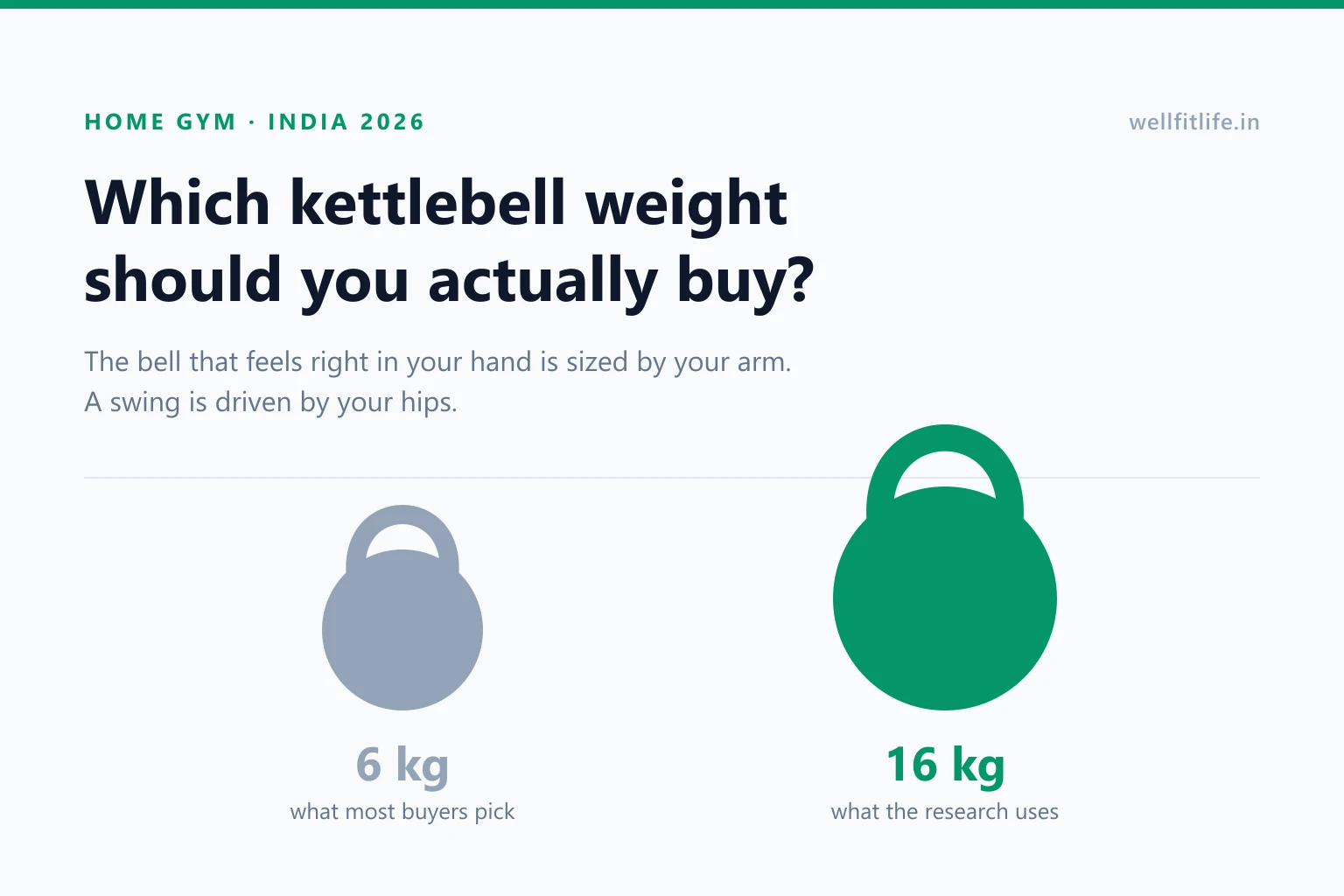
Best Kettlebells for Home Gym in India (2026): Which Weight to Buy
Almost every kettlebell sold in India is lighter than the ones the research is done with. The weight that feels right when you pick it up is roughly half the weight your hips need — and that single mistake is why most kettlebells end up under a bed.

17 min read
Amazon Great Indian Festival 2026: Home Gym Deals Worth Buying (and What to Skip)
The Great Indian Festival started on 8 October 2026. The percentage off on a fitness listing is measured against MRP, which is a legal ceiling rather than a real price, so that number tells you very little. What tells you whether a deal is real is the price history and the bank offer. Here is the short list of home gym equipment worth buying in the sale, and how to check each deal before you pay.