HIIT Workout for Beginners at Home: Burn Fat in 20 Minutes (No Equipment)
Short on time but want real fat-burning results? HIIT — High-Intensity Interval Training — is one of the most effective workouts you can do in under 25 minutes, completely at home, with zero equipment. Here's exactly how to start.

Why HIIT Is Perfect for Busy Indians
Most people say they don't have time to exercise. And honestly — for a lot of us, that's true. Between work, commute, family, and cooking, finding 60–90 minutes for the gym feels impossible.
That's exactly where HIIT comes in. HIIT stands for High-Intensity Interval Training — alternating short bursts of intense exercise with brief rest periods. A good HIIT session can be done in 15–25 minutes and burns more fat than a 45-minute jog.
Why does it work so well? Because of something called the afterburn effect (technically EPOC — Excess Post-exercise Oxygen Consumption). After a HIIT session, your body continues burning calories at a higher rate for 12–24 hours as it recovers. You're literally burning fat while watching TV or sleeping.
No gym. No equipment. No 1-hour commitment. Just 20 minutes that actually matter.
And because it's entirely indoors, HIIT keeps working even when the weather doesn't cooperate — no need to skip training just because it's pouring outside.
📖 Read Also:
Monsoon Fitness India: Complete Workout, Diet & Immunity Guide for Rainy SeasonIf outdoor runs and walks get rained out for months, this guide shows how to keep your fitness routine — including sessions like this one — going strong through monsoon.
⚠️ Who Should NOT Start With HIIT
HIIT is intense. If any of the following apply to you, start with walking or basic workouts first and consult your doctor before attempting HIIT:
-
You have a heart condition or high blood pressure
-
You've been completely sedentary for 6+ months
-
You have joint pain (knees, hips, ankles)
-
You are pregnant or recently postpartum
-
You are above 50 and have not exercised in years
For these groups — start with walking or yoga. HIIT will still be there when you're ready.
How HIIT Works: The Basic Principle
The concept is simple: work hard for a short period, rest briefly, repeat. The "hard" work should be at around 80–90% of your maximum effort. This is not a comfortable pace — you should be breathing heavily.
← Swipe to compare →
| HIIT Style | Work Period | Rest Period | Best For |
|---|---|---|---|
| Beginner | 20 seconds | 40 seconds | First 2–3 weeks |
| Intermediate | 30 seconds | 30 seconds | After 1 month |
| Advanced | 40 seconds | 20 seconds | After 3+ months |
As a beginner, always start with the 20-second work / 40-second rest format. It feels easy at first — and that's fine. You'll increase intensity as your fitness improves.
The Beginner 20-Minute HIIT Workout
This workout requires zero equipment and can be done in any room with about 2×2 metres of space. Do a 3–5 minute warm-up before starting (arm circles, neck rolls, light marching in place).
🔥 Format: 20 sec work / 40 sec rest | 4 rounds | 5 exercises
Exercise 1: High Knees
Run in place, bringing each knee up to hip height. Pump your arms. Keep your core tight.
✅ Beginner tip: Go slower than you think. Focus on form first — knees should come up, not just feet shuffling.
Exercise 2: Jump Squats (or Regular Squats for Beginners)
Stand feet shoulder-width. Lower into a squat, then explode upward. Land softly with knees bent. If jumping hurts — do regular squats at pace instead.
✅ Beginner tip: Land on your toes, not your heels. Never lock your knees at the top.
Exercise 3: Mountain Climbers
Start in a push-up position. Alternate bringing each knee toward your chest rapidly. Keep hips level — don't let them rise up.
✅ Beginner tip: Go slow if needed. This is a core and cardio combination — both benefits happen even at slower speed.
Exercise 4: Burpees (Modified)
From standing, squat down, place hands on floor, step (not jump) feet back into plank, do one push-up (optional), step feet forward, stand up. Beginners: skip the push-up and the jump at the top.
✅ Beginner tip: The modified version is fine. Even slow burpees are extremely effective.
Exercise 5: Jumping Jacks
Classic jumping jacks — out and in with arms and legs simultaneously. Keep a consistent rhythm. This is your "active recovery" exercise in the circuit.
✅ Beginner tip: If jumping is too intense, step out one foot at a time (step jacks) instead.
If the same five moves start feeling repetitive after a few weeks, swap in a dance-based cardio session a couple of times a week for variety — it raises your heart rate just as effectively while feeling more like fun than a workout.
📖 Read Also:
Zumba for Beginners in India: Getting Started at HomeA great alternative cardio day to mix into your HIIT week — same fat-burning intensity, but set to music instead of a timer.
🕐 How to structure 20 minutes:
-
3 min warm-up (light marching, arm circles)
-
Round 1: All 5 exercises × 20 sec work / 40 sec rest = 5 min
-
1 min rest between rounds
-
Round 2: Repeat
-
1 min rest
-
Round 3: Repeat
-
2 min cool-down (light stretching)
Total: ~22 minutes including warm-up and cool-down
Weekly HIIT Schedule for Beginners
HIIT is intense — your muscles and cardiovascular system need recovery time. As a beginner, 3 days per week maximum. Rest or do light walking on off days.
← Swipe to compare →
| Day | Activity | Duration |
|---|---|---|
| Monday | HIIT Session | 20 min |
| Tuesday | Rest or 30-min walk | Active recovery |
| Wednesday | HIIT Session | 20 min |
| Thursday | Rest or yoga/stretching | 20 min |
| Friday | HIIT Session | 20 min |
| Saturday | Walk or light activity | 30–45 min |
| Sunday | Complete rest | — |
Common HIIT Mistakes to Avoid
✗
Skipping the warm-up
Going from zero to 100% effort cold is how you pull a muscle. Always 3–5 minutes of light movement first.
✗
Doing HIIT every day
More is not better here. 3 days a week is ideal for beginners. Over-training leads to injury and burnout, not faster results.
✗
Not giving 100% during work intervals
If you can comfortably talk during the "work" phase, you're not pushing hard enough. HIIT only works when you actually go hard in those 20–30 seconds.
✗
Poor form to go faster
Speed means nothing if your form is wrong. Slow down, get the movement right, then add intensity. Bad form = injuries.
✗
Eating a heavy meal right before
HIIT with a full stomach = nausea. Either do it fasted (morning) or 2+ hours after a meal. A light banana 30 minutes before is fine.
What Results Can You Expect?
In the first month of consistent HIIT (3x/week) combined with a reasonable diet:
-
Week 1–2: You'll feel winded quickly. That's normal. Your cardiovascular fitness improves fast.
-
Week 3–4: Noticeably less out-of-breath. Can complete all rounds. Clothes start to feel different.
-
Month 2: Visible changes in body composition. Fat loss + lean muscle gain showing. You'll need to increase intensity to keep progressing.
Combined with a healthy diet, HIIT 3x/week can contribute to 3–5 kg of fat loss in 8 weeks. Without diet changes, results will be slower — exercise alone is not enough.
If your main goal is trimming belly fat specifically, you can also pair these HIIT days with a short, targeted core-focused routine.
📖 Read Also:
Home Workout for Belly Fat: 15-Minute Daily Routine (No Equipment)A focused 15-minute routine you can slot in on non-HIIT days to keep chipping away at stubborn belly fat.
Start Today — Not Monday
Twenty minutes. That's literally all it takes. If you have that much time to scroll Instagram, you have that much time to do this workout.
The hardest part isn't the workout — it's starting the first one. Once you feel the endorphin rush after those 20 minutes, you'll understand why people get addicted to this.
Clear some floor space right now. Start the warm-up. That's all you need to do.
📖 You Might Also Like:
Frequently Asked Questions
Is HIIT workout good for complete beginners?
HIIT can be done by beginners if the intensity is appropriate. Start with a beginner-modified HIIT that uses lower-impact moves (step jacks instead of jumping jacks, slow mountain climbers) with longer rest periods (work:rest ratio of 1:2 or 20 seconds on, 40 seconds off). Progress intensity over 4–6 weeks.
How many times per week should beginners do HIIT?
Beginners should do HIIT 2–3 times per week with at least one rest day between sessions. HIIT places significant stress on the cardiovascular system and muscles — daily HIIT for beginners leads to excessive fatigue, poor recovery, and increased injury risk. Quality over frequency is the rule.
How many calories does a 20-minute HIIT burn?
A 20-minute beginner HIIT session burns approximately 200–300 calories depending on your weight and effort level. More importantly, HIIT creates an "afterburn" effect (EPOC) where you continue burning slightly elevated calories for 12–24 hours post-workout, boosting total daily calorie expenditure.
What should I eat before and after HIIT?
Before HIIT: have a light meal or snack 60–90 minutes prior — a banana, a small bowl of poha, or a slice of toast with peanut butter works well. After HIIT: eat within 30–60 minutes — a protein-rich meal like eggs with vegetables, curd with fruit, or a protein shake helps muscle recovery.
Can beginners do HIIT at home without any equipment?
Yes — no equipment is needed for effective HIIT at home. Exercises like jumping jacks, high knees, burpees, squat jumps, mountain climbers, and push-ups provide an intense cardiovascular workout using only body weight. A yoga mat and enough floor space (2×2 metres) is all you need.
📖 Read Also:
Best Home Gym Under ₹5000 in India (2026): Complete Beginner Equipment GuideA decent mat makes high-impact moves like burpees and mountain climbers far more comfortable on tile or marble floors — this budget setup covers it along with a few other essentials.
Related Reading
- 7-Day Beginner Home Workout Plan
- 30-Day Home Fitness Challenge for Beginners
- Daily Fat Loss Routine
- Post-Workout Meal Guide for Indians
- Common Home Workout Mistakes to Avoid
- Best Gym Shoes in India — HIIT involves more lateral movement than steady cardio, which is where a running shoe's soft sole works against you
Free Tools to Help You
Put this article into action — use our free calculators to get your personalized numbers.
Was this article helpful?
Want More Tips Like This?
Join 1,000+ readers getting weekly fitness, diet, and wellness tips + FREE meal plan
No spam, ever. Unsubscribe anytime.

About the Author: Ashwani
Fitness influencer and wellness writer helping Indians build healthier lifestyles.
Read more about us →Comments
Leave a Comment
Your email will not be published. Comments are reviewed before appearing.
You Might Also Like
Continue your wellness journey

24 min read
Home Workout Plan for Indians 2026: No Gym, Real Results (Beginner to Advanced)
No gym? No problem. A complete home workout guide for Indians — fat loss, muscle building, HIIT, yoga, PCOS-friendly routines, and equipment under ₹5,000. Beginner to advanced, proven progressions.
15 min read
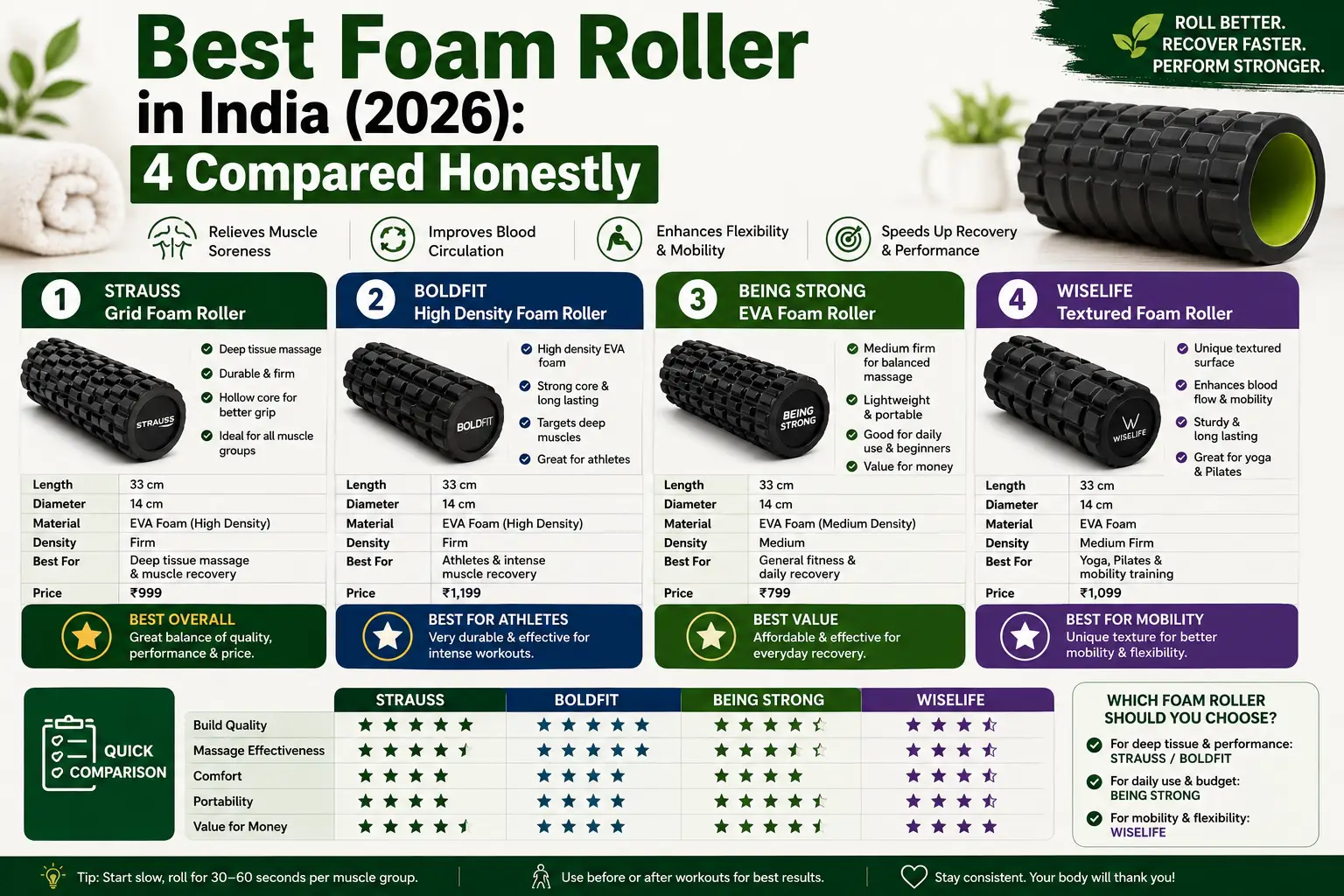
Best Foam Roller in India (2026): 4 Compared Honestly
Boldfit and Strauss foam rollers compared on density, size and rating data — plus what foam rolling actually does for sore muscles, and what it definitely does not.

17 min read
Best Gym Shoes in India (2026): 6 Compared Honestly
Most Indians buy a running shoe for the gym. Here is exactly when that is fine, when it costs you, and six options compared — from a ₹1,500 Campus to the Nike Metcon.