How to Build Muscle at Home Without Gym (Complete Workout + Diet Strategy)
You don't need a gym to build muscle. With bodyweight training, right progression, protein-rich diet and consistency, you can develop strength and shape at home.

Introduction
Muscle building is often linked with gyms, dumbbells and heavy machines — but the truth is you can build a strong, muscular body at home using only bodyweight training.
The biggest drivers of muscle gain are: Progressive overload, Protein intake, Consistency, and Recovery.
The body doesn't know equipment — it only recognises tension and resistance. This guide breaks down exactly how to build muscle at home, even if you're a beginner — no equipment required, optional upgrades suggested later.
Muscle Building Basics
Muscle grows when:
-
You train a muscle with resistance
-
Tiny muscle fibres tear
-
You eat enough protein
-
Body repairs & grows stronger during rest
Training + Protein + Rest = Muscle Growth
Bodyweight Exercises That Build Muscle
Upper Body:
-
Push-ups
-
Incline push-ups
-
Decline push-ups
-
Dips (chair)
-
Pike push-ups
Lower Body:
-
Squats
-
Lunges
-
Bulgarian splits
-
Glute bridges
-
Calf raises
Core:
-
Plank
-
Leg raise
-
Bicycle crunches
-
Russian twist
-
Hollow hold
Progressive Overload - The Key to Growth
Beginners stop progressing because reps stay same for months. To build muscle you must increase difficulty gradually.
Ways to progress:
-
⬆ Increase reps
-
⬆ Increase sets
-
⬆ Slow tempo (3 sec down, 1 up)
-
⬆ Add variations (standard → decline → diamond)
-
⬆ Add weight by backpack/books later
Example progression for push-ups:
-
Week 1: 8 reps × 3 sets
-
Week 2: 10 reps × 3 sets
-
Week 3: 12 reps × 4 sets
-
Week 4: 15 reps × 4 sets
-
Week 6+: Decline push-ups × 10 reps
Once decline push-ups stop being hard, bodyweight has taken you as far as it goes on chest. That is the point to add load — dumbbells first, and then a gym bench when you want a proper press range and incline work.
Home Workout Plans
Beginner Routine (3–4 Days/Week)
Day 1 — Upper Body
-
Push-ups: 3 sets × 8–12 reps
-
Incline Push-ups: 3 × 10–15
-
Dips (chair): 3 × 8–12
-
Plank: 3 × 30 sec
Day 2 — Lower Body
-
Squats: 4 × 12–20
-
Lunges: 3 × 10 each
-
Glute Bridge: 3 × 15
-
Calf Raise: 3 × 20
Intermediate Routine (4–5 Days/Week)
Upper Push Day:
-
Standard push-ups 4×12
-
Decline push-ups 3×10
-
Dips 3×12
-
Pike push 3×8
Leg Day:
-
Squats 4×20
-
Lunges 4×12 each
-
Bulgarian squats 3×10
-
Wall sit 45 sec × 2
Diet for Muscle Gain
You can train hard but no muscle builds without protein & calories.
Daily Protein Target:
1.2 – 1.8g protein per kg body weight
Example: 70kg person → 85–120g protein/day
Best Indian Protein Foods:
🥛 Milk & Curd
🧀 Paneer
🌱 Soya & Tofu
🍛 Dal, Rajma, Chana
🥜 Peanut, Chia seeds
🍳 Eggs
Sample Meal Plan:
-
Breakfast: Oats + milk + nuts / Moong dal cheela
-
Lunch: Dal + Rice + Sabzi + Paneer + Curd
-
Evening: Fruit + peanuts / Sprout chaat
-
Dinner: Paneer stir fry + salad / Soya bowl
Recovery
Muscle grows when resting, not while training.
-
✔ Sleep 7–9 hours
-
✔ 1–2 rest days weekly
-
✔ Hydrate 2–3L water/day
-
✔ Stretch post-workout
No rest = stalled growth.
Results Timeline
3–4 Weeks
Strength increases
6–8 Weeks
Muscle shape visible
12+ Weeks
Noticeable transformation
With consistency → transformation is very likely.
Common Mistakes to Avoid
-
❌ Only doing push-ups daily
-
❌ Low protein diet
-
❌ No progressive overload
-
❌ Skipping rest days
-
❌ Expecting instant results
-
❌ High reps with no challenge
Train smart, not random.
Conclusion
You don't need a gym to build muscle — you need consistency, progression and a protein-rich diet. Your body is capable of growing stronger anywhere.
Strength is built when you show up daily and push a little more than yesterday. You are not just building muscle — you are building discipline, confidence and a stronger version of yourself.
Start now. One set. One rep. One routine at a time.
Budget Equipment Upgrades (Optional but Powerful)
Bodyweight training has limits — eventually you need external resistance to keep progressing. Here's a budget-friendly home gym setup that delivers gym-quality results:
← Swipe to compare →
| Equipment | Cost (INR) | Exercises Unlocked | Priority |
|---|---|---|---|
| Resistance Bands (set of 3) | ₹400–800 | Pull-down, rows, bicep curls, glute work | Buy First |
| Pull-up Bar (door-mounted) | ₹600–1200 | Pull-ups, chin-ups, hanging core | Buy Second |
| Adjustable Dumbbells | ₹1500–4000 | Curls, rows, shoulder press, lunges | Buy Third |
| Yoga Mat | ₹400–800 | Floor work, stretching, core exercises | Buy First |
| Dip Stand / Push-up bars | ₹800–1500 | Better push-up range, dips | Optional |
Total starter setup: ₹1200–2000 (mat + resistance bands) delivers 80% of what a gym membership provides for home training. That's less than one month's gym fee in most Indian cities.
📖 Read Also:
5 Best Resistance Bands for Home Workout in India (2026)Resistance bands are the 'buy first' item in the table above — here's a tested comparison across price ranges so you don't waste money on a set that snaps in two weeks.
📖 Read Also:
Dumbbells vs Resistance Bands — Which is Better for Home Workouts in India?Bands are 'buy first' and dumbbells 'buy third' in the table above — but if you can only afford one, this head-to-head on muscle building, cost, and progression settles it.
Protein Deep Dive: How to Hit Your Target on Indian Budget
A 70 kg person building muscle needs 85–120g protein daily. Here's a realistic daily protein map using affordable Indian foods:
Breakfast: Moong dal cheela (2) + 100g paneer stuffing
Protein: ~28g | Cost: ₹30–40
Lunch: Dal (1 cup) + 1 cup curd + roti
Protein: ~20g | Cost: ₹25–35
Evening: Sprout chaat (1 cup) + peanuts (30g)
Protein: ~18g | Cost: ₹15–20
Dinner: Soya chunks sabzi + 1 cup rajma
Protein: ~30g | Cost: ₹25–35
Daily Total
~96g protein | Cost: ₹95–130/day
This is fully vegetarian and costs less than ₹4000/month — no supplements required to hit muscle-building protein targets.
6-Week Home Muscle Building Program
A structured progression plan that takes you from beginner to intermediate over 6 weeks:
Weeks 1–2: Foundation Phase
Focus on form, not volume. 3 days/week. Full body each session. 2–3 sets per exercise, 8–12 reps. Rest 90 seconds between sets. Goal: Master the movements without injury.
Weeks 3–4: Volume Phase
Increase to 4 sets per exercise. Introduce slow tempo (3 seconds down, 1 second up) for all movements. Add 1 new exercise per muscle group. Begin 4 days/week if energy allows.
Weeks 5–6: Intensification Phase
Switch to harder variations: decline push-ups, Bulgarian split squats, pike push-ups. Add resistance bands for upper body exercises — the 15-exercise band routine has the progressions laid out over four weeks. Superset opposing muscle groups (push + pull) to increase density. Begin tracking weights/reps in a notebook.
Frequently Asked Questions
Q: Can bodyweight training actually build significant muscle?
Yes — for beginners and intermediate trainees, bodyweight training builds muscle at comparable rates to gym training, provided progressive overload is applied. Elite calisthenics athletes (gymnasts, street workout champions) demonstrate extraordinary muscle development using only bodyweight. The key variable is progressive difficulty — you must continuously make exercises harder to keep stimulating growth.
Q: How many push-ups should I do to build chest muscle?
The number matters less than the proximity to failure. Doing 30 easy push-ups builds less muscle than 12 push-ups where the last 2 are genuinely difficult. Aim for 3–4 sets of push-ups where the last 2 reps of each set are hard. When 15 reps become easy, progress to a harder variation (decline, diamond, archer push-ups).
Q: Why am I not gaining muscle despite eating protein and training?
Four most common reasons: (1) Not enough total calories — muscle gain requires a slight caloric surplus of 200–300 kcal. (2) Not enough sleep — 7–9 hours is non-negotiable for muscle protein synthesis. (3) No progressive overload — doing the same workout for months. (4) Too much cardio — excessive cardio blunts muscle growth signals. Check all four before changing your protein or training approach.
Q: Should I train the same muscle every day?
No. Muscles need 48–72 hours to recover and grow after a training session. Training the same muscle daily causes accumulated fatigue and can lead to overuse injuries. Use a push/pull/legs split or upper/lower split to allow adequate recovery. The only exception is low-intensity movements like walking or light yoga which can be done daily.
Q: Do I need whey protein or creatine to build muscle at home?
No, they are conveniences not requirements. If you can hit your protein target through food (and most Indians can through dal, paneer, curd, eggs), you don't need whey protein. Creatine is the most evidence-backed supplement for strength and muscle gain, but adds only 5–10% to results — far less impactful than consistent training and adequate sleep. Sort your diet and training first, then consider supplements only if food falls short.
Can I really build muscle at home without any equipment?
Yes — bodyweight exercises like push-up variations, pull-ups, dips, squats, and lunges provide enough resistance to stimulate significant muscle growth, especially for beginners and intermediate trainees. The key is progressive overload — making exercises harder over time.
Related Reading
Free Tools to Help You
Put this article into action — use our free calculators to get your personalized numbers.
Was this article helpful?
Want More Tips Like This?
Join 1,000+ readers getting weekly fitness, diet, and wellness tips + FREE meal plan
No spam, ever. Unsubscribe anytime.

About the Author: Ashwani
Fitness influencer and wellness writer helping Indians build healthier lifestyles.
Read more about us →Comments
Leave a Comment
Your email will not be published. Comments are reviewed before appearing.
You Might Also Like
Continue your wellness journey

20 min read
Home Gym Under ₹5000 in India (2026): What to Buy
You do not need a ₹50,000 setup or a gym membership to get fit at home. This guide builds a complete, functional home gym for under ₹5000 — prioritised by impact, with trusted Indian brands, available on Amazon.in and Flipkart, suited to Indian apartments and budgets. Updated June 2026.
15 min read
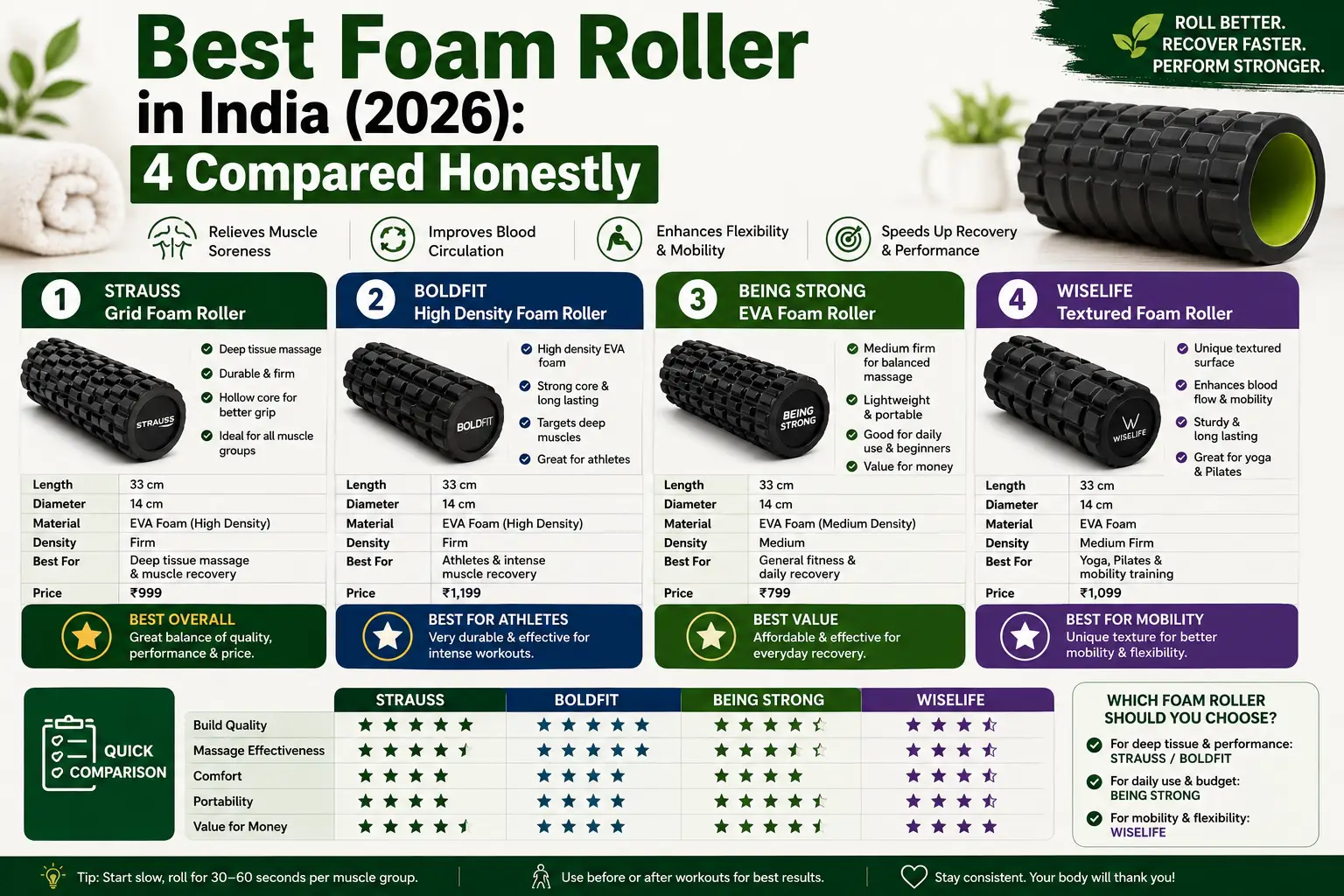
Best Foam Roller in India (2026): 4 Compared Honestly
Boldfit and Strauss foam rollers compared on density, size and rating data — plus what foam rolling actually does for sore muscles, and what it definitely does not.
17 min read
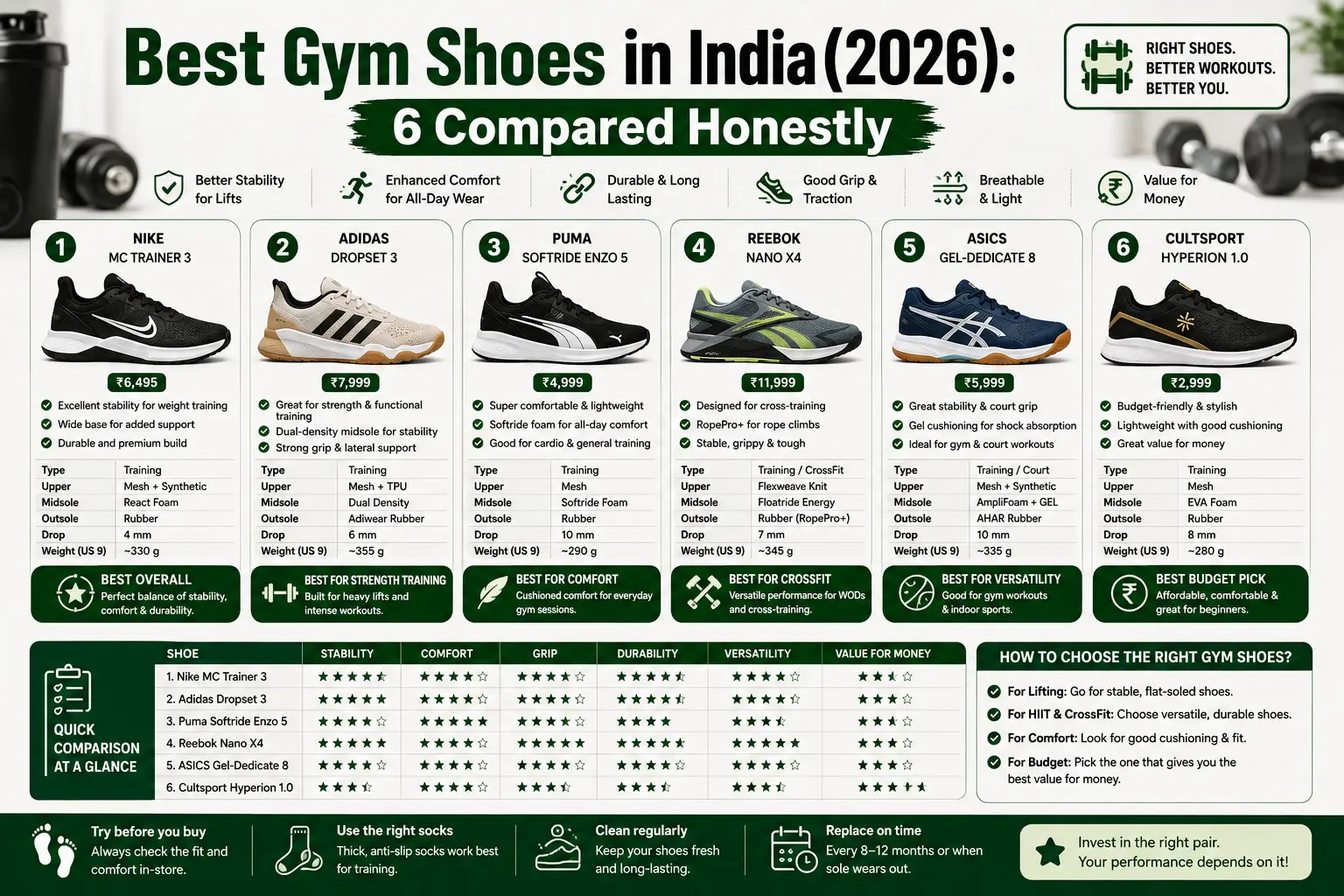
Best Gym Shoes in India (2026): 6 Compared Honestly
Most Indians buy a running shoe for the gym. Here is exactly when that is fine, when it costs you, and six options compared — from a ₹1,500 Campus to the Nike Metcon.