Best Yoga Mat in India (2026): 5 Mats Compared & Ranked
I compared 5 of the most popular yoga mats sold on Amazon India — Boldfit, Strauss, Amazon Basics, Lifelong, and Wakefit — on grip, cushioning, thickness, and durability to find the one actually worth your money in 2026.
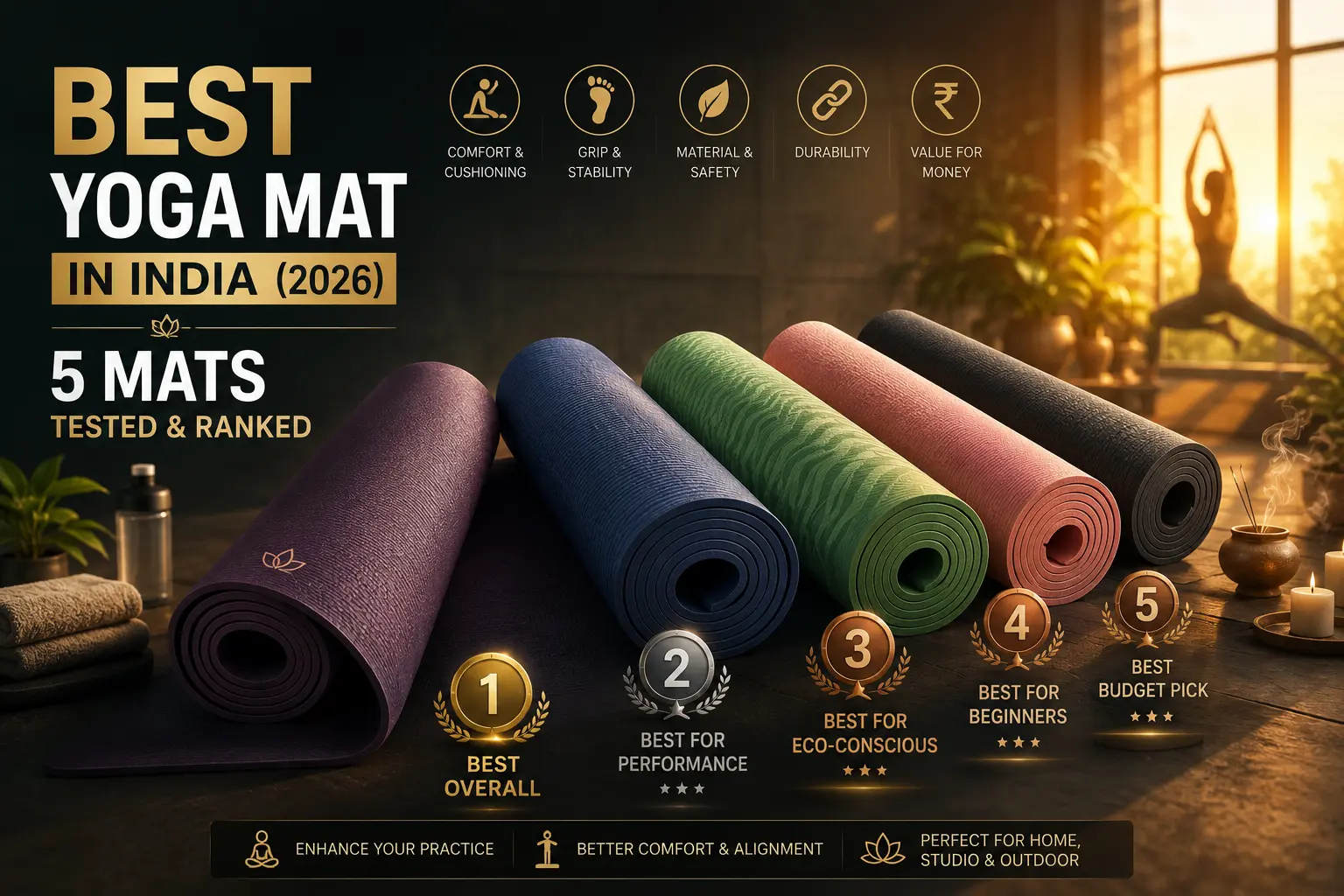
Affiliate Disclosure: As an Amazon Associate I earn from qualifying purchases. This post contains affiliate links. If you buy through them, we may earn a small commission at no extra cost to you — this never affects our recommendations. We only suggest products we believe in. Read our full affiliate disclosure.
Quick Answer
Buy the Boldfit 6mm anti-slip if you want one mat for everything. 6mm is the thickness that works for both standing poses and floor work, and it grips Indian tile and marble — which is where cheap mats actually fail, not on durability. Two things worth knowing first: it smells of rubber for the first few days, and its 4.1 rating rests on 176 reviews rather than thousands. If you would rather buy what the largest number of Indian buyers have actually tested, the Strauss TPE 6mm sits on nearly 10,000 ratings and grips better once you sweat.
Boldfit Yoga Mat for Men & Women — 6mm Anti-Slip
6mm high-density anti-slip mat, textured on both sides. Grips tile and marble, which is where cheap mats fail first, and cushions knees and spine without losing the stability standing poses need. Light enough to roll and store in a small flat. The all-round pick for yoga, Surya Namaskar and general home training.
Check Price on AmazonFive mats compared below, split by what you actually practise — plus the thickness rule that decides which row is yours.
A yoga mat is the single most-used piece of fitness equipment in an Indian home — it's under you for yoga, Surya Namaskar, stretching, HIIT, core work, even meditation. And yet most people buy whatever is cheapest, end up with a mat that slides on tile floors, tears at the corners in three months, or smells of rubber for weeks.
I've gone through this cycle myself — my first two mats were both mistakes. Since then I've used and compared mats across the price range for everything from morning Surya Namaskar to sweaty HIIT circuits on Indian marble and tile flooring. This guide covers the 5 mats actually worth buying on Amazon India in 2026, what thickness and material genuinely matter, and which one fits your specific use.
No sponsored placements. Honest pros and cons for each.
Which Mat Fits What You Practise
Yoga mats are a thickness decision before they are a brand decision. Go too thin and your knees pay for it during floor work; go too thick and you lose the stability every standing pose depends on. There is no mat that does both — so pick the row that matches what you actually practise.
← Swipe to compare →
| If you mostly do | Look at | The trade-off you accept |
|---|---|---|
| Yoga, Surya Namaskar, mixed home workouts | Boldfit 6mm anti-slip | Rubber smell for the first few days, and the surface needs a session or two to break in |
| Sweaty sessions, or you want eco-friendly | Strauss TPE 6mm | TPE dents more easily than high-density PVC — no shoes, and treat it gently |
| Floor work, stretching, sensitive knees | Amazon Basics 13mm NBR | Too soft and unstable for standing poses — this is a floor-work mat, not an all-rounder |
| Buying on the tightest budget | Lifelong 6mm | Compresses faster with daily use, and the texture wears smooth within months |
| Knee pain, but you still do standing poses | Wakefit 8mm anti-skid | Heavier to carry, and slightly less stable in one-leg balances |
Every one of these sits under ₹1,500. Live prices are with each review below — Amazon moves them week to week.
One thing to weigh before you decide. The rating counts behind these five are wildly uneven: Amazon Basics has over 15,000 ratings and Strauss nearly 10,000, while Boldfit, Lifelong and Wakefit sit in the low hundreds. That does not make the smaller-sample mats worse — a newer listing is not a worse product — but if you want the option that the largest number of Indian buyers have actually used and rated, the Strauss and Amazon Basics mats are on much firmer evidence. Pick accordingly.
What to Look For Before Buying a Yoga Mat in India
Five minutes here saves you from buying twice.
1. Thickness — The Most Misunderstood Spec
Thicker is not automatically better. Thickness trades cushioning against stability:
← Swipe to compare →
| Thickness | Best For | Trade-off |
|---|---|---|
| 3–4mm | Balance-focused yoga, travel | Less knee cushioning on hard floors |
| 6mm | Most people — yoga + Surya Namaskar + workouts | Best all-round balance |
| 8mm | Sensitive knees, stretching-heavy routines | Slightly wobbly in standing poses |
| 10–13mm | Floor exercises, sit-ups, physiotherapy | Poor stability for yoga balance poses |
For Indian homes with tile or marble flooring — which is harder than the wooden floors most international guides assume — 6mm is the sweet spot for most people.
2. Material — What the Mat Is Actually Made Of
- PVC: Cheapest, durable, decent grip. Heavier, not eco-friendly, and can smell initially. Most budget Indian mats are PVC or PVC-blend.
- TPE: Lighter, eco-friendlier, better sweat grip, usually dual-layered. Costs a bit more and very cheap TPE can tear faster.
- NBR (foam): Very thick and soft — great for floor work, poor for yoga grip. This is what most 10mm+ mats are.
- EVA: Light and cheap but compresses permanently over time. Fine as a starter, not a long-term buy.
- Cork/natural rubber: Premium grip that improves with sweat — but ₹2,000+ in India and overkill for most beginners.
3. Grip — On Both Sides
The bottom must grip your floor (tile/marble slides more than wood); the top must grip your palms — especially in Downward Dog and high-plank positions once you start sweating. Textured dual-sided mats handle both. If your palms sweat heavily, TPE holds grip better than smooth PVC.
4. Size — Check the Length If You're Tall
Standard mats are ~172–183cm long. If you're above 5'10", look for 183cm so your head and feet stay on the mat in lying poses. Width is standard ~61cm almost everywhere.
5. Smell and Off-Gassing
Cheap PVC/NBR mats often smell of rubber for the first week. It's not harmful, but if you're sensitive, TPE mats smell far less. Airing any new mat out for 2–3 days before first use helps.
The 5 Best Yoga Mats in India — Full Reviews
1. Boldfit 6mm Anti-Slip Mat — Best Overall
Boldfit has quietly become one of India's most reliable budget fitness brands (their resistance bands topped our resistance bands comparison too), and their 6mm mat is the best all-rounder here. The high-density material holds its shape — it doesn't develop permanent elbow and knee dents after a month like cheaper foam mats. The textured surface grips well on tile, and 6mm is enough cushioning for Surya Namaskar without feeling wobbly in Tree Pose.
Pros: Excellent grip on Indian tile/marble, holds shape long-term, good width, carrying strap included Cons: Slight rubber smell for the first few days, top surface takes a session or two to break in
Boldfit Yoga Mat for Men & Women — 6mm Anti-Slip
6mm high-density anti-slip mat with textured surface on both sides. Good grip on tile and marble floors, comfortable cushioning for knees and spine, light enough to roll and store. The best all-round pick for yoga, Surya Namaskar, and general home workouts in India.
Check Price on Amazon2. Strauss TPE Eco-Friendly 6mm — Best Grip for Sweaty Sessions
If your sessions get sweaty — power yoga, HIIT on the mat, or summer workouts without AC — TPE is the material you want, and Strauss makes the most widely available TPE mat in India. It's noticeably lighter than PVC mats (easier to carry to a park or class), the dual-layer design gives a grippy top and a floor-holding bottom, and it has almost no chemical smell out of the packaging.
Pros: Best wet/sweat grip in this list, lightweight, eco-friendlier material, minimal smell Cons: TPE is less dent-resistant than high-density PVC — treat it a bit more gently, avoid shoes
Strauss TPE Eco-Friendly Yoga Mat — 6mm Dual Layer
Lightweight dual-layer TPE mat with superior sweat grip — the right choice for power yoga, HIIT, and anyone whose palms sweat during practice. Eco-friendlier material with almost no chemical smell, in a 183cm length that suits taller users.
Check Price on Amazon3. Amazon Basics 13mm NBR — Best Cushioning for Floor Work
This is not really a yoga mat — it's a comfort mat, and it's excellent at that job. 13mm of NBR foam makes floor exercises, sit-ups, stretching, and physiotherapy movements genuinely comfortable on hard Indian floors. Knees, tailbone, and spine feel protected. But that same softness makes it wrong for standing yoga: your foot sinks, and balance poses become wobbly.
Pros: Outstanding knee/spine comfort, great for core work and stretching, good for older users and physiotherapy Cons: Too soft and unstable for standing yoga poses, bulkier to roll and store
Amazon Basics 13mm Extra Thick NBR Exercise Mat
13mm NBR foam mat with maximum cushioning for floor exercises, core work, stretching, and physiotherapy on hard floors. Includes carrying strap. Choose this for comfort-first floor training — not for balance-focused yoga.
Check Price on Amazon4. Lifelong 6mm — Best Budget Pick
If you're not sure you'll stick with the habit yet and want to spend the minimum, Lifelong's 6mm mat is the honest budget answer. The grip and density are a clear step below Boldfit — it will compress and show wear sooner — but it's a functional, full-sized 6mm mat at roughly the price of a food delivery order. A perfectly sensible first mat to test your consistency.
Pros: Very affordable, full standard size, decent starter grip Cons: Compresses faster with daily use, thinner texture wears smooth within months of heavy use
Lifelong Yoga Mat — 6mm Anti-Skid
Functional 6mm anti-skid mat at the lowest price of our picks. The right choice if you're testing whether the yoga habit sticks before investing more. Full standard size with basic but adequate grip.
Check Price on Amazon5. Wakefit 8mm Anti-Skid — Best for Sensitive Knees
Wakefit — the D2C mattress brand — applies the same comfort-first thinking to its 8mm mat. It sits in the useful middle ground: noticeably more cushioning than a 6mm for knees and elbows, while staying firm enough that standing poses don't feel like sand. If your knees complain during kneeling poses or you're above 40 and want joint comfort without giving up yoga stability, this is the pick.
Pros: Comfortable for knees/elbows, firmer than typical thick mats, good build quality Cons: Heavier than 6mm options, slight stability compromise in one-leg balance poses
Wakefit Yoga Mat — 8mm Anti-Skid
8mm anti-skid mat balancing extra joint cushioning with enough firmness for standing poses. Best for users with sensitive knees or anyone over 40 who wants comfort without fully sacrificing stability.
Check Price on AmazonFull Comparison Table
← Swipe to compare →
| Mat | Thickness | Material | Grip | Best For | Weight | Amazon India rating (sample size) |
|---|---|---|---|---|---|---|
| Boldfit | 6mm | High-density PVC blend | Very good | All-round use | Medium | 4.1 (176 ratings) |
| Strauss TPE | 6mm | TPE dual-layer | Best (incl. sweat) | Power yoga, HIIT | Light | 4.1 (~10,000 ratings) |
| Amazon Basics | 13mm | NBR foam | Good (floor) | Floor work, comfort | Bulky | 4.3 (15,000+ ratings) |
| Lifelong | 6mm | EVA/PVC | Decent | Budget starters | Light | 4.0 (few hundred ratings) |
| Wakefit | 8mm | Anti-skid blend | Good | Sensitive knees | Medium | 4.2 (few hundred ratings) |
Read that last column as two numbers, not one. A 4.1 backed by 176 ratings and a 4.1 backed by ~10,000 are not the same claim — the second has survived far more real use. None of these are our own scores; they are Amazon India's listing ratings, quoted so you can weigh them yourself.
Prices change frequently on Amazon India — check the live price on the product page. Picks selected July 2026; page last reviewed September 2026.
Which Yoga Mat Should You Actually Buy?
Stop overthinking it — match your situation:
Buy Boldfit 6mm if: You want one mat for everything — yoga, Surya Namaskar, stretching, home workouts — and want it to still look fine a year from now. The right answer for most people reading this.
Buy Strauss TPE if: You sweat heavily, practice power yoga or HIIT, or carry your mat to a class or park. The lighter weight and sweat grip are worth the small premium.
Buy Amazon Basics 13mm if: Your mat time is mostly floor exercises, core work, or physiotherapy — not standing yoga. Also the best pick for older family members.
Buy Lifelong 6mm if: You're testing the habit and want the minimum viable mat. Upgrade to Boldfit if you're still practicing in 3 months.
Buy Wakefit 8mm if: Kneeling poses hurt, or you want extra joint comfort without going full foam-mat.
How to Make Your Yoga Mat Last Longer
A good mat should last 1–2 years of daily use. Three habits make the difference:
- Wipe it after sweaty sessions — plain water or a 1:4 vinegar-water mix on a cloth. Sweat left on the surface degrades grip and starts to smell within weeks.
- Keep it out of direct sunlight — Indian balcony sun destroys PVC and TPE mats fast. Dry it in shade, store it rolled indoors.
- No shoes, ever — one session with trainers on a TPE mat can leave permanent dents and tears.
Deep-clean monthly: mild soap, soft cloth, air-dry fully in shade before rolling.
Can One Mat Handle Yoga AND Home Workouts?
Yes — and for most Indian homes it should. A good 6mm mat handles yoga, Surya Namaskar, bodyweight circuits, resistance band exercises, core work, and stretching. You only need to split into two mats when your training pulls in opposite directions — deep floor comfort (13mm) and balance-heavy yoga (6mm) — or when two family members practice at the same time.
If you're building a complete budget home setup, a mat is Priority 1 alongside resistance bands — see our full ₹5,000 home gym build for the complete plan.
Where a mat stops being enough is the moment you want real load. Bands cover a surprising amount, but progressive strength work needs weight — that is where adjustable dumbbells come in, and a bench after that if you want to press properly. And since the mat is also where most people do their mobility and recovery work, it is worth knowing what the research actually supports there before buying a massage gun — the answer is narrower than the marketing suggests.
Frequently Asked Questions
Which thickness yoga mat is best in India — 4mm, 6mm, or 8mm?
6mm is the best all-round thickness for Indian homes, which typically have hard tile or marble floors. It cushions knees and spine adequately while staying stable for standing poses. Choose 8mm only if your knees are sensitive, and 4mm only if balance work dominates your practice.
Is a thick 10mm or 13mm mat better for yoga?
No — thick foam mats are better for floor exercises, core work, and stretching, but worse for actual yoga. Your feet sink into the soft surface, making standing and balance poses unstable. For yoga and Surya Namaskar, stay at 6–8mm.
Which is the best yoga mat for Surya Namaskar?
A 6mm anti-slip mat like the Boldfit or Strauss TPE. Surya Namaskar cycles between standing, plank, and kneeling positions, so you need both stability and moderate cushioning — exactly what 6mm provides. Grip matters most here, since your palms stay planted through Ashtanga Namaskara and upward dog.
TPE vs PVC yoga mat — which is better?
TPE is lighter, grips better when wet with sweat, and is more eco-friendly; PVC is more dent-resistant and usually cheaper. If you sweat a lot or carry your mat around, choose TPE. If the mat stays home and you want maximum durability per rupee, a high-density PVC mat is fine.
How long does a yoga mat last?
A quality mat lasts 1–2 years with daily use; budget mats closer to 6–12 months. Replace your mat when the surface turns smooth and slippery, the foam stays compressed where your knees land, or edges start flaking. Wiping off sweat and keeping the mat out of sunlight roughly doubles its life.
Can I wash my yoga mat with water?
Wipe-clean, yes — soak, no. Use a damp cloth with mild soap or diluted vinegar, then air-dry completely in shade before rolling. Never machine-wash a foam mat and never dry it in direct sun, which cracks PVC and warps TPE.
Is an expensive yoga mat worth it for beginners?
Not at the start. A ₹500–900 mat from this list covers everything a beginner needs. Consider a premium cork or natural-rubber mat (₹2,000+) only after 6+ months of consistent practice, when you can actually feel the grip and alignment differences that justify the price.
Final Recommendation
If you skipped to the end: buy the Boldfit 6mm for all-round use, the Strauss TPE 6mm if you sweat heavily or travel with your mat, and the Amazon Basics 13mm only if floor comfort — not yoga — is the real goal.
Boldfit Yoga Mat for Men & Women — 6mm Anti-Slip
6mm high-density anti-slip mat with textured surface on both sides. Good grip on tile and marble floors, comfortable cushioning for knees and spine, light enough to roll and store. The best all-round pick for yoga, Surya Namaskar, and general home workouts in India.
Check Price on Amazon📖 Read Also:
Surya Namaskar for Weight Loss — Calories, Benefits & How Many RoundsThe exact practice your new mat will see the most — how many calories Surya Namaskar burns per round, how many rounds to do for fat loss, and the correct 12-step form.
📖 Read Also:
10 Beginner Yoga Poses for Stress Relief & FlexibilityNew to yoga? Start with these 10 beginner-safe poses for flexibility and stress relief — with step-by-step form cues you can follow on your mat at home.
📖 Read Also:
Build a Complete Home Gym Under ₹5,000 (India)A yoga mat is Priority 1 of a budget home gym. Here's the full ₹5,000 build — what to buy at each price point, in what order, and what to skip.
📖 Read Also:
Dumbbells vs Resistance Bands — Which is Better for Home Workouts?Once your mat is sorted, this is the next equipment decision — the honest head-to-head on muscle building, cost, and space for Indian homes.
Free Tools to Help You
Put this article into action — use our free calculators to get your personalized numbers.
Was this article helpful?
Want More Tips Like This?
Join 1,000+ readers getting weekly fitness, diet, and wellness tips + FREE meal plan
No spam, ever. Unsubscribe anytime.

About the Author: Ashwani
Fitness enthusiast and wellness writer. I research and write about home workout equipment and supplements — so you can make informed decisions without wasting money.
Read more about us →Comments
Leave a Comment
Your email will not be published. Comments are reviewed before appearing.
You Might Also Like
Continue your wellness journey
26 min read
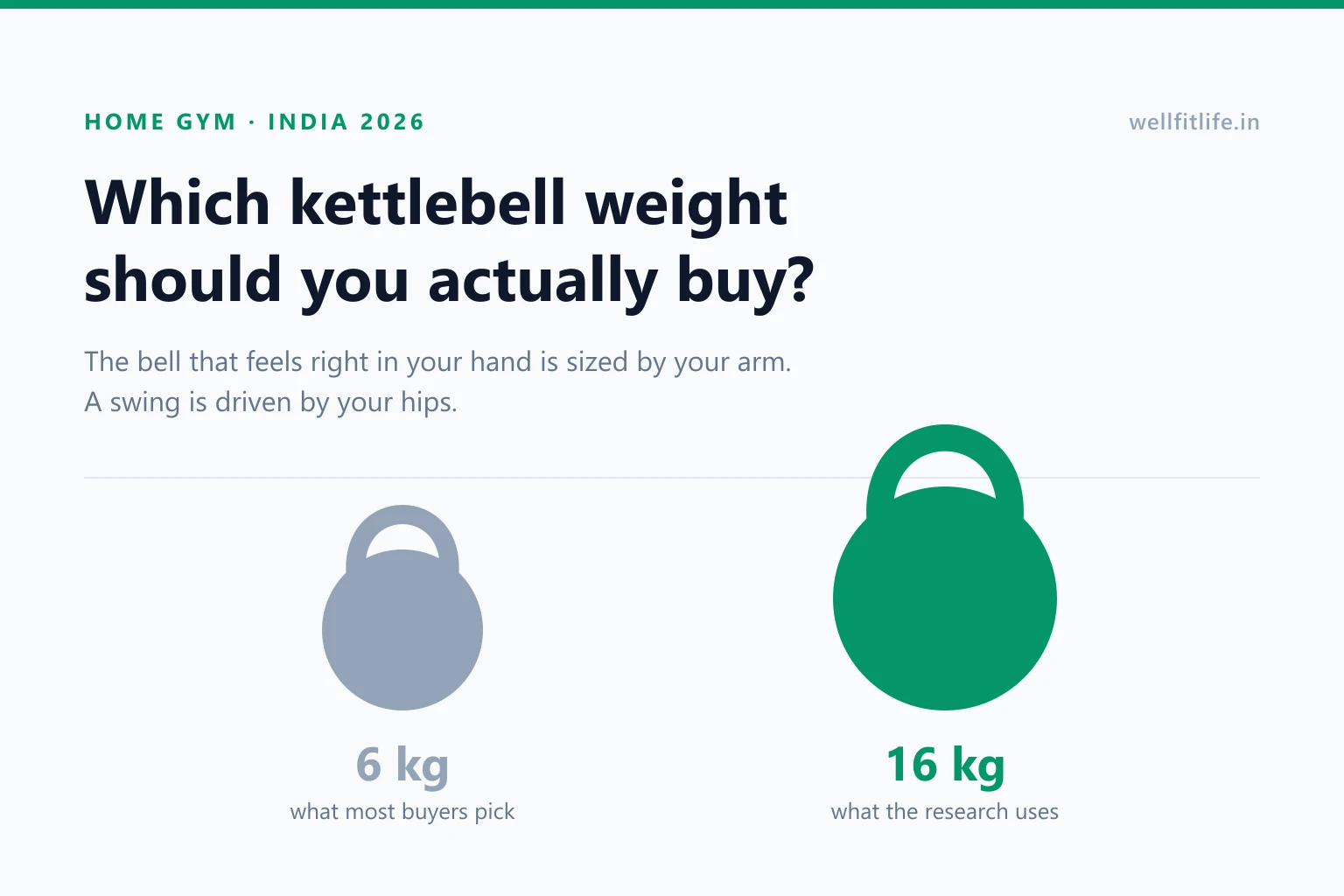
Best Kettlebells for Home Gym in India (2026): Which Weight to Buy
Almost every kettlebell sold in India is lighter than the ones the research is done with. The weight that feels right when you pick it up is roughly half the weight your hips need — and that single mistake is why most kettlebells end up under a bed.
15 min read
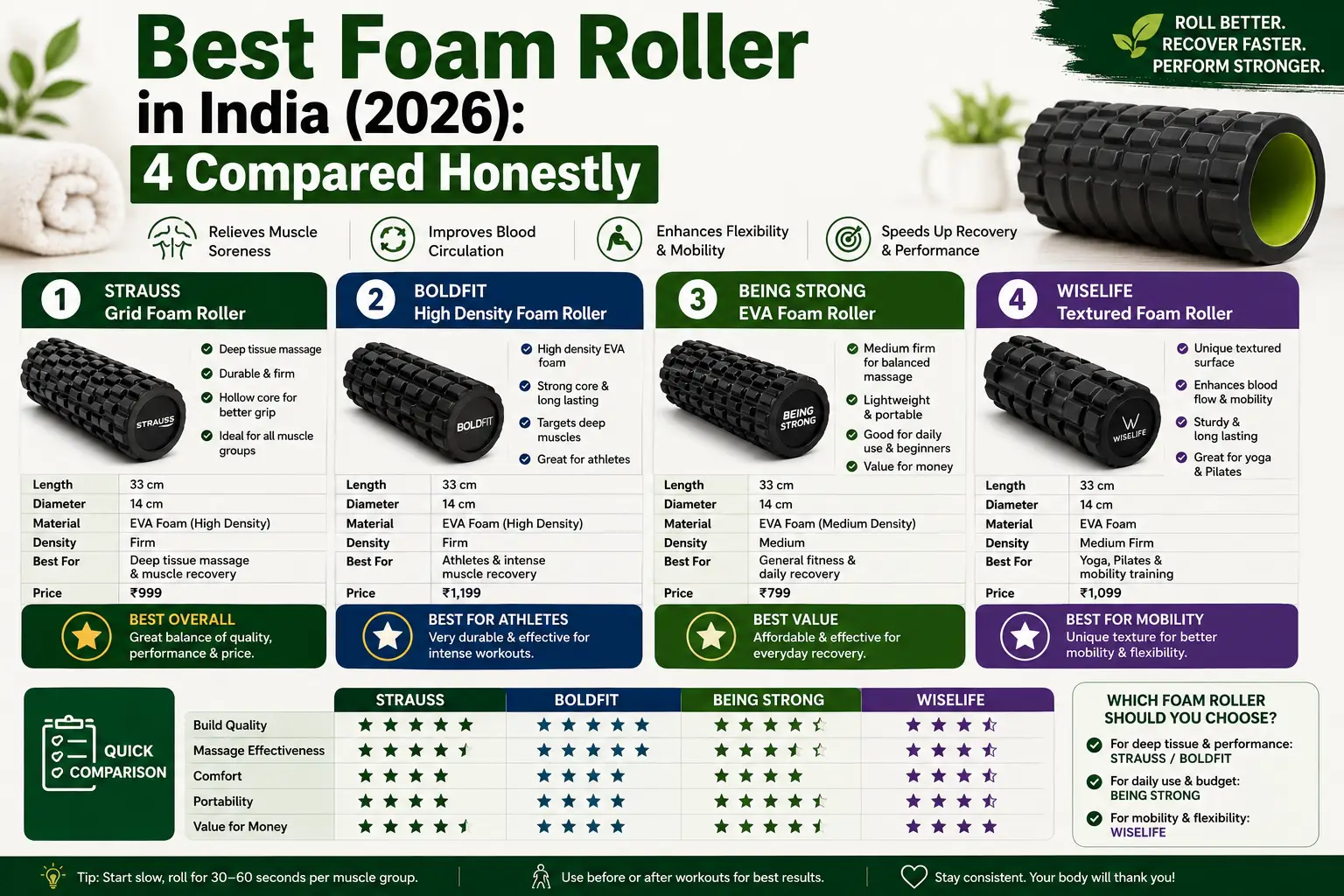
Best Foam Roller in India (2026): 4 Compared Honestly
Boldfit and Strauss foam rollers compared on density, size and rating data — plus what foam rolling actually does for sore muscles, and what it definitely does not.

18 min read
Amazon Great Indian Festival 2026: Home Gym Deals Worth Buying (and What to Skip)
The Great Indian Festival starts on 8 October 2026. The percentage off on a fitness listing is measured against MRP, which is a legal ceiling rather than a real price, so that number tells you very little. What tells you whether a deal is real is the price history and the bank offer. Here is the short list of home gym equipment worth buying in the sale, and how to check each deal before you pay.