Best Massage Gun in India (2026): 5 Compared Honestly
Most massage gun listings in India hide the one spec that decides whether the device actually reaches muscle. Here is what to check, what the research supports, and an honest comparison of five options.
Affiliate Disclosure: This post contains affiliate links. If you buy through them, we may earn a small commission at no extra cost to you — this never affects our recommendations. We only suggest products we believe in. Read our full affiliate disclosure.
Quick Answer
Most people reading this should buy a foam roller instead. A massage gun does one thing a roller cannot — reach a specific knot in the neck, shoulder or upper back that body weight cannot press into. If you do not have a recurring, locatable sore spot, you are paying five to ten times more for a tool that does the same job less comfortably.
If you do have that problem, buy on evidence rather than claims — the Dr Physio USA Dynamo has more rating volume behind it than every other option here combined.
Boldfit Foam Roller 33cm — High Density EVA
The cheaper answer for most people, and the one to try before spending on percussion. High-density EVA at 4.5 across 1,036 ratings — it covers quads, hamstrings, calves, IT band and glutes using your own body weight. If it does not fix your problem after a few weeks, that is when a massage gun starts to make sense.
Five massage guns compared below, on how much evidence there is that they work rather than what they claim.
Almost every massage gun sold in India advertises the same three numbers: speed levels, number of heads, and a motor figure. Not one of those three tells you whether the device will actually do anything for a sore muscle.
The spec that decides that is amplitude — how far the head travels on each stroke. And it is missing from most Indian listings entirely.
That single gap is why so many ₹2,000–4,000 massage guns feel like an expensive vibrating toy. They buzz on the surface of the skin at high speed and never reach the tissue underneath. The device is doing exactly what its spec sheet promised; the spec sheet just never mentioned the number that mattered.
This guide covers what to actually check before buying, what the published research does and does not support, and five options compared on the data available.
How this guide was put together: I have not owned these five massage guns long-term, so you will not find "I tested each of these for three months" claims here. What follows is a criteria and specification comparison built from current Indian listings, published customer rating data, and peer-reviewed research on percussive therapy — the homework I would do before spending my own money. Where I rate one option above another, it is because of the data below, not because I have worn one out.
Which One, If You Do Buy
There is no single "best" massage gun here, because the five differ mostly in how much evidence there is that they work, not in what they claim. Pick the row that matches how you weigh proof against price.
← Swipe to compare →
| If this is you | Start with | The catch you should know first |
|---|---|---|
| You want the option most Indians have already bought and rated | Dr Physio USA Dynamo | 31,667 ratings is by far the largest sample here — but the average is only 4.2, so popular is not the same as best-rated |
| You want the widest set of attachments | Lifelong LLGM109 | Seven heads sounds better than it is — most people settle on two within a fortnight |
| Average rating matters more to you than sample size | Caresmith Charge Go | Highest rated of the five at 4.4, but on just 769 ratings — the least proven here |
| You want at least one honest performance number | HealthSense HM140 | The only one that publishes its RPM (2,800, a sensible figure) — but amplitude still is not stated |
| You already buy Cult gear and want it to match | Cult Impact | Lowest rated of the five at 3.8, and it ships as essentially a one-head device |
Who should skip this page entirely: if you have no specific recurring soreness problem, a foam roller at a fraction of the price does most of what a massage gun does. That case is covered near the end, and no spec on this page changes it.
📖 Read Also:
Amazon Great Indian Festival 2026: Home Gym Deals Worth BuyingBuying in the 8 October sale? How to tell whether a percentage off is real, and what the SBI offer is actually worth on this.
What the Research Actually Supports
Worth knowing before you spend anything, because the marketing claims run well ahead of the evidence.
A 2020 randomised trial in the Journal of Sports Science and Medicine applied five minutes of percussive massage to the calf muscles of 16 healthy adults. Ankle range of motion increased. Maximum voluntary contraction — actual force production — did not change.[1]
A 2025 randomised controlled trial in Frontiers in Public Health took 30 physically active young men, induced muscle soreness, then split them into static stretching, a 25-minute percussion session, and a 40-minute percussion session. At the 48-hour mark the long-duration percussion group reported significantly lower pain than the stretching group, and had significantly greater knee joint range of motion.[2]
So the honest summary:
- Supported: short-term flexibility and range of motion, and reduced delayed-onset muscle soreness.
- Not supported: strength, power, or performance gains. A massage gun does not make you stronger.
- Caveats worth stating: both studies used small samples of young, physically active men. Neither tells you much about a 45-year-old with chronic desk-related neck tightness, which is what a lot of Indian buyers actually want one for.
A massage gun is a recovery and mobility tool, not a treatment. If you have persistent pain — particularly back, neck or joint pain that has lasted more than a few weeks — that is a reason to see a doctor or physiotherapist, not a reason to buy a percussion device. This guide is general information and not medical advice.
What Actually Matters When Buying
1. Amplitude — the spec Indian listings hide
Amplitude is how deep the head punches on each stroke, measured in millimetres. It matters more than every other number combined.
- 10–16 mm — genuine deep tissue. This is what professional-grade devices deliver.
- 6–9 mm — surface level. Fine for warm-up and light soreness, not much use on a thick quad or glute.
- Under 6 mm — this is a vibration massager wearing a massage gun's clothes.
Here is the practical problem: none of the five devices on this page state amplitude in the product title, and most Indian listings do not state it anywhere. Before you buy any massage gun in India, scroll to the A+ content and the customer Q&A section and look for it specifically. If the brand will not publish the number, assume it is at the low end — brands publish the specs that flatter them.
2. Stall force — whether it survives contact with an actual muscle
Stall force is how much pressure you can push with before the motor stalls out. A device with a high RPM and low stall force stops dead the moment you lean into a tight calf, which is exactly when you need it.
Roughly: under 10 kg is light-use only, 20 kg and above handles real pressure. Like amplitude, this is rarely published on Indian listings — and its absence tells you something.
3. RPM — where higher is not better
Percussions per minute usually run 1,800–3,200. It is the number brands love to advertise because it is easy to inflate and sounds impressive.
More is not better. Very high RPM combined with low amplitude gives you a fast, shallow buzz — the worst combination. 2,400–3,200 RPM paired with decent amplitude is the useful range. Of the five here, only the HealthSense HM140 puts its figure (2,800 RPM) in the title, which sits sensibly in that band.
4. Noise — the spec that decides whether you keep using it
A loud massage gun does not get used in a shared Indian home at 6 AM, and it definitely does not get used during a work call. Brushless motors are meaningfully quieter than brushed ones. If a listing advertises "quiet operation" without a decibel figure, treat it as marketing rather than data.
5. Weight — you are holding this at arm's length
Most fall between 700 g and 1.2 kg. That difference sounds trivial and is not: reaching your own upper back or shoulder means holding the device out at an awkward angle, and 300 extra grams turns a comfortable two-minute session into an arm workout. If you plan to use it on your own back, lighter genuinely wins.
6. Heads — and why the count is a vanity number
Four to seven heads is typical. In practice almost everyone uses two:
- Round / ball — general large muscle groups. This is the one you will use most.
- Flat — broader, gentler pressure. Good for areas close to bone.
- Bullet / cone — trigger points and small knots. Precise and easy to overdo.
- Fork / U-shaped — designed to straddle the spine, never to be used directly on it. Also useful either side of the Achilles.
A seven-head set is not meaningfully better than a four-head set. It is a spec-sheet win, not a usage win.
7. Battery and warranty — the India-specific part
Battery capacity in mAh tells you roughly how many sessions you get between charges; a 3,000 mAh cell in this device class is generous. But the more important India question is service: check whether the brand has a service process that does not require shipping the unit somewhere and hoping. Brands with an existing Indian retail presence — Lifelong, Cult, HealthSense, Dr Physio — are generally easier to deal with here than imported names.
The Five Worth Considering
Quick comparison
← Swipe to compare →
| Product | Ratings | Avg rating | Speeds | Heads | Stated figures |
|---|---|---|---|---|---|
| Dr Physio USA Dynamo | 31,667 | 4.2 | 6 | 4 | 3,000 mAh battery |
| Lifelong LLGM109 | 2,685 | 4.3 | 6 | 7 | Quiet operation claim |
| Caresmith Charge Go | 769 | 4.4 | — | 4 | Specialised head set |
| HealthSense HM140 | 7,667 | 4.2 | 6 | 4 | 2,800 RPM, high torque |
| Cult Impact | 1,608 | 3.8 | 6 | 1 | Silicone round head |
Read that ratings column carefully — it is the most useful data on this page. In a category where the decisive specs go unpublished, the number of people who have actually bought and rated a device is the closest thing to evidence you have.
Dr Physio USA Dynamo Rechargeable Percussion Massage Gun (1034)
3,000 mAh rechargeable battery, 6 speed levels, 4 removable heads, cordless. The safest default if you want the option that the largest number of Indian buyers have already tried.
Lifelong LLGM109 Percussion Massage Gun — 7 Heads
2,685 ratings and the widest attachment set here at 7 heads, covering neck, shoulders, back, arms, legs and feet. Cordless with a quiet-operation claim. Worth it if you genuinely want to treat several different areas — though most users settle on two heads.
Caresmith Charge Go Massage Gun — 4 Specialised Heads
The highest average rating in this comparison at 4.4, across 4 specialised heads for back, leg and full body use. The caveat is sample size: 769 ratings is a fraction of the Dr Physio's, so that 4.4 rests on much less data.
HealthSense HM140 Percussion Massage Gun — 2,800 RPM
7,667 ratings, and the only device here that publishes a performance figure in its own title: 2,800 RPM, which sits in the genuinely useful band rather than the inflated one. High torque motor, 6 speed levels, 4 removable heads, lightweight with a non-slip handle and a speed indicator.
Cult Impact Deep Tissue Massage Gun
6-speed intensity with a single silicone round head, from a brand with an established Indian retail and service presence. Be aware going in: at 3.8 across 1,608 ratings this is the lowest-rated option in this comparison, and the single head limits what you can target.
If you only take one thing from this section: in a category where amplitude and stall force go unpublished, rating volume is your best available proxy for whether a device holds up. The Dr Physio's 31,667 ratings and the HealthSense's 7,667 are doing more to justify those two picks than any spec on their listings.
Where You Must Not Use It
This matters more with a massage gun than with most fitness equipment, because the device delivers real force and people instinctively aim it at whatever hurts.
Never use it on:
- The front and sides of the neck. There is very little soft tissue protecting the nerves and blood vessels there. This is the single most important one.
- Directly on the spine. Use a fork head either side of the vertebrae, never on them.
- Over bone — knees, elbows, ankles, shins, the top of the shoulder.
- Anywhere you can feel a pulse. Stay on muscle bellies.
- Broken skin, wounds, or active skin conditions such as eczema or psoriasis.
- Varicose veins. Percussion will not improve them and may make things worse.
- A recent strain, sprain, tear, fracture or surgical site. Percussion on fresh injury adds inflammation to inflammation.
Talk to a doctor first if you are pregnant, take blood thinners, have a clotting disorder or history of DVT, have osteoporosis, or have any implanted device.
And a general rule that prevents most misuse: two minutes per muscle group is enough. More is not better, and a massage gun should never be painful. Discomfort at the edge of a tight muscle is normal; sharp pain means stop.
Massage Gun vs Foam Roller vs Just Stretching
← Swipe to compare →
| Tool | Cost | Best at | Weakness |
|---|---|---|---|
| Massage gun | Highest | Targeted spots, hard-to-reach knots, speed — two minutes and done | Cannot apply body-weight pressure across a broad area |
| Foam roller | Lowest | Broad areas — quads, IT band, upper back — using your own body weight | Awkward for arms, neck and shoulders; slower |
| Static stretching | Free | Long-term flexibility, and it needs nothing at all | Slowest for acute soreness; the 2025 trial above found percussion beat it at 48 hours |
These are not competitors so much as different tools. If you have never owned any of them, a foam roller gives you more recovery benefit per rupee. A massage gun earns its price when the areas you need to reach — neck, shoulders, upper back — are exactly the ones a foam roller handles badly.
📖 Read Also:
Best Foam Roller in India — 4 ComparedIf the row above pointed you at a foam roller instead, this is that comparison — including the density spec that decides whether a roller lasts years or flattens in months.
📖 Read Also:
5 Best Resistance Bands for Home Workout in India (2026)If you are buying recovery gear, this is the training side of the same setup — the most versatile piece of home equipment at a fraction of the cost.
Who Should Not Buy One
Being direct, because this is a category with a high rate of purchase regret:
- You have no recurring soreness problem. If you train twice a week and nothing hurts, this solves a problem you do not have.
- You want it for chronic pain. Persistent back, neck or joint pain needs a diagnosis, not a percussion device. A massage gun may mask a symptom you should be investigating.
- You expect performance gains. The research is clear that it does not improve force production.
- You will not actually use it. Recovery tools have a high abandonment rate. If your foam roller is already under the bed, this will join it.
- Your real problem is sitting for nine hours. Then the fix is movement through the day, not a device applied at the end of it. Our office worker fitness routine covers that properly, and a walking pad addresses the step-count side.
Frequently Asked Questions
Is a massage gun worth it in India?
It is worth it if you have a specific, recurring soreness problem — post-workout DOMS, or desk-related shoulder and upper back tightness — and you will actually use it two or three times a week. The published research supports improvements in soreness and short-term range of motion. It is not worth it as a general wellness purchase, and it will not make you stronger. If you own no recovery equipment at all, a foam roller delivers more per rupee.
What amplitude should a good massage gun have?
10–16 mm is genuine deep tissue territory. 6–9 mm is surface level and adequate for warm-ups and light soreness. Below 6 mm the device is effectively a vibration massager. The practical difficulty in India is that most listings do not publish amplitude at all — check the A+ content and customer Q&A, and if the brand refuses to state the number, assume it is at the low end.
How many RPM is good for a massage gun?
2,400 to 3,200 RPM is the useful range when paired with reasonable amplitude. Higher is not better — a very high RPM with low amplitude produces a fast, shallow buzz that never reaches muscle. Of the devices compared here, the HealthSense HM140's stated 2,800 RPM sits sensibly in that band.
How long should you use a massage gun on one muscle?
Around two minutes per muscle group. More is not better. It should never be painful — mild discomfort at the edge of a tight muscle is normal, but sharp pain means stop and move off that spot.
Can you use a massage gun on your neck?
Not on the front or sides of the neck. There is very little soft tissue protecting the nerves and blood vessels there, and this is the most common misuse of the device. The upper trapezius — the muscle between the neck and shoulder — is generally fine on a low setting, but stay off the neck itself and off the spine.
Does a massage gun help with weight loss?
No. There is no mechanism by which percussion therapy burns meaningful calories or reduces fat, and no credible evidence supporting it. Anyone marketing a massage gun for fat loss is misleading you. It is a recovery and mobility tool.
Massage gun or foam roller — which should I buy first?
Foam roller, if you own neither. It costs a fraction as much and handles the large areas — quads, hamstrings, IT band, upper back — using your own body weight. A massage gun is the better second purchase, because it reaches the places a foam roller struggles with, particularly the neck-shoulder region and the arms.
Do cheap massage guns under ₹2,000 work?
Some do, but the odds are against you, and for a specific reason: the components that cost money are the motor and the mechanism that produces amplitude. Those are precisely the specs budget devices do not publish. At that price you are usually buying speed levels and attachment count rather than depth. Rating volume is the most reliable filter you have in this segment.
Final Word
Massage guns are a category where the marketing has completely outrun the disclosure. Five devices, six speed levels each, and between them not one published amplitude figure — which is the number that decides whether any of it works.
Until Indian listings start publishing amplitude and stall force, buy on rating volume rather than spec sheets, budget for a device that publishes at least one honest performance number, and be realistic about the outcome. Better range of motion and less soreness at 48 hours is what the evidence supports. That is genuinely useful. It is also all of it.
📖 Read Also:
15 Resistance Band Exercises You Can Do at Home in IndiaThe training that creates the soreness this device is meant to help with — a full-body routine and 4-week progression, no bench or door anchor needed.
References
- Konrad A, Glashüttner C, Reiner MM, Bernsteiner D, Tilp M. The Acute Effects of a Percussive Massage Treatment with a Hypervolt Device on Plantar Flexor Muscles' Range of Motion and Performance. Journal of Sports Science and Medicine. 2020;19(4):690–694. PMID: 33239942.
- The effect of percussion massage therapy on the recovery of delayed onset muscle soreness in physically active young men — a randomized controlled trial. Frontiers in Public Health. 2025. PMC11979224.
Free Tools to Help You
Put this article into action — use our free calculators to get your personalized numbers.
Was this article helpful?
Want More Tips Like This?
Join 1,000+ readers getting weekly fitness, diet, and wellness tips + FREE meal plan
No spam, ever. Unsubscribe anytime.

About the Author: Ashwani
Fitness enthusiast and wellness writer. I research and write about home workout equipment and supplements — so you can make informed decisions without wasting money.
Read more about us →Comments
Leave a Comment
Your email will not be published. Comments are reviewed before appearing.
You Might Also Like
Continue your wellness journey
15 min read
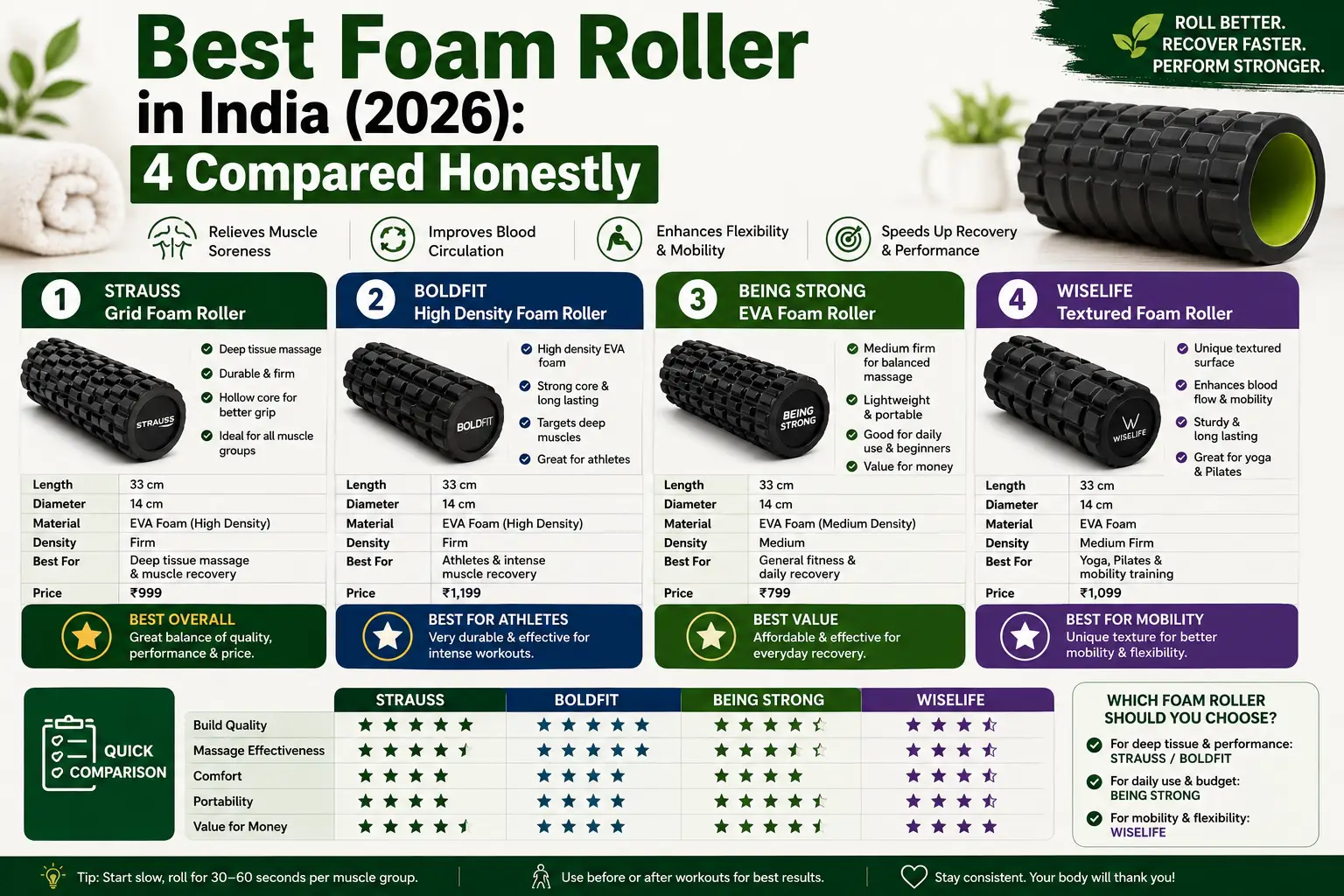
Best Foam Roller in India (2026): 4 Compared Honestly
Boldfit and Strauss foam rollers compared on density, size and rating data — plus what foam rolling actually does for sore muscles, and what it definitely does not.
27 min read
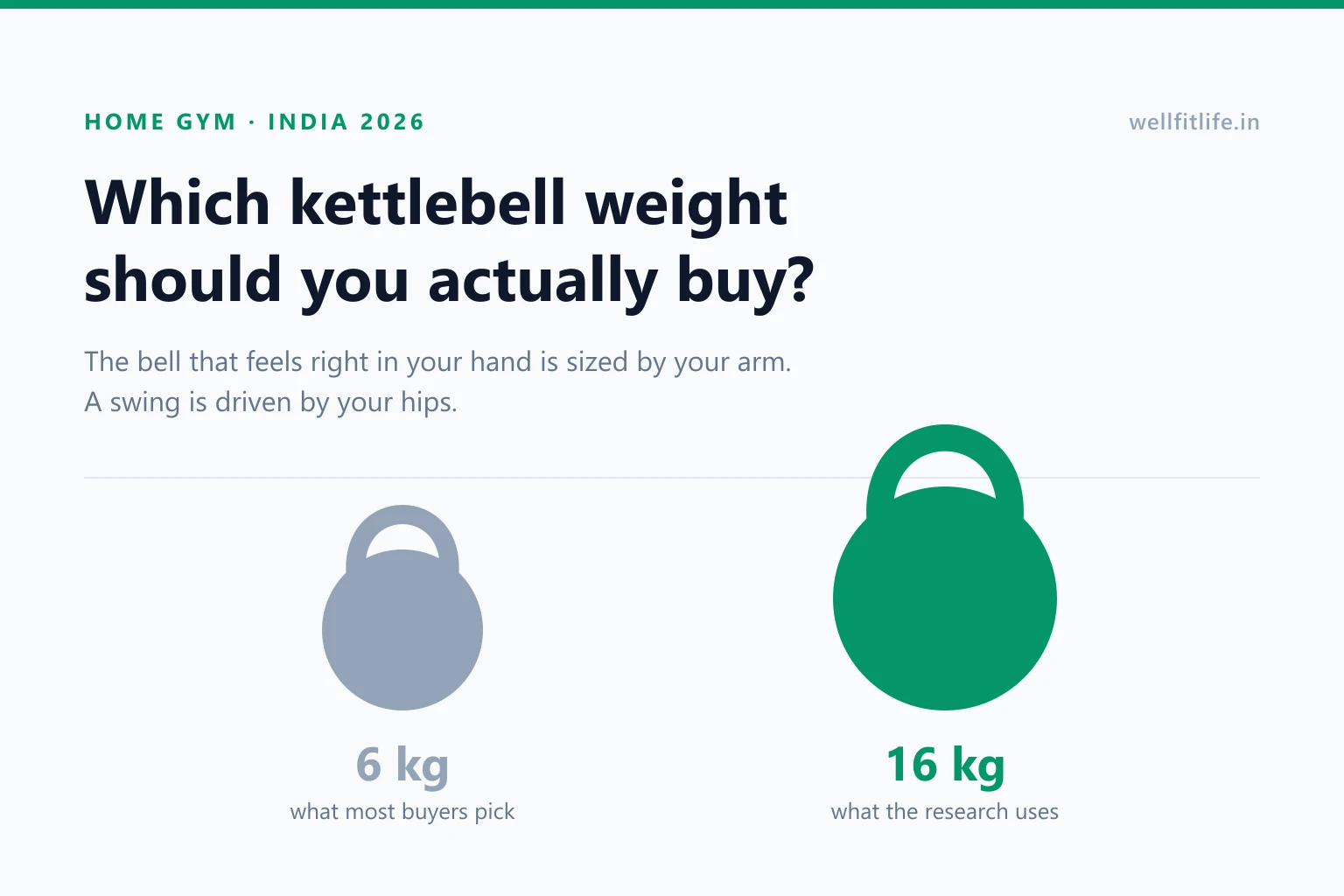
Best Kettlebells for Home Gym in India (2026): Which Weight to Buy
Almost every kettlebell sold in India is lighter than the ones the research is done with. The weight that feels right when you pick it up is roughly half the weight your hips need — and that single mistake is why most kettlebells end up under a bed.

18 min read
Amazon Great Indian Festival 2026: Home Gym Deals Worth Buying (and What to Skip)
The Great Indian Festival starts on 8 October 2026. The percentage off on a fitness listing is measured against MRP, which is a legal ceiling rather than a real price, so that number tells you very little. What tells you whether a deal is real is the price history and the bank offer. Here is the short list of home gym equipment worth buying in the sale, and how to check each deal before you pay.