Best Foam Roller in India (2026): 4 Compared Honestly
Boldfit and Strauss foam rollers compared on density, size and rating data — plus what foam rolling actually does for sore muscles, and what it definitely does not.
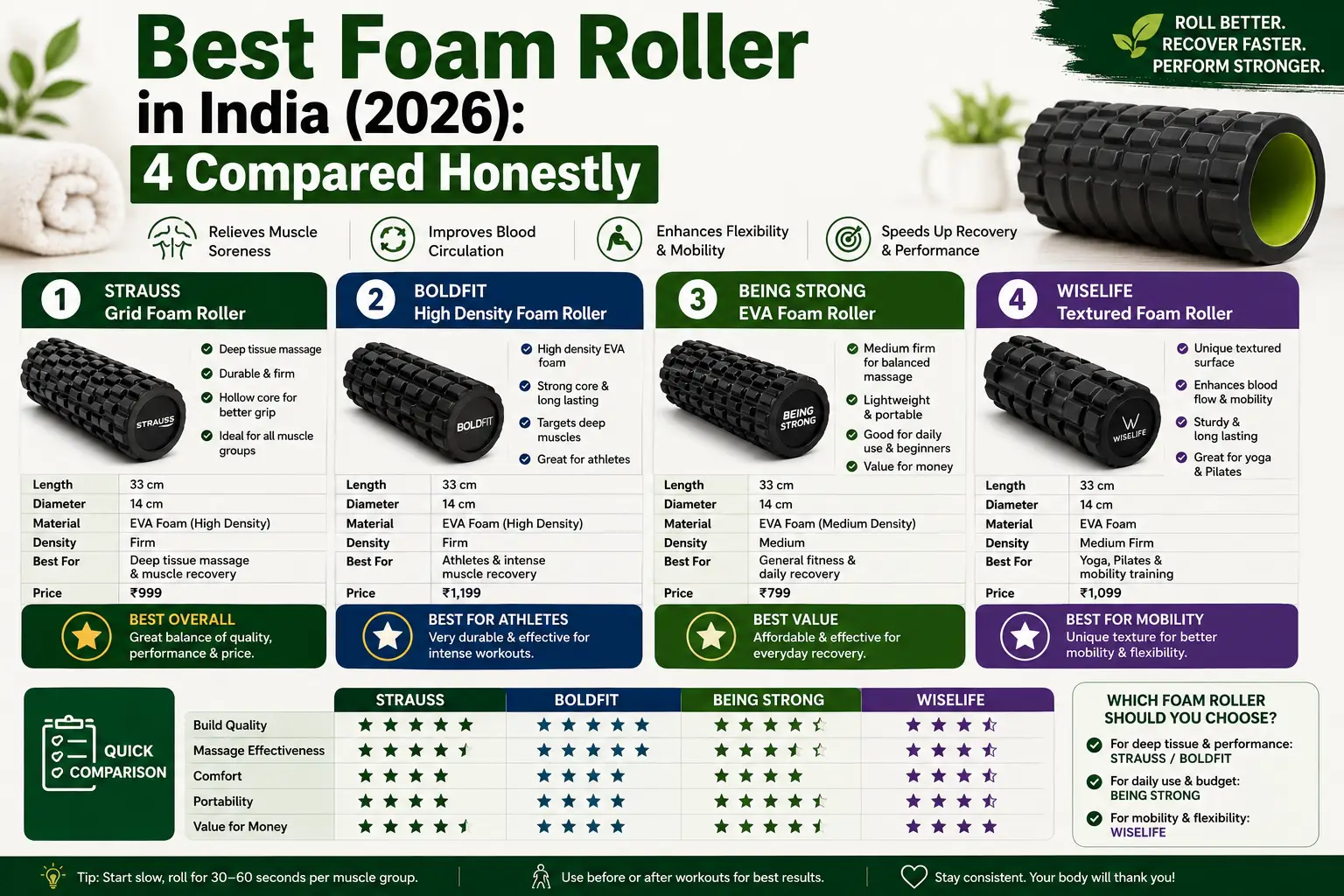
Affiliate Disclosure: As an Amazon Associate I earn from qualifying purchases. This post contains affiliate links. If you buy through them, we may earn a small commission at no extra cost to you — this never affects our recommendations. We only suggest products we believe in. Read our full affiliate disclosure.
Quick Answer
Buy the Boldfit 33cm high-density roller. It is the highest-rated on this page across the largest sample — 4.5 across 1,036 ratings — and it costs about as much as two protein shakes. High-density EVA is the only spec that matters, because low-density foam flattens permanently within months. Nothing in this category gets meaningfully better as you spend more, so the honest recommendation really is the cheap one.
Boldfit Foam Roller 33cm — High Density EVA
The highest-rated foam roller on this page at 4.5 across 1,036 ratings, and the sensible default for a first purchase. High-density EVA is the spec that matters — low-density foam compresses permanently flat within months and stops applying real pressure. 33cm suits quads, hamstrings, calves and IT band and fits in a gym bag; it is a little short for rolling across the upper back.
If you already own a roller sitting unused under your bed, a second one will not fix that — recovery tools have a high abandonment rate, and the tool is rarely the problem.
Recovery is the most oversold category in Indian fitness e-commerce. Scroll any "12 must-have recovery gadgets" list and you will find vibrating rollers, ice-and-heat devices and percussion guns, all promising to "flush lactic acid" and "release toxins."
Both of those phrases are marketing, not physiology. Lactic acid clears from your muscles within an hour of training on its own, and it was never what made you sore in the first place.
Here is what the evidence actually supports: foam rolling produces a modest reduction in short-term muscle soreness and a genuine short-term improvement in range of motion, most likely through reduced muscle tension and increased blood flow to the area. That is a real, useful effect — and it is fully delivered by a ₹600 piece of moulded foam. Nothing in this category gets meaningfully better as you spend more.
Which makes this an unusual product page: the honest recommendation is to buy the cheap one.
How this guide was put together: a specification and rating-data comparison built from current Amazon India listings, plus the published research on foam rolling and delayed-onset muscle soreness. I have not used all four rollers long-term. Last verified: August 2026.
Which Roller Suits You
← Swipe to compare →
| If this is you | Start with | The catch you should know first |
|---|---|---|
| First foam roller, want the safe default | Boldfit Foam Roller 33cm | Highest rated here at 4.5 across 1,036 ratings — genuinely the easy answer |
| You want the same thing a bit cheaper | Strauss Yoga Foam Roller 30cm | 4.2 across 396 ratings, 3cm shorter — fine unless you roll your upper back |
| You already roll and have stubborn knots | Strauss Grid (Spikes) | The textured surface reaches what smooth rollers glide over — but 3.9 on 160 ratings is the weakest data here |
| You want a longer, denser roller | Boldfit Supreme | 4.3 across 791 ratings, higher density — more intense than a beginner usually wants |
If you just want one answer: the Boldfit 33cm is the highest-rated foam roller on this page across the largest sample, and it costs about as much as two protein shakes. There is no sophisticated reasoning required here.
Who should skip this page: if you already own a foam roller that is sitting under your bed unused, a second one will not fix that. Recovery tools have a genuinely high abandonment rate, and the problem is rarely the tool.
Smooth vs Textured — The Only Real Decision
Every foam roller sold in India is one of two things, and picking the wrong one first is the most common mistake in this category.
Smooth rollers have a flat, even surface. Pressure spreads across a broad area, which makes them more forgiving and considerably more comfortable. This is what you want for large muscle groups — quads, hamstrings, calves, glutes, upper back — and it is the correct first purchase for essentially everyone.
Textured or grid rollers have raised ridges or spikes designed to concentrate pressure into a smaller area, mimicking a thumb or elbow digging into a specific spot. They reach knots a smooth roller glides straight past. They are also genuinely uncomfortable if you are not used to rolling.
The rule: smooth first, textured second — and only if the smooth roller has stopped resolving a specific stubborn spot. Buying a spiked roller as your first is how people conclude that foam rolling "hurts too much" and stop.
Foam rolling should feel like firm, tolerable pressure that eases as you hold it. It should not feel like sharp pain. Never roll directly over a joint, a bone, the lower back, or an area of acute injury or inflammation — and if you are on blood thinners or have a bleeding disorder, check with your doctor before using any pressure-based recovery tool.
The Comparison
← Swipe to compare →
| Product | Surface | Length | Rating |
|---|---|---|---|
| Boldfit Foam Roller | Smooth, high-density EVA | 33cm | 4.5 (1,036) |
| Boldfit Supreme | Smooth, higher density | Full size | 4.3 (791) |
| Strauss Yoga Foam Roller | Smooth EVA | 30cm | 4.2 (396) |
| Strauss Grid (Spikes) | Textured / spiked | 33cm | 3.9 (160) |
All four sit in roughly the same low price band, and Amazon discounts these 40–55% off MRP routinely — so the listed MRP is close to meaningless. Check the live price.
The Reviews
Boldfit Foam Roller 33cm — Best Overall
4.5 stars across 1,036 ratings — the highest average on this page on the largest sample, which makes this a straightforward recommendation rather than a finely balanced one.
The specification that matters is high-density EVA foam, and it matters for one reason: a roller that compresses permanently flat stops working. Cheap low-density foam loses its shape within a few months of regular use and becomes a padded tube you are lying on rather than a tool applying pressure. Density is the entire durability story in this category.
33cm is the right length for most uses — long enough for quads, hamstrings, calves and IT band, short enough to keep in a gym bag. The one thing it does not do well is upper back rolling across the spine, which wants a longer roller so both shoulder blades stay supported.
Boldfit Foam Roller 33cm — High Density EVA
The highest-rated foam roller on this page at 4.5 across 1,036 ratings, and the sensible default for a first purchase. High-density EVA is the spec that matters — low-density foam compresses permanently flat within months and stops applying real pressure. 33cm suits quads, hamstrings, calves and IT band and fits in a gym bag; it is a little short for rolling across the upper back.
Boldfit Supreme — Denser, More Intense
The same brand's firmer option, rated 4.3 across 791 ratings. Higher density means more pressure transmitted for the same bodyweight, which is either the upgrade you want or more than you can tolerate, depending entirely on where you are.
Worth being clear about who this suits: someone who has been rolling for a while on a standard roller and finds it no longer does much. A denser roller is the natural progression there, and a more sensible one than jumping straight to spikes, because it increases pressure evenly rather than concentrating it into points.
For a first roller, this is more than you need.
Boldfit Foam Roller Supreme — High Density
The firmer option in Boldfit's range at 4.3 across 791 ratings. Higher density transmits more pressure for the same bodyweight, which is the natural progression once a standard roller stops doing much for you — and a gentler step up than jumping to a spiked roller, because it raises pressure evenly rather than concentrating it into points. More than a first-time buyer needs.
Strauss Yoga Foam Roller 30cm — Cheapest Sensible Option
Rated 4.2 across 396 ratings, and functionally very close to the Boldfit 33cm — smooth EVA surface, same use cases, 3cm shorter.
That 3cm is the only meaningful difference and it only matters in one place: rolling across your upper back. On a 30cm roller, a broader-shouldered person will find the shoulder blades hanging off the ends slightly. For every other muscle group — quads, calves, hamstrings, glutes, IT band — the difference is irrelevant.
If it is cheaper than the Boldfit when you check, and upper back rolling is not your priority, buy it and spend the difference on something else.
Strauss Yoga Foam Roller 30cm — Deep Tissue EVA
Functionally near-identical to the Boldfit 33cm — smooth EVA, same muscle groups, 4.2 across 396 ratings — at typically a slightly lower price. The 3cm length difference only matters for rolling across the upper back, where broader shoulders will overhang a 30cm roller. For quads, calves, hamstrings, glutes and IT band it makes no practical difference.
Strauss Grid (Spikes) — For Specific Knots Only
The textured option, and the one with the honest caveat attached: 3.9 stars across 160 ratings is both the lowest average and the smallest sample on this page.
Some of that is likely the category rather than the product. Spiked rollers are genuinely uncomfortable, and a meaningful share of low ratings on textured rollers come from people who bought one as their first roller, found it painful, and rated accordingly. That is a mismatch between buyer and product more than a defect.
Which is exactly why it belongs here with a condition attached. Buy it if you already roll regularly and have a specific spot — a knot in the upper back, IT band tightness — that a smooth roller keeps gliding over. Do not buy it first.
Strauss Grid Foam Roller 33cm — Textured / Spiked EVA
The textured option, for concentrating pressure into a specific knot the way a thumb or elbow would — something a smooth roller cannot replicate. Rated 3.9 across 160 ratings, the weakest data on this page, though much of that likely reflects beginners buying a spiked roller first and finding it painful. Buy it as a second roller for a specific stubborn spot, never as your first.
How to Actually Use One
Most people buy a foam roller, use it wrong for two weeks, feel nothing, and stop. Four rules cover almost all of it:
Go slowly. The most common error by a distance. Rolling fast up and down a muscle achieves very little — the tissue does not have time to respond. Move roughly 2–3cm per second, which will feel absurdly slow the first time.
Stop and hold on the tender spots. When you find a spot that is noticeably tender, stop there and hold for 20–30 seconds, breathing normally, until the sensation eases. That pause is where the effect actually happens. Rolling past it is the difference between a tool and a massage-shaped fidget.
Ninety seconds to two minutes per muscle group. Longer is not better and there is no benefit to grinding away for ten minutes.
Never roll the lower back. This is the one genuine safety rule people break. The lumbar spine has no rib protection and rolling directly over it puts pressure on structures that cannot take it. If your lower back is tight, roll your glutes and hip flexors instead — that is usually where the tension originates anyway.
Before or after training? Both work, for different purposes. A brief 30–60 seconds per muscle group before training helps mobility as part of a warm-up. Longer rolling after training is the version that targets next-day soreness.
📖 Read Also:
Sleep, Recovery and Fat LossFoam rolling is a minor recovery lever. Sleep is the major one — and it is free.
What About a Massage Gun?
Different tool, different problem — not an upgrade.
A foam roller works through sustained pressure applied by your own bodyweight, which suits large muscle groups where you want a slow, broad release. A massage gun delivers rapid percussion at a point, which suits small, specific spots and — crucially — places you cannot reach with a roller. You cannot foam roll your own shoulder or upper trapezius properly. A massage gun handles that one-handed.
If you own neither, buy the foam roller first. It costs a fraction as much, has no battery, and covers more of the body effectively. A massage gun is a sensible second purchase once you know the recovery habit has actually stuck.
Two options worth knowing if you have reached that point:
beatXP Bolt Deep Tissue Massage Gun — Percussion Massager
The most-bought massage gun in this comparison by a wide margin — 4.4 stars across 6,750 ratings, which is more rating volume than every foam roller on this page combined. Percussion massager for neck, shoulder, back and foot, with up to a 1-year warranty. Sensible as a second recovery tool once foam rolling is already a habit, not as a first purchase.
Caresmith Charge Go Massage Gun — 4 Specialised Heads
A compact percussion massager with four specialised heads, rated 4.3 across 731 ratings. Covers the same use case as the beatXP — reaching the neck, shoulder and upper back areas a foam roller genuinely cannot — in a smaller, more portable body. Worth comparing head-to-head on live price, since these two trade places regularly.
📖 Read Also:
Best Massage Gun in India — 5 Compared, With the ResearchIf you are seriously considering percussion therapy, this is the full comparison — including the one spec Indian listings hide, and what the published trials actually found.
Frequently Asked Questions
Does foam rolling actually reduce muscle soreness?
There is reasonable evidence that it modestly reduces short-term soreness and temporarily improves range of motion, most likely through increased blood flow and reduced muscle tension. It is a genuinely useful habit and a minor one — it will not transform your recovery, and it is nowhere near as powerful as adequate sleep and protein. Ignore any product claiming it releases toxins or flushes lactic acid; neither describes what is happening.
Should I foam roll before or after a workout?
Both have a place. A brief roll of 30–60 seconds per muscle group before training supports mobility as part of a warm-up. Longer rolling of one to two minutes per area after training is the version aimed at reducing next-day soreness. If you only do one, do it after.
Is a more expensive foam roller actually better?
Past a basic quality threshold — the foam holding its density over months rather than compressing flat — extra money buys surface texture and sometimes vibration motors. Neither has a strong evidence base for improving on what a well-made basic roller does. This is one of the few categories where the cheap option genuinely is the right answer for most people.
Can foam rolling replace stretching?
No, they address different things. Foam rolling works on muscle tension and blood flow in the short term; stretching works on muscle length and joint range of motion over a longer horizon. Most well-built routines use both rather than substituting one for the other.
Why does foam rolling hurt so much?
Usually one of three reasons: you are using a textured roller before you are ready for one, you are rolling too fast, or you are rolling somewhere you should not — the lower back and directly over joints being the common culprits. Firm, tolerable pressure that eases as you hold it is normal. Sharp pain is a signal to stop and move off that spot.
How long does a foam roller last?
A high-density EVA roller used regularly should hold its shape for years. Cheap low-density foam is a different story — it can compress permanently within months, at which point it looks fine and does nothing. If your roller feels noticeably softer than when you bought it, it has stopped working.
Final Word
This is a rare category where the honest recommendation costs almost nothing. The research supports a modest, real benefit for soreness and range of motion, and that benefit is delivered in full by the cheapest well-made roller on the list.
So buy the Boldfit 33cm, or the Strauss if it is cheaper on the day. Roll slowly, hold on the tender spots, stay off your lower back, and give it ninety seconds per muscle group.
Then spend the money you did not spend on a vibrating roller on sleep, protein and consistency — which is where recovery actually comes from.
📖 Read Also:
30-Day Gym Workout Plan for BeginnersBuild recovery into the routine from week one rather than bolting it on after the soreness arrives.
Free Tools to Help You
Put this article into action — use our free calculators to get your personalized numbers.
Was this article helpful?
Want More Tips Like This?
Join 1,000+ readers getting weekly fitness, diet, and wellness tips + FREE meal plan
No spam, ever. Unsubscribe anytime.

About the Author: Ashwani
Fitness enthusiast and wellness writer. I research and write about home workout equipment and supplements — so you can make informed decisions without wasting money.
Read more about us →Comments
Leave a Comment
Your email will not be published. Comments are reviewed before appearing.
You Might Also Like
Continue your wellness journey
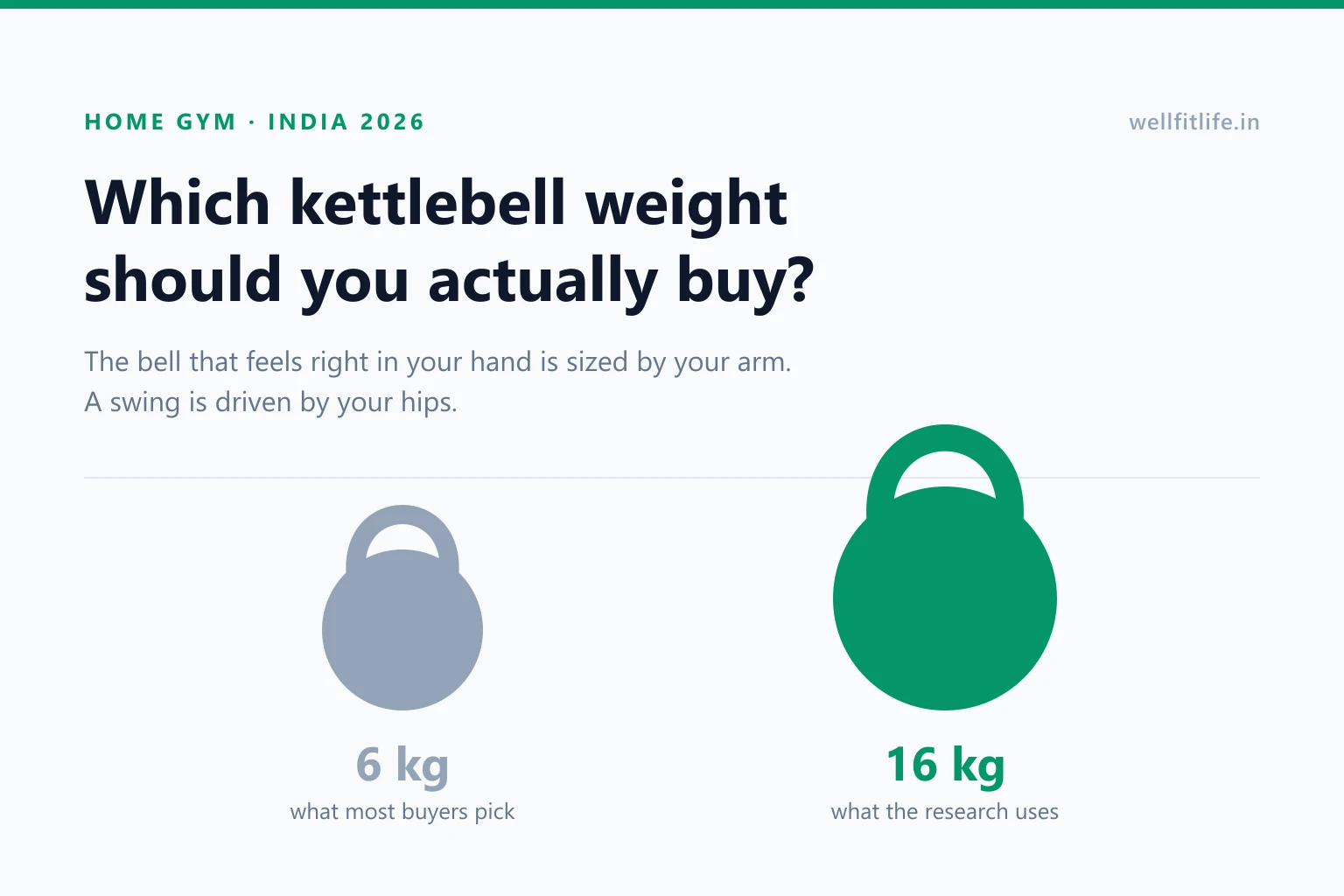
26 min read
Best Kettlebells for Home Gym in India (2026): Which Weight to Buy
Almost every kettlebell sold in India is lighter than the ones the research is done with. The weight that feels right when you pick it up is roughly half the weight your hips need — and that single mistake is why most kettlebells end up under a bed.
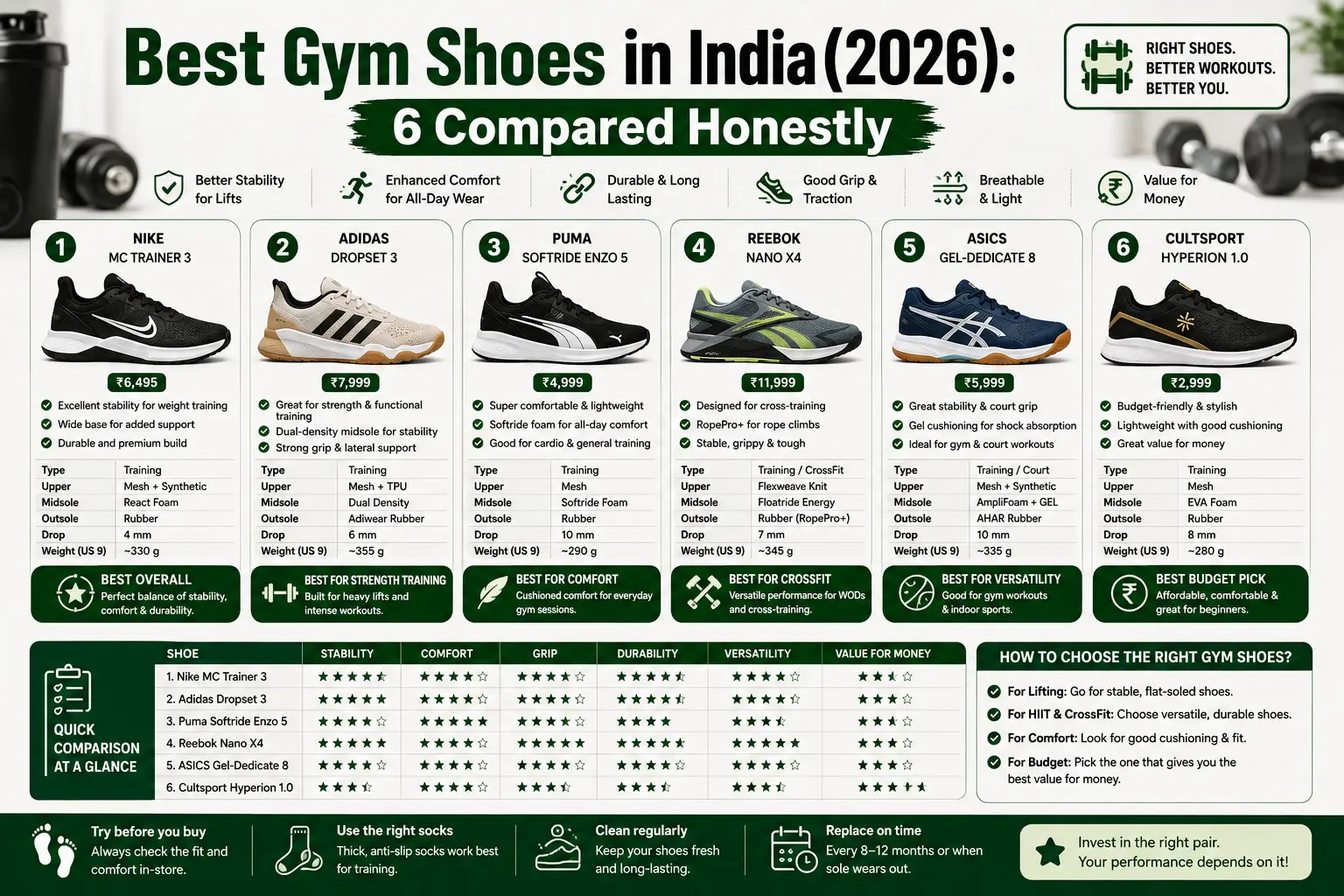
17 min read
Best Gym Shoes in India (2026): 6 Compared Honestly
Most Indians buy a running shoe for the gym. Here is exactly when that is fine, when it costs you, and six options compared — from a ₹1,500 Campus to the Nike Metcon.

18 min read
Amazon Great Indian Festival 2026: Home Gym Deals Worth Buying (and What to Skip)
The Great Indian Festival starts on 8 October 2026. The percentage off on a fitness listing is measured against MRP, which is a legal ceiling rather than a real price, so that number tells you very little. What tells you whether a deal is real is the price history and the bank offer. Here is the short list of home gym equipment worth buying in the sale, and how to check each deal before you pay.