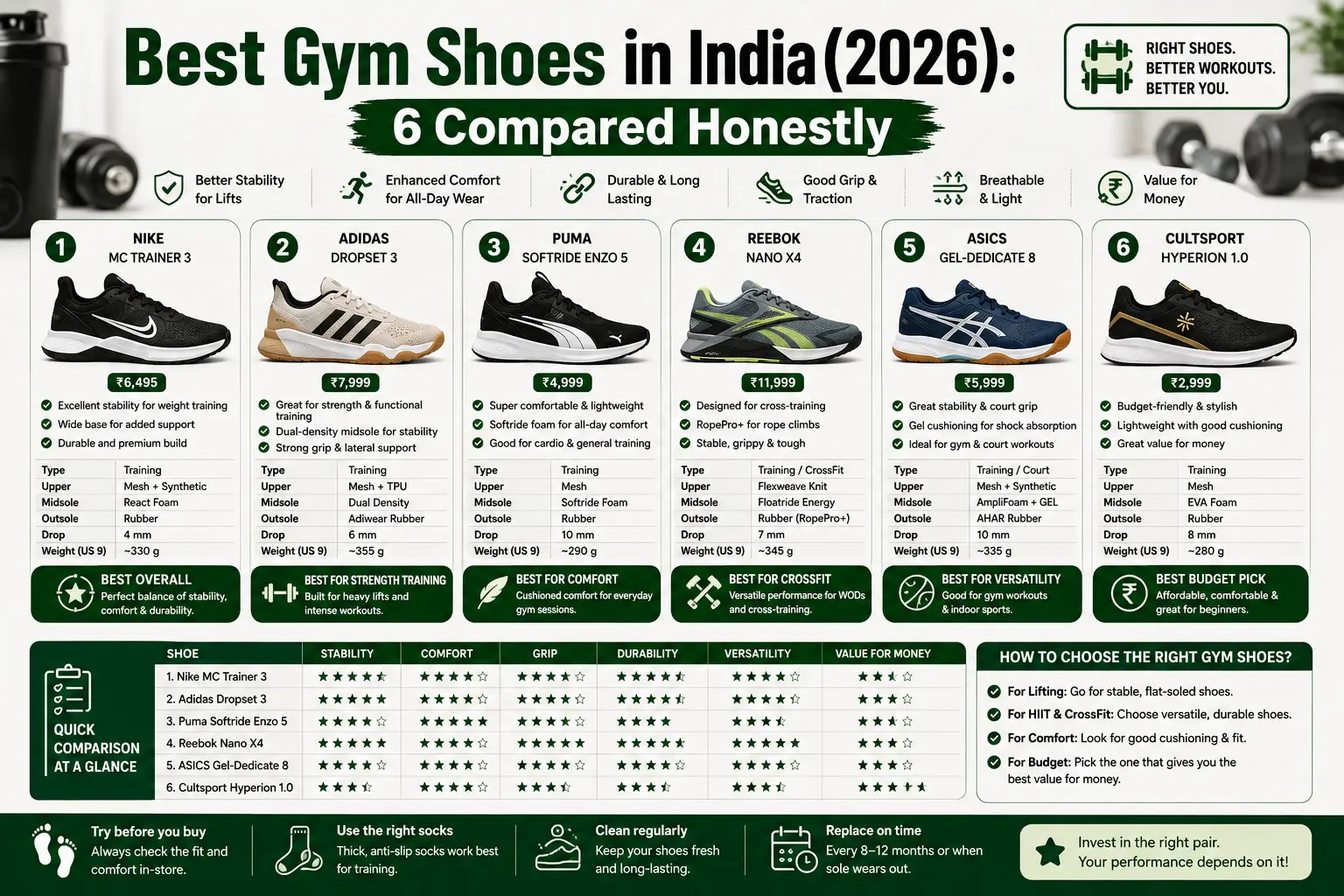
Best Gym Shoes in India (2026): 6 Compared Honestly
Most Indians buy a running shoe for the gym. Here is exactly when that is fine, when it costs you, and six options compared — from a ₹1,500 Campus to the Nike Metcon.
Affiliate Disclosure: As an Amazon Associate I earn from qualifying purchases. This post contains affiliate links. If you buy through them, we may earn a small commission at no extra cost to you — this never affects our recommendations. We only suggest products we believe in. Read our full affiliate disclosure.
Quick Answer
Buy the Campus First if you do a bit of everything at the gym. It is the most-reviewed shoe here by a factor of twenty — 18,109 ratings at 4.0 — and Campus builds around Indian foot shapes, wider through the midfoot than most international lasts. Buy a training shoe instead only if barbell squats, deadlifts or heavy presses are already the centre of your routine.
Campus First Running Shoes — Men's
Wider through the midfoot than international brands' standard lasts, so it suits people who find Nike or Adidas tight across the ball of the foot. It is a running shoe, so keep the barbell work moderate.
Check Price on AmazonNot sure which side of that line you are on? There is a two-question test below, then six shoes compared on both sides of it.
Nearly everyone in an Indian gym is wearing a running shoe. Walk into any commercial gym in Delhi or Pune and count — the Campus, the Puma, the Nike Revolution. Very few people are wearing an actual training shoe.
Most articles respond to this by telling you that you are doing it wrong. That is only half true, and the half that is missing is the useful half.
Here is the honest version. A running shoe has a soft, compressible midsole built to absorb heel-strike impact over kilometres. Under a loaded barbell, that same softness works against you — part of your force disappears into compressing foam instead of going into the floor, and your footing becomes less stable exactly when you need it most.[1] That is a real problem, and it is worth understanding.
But it only becomes your problem at a certain point. If your gym session is treadmill, cross-trainer, machines and a few dumbbell sets, the compressible sole costs you essentially nothing — and a running shoe is genuinely the more comfortable choice for the cardio half. If you are squatting and deadlifting anything close to your bodyweight, it starts costing you real stability.
This guide covers both sides of that line, because that is where Indian buyers actually sit.
How this guide was put together: this is a specification and rating-data comparison built from current Amazon India listings, not a claim that I have worn all six pairs for a year each. Footwear is also the most individual category on this site — foot shape and width vary enormously, and a shoe that suits me may not suit you. Treat this as a shortlist to try, not a verdict. Last verified: August 2026.
Which Side of the Line Are You On
← Swipe to compare →
| If this is you | Start with | The catch you should know first |
|---|---|---|
| Beginner, mixed gym session, tight budget | Campus First | 18,109 ratings makes it the most proven shoe here — but it is a running shoe, so keep the heavy lifting light |
| Treadmill and cardio are most of your session | Puma Galaxis Pro | Better cushioning for running, which is exactly what makes it worse under a heavy bar |
| You want one shoe for both cardio and weights | Reebok Energy Fly | The honest compromise — it does neither job as well as a specialist would |
| You are chasing real strength numbers | Reebok Nano Thunder | A proper training shoe, and a noticeably harsher ride if you run in it |
| You train often and want the shoe to last years | Nike Metcon 8 | Highest rated here at 4.4, and the most expensive by a distance |
If you just want one answer: for a beginner doing a bit of everything, Campus First is the sensible buy. It is the most-reviewed shoe on this page by a factor of twenty, it fits Indian feet well, and it costs little enough that outgrowing it in a year is not a painful loss.
Buy a training shoe instead if — and only if — barbell squats, deadlifts or heavy presses are already the centre of your routine.
The 30-Second Test
Before spending anything, work out which half of this page applies to you. Two questions:
1. What percentage of your gym time is spent under a loaded barbell? Not machines, not dumbbells — a barbell on your back or in your hands, at a weight that feels genuinely heavy. Under 20%, a running shoe is fine. Over 40%, you want a training shoe.
2. Press your thumb hard into the heel of the shoe you own now. If it sinks in easily and springs back, that is a running midsole. It is doing exactly what it was designed to do, and it will do the same thing under a barbell.
That is the whole decision. Everything below is choosing within the answer.
The cheapest fix nobody mentions: if you own running shoes and only occasionally lift heavy, take them off. Lifting in socks on a flat gym floor is more stable than lifting in a cushioned running shoe, and costs nothing. Check your gym's rules first — many do not allow it — but for deadlifts especially, it is a genuine option.
The Comparison
← Swipe to compare →
| Shoe | Type | Rating | Best For |
|---|---|---|---|
| Campus First | Running | 4.0 (18,109) | Beginners, mixed sessions, budget |
| Puma Galaxis Pro | Running | 4.1 (876) | Cardio-led gym routines |
| Reebok Energy Fly | Running / gym hybrid | 4.0 (300) | One shoe for cardio and light weights |
| Puma FTR Wave | Running | 3.9 (79) | The least proven option here |
| Reebok Nano Thunder | Training | 4.2 (450) | Lifting, HIIT, lateral work |
| Nike Metcon 8 | Cross training | 4.4 (224) | Serious lifting, long-term durability |
No price column — Indian footwear pricing swings wildly with sales, and shoe prices in particular move 40–60% during festival periods. Check the live price on each card.
The Running Shoes — Fine for Most Gym-Goers
These four are running shoes. That is not a criticism, it is a spec. If your session is mostly cardio, machines and moderate free weights, they will serve you well and be more comfortable than a training shoe for the running portion.
Campus First — The Default Indian Gym Shoe
With 18,109 ratings at 4.0, this is not just the most-reviewed shoe on this page — it is one of the most-reviewed training-adjacent shoes on Amazon India. That volume matters more than it looks. A 4.0 across eighteen thousand buyers is a thoroughly settled number, and it tells you the fit and durability are consistent rather than a lottery.
Campus has built its position in the Indian market by designing around Indian foot shapes, which generally run wider through the midfoot than the standard lasts used by international brands. If you have ever found a Nike or Adidas tight across the ball of your foot in your usual size, this is why that happens and why Campus often does not.
The honest limits: it is a running shoe, so the midsole compresses under load, and durability past six to eight months of four-times-a-week use is inconsistent in user reports. At this price, replacing it annually is not a real hardship.
Campus First Running Shoes — Men's
Campus builds around Indian foot shapes, generally wider through the midfoot than international brands' standard lasts, so it suits people who find Nike or Adidas tight across the ball of the foot. It is a running shoe, so keep the barbell work moderate.
Check Price on AmazonPuma Galaxis Pro — If Cardio Leads Your Session
The step up from the Campus, and the pick if your gym time is genuinely treadmill-led with weights as the secondary activity. At 4.1 across 876 ratings it holds the best average of the four running shoes here on a reasonable sample.
The thing to understand about this shoe is that its strength and its weakness are the same property. More cushioning makes a 5km treadmill run considerably more comfortable, and makes a heavy squat slightly less stable. If you run more than you lift, that trade is correct for you. If you lift more than you run, it is backwards.
Puma Galaxis Pro Running Shoe — Men's
The sensible pick if the treadmill is the main event and weights are secondary. The extra cushioning that makes a 5km run comfortable is the same property that makes a heavy squat less stable — a correct trade if you run more than you lift, and the wrong one if you do not.
Check Price on AmazonReebok Energy Fly — The One-Shoe Compromise
Reebok markets this one explicitly for running and gym use, which is a more honest positioning than most hybrids manage. At 4.0 across 300 ratings it is solidly rated without standing out.
Worth being clear about what a hybrid actually is: it is not a shoe that does both jobs well, it is a shoe that does both jobs acceptably. For someone splitting time evenly between cardio and moderate weights who does not want to own or carry two pairs, that is a genuinely reasonable purchase. For someone at either extreme, a specialist shoe will serve better.
Reebok Energy Fly Running Shoe — Men's
Marketed explicitly for both running and gym use. An honest compromise rather than a shoe that excels at either job — sensible if you split time fairly evenly between cardio and moderate weights and do not want to carry two pairs. If you are at either extreme, buy the specialist instead.
Check Price on AmazonPuma FTR Wave — The Least Proven Here
Included for completeness, with the caveat stated plainly: 3.9 stars across 79 ratings is both the lowest average and by far the smallest sample on this page. Seventy-nine ratings tells you very little — a handful of additional reviews could move that average meaningfully in either direction.
That is not evidence the shoe is bad. It is evidence that there is not yet enough evidence. With the Campus sitting at 4.0 across eighteen thousand ratings in the same category, there is no strong reason to take the less-known bet unless the fit or styling specifically appeals to you.
Puma FTR Wave Running Shoe — Unisex
The least proven option on this page — 3.9 stars across just 79 ratings, the lowest average and smallest sample here. That is not evidence the shoe is bad, only that there is not yet enough data to judge it. With the Campus at 4.0 across 18,109 ratings in the same category and price region, take this one only if the fit or styling specifically appeals to you.
Check Price on AmazonThe Training Shoes — If You Actually Lift
These two are built for the opposite job: a flat, firm sole that transmits force into the floor instead of absorbing it, a reinforced heel for stability under load, and a torsion-resistant midfoot for lateral movement.
They are noticeably less pleasant to run in. That is the trade, and it is deliberate.
Reebok Nano Thunder — The Lifting Pick
The Nano line is the reference point in this category, and this is the shoe you will see on most serious lifters and functional-fitness gym-goers. Flat, firm sole with minimal heel-to-toe drop, reinforced heel counter, and a build designed for the squat-plus-HIIT combination rather than for distance.
At 4.2 across 450 ratings it is well-regarded on a decent sample — considerably better proven than the Metcon's 224 ratings, at a fraction of the price.
The trade-off is exactly what the design implies. If your routine includes meaningful treadmill time, this will feel harsh, and you will want a second pair rather than expecting one shoe to cover both.
Reebok Nano Thunder Training Shoes — Men's
A proper training shoe rather than a running shoe worn to the gym: flat firm sole with minimal heel drop, reinforced heel counter for stability under a loaded bar, and a torsion-resistant midfoot for lateral work. Harsh for treadmill running, by design.
Check Price on AmazonNike Metcon 8 — Best If Budget Is Not the Constraint
The highest-rated shoe on this page at 4.4, and the one that occupies roughly the same use case as the Nano while charging a real premium for it.
What the premium buys is durability. The reinforced upper and heavier-duty construction consistently outlast cheaper training shoes across years rather than months of frequent use. If you train four or five times a week and are tired of replacing shoes annually, the arithmetic works out better than the sticker price suggests. If you train twice a week, it does not.
The caveat is sample size: 224 ratings is the second-smallest here. The Metcon has a long global reputation behind it, but on this specific listing the Indian rating data is thin.
Nike Metcon 8 Cross Training Shoes — Men's
The durability pick — reinforced construction that consistently outlasts cheaper training shoes across years rather than months. The arithmetic works if you train four or five times a week and are tired of replacing shoes annually; it does not if you train twice a week.
Check Price on AmazonHow to Actually Choose
- Beginner, mixed routine, want to spend the minimum? → Campus First. Eighteen thousand ratings and an Indian-foot-friendly last.
- Treadmill is most of your session? → Puma Galaxis Pro.
- Genuinely split between cardio and weights, want one pair? → Reebok Energy Fly.
- Barbell work is the centre of your training? → Reebok Nano Thunder.
- Training 4–5x a week and want it to last years? → Nike Metcon 8.
Sizing — The Part That Ruins Online Shoe Purchases
More gym shoe returns come down to fit than to any spec on this page.
Indian brands generally run wider. Campus in particular is built on a broader last than Nike or Adidas. If you are a UK 9 in Campus, you may need a 9.5 in Nike for the same comfort across the ball of the foot — not because of length, but width.
Buy for your larger foot. Almost everyone has one foot slightly bigger. Fit the bigger one; the other can be managed with lacing.
Measure in the evening. Feet swell across the day by a genuinely measurable amount. A shoe fitted first thing in the morning is often tight by 7pm, which is exactly when most people train.
Leave a thumb's width at the toe. This applies to running shoes especially — feet move forward on impact. For training shoes you can fit slightly closer, since you want the foot locked in place rather than free to slide.
A note on sizing above: all six shoes here are listed in men's or unisex sizing on Amazon India. Women's-specific lasts run differently, so go up half a size if you are between sizes on a men's/unisex listing. If barbell work is new to you regardless of shoe, our strength training for women guide covers the training side of this.
Frequently Asked Questions
Can I use running shoes for weightlifting?
You can, and most people in Indian gyms do. It is genuinely fine for machine work, dumbbells and moderate barbell loads. It becomes a real problem when you are squatting or deadlifting near your bodyweight, because the compressible midsole absorbs force that should go into the floor and makes your base less stable. If that describes your training, switch. If it does not, this is not the thing holding you back.
Do I need different shoes for cardio and weights?
Only once both halves of your training are serious. For a beginner or a casual gym-goer, one pair is fine — a running shoe if cardio leads, a hybrid like the Energy Fly if it is genuinely even. The two-pair stage arrives when you are running long distances and lifting heavy, at which point neither shoe can honestly cover the other's job.
How often should gym shoes be replaced?
Budget shoes used three to four times a week typically show meaningful sole compression and reduced grip by six to eight months. Premium cross-trainers commonly last a year and a half to two years under the same use — which is where a large part of the price difference actually goes. The signal to watch is not how the upper looks but whether the sole still feels firm underfoot.
Are gym shoes worth it if I only do machines?
Honestly, not especially. Machine-based training puts very little demand on footwear stability compared with free weights, so almost any comfortable, non-slip shoe will do the job. Save the money for when your training moves toward barbells, or spend it on something with a bigger effect on your results.
Is a flat sole the same as a weightlifting shoe?
No, and this trips people up. The shoes on this page are flat training shoes. A true weightlifting shoe is a different product — it has a raised, solid heel designed to improve squat depth and ankle mobility for Olympic lifting. It is a specialist purchase for a specific style of training and unnecessary for general gym use.
Do gym shoes actually prevent injury?
Proper footwear removes specific risks — slipping on a gym floor, instability under a loaded bar. It does not compensate for poor form or for weight beyond your current strength. Treat the right shoe as eliminating one risk factor, not as insurance against the others.
Final Word
The reason the shoe question confuses so many beginners is that the honest answer is boring: for most people, in most gym sessions, the shoe barely matters. Cardio, machines and moderate weights are forgiving, and the Campus on your feet is fine.
It starts to matter at a specific, identifiable point — when a loaded barbell becomes the centre of your training. At that point the compressible sole stops being a comfort feature and starts being a stability problem, and a training shoe is a genuine upgrade rather than a cosmetic one.
So the sensible path for almost everyone is: buy cheap now, train for six months, and let your own routine tell you whether you ever needed the expensive pair.
📖 Read Also:
Gym Essentials Every Indian Beginner Actually NeedsThe rest of the gym bag — what to buy on day one, what can wait, and what to skip entirely.
📖 Read Also:
30-Day Gym Workout Plan for BeginnersYour shoe choice should match your actual training. Here is the programme that decides which half of this page applies to you.
📖 Read Also:
Gym Gloves, Straps & Bags — What's Actually Worth BuyingThe other accessories worth an honest look — including which ones you should deliberately delay buying, and why.
References
- Footwear Effects on Postural Stability Are Greater During Unilateral than Bilateral Squat-Based Strength Training Exercises. Sensors, 2026, 26(13), 4283. MDPI
Free Tools to Help You
Put this article into action — use our free calculators to get your personalized numbers.
Was this article helpful?
Want More Tips Like This?
Join 1,000+ readers getting weekly fitness, diet, and wellness tips + FREE meal plan
No spam, ever. Unsubscribe anytime.

About the Author: Ashwani
Fitness enthusiast and wellness writer. I research and write about home workout equipment and supplements — so you can make informed decisions without wasting money.
Read more about us →Comments
Leave a Comment
Your email will not be published. Comments are reviewed before appearing.
You Might Also Like
Continue your wellness journey
26 min read
Best Kettlebells for Home Gym in India (2026): Which Weight to Buy
Almost every kettlebell sold in India is lighter than the ones the research is done with. The weight that feels right when you pick it up is roughly half the weight your hips need — and that single mistake is why most kettlebells end up under a bed.
15 min read
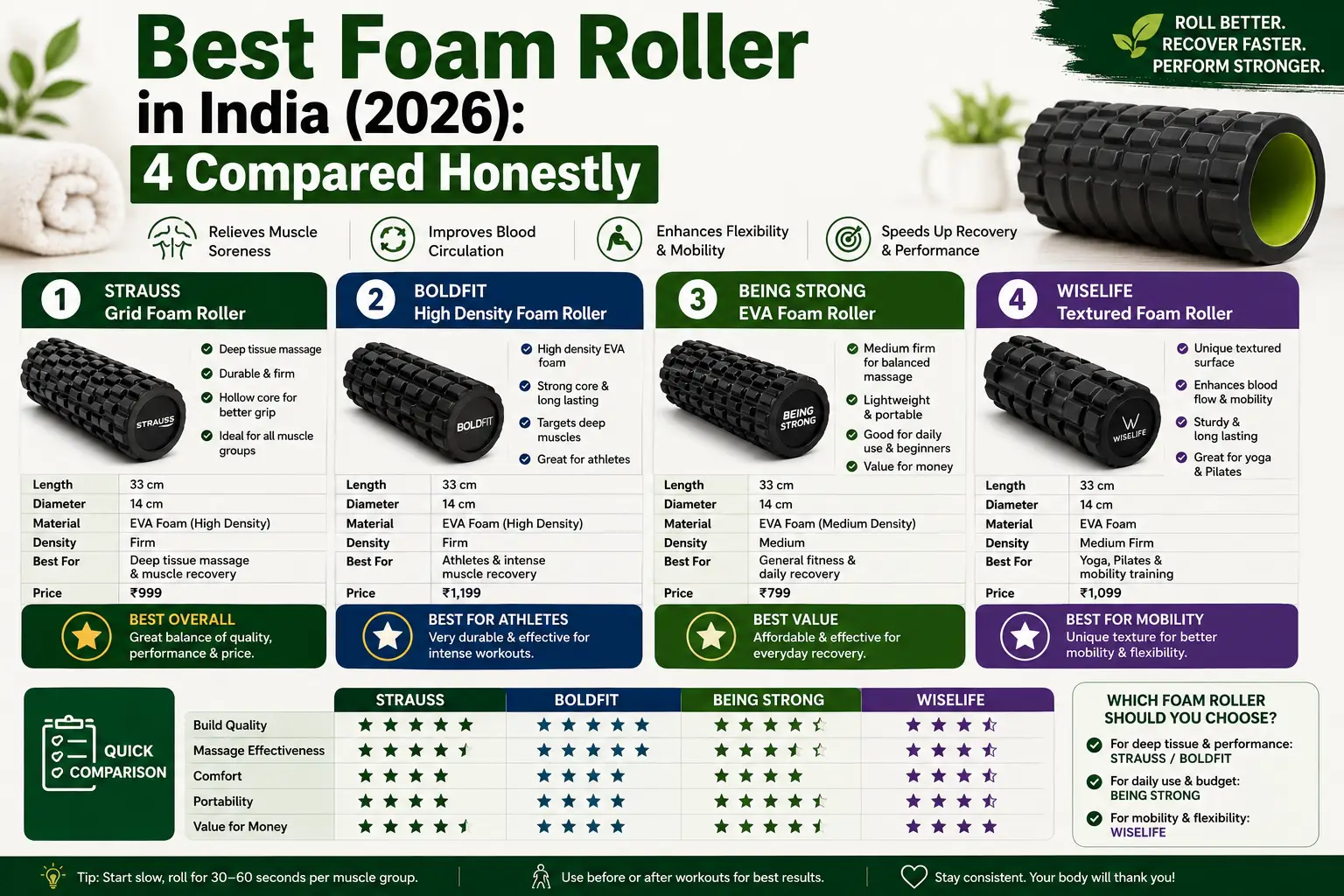
Best Foam Roller in India (2026): 4 Compared Honestly
Boldfit and Strauss foam rollers compared on density, size and rating data — plus what foam rolling actually does for sore muscles, and what it definitely does not.
18 min read
Amazon Great Indian Festival 2026: Home Gym Deals Worth Buying (and What to Skip)
The Great Indian Festival starts on 8 October 2026. The percentage off on a fitness listing is measured against MRP, which is a legal ceiling rather than a real price, so that number tells you very little. What tells you whether a deal is real is the price history and the bank offer. Here is the short list of home gym equipment worth buying in the sale, and how to check each deal before you pay.