Strength Training for Women India: Complete Beginner's Guide to Lift & Get Toned
Most women in India do cardio and avoid weights, fearing they will get bulky. This is the biggest fitness mistake Indian women make. Strength training gives you a leaner, more toned body — and this guide shows you exactly how to start.

Medical Safety Note: This article is for general educational purposes only and is not a substitute for professional medical advice, diagnosis, or treatment. If you are pregnant, managing a condition like diabetes, PCOS, or thyroid disorder, or taking medication, please consult a qualified doctor or registered dietitian before changing your diet, supplements, or exercise routine.
Walk into any gym in India and you will see the same pattern: men in the weights section, women on the treadmills and in the Zumba class. This split is not based on what works — it is based on a myth that has been holding women back from their best results for decades.
The myth: lifting weights will make women look bulky and masculine.
The reality: strength training is the most effective tool for getting the lean, toned, strong body that most women are actually trying to achieve through cardio.
This guide explains why, and gives you a complete plan to start.
📖 Read Also:
Free One-Rep Max CalculatorAs you progress past the beginner phase, use this to estimate your 1RM and structure your lifts around accurate percentages instead of guessing.
Why Women Will NOT Get Bulky From Lifting Weights
This is the first thing to understand, because it is the fear that stops most Indian women from ever picking up a weight.
Testosterone is the primary driver of significant muscle mass increase. Men have testosterone levels of 300–1,000 ng/dL. Women have 15–70 ng/dL — approximately 15–20 times less.
Building large, bulky muscles requires sustained high testosterone levels alongside years of progressive heavy training and often specific nutritional strategies. It does not happen accidentally from a few months of gym workouts.
When women lift weights, they develop:
- Muscle definition and tone — the "toned" look everyone wants
- Reduced body fat percentage
- Firmer, more lifted appearance (arms, glutes, thighs)
- Better posture
- More metabolic activity (muscle burns more calories at rest)
The women you see who look "bulky" from lifting are either professional bodybuilders following extreme protocols, or are using performance-enhancing substances. Neither applies to someone doing 3–4 gym sessions per week.
Why Strength Training is Better Than Cardio for Fat Loss
This is counterintuitive for most people — but well-established in exercise science.
1. Afterburn Effect (EPOC)
After strength training, your body continues burning elevated calories for up to 24–48 hours as it repairs muscle tissue. This is called Excess Post-Exercise Oxygen Consumption (EPOC). Steady-state cardio produces minimal afterburn.
A 45-minute strength training session may burn 200–300 calories during the workout, but an additional 100–200 calories in the 24 hours after. Cardio burns during the session and stops.
2. Muscle Mass Increases Resting Metabolic Rate
Each kilogram of muscle burns approximately 13 additional calories per day at rest. Add 3kg of lean muscle (achievable in 3–6 months of consistent training) and your metabolism burns 40 extra calories per day passively. Small number, but it compounds over time.
3. Cardio Alone Can Reduce Muscle Mass
Excessive cardio without strength training, especially in a calorie deficit, can cause the body to break down muscle for energy — lowering metabolic rate and making fat loss harder over time. Strength training preserves and builds muscle even during fat loss.
4. Body Composition vs Body Weight
Two women can weigh the same but look completely different based on their muscle-to-fat ratio. Cardio reduces weight but not always fat percentage. Strength training reduces fat while building muscle — better composition at the same or similar weight.
Benefits of Strength Training Specifically for Indian Women
Beyond body composition, strength training offers benefits particularly relevant to common health concerns among Indian women:
PCOS: Resistance training improves insulin sensitivity, reduces testosterone levels, and helps manage PCOS symptoms more effectively than cardio alone.
📖 Read Also:
Women's Fitness Guide India 2026: PCOS, Fat Loss & Strength Plan That WorksIf hormonal health is your bigger concern than just toning up, this guide widens the lens — covering PCOS, thyroid, and a full hormone-aware fitness plan for Indian women.
Bone density: India has a high prevalence of osteoporosis and vitamin D deficiency. Strength training is one of the most effective ways to maintain and increase bone density — critical for women over 30.
Hormonal balance: Resistance training helps regulate cortisol (stress hormone), improves oestrogen metabolism, and supports thyroid function.
Posture and back pain: Strengthening the posterior chain (back, glutes, hamstrings) corrects the forward-rounded posture common in desk workers and reduces chronic back pain.
Mental health: Strength training has some of the strongest evidence for reducing depression and anxiety symptoms — comparable to medication in mild-moderate cases.
Understanding Key Concepts Before You Start
Progressive Overload
The most important principle in strength training. Your muscles adapt to a stimulus — once they adapt, growth stops unless the challenge increases. Progressive overload means gradually increasing:
- Weight lifted
- Reps performed
- Sets completed
- Training frequency
You do not need to increase every session. Week-to-week progress is sufficient.
Rep Ranges
- 1–5 reps (very heavy): Maximal strength — not necessary for beginners
- 6–12 reps (moderate weight): Hypertrophy (muscle building and toning) — ideal for most goals
- 12–20 reps (lighter weight): Endurance, toning, beginner-friendly
For women wanting to tone and lose fat: 8–15 reps per set is the sweet spot.
Rest Between Sets
- 60–90 seconds for toning/endurance goals
- 2–3 minutes for strength goals
Compound vs Isolation Exercises
- Compound: Work multiple muscle groups at once (squats, deadlifts, bench press, rows) — most time-efficient
- Isolation: Target one muscle (bicep curls, leg extensions) — supplementary
Beginners should focus primarily on compound movements.
4-Week Beginner Strength Training Plan for Women
Frequency: 3 days per week (e.g., Monday, Wednesday, Friday) Structure: Full body each session Rest between sets: 60–90 seconds Warm-up: 5–10 minutes light cardio + dynamic stretching
Week 1–2 (Foundation — Learn the Movements)
Session A (Monday & Friday)
← Swipe to compare →
| Exercise | Sets | Reps |
|---|---|---|
| Bodyweight Squats | 3 | 12–15 |
| Knee Push-ups | 3 | 10–12 |
| Dumbbell Romanian Deadlift | 3 | 12 |
| Seated Dumbbell Shoulder Press | 3 | 12 |
| Plank | 3 | 20–30 sec |
| Glute Bridges | 3 | 15 |
Session B (Wednesday)
← Swipe to compare →
| Exercise | Sets | Reps |
|---|---|---|
| Reverse Lunges | 3 | 10 each leg |
| Dumbbell Bent-Over Row | 3 | 12 |
| Dumbbell Chest Press (floor or bench) | 3 | 12 |
| Lat Pulldown (cable) or Band Pull-down | 3 | 12 |
| Dead Bug | 3 | 10 |
| Calf Raises | 3 | 15 |
Week 3–4 (Progression — Add Challenge)
Same exercises, but:
- Increase dumbbell weight by 1–2kg
- Try 3–4 sets instead of 3
- Aim for the higher end of the rep range
Or add these progressions:
- Bodyweight Squat → Goblet Squat (holding dumbbell)
- Knee Push-up → Full Push-up
- Glute Bridge → Single-leg Glute Bridge
Key Exercises Explained for Beginners
Goblet Squat
Hold a dumbbell at your chest. Feet shoulder-width apart, toes slightly out. Push your hips back and down, keeping your chest up. Go as deep as comfortable. Drive through your heels to stand. Works: Quads, glutes, core.
Romanian Deadlift (RDL)
Hold dumbbells in front of your thighs. Hinge at the hips (push them back), lowering the dumbbells down your legs, keeping your back flat. Feel the stretch in your hamstrings. Drive hips forward to return to standing. Works: Hamstrings, glutes, lower back.
Bent-Over Row
Hinge at the hips (back flat, slight bend in knees). Hold dumbbells hanging down. Pull them to your hips, squeezing your shoulder blades together. Lower slowly. Works: Upper and mid back, biceps.
Hip Thrust / Glute Bridge
Lie on your back, feet flat on the floor hip-width apart. Drive through your heels, pushing your hips up until your body forms a straight line from shoulders to knees. Squeeze your glutes hard at the top. Works: Glutes, hamstrings.
Nutrition to Support Strength Training
Training without adequate nutrition is like building a house without cement. The workout breaks down muscle tissue; nutrition is what rebuilds it stronger.
Protein — most critical: Aim for 1.6–2g of protein per kg of body weight daily.
For a 60kg woman: 96–120g protein per day.
Good Indian protein sources:
- Paneer (100g = 18g protein)
- Eggs (1 large = 6g protein)
- Dal (100g cooked = 9g protein)
- Curd / Greek yogurt (200ml = 7–12g protein)
- Soya chunks (100g cooked = 20g protein)
- Chicken / fish (100g = 25–30g protein)
Carbohydrates — do not fear them: Carbohydrates are muscle fuel. Eating too few while training hard leads to poor performance, fatigue, and muscle breakdown. Eat sufficient carbs — from whole sources like millets, brown rice, oats, sweet potato.
What about creatine? Beyond protein, creatine is one of the few supplements with strong evidence for strength gains and faster recovery between sessions. If you're wondering whether it's safe and won't make you bulky, see our dedicated breakdown in creatine for women.
Calorie surplus vs deficit:
- If your goal is muscle building: eat at maintenance or slight surplus
- If your goal is fat loss + toning: eat at a moderate deficit (200–300 kcal below maintenance) with high protein
Common Mistakes Women Make in Strength Training
1. Using Weights That Are Too Light
Picking up 1–2kg dumbbells and doing 30 reps does not build muscle or tone. The weight should feel challenging by the last 2–3 reps of each set. If you can do 15 reps and feel like you could do 10 more, the weight is too light.
2. Not Eating Enough Protein
Training without protein is the most common nutrition mistake. Without adequate protein, your body cannot repair and build muscle. The "toned" look does not come from training alone — it comes from building muscle + having a low enough body fat to see it.
3. Skipping Compound Movements for Isolation
Many women spend 30 minutes on bicep curls and leg extensions. While isolation exercises have their place, compound movements (squats, deadlifts, rows, presses) give you more results in less time.
4. Never Increasing the Weight
Doing the same workout with the same weight every week for months. Your muscles adapt after 2–3 weeks. If the weight never increases, the stimulus never increases, and growth stops.
5. Inconsistency — Training Hard Then Stopping for 2 Weeks
Consistency over time beats intensity on any single day. Three sessions per week, every week for 6 months, will transform your body. Three sessions per week for two weeks, then a long break, accomplishes very little.
What to Expect (Realistic Timeline)
← Swipe to compare →
| Timeframe | What Changes |
|---|---|
| Week 1–2 | Soreness, learning movements, no visible change |
| Week 3–4 | Strength starts increasing, muscles feel firmer |
| Month 2 | Noticeable muscle definition begins, clothes fit differently |
| Month 3 | Visible toning in arms, legs, core |
| Month 4–6 | Significant body composition change, posture improves |
The first 4 weeks feel slow. The changes compound from month 2 onwards. Do not quit before the results start showing.
Home vs Gym for Strength Training
Gym advantages: Heavier weights available, cables and machines, structured environment Home advantages: No commute, privacy, convenience
You can start strength training at home with a pair of adjustable dumbbells (2–15kg range) and a good resistance band set. This covers virtually all beginner and intermediate exercises.
If you have access to a gym, use it — the additional equipment makes progressive overload much easier as you advance.
📖 Read Also:
Best Home Gym Under ₹5000 in India (2026): Complete Beginner Equipment GuideWant to build a proper home setup instead of relying on a gym membership? This guide breaks down exactly what to buy under ₹5000 to cover your strength training needs.
📖 Read Also:
Best Kettlebells for Home Gym in India (2026): Which Weight to BuyThe standard starting weight for women is 8 kg moving to 12 kg — heavier than most Indian shops steer you towards, and the reason so many kettlebells go unused.
Final Word
Strength training is not just for men, not just for athletes, and not just for those who want to "get big." It is the most effective tool for achieving the lean, toned, strong body that most Indian women are actually trying to build.
Three sessions per week, progressive overload, adequate protein, and consistency over 3–6 months. That is the entire formula.
Start this week. The version of yourself you have been trying to build through cardio alone is waiting on the other side of the weights section.
Frequently Asked Questions
Will strength training make Indian women look bulky?
No — women have 10–20 times less testosterone than men, making it physiologically very difficult to build large, bulky muscles naturally. Strength training makes women leaner, more toned, and stronger. The "toned" look that most women want is actually a combination of low body fat and developed muscle — both achieved through strength training.
How many days per week should women do strength training?
2–3 days per week is ideal for beginner women. Each session should cover all major muscle groups (legs, back, chest, shoulders, core). After 3–4 months of consistent training, you can progress to a 4-day split. More is not always better — rest days are when muscles grow and repair.
What weights should women start with for strength training?
Start with a weight that you can lift for 12–15 reps with good form but where the last 2–3 reps feel challenging. This is typically 3–7 kg for upper body exercises and 10–20 kg for lower body exercises. Beginners often underestimate themselves — the weight should feel challenging, not easy.
What should women eat when doing strength training?
Increase protein to 1.6–2g per kg body weight — essential for muscle repair and growth. Good Indian sources: eggs, chicken, paneer, curd, and dal. Do not fear carbohydrates — they provide energy for lifting. Eat 2–3 hours before training and a protein-rich meal within 1–2 hours after.
Can women do strength training at home without a gym?
Absolutely — bodyweight strength training (push-ups, squats, lunges, glute bridges, dips) is highly effective for women, especially in the first 6–12 months. Adding resistance bands (INR 300–600) significantly increases the exercise variety and challenge for home-based strength training — our 15 resistance band exercises for home covers the full-body routine, and 13 of the 15 need no door anchor or bench.
Related Reading
- Female Fitness Beginner Guide — complete workout and diet routine for women
- Calorie Deficit Explained — pair strength training with the right calorie intake for fat loss
- Top 20 Protein-Rich Vegetarian Foods in India — how to hit your protein targets on a vegetarian diet
- HIIT Workout for Beginners at Home — add HIIT on rest days to accelerate fat loss
- Whey Protein Guide for Beginners India — whether women need protein supplements
Free Tools to Help You
Put this article into action — use our free calculators to get your personalized numbers.
Was this article helpful?
Want More Tips Like This?
Join 1,000+ readers getting weekly fitness, diet, and wellness tips + FREE meal plan
No spam, ever. Unsubscribe anytime.

About the Author: Ashwani
Fitness influencer and wellness writer helping Indians build healthier lifestyles.
Read more about us →Comments
Leave a Comment
Your email will not be published. Comments are reviewed before appearing.
You Might Also Like
Continue your wellness journey

24 min read
Home Workout Plan for Indians 2026: No Gym, Real Results (Beginner to Advanced)
No gym? No problem. A complete home workout guide for Indians — fat loss, muscle building, HIIT, yoga, PCOS-friendly routines, and equipment under ₹5,000. Beginner to advanced, proven progressions.
27 min read
Best Kettlebells for Home Gym in India (2026): Which Weight to Buy
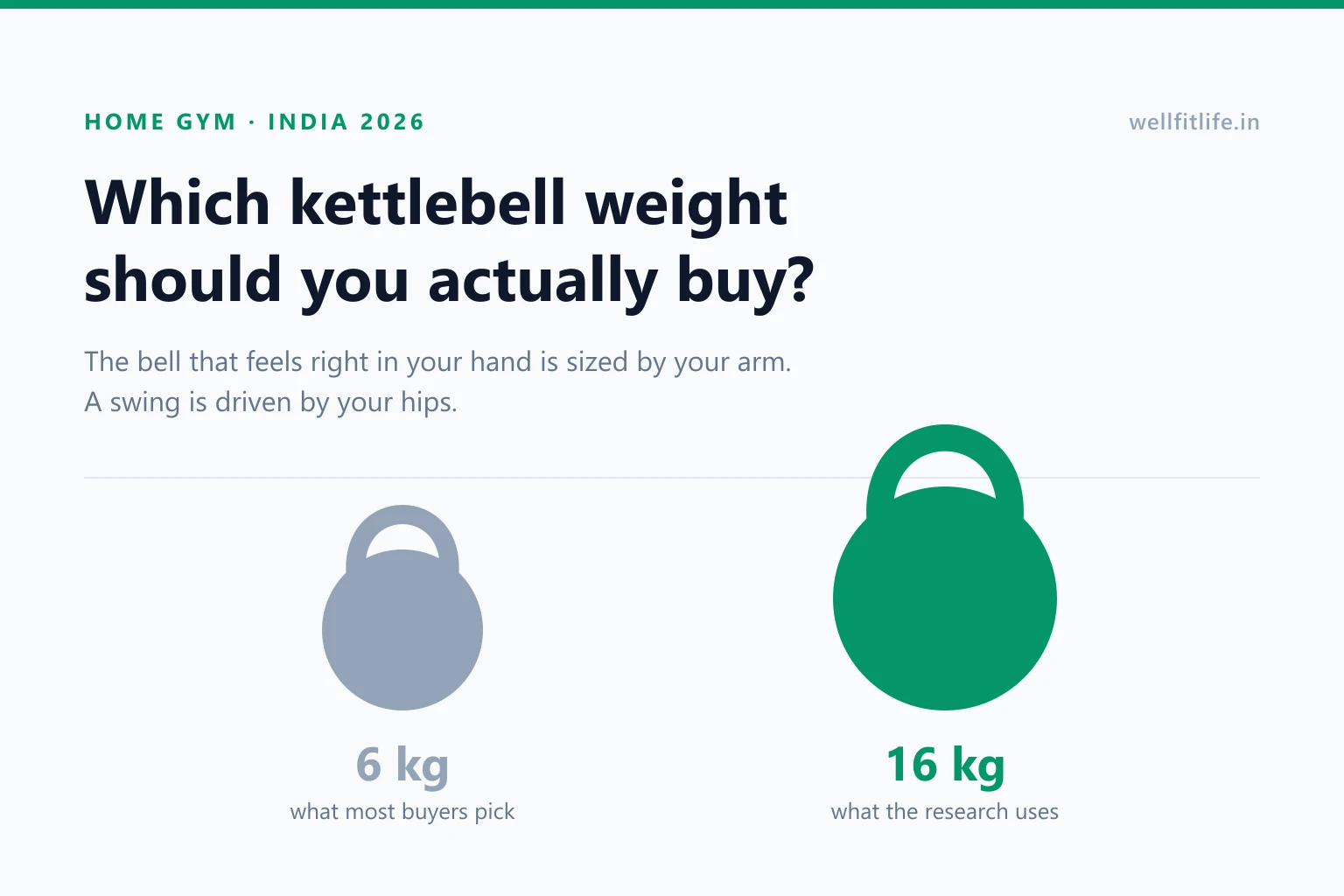
Almost every kettlebell sold in India is lighter than the ones the research is done with. The weight that feels right when you pick it up is roughly half the weight your hips need — and that single mistake is why most kettlebells end up under a bed.

18 min read
Amazon Great Indian Festival 2026: Home Gym Deals Worth Buying (and What to Skip)
The Great Indian Festival starts on 8 October 2026. The percentage off on a fitness listing is measured against MRP, which is a legal ceiling rather than a real price, so that number tells you very little. What tells you whether a deal is real is the price history and the bank offer. Here is the short list of home gym equipment worth buying in the sale, and how to check each deal before you pay.