Best Whey Protein for Beginners in India (2026 Guide)
Starting whey protein in India and don't know where to begin? This complete guide covers exact dosage, best timing, honest reviews of ON Gold Standard, MuscleBlaze Biozyme and AS-IT-IS ATOM, side effects myths busted, and which whey is actually worth buying in 2026.

Medical Safety Note: This article is for general educational purposes only and is not a substitute for professional medical advice, diagnosis, or treatment. If you are pregnant, managing a condition like diabetes, PCOS, or thyroid disorder, or taking medication, please consult a qualified doctor or registered dietitian before changing your diet, supplements, or exercise routine.
Affiliate Disclosure: This post contains affiliate links. If you buy through them, we may earn a small commission at no extra cost to you — this never affects our recommendations. We only suggest products we believe in. Read our full affiliate disclosure.
Quick Answer
For most Indian beginners the answer is MuscleBlaze Biozyme, not the imported name everyone recommends. It gives comparable protein to ON Gold Standard at roughly half the price per kg, and because it is made and sold in India it carries a fraction of the counterfeit risk — which matters most to exactly the people least able to spot a fake tub. Buy ON instead only if taste and mixability are what will keep you drinking it, and only from an authorised seller with the code verified.
MuscleBlaze Biozyme Performance Whey — Chocolate Hazelnut
India's best-selling whey with the DigeZyme absorption blend, FSSAI certified and scratch-code verified. Usually well below ON's price per kilogram, at comparable protein per scoop. Made and sold in India, so the counterfeit problem that follows imported whey here barely touches it.
How much, when, and the full brand breakdown below.
Walk into any gym in India and half the members are carrying a shaker bottle. Ask what is inside and the answer is almost always whey protein.
It is the most purchased fitness supplement in the country — and also the most misunderstood.
I have been using and researching whey protein for years. In this guide, I am going to give you everything you need to know as a beginner: what whey actually is, how much to take, when to take it, which brands are genuinely worth your money in India, and which fears about it are completely exaggerated.
No supplements store bias. No brand sponsorship. Just what actually works.
The Short Version
Everything in this guide, compressed:
- What to buy: Whey protein concentrate — it is the cheapest type, tastes better, and builds muscle just as well as isolate for most beginners.
- How much: 1 scoop (24–26g protein) per day. A second scoop only if your total daily protein is still below 1.6g per kg of body weight.
- When: After your workout on training days; with breakfast on rest days. Total daily protein matters far more than exact timing.
- How: Mix 1 scoop with 200–250ml water or milk in a shaker for 20–30 seconds.
- Which brand: MuscleBlaze Biozyme for most beginners — comparable protein to ON at roughly half the price per kg, and far lower counterfeit risk. Optimum Nutrition Gold Standard if taste and mixability are what will keep you consistent, bought only from an authorised seller. AS-IT-IS ATOM if you want the cleanest label. All three are FSSAI certified and reviewed in detail below.
Everything below explains the why behind each of these answers.
What Is Whey Protein? (Simple Explanation)
Whey is a natural byproduct of cheese manufacturing. When milk is processed to make cheese, it separates into two parts: solid curds (which become cheese) and liquid whey. This liquid is then filtered, processed, and dried into the powder you see in supplement stores.
It is derived from cow's milk, which means:
- ✅ Suitable for lacto-vegetarians
- ❌ Not suitable for vegans
- ✅ One of the highest quality proteins available anywhere
Whey is a complete protein — it contains all 9 essential amino acids your body cannot make on its own. It is especially rich in leucine, which is the specific amino acid that triggers muscle protein synthesis (the process of actually building new muscle).
The simplest way to think about it: Whey protein is just concentrated milk protein in powder form. Nothing exotic. Nothing dangerous. Just a very convenient way to get high-quality protein.
Types of Whey Protein — Which One Should You Buy?
1. Whey Protein Concentrate (WPC) — Best for Beginners
- Protein content: 70–80% per serving
- Contains small amounts of fat and lactose
- Most affordable option in India
- Better taste due to fat content
- Best for: Most beginners, budget-conscious buyers, people without lactose sensitivity
2. Whey Protein Isolate (WPI) — Best for Lactose Sensitivity
- Protein content: 90%+ per serving
- Fat and lactose almost completely removed
- More expensive than concentrate
- Good for people who bloat with regular dairy
- Best for: Lactose-sensitive individuals, people in a strict calorie cut
3. Whey Protein Hydrolysate (WPH) — Skip This as a Beginner
- Pre-digested, fastest absorption
- Most expensive type
- Often bitter taste
- Best for: Post-surgery recovery, advanced athletes — unnecessary for beginners
Beginner recommendation: Start with Whey Concentrate. It is cheaper, tastes better, and works just as well for muscle building as isolate for most people. Switch to isolate only if you experience regular bloating or digestive issues.
Do You Actually Need Whey Protein? Honest Answer
This is the most important question — and the honest answer is: probably not as a necessity, but it helps a lot.
Whey protein is a supplement, not a magic muscle builder. It supplements your diet when you cannot get enough protein from whole food alone.
And it supplements training, not the other way round. Protein is the raw material; progressive resistance is the signal that tells your body to use it. If you are buying whey before you have anything to train against at home, you have bought the second half of the equation first.
📖 Read Also:
Home Gym Under ₹5,000 in India: The Complete Beginner SetupWhat actually earns its place in a small Indian flat — and what to skip. The training half of the muscle-gain equation.
Your daily protein requirement for muscle building is approximately 1.6–2.2g per kg of body weight.
For a 70kg person, that means 112–154g of protein every single day.
How much protein common Indian foods actually provide:
← Swipe to compare →
| Food | Protein per serving |
|---|---|
| 100g chicken breast | 31g |
| 100g paneer | 18g |
| 3 whole eggs | 18g |
| 200ml full-fat curd | 7g |
| 100g dal (cooked) | 9g |
| 100g soya chunks (dry) | 52g |
| 1 scoop whey protein (30g) | 22–26g |
If you are vegetarian and eating dal, curd, and paneer daily — hitting 120–150g of protein from food alone is genuinely difficult without eating enormous quantities.
You need whey protein if:
- You are vegetarian and consistently falling short of protein targets
- Your schedule does not allow protein-dense meals during the day
- You are actively building muscle or preserving muscle during fat loss
You do not need it if:
- You already hit your protein target from food comfortably
- You are not strength training and just doing light activity
- Budget is tight (whole food protein is always more cost-effective)
How Much Whey Protein to Take Per Day
Standard dose: 1–2 scoops per day (25–50g of whey protein)
Most standard scoops are 30–33g of powder and deliver 22–26g of actual protein.
← Swipe to compare →
| Your Goal | Recommended Daily Intake |
|---|---|
| General fitness / light gym | 1 scoop (25g protein) |
| Muscle building | 1–2 scoops (25–50g protein) |
| Fat loss while keeping muscle | 1–2 scoops |
| Intense training / high volume | 2 scoops maximum |
Important: Whey should fill the gap in your diet — not replace whole food protein. Aim to get at least 60–70% of your daily protein from food like eggs, paneer, dal, chicken, or curd. Use whey to bridge what is missing.
More than 2 scoops per day is unnecessary for most people and just wastes money. Your body can only use so much protein at once — the rest is oxidised for energy, not magically converted into extra muscle.
If you are looking to build a beginner supplement stack beyond just whey, creatine is usually the next logical addition — read our creatine guide for beginners in India to understand dosage and safety before adding it.
📖 Read Also:
Whey Protein vs Creatine: Which Should You Buy First? (India 2026)Limited budget and can only buy one right now? A clear decision framework plus real cost breakdowns for Indian beginners.
When to Take Whey Protein — Best Timing
The "anabolic window" myth — the idea that you must drink protein within 30 minutes of training or your gains disappear — is largely exaggerated. Research shows that total daily protein intake matters far more than exact timing.
That said, here is what actually makes practical sense:
← Swipe to compare →
| Timing | When It Helps |
|---|---|
| Post-workout | Convenient, supports muscle repair when you are already in gym mode |
| Morning | If your breakfast is low in protein (common in Indian households) |
| Between meals | Helps hit daily target without forcing yourself to eat large meals |
| Before bed | Casein protein is better here, but whey works fine too |
My recommendation for beginners: One scoop after your workout. On rest days, have it in the morning with breakfast. Keep it simple — consistency beats perfect timing every time.
Best Whey Protein for Beginners in India 2026
These are the brands I actually recommend based on quality, third-party testing, availability, and value for Indian buyers:
Best Taste — Optimum Nutrition Gold Standard Whey
ON Gold Standard has been the world's most trusted whey protein for over 25 years — and for good reason. It is a premium whey blend of isolate, concentrate, and peptides that delivers fast absorption and a complete amino acid profile. The Double Rich Chocolate flavour is the most popular choice in India, and the mixability is genuinely best-in-class. Every batch is third-party lab tested for purity and label accuracy.
Buy this one carefully. ON is the most counterfeited supplement in India — because it is imported and premium-priced, refilled and under-dosed tubs turn up on unverified marketplaces, gym counters and grey-market sellers. Buy only from an authorised seller, check the tamper seal, and verify the authenticity code on the official site before your first scoop. A price that looks too good is the most reliable sign of a fake. This is the main reason a first-time buyer is usually better served by an India-made whey.
Optimum Nutrition Gold Standard Whey Protein — Double Rich Chocolate
World's #1 whey protein for 25+ years. Blend of isolate, concentrate and peptides — 24g protein per scoop, third-party lab tested. The best-tasting and best-mixing option on this page, and worth the premium if flavour is what keeps you consistent — provided you buy from an authorised seller and verify the authenticity code.
Top Pick — MuscleBlaze Biozyme Performance Whey
MuscleBlaze is India's #1 selling supplement brand — and there are solid reasons for that. The Biozyme formula includes a DigeZyme enzyme blend that improves protein absorption compared to standard whey. The Chocolate Hazelnut flavour is genuinely good. It is FSSAI certified, has scratch-code authenticity verification, and delivers consistent quality across batches.
MuscleBlaze Biozyme Performance Whey — Chocolate Hazelnut
India's best-selling whey protein with enhanced DigeZyme absorption formula. FSSAI certified, scratch-code verified authenticity. Rich Chocolate Hazelnut flavour — best Indian brand for beginners who want great taste and proven quality.
Clean Label Pick — AS-IT-IS ATOM Whey Protein
AS-IT-IS stands out for one clear reason — zero unnecessary ingredients. No added sugar, no artificial colours, no fillers. Just clean whey protein. It is FSSAI certified with lab reports publicly available on their website. The Double Rich Chocolate flavour tastes decent, and the protein-per-rupee value is excellent compared to most competitors.
AS-IT-IS ATOM Whey Protein — Double Rich Chocolate
Cleanest whey protein in India — no added sugar, no artificial colours, zero fillers. FSSAI certified with public lab reports. Best clean-label pick for ingredient-conscious buyers who want pure whey without compromise.
📖 Read Also:
ON Gold Standard vs MuscleBlaze Biozyme Whey — Which is Better for Indians?Stuck between the two biggest names? We compared ON and MuscleBlaze head-to-head on protein per rupee, absorption tech, lab reports, and taste — with a clear verdict for Indian buyers.
📖 Read Also:
Best Peanut Butter in India (2026): Protein-Per-Rupee ComparedWhey isn't the only cheap protein source worth optimizing for value — see which peanut butter brand actually gives you the most protein per rupee.
How to Make a Whey Protein Shake
The basics:
- Add 1 scoop (30g) whey protein to your shaker bottle
- Add 200–250ml water or milk
- Close the lid and shake for 20–30 seconds
- Drink within 30 minutes of making it
With water: Lower calories, faster absorption, slightly thinner taste With milk: More protein overall, creamier texture, slightly slower absorption
Indian combinations that work well:
- Whey + banana + 200ml milk (smoothie) — good pre-workout meal
- Whey + oats + 250ml milk (shake) — filling breakfast on training days
- Whey + curd + fruits (bowl) — high-protein snack, no blending needed
How to Spot Fake Whey Protein in India
The Indian supplement market has a significant counterfeit problem. Here is how to protect yourself:
- Buy from Amazon India (Fulfilled by Amazon) or brand official websites only
- Check the QR/scratch code on the packaging — all legitimate brands have verification systems
- Price check: If a 1kg ON Gold Standard is selling for ₹1,500 when the market rate is ₹4,000+, it is almost certainly fake
- Avoid unknown sellers on marketplaces with few reviews or recently created accounts
- Check FSSAI registration — legitimate Indian brands are registered
Never buy supplements from local gym stores or unknown WhatsApp sellers, even if the price seems attractive. Counterfeit whey is a genuine health risk — not just a waste of money.
Side Effects of Whey Protein — What Is Actually True
Kidney Damage — FALSE for Healthy People
The most common fear in India. This myth originated from studies on people with pre-existing kidney disease. In people with healthy kidneys, high protein intake (including whey protein) does not cause kidney damage. Multiple large-scale studies confirm this clearly.
Exception: If you have a diagnosed kidney condition, consult your doctor before taking any protein supplement.
Acne — SOMETIMES TRUE
Some people, particularly those with dairy sensitivity or hormonal acne, may notice breakouts after starting whey. This is real but not universal. If you experience this, try switching to whey isolate (lower lactose) or a plant-based protein.
Bloating and Gas — COMMON WITH CONCENTRATE
If you are lactose intolerant, whey concentrate can cause bloating. Fix: switch to whey isolate, which has almost no lactose. Adding digestive enzymes also helps.
Hair Loss — FALSE
Not caused by standard whey protein at normal doses. This rumour often gets confused with high-dose creatine use or steroid use. Whey alone, at 1–2 scoops per day, does not cause hair loss.
Liver Damage — FALSE
Same origin as the kidney myth. For healthy individuals, normal whey protein use has no negative impact on liver function.
Whey Protein vs Plant Protein — Which Is Better for Indians?
← Swipe to compare →
| Factor | Whey Protein | Plant Protein (Soy/Pea/Rice) |
|---|---|---|
| Protein quality (PDCAAS score) | 1.0 (highest possible) | 0.8–1.0 |
| Leucine content | Very high | Moderate |
| Digestion speed | Fast | Moderate to slow |
| Lactose | Yes (less in isolate) | None |
| Taste | Generally better | Variable, often chalky |
| Cost in India (per kg) | ₹700–2000 | ₹1500–3500 |
| Suitable for vegans | No | Yes |
For vegetarians: Whey is the best protein supplement available — better quality, cheaper, and more palatable than plant alternatives. For vegans, a pea + rice protein blend is the closest option.
📖 Read Also:
Best Vegan Protein Powder in India — 5 ComparedIf you are vegan or whey gives you bloating, this covers the pea, soy and blended options sold in India — and the cost-per-serving trap that catches most first-time buyers.
Whey covers muscle repair, but it does not do much for joint and skin health, which take a beating from heavy training over time. If recovery and skin/joint support matter to you, it is worth reading about collagen supplements in India as a complementary addition to your stack.
How to Take Whey Protein for Beginners — Step-by-Step
Starting whey protein for the first time? Follow this exact sequence:
Day 1: Take half a scoop (about 15g powder) mixed in 200ml water, after your workout or with breakfast. This tests how your stomach responds before you commit to a full dose.
Week 1–2: Continue with half a scoop daily. Some people experience mild bloating in the first week as their gut adjusts — this is normal with whey concentrate and usually settles on its own. If bloating persists beyond two weeks, switch to whey isolate.
Month 1: 1 scoop post-workout on training days. On rest days, have it in the morning with breakfast if your meals are low in protein.
Month 2 onwards: Assess whether you are hitting 1.6g protein per kg of body weight daily. If yes, maintain. If not, add a second scoop at a different time of day.
Track your intake: Use HealthifyMe (best Indian food database) or Cronometer for the first 2–4 weeks. Most people are surprised by how far below their protein target they actually are.
📖 Read Also:
Best Whey Protein in India 2026: Top Brands RankedThe full brand showdown — AS-IT-IS ATOM vs ON Gold Standard vs MuscleBlaze Biozyme, ranked on protein per scoop and price per serving.
Frequently Asked Questions
Is whey protein safe for beginners in India?
Yes, whey protein is safe for healthy adults including beginners. It is simply a concentrated form of milk protein. Start with 1 scoop per day to assess tolerance, especially if you are lactose sensitive. If you have any pre-existing kidney or liver condition, consult your doctor first.
Which is the best whey protein for beginners in India in 2026?
Three options stand out depending on your priority. Optimum Nutrition Gold Standard (₹2,039) is the best overall for quality and taste. MuscleBlaze Biozyme Performance Whey (₹3,399) is the best Indian brand with proven track record and DigeZyme absorption formula. AS-IT-IS ATOM Whey (₹2,848) is the cleanest label option with no added sugar or artificial colours. All three are FSSAI certified and available on Amazon India with authenticity verification.
How many scoops of whey protein should a beginner take per day?
Start with 1 scoop (25–30g of protein) per day. This is sufficient for most beginners. Taking 2 scoops is only necessary if your total daily protein from food + supplement is still below 1.6g per kg of body weight.
Can I take whey protein without going to the gym?
Yes, but it makes less sense. Whey protein helps rebuild muscle damaged during exercise. Without training, your body has less reason to build new muscle — so the extra protein from whey will mostly just be used for energy. It is not harmful, just less effective and an unnecessary expense.
What is the difference between whey protein and mass gainer?
Whey protein is primarily protein (80–90% of calories from protein). Mass gainer has a lot of added carbohydrates and calories — it is designed for people who genuinely struggle to eat enough calories. Most Indian beginners do not need a mass gainer and gain unnecessary fat from using one. Stick to whey protein.
Is whey protein vegetarian?
Yes. Whey protein is derived from milk (a byproduct of cheese manufacturing) and is suitable for lacto-vegetarians. It is not suitable for vegans. Vegans can use plant-based protein powders made from pea, rice, or soy protein instead.
Can I take whey protein on rest days?
Yes — your muscles recover and grow on rest days, not just on training days. Having 1 scoop of whey on rest days (especially in the morning if your breakfast is low in protein) is perfectly useful.
How should a complete beginner start taking whey protein?
Start with half a scoop (15g) mixed in 200ml water once a day for the first two weeks to test your tolerance. Then move to 1 full scoop after workouts. Do not start with 2 scoops on day one — give your digestion time to adjust, especially if you rarely consume concentrated dairy protein.
Should beginners take whey protein with milk or water?
Water is the safer starting point — fewer calories, faster digestion, and no double-dairy load on your stomach. Milk adds roughly 6–8g extra protein and a creamier taste, which suits skinny beginners trying to gain weight. If fat loss is your goal, stick with water.
📖 Read Also:
Paneer vs Chicken: Which Is Better for Muscle Building?If you are vegetarian and relying on paneer for protein, read this comparison before buying expensive supplements.
📖 Read Also:
Complete Muscle Gain Diet Plan for Indian MenFull nutrition strategy — what to eat, how much, and how whey protein fits into your daily meal plan.
📖 Read Also:
Protein Guide India: How Much You Actually NeedNot sure you even need powder? The complete protein guide works out your daily target first, then shows whether food alone can get you there.
References
The guidance in this article is based on the following peer-reviewed research and public health guidance. Always discuss changes to your diet, supplements, or medication with a qualified doctor or registered dietitian.
- International Society of Sports Nutrition. Position Stand: Protein and Exercise. JISSN (2017)
- Morton RW, et al. A systematic review, meta-analysis and meta-regression of the effect of protein supplementation on resistance training-induced gains in muscle mass and strength. Br J Sports Med (2018)
- Leidy HJ, et al. The role of protein in weight loss and maintenance. Am J Clin Nutr (2015)
- National Institute of Nutrition (ICMR), Hyderabad — Dietary Guidelines for Indians
Free Tools to Help You
Put this article into action — use our free calculators to get your personalized numbers.
Was this article helpful?
Want More Tips Like This?
Join 1,000+ readers getting weekly fitness, diet, and wellness tips + FREE meal plan
No spam, ever. Unsubscribe anytime.

About the Author: Ashwani
Fitness enthusiast and wellness writer. I research and write about supplements, workouts, and Indian diet strategies, and share my own experience where I have it — so you can make informed decisions without wasting money.
Read more about us →Comments
Leave a Comment
Your email will not be published. Comments are reviewed before appearing.
You Might Also Like
Continue your wellness journey
25 min read
Best 1000mg Omega-3 Fish Oil in India (2026): EPA+DHA Compared
A capsule labelled 1000mg fish oil can contain as little as 300mg of actual omega-3. Here is what the EPA+DHA numbers really say, what a gram of it costs across the strength tiers, and the dose-response finding that argues against the biggest bottle.
19 min read
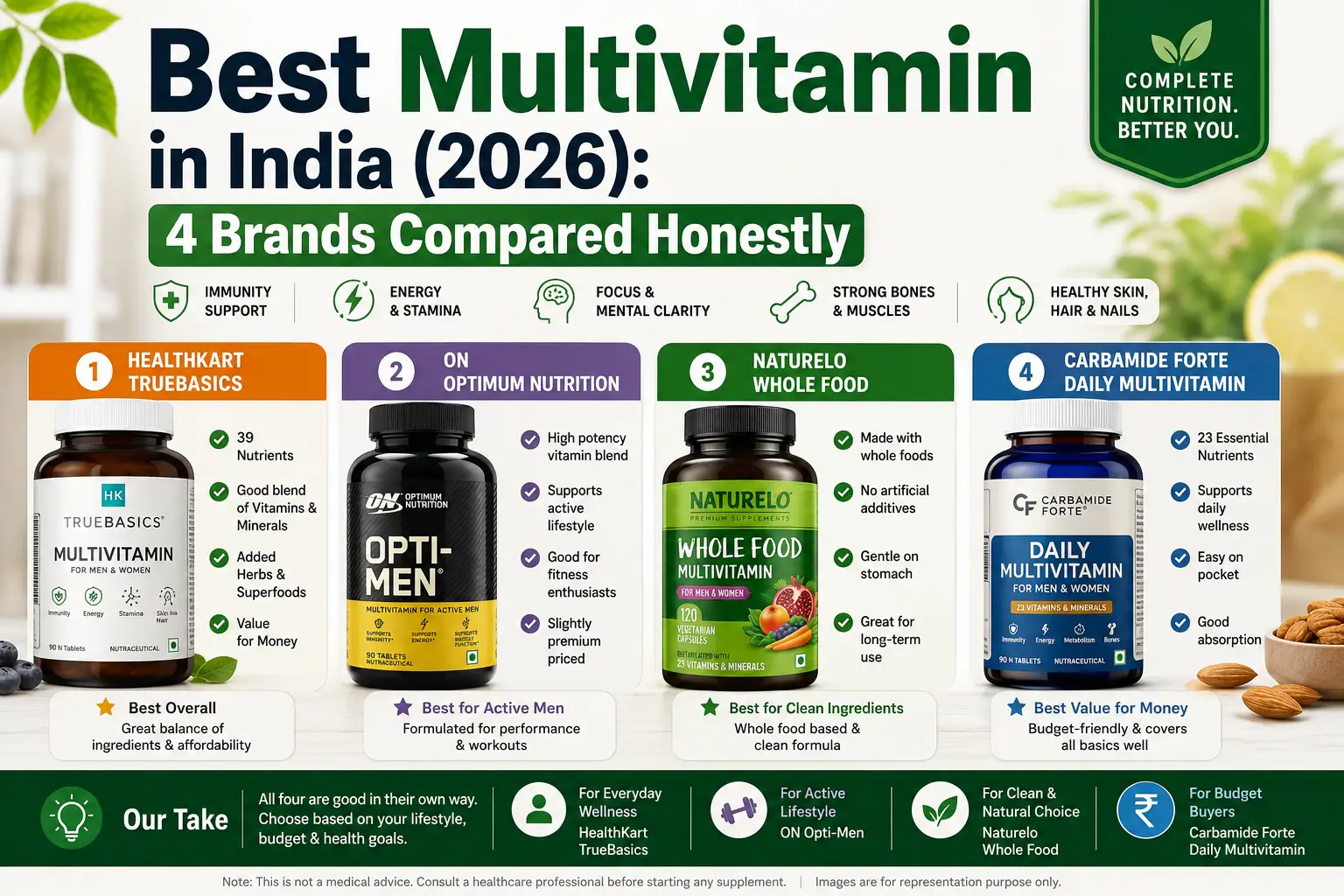
Best Multivitamin in India (2026): 4 Brands Compared Honestly
Centrum, Revital, HK Vitals and MuscleBlaze MB-Vite compared on what is actually in them — plus the honest answer to whether you need a multivitamin at all.
24 min read
Best Protein Bars in India 2026: RiteBite vs Yogabar vs MuscleBlaze
All three flagship bars deliver exactly 20g of protein, so the protein number tells you nothing. What separates them is saturated fat, fibre, polyol load — and a cost per gram of protein roughly three times what whey costs.