Creatine for Beginners India: What It Is, How to Take It & Is It Safe?
Creatine is the most researched supplement in sports science — and one of the most misunderstood in India. It is not a steroid. It is not harmful to kidneys. This complete guide explains what creatine does, how to use it, and whether it is right for you.

Medical Safety Note: This article is for general educational purposes only and is not a substitute for professional medical advice, diagnosis, or treatment. If you are pregnant, managing a condition like diabetes, PCOS, or thyroid disorder, or taking medication, please consult a qualified doctor or registered dietitian before changing your diet, supplements, or exercise routine.
Affiliate Disclosure: This post contains affiliate links. If you buy through them, we may earn a small commission at no extra cost to you — this never affects our recommendations. We only suggest products we believe in. Read our full affiliate disclosure.
No supplement in the history of sports science has been studied as extensively as creatine. Over 500 peer-reviewed studies spanning 30+ years¹ consistently show that it works, that it is safe, and that it is one of the very few supplements with genuine evidence behind it.
Yet in India, creatine is still surrounded by myths — that it is a steroid, that it damages kidneys, that it is only for bodybuilders, that it causes hair loss. None of these are true.
This guide cuts through the noise and gives you everything you actually need to know.
Quick Answer: Creatine for Beginners
The short version, if you want to start today:
- What to buy: Plain creatine monohydrate — the cheapest and most researched form. Skip HCl, buffered, and "advanced" versions; they have no proven advantage.
- How much: 3–5g daily (about 1 teaspoon). No loading phase needed.
- When: Any time of day — consistency matters, timing does not. Take it every day, including rest days.
- How: Mix in 200–300ml water, juice, or your protein shake.
- Is it safe: Yes, for healthy adults — 500+ studies over 30 years confirm it. It is not a steroid and does not damage healthy kidneys.
- Cost: ₹500–1,500 for a 2–3 month supply — one of the cheapest, best-value supplements in all of sports nutrition.
- Vegetarians: Benefit even more than meat-eaters, since vegetarian diets naturally contain almost no dietary creatine.
- Results: Noticeable strength and rep improvements within 3–4 weeks.
The rest of this guide explains each point in detail.
What Is Creatine?
Creatine is a naturally occurring compound made in your body — primarily in your liver and kidneys — from the amino acids arginine, glycine, and methionine. About 95% of the creatine in your body is stored in your muscles.
You also get small amounts of creatine from food:
- Red meat: ~5g per kg
- Fish (salmon, tuna): ~4–4.5g per kg
- Chicken: ~3.4g per kg
- Dairy: small amounts
Vegetarians and vegans have significantly lower creatine stores than meat eaters — which is one reason creatine supplementation tends to show more dramatic results in vegetarians.
How Does Creatine Work?
Your muscles use a molecule called ATP (adenosine triphosphate) as their immediate energy source. ATP is the fuel for every muscular contraction.
The problem: your body can only store a small amount of ATP. During intense exercise (lifting, sprinting, HIIT), you deplete ATP stores within 8–10 seconds.
Creatine replenishes ATP faster.
When you supplement with creatine, your muscles store more phosphocreatine — the compound that rapidly regenerates ATP. More phosphocreatine = more ATP available = you can lift heavier, push harder, and do more reps before fatigue sets in.
This is why creatine's effects are most noticeable in:
- Weight training (extra reps, heavier weights)
- Sprinting and HIIT
- Any activity requiring short, intense bursts of energy
What Does Creatine Actually Do (and Not Do)?
What It Does
- Increases strength and power output (well-established)
- Increases muscle endurance (more reps at same weight)
- Improves muscle recovery between sets and sessions
- Increases lean body mass (some of which is water in muscle cells — a good thing)
- Improves cognitive function (brain also uses creatine — emerging evidence)
- Particularly effective for vegetarians (who have lower baseline creatine stores)
What It Does NOT Do
- It does not directly burn fat
- It does not build muscle without training — you still need to lift
- It is not a steroid (it has no hormonal effect)
- It does not make you "bulky" on its own
- It does not cause significant fat gain
Does Creatine Cause Water Retention?
When you start creatine, your muscles pull water into the muscle cells. This is called intracellular water retention and it is a feature, not a bug.
More water in muscle cells means:
- Muscles look fuller and more pumped
- Better muscle protein synthesis environment
- Faster recovery
This is different from subcutaneous water retention (the bloated look). Creatine does not cause the "puffy face" water retention that many people fear. The weight gain (typically 1–2kg in the first week) is almost entirely water inside the muscles.
Types of Creatine — Which One to Buy
Several forms of creatine are marketed in India. The research is clear:
Creatine Monohydrate is the gold standard. It is the most studied, the most affordable, and has the same or better efficacy than all other forms.
← Swipe to compare →
| Type | Evidence | Cost | Verdict |
|---|---|---|---|
| Creatine Monohydrate | Strongest (500+ studies) | Low | Best choice |
| Creatine HCl | Limited | High | No proven advantage |
| Buffered Creatine (Kre-Alkalyn) | Limited | High | No proven advantage |
| Creatine Ethyl Ester | Limited | High | May actually be inferior |
| Micronised Monohydrate | Same as monohydrate | Slightly higher | Mixes better, equally effective |
Buy creatine monohydrate. Do not pay extra for other forms.
Dosage — Loading vs No Loading
Option 1: Loading Phase (Faster Saturation)
- Loading: 20g per day (4 x 5g doses) for 5–7 days
- Maintenance: 3–5g per day after loading
The loading phase saturates your muscles with creatine in about a week. You see results faster.
Downside: Some people experience digestive discomfort (nausea, diarrhoea) at 20g per day.
Option 2: No Loading (Recommended for Most Beginners)
- Start directly: 3–5g per day
- Muscles reach saturation in 3–4 weeks instead of 1 week
- No digestive issues
- Same end result
Recommendation: Skip the loading phase. Take 3–5g daily, consistently, and you will be fully saturated within a month.
When Should You Take Creatine?
Timing matters less than consistency. Creatine works by accumulation in muscle stores — not by immediate effect like caffeine.
- Post-workout is slightly preferred in research (marginally better uptake)
- Pre-workout is also fine
- Any time of day on rest days — just take it
What matters: take it every day, regardless of whether you train that day.
How Should You Take Creatine?
- 3–5g creatine monohydrate (approximately 1 teaspoon)
- Mixed in 200–300ml water, juice, or protein shake
- Stir or shake until dissolved
Taking creatine with carbohydrates (juice, banana, rice) may improve uptake slightly — insulin helps transport creatine into muscle cells. Practically, mixing with fruit juice or taking it post-meal works well.
Does Creatine Work for Women?
Yes — equally effectively. Creatine is not gender-specific. Women benefit from:
- Improved strength and performance (same mechanisms)
- Better muscle preservation during fat loss
- Potential benefits for mood and cognitive function (research ongoing)
- Bone health support (early evidence)
The concern about "bulking up" is unfounded. Women do not have the hormonal environment (testosterone levels) to bulk up from creatine. Creatine will help women look more toned and athletic, not masculine.
If you're specifically wondering about creatine as a woman — dosage differences, water retention concerns, or how it interacts with your cycle — see our dedicated guide on creatine for women.
Is Creatine Safe? Addressing Indian Concerns
Kidney Damage
This is the #1 concern in India. For healthy individuals, creatine does not damage kidneys.
The creatine-kidney myth arose because creatine supplementation raises creatinine levels in blood tests — and creatinine is used as a kidney health marker. However, creatine-induced elevated creatinine is not a sign of kidney damage in the same way that pathological elevated creatinine is. Multiple long-term studies confirm no kidney damage in healthy individuals¹ ³.
If you have existing kidney disease, consult your doctor before taking creatine.
Hair Loss
Some studies suggest creatine may increase DHT (dihydrotestosterone) — a hormone linked to male pattern baldness. The evidence is limited to one small study² in college rugby players. If you have a strong family history of male pattern baldness and are concerned, this is a personal risk to weigh. For most people, this risk is minimal.
Liver Damage
No evidence of this. The liver is involved in creatine synthesis naturally — supplementing does not stress or damage the liver.
Dehydration
Creatine increases water uptake into muscles. This means you need to drink adequate water while supplementing — 3–4 litres per day. Not because creatine dehydrates you, but because hydration supports creatine's function.
Which Are the Best Creatine Supplements in India (2026)?
Buy plain creatine monohydrate — the form matters, the brand mostly does not. Below are tested options available on Amazon India. For a detailed head-to-head between two of the most popular Indian brands, see our AS-IT-IS vs MuscleBlaze creatine comparison.
Disclosure: The links below are Amazon affiliate links. If you purchase through them, WellFitLife earns a small commission at no extra cost to you. We only recommend products we have independently researched.
AS-IT-IS ATOM Creatine Monohydrate 250g
Made with pure micronized creatine monohydrate for better mixability, strength, workout performance, and muscle recovery. Best entry-level option for beginners.
AS-IT-IS ONE Creatine Monohydrate 500g — Unflavoured
Same pure formula, larger pack. 5 months supply at 3g/day. Significantly cheaper per gram than 100g pack — better value for anyone committed to long-term use.
MuscleBlaze Micronised Creatine Monohydrate 250g
Most popular creatine brand in India. Lab-tested, widely available, consistent quality across batches. Good option if AS-IT-IS is out of stock.
All three are plain creatine monohydrate — the most effective and cheapest form. Any of them will work identically.
Who Should Take Creatine?
Best candidates:
- People doing resistance/weight training (gym or home)
- Vegetarians and vegans (biggest benefit due to low dietary creatine)
- People doing HIIT or sprint-based training
- Anyone who wants to improve strength performance
- Women looking to preserve muscle during fat loss
Less benefit for:
- Purely endurance athletes (marathoners, cyclists) — some benefit, but less pronounced
- People who do not train at all
- People who eat large amounts of red meat daily (already have higher creatine stores)
Whey or Creatine — Which Should a Beginner Buy First?
The most common question from Indian beginners with a limited budget. Here is the honest decision rule:
Buy whey protein first if you are not hitting your daily protein target (1.6–2.2g per kg of body weight) from food. Protein is the raw material for muscle — no amount of creatine compensates for a protein shortfall. Most Indian vegetarians fall in this category. Start with our whey protein guide for beginners.
Buy creatine first if your diet already covers your protein needs (eggs, chicken, paneer, dal in good quantities). At ₹300–500 for 2–3 months of supply, creatine is the cheapest performance upgrade in all of sports nutrition — roughly one-fifth the monthly cost of whey.
If you can afford both: take both. They work through completely different mechanisms (protein supplies building material; creatine improves training output) and combine safely — there is no interaction.
📖 Read Also:
Whey Protein vs Creatine: Which Should You Buy First? (India 2026)For the full decision framework, real cost breakdowns, and specific product picks for each budget scenario, see our complete comparison guide.
Simple Beginner Protocol
Week 1: 3g per day, post-workout or with a meal Week 2 onwards: 5g per day, consistently every day
Track your performance (weights lifted, reps completed) over 4–6 weeks. Most people notice a clear improvement in workout performance within 3–4 weeks.
Final Word
Creatine is the most evidence-backed supplement available. It is safe, it is affordable (₹500–1,500 for 2–3 months supply), and it genuinely improves training performance and muscle gain.
For Indian vegetarians specifically — who typically have lower dietary creatine intake than meat-eaters — the benefits are even more pronounced.
Buy plain creatine monohydrate, take 5g daily, drink plenty of water, and train hard. The results will follow.
References
- Kreider, R.B. et al. (2017). International Society of Sports Nutrition position stand: safety and efficacy of creatine supplementation in exercise, sport, and medicine. Journal of the International Society of Sports Nutrition. PubMed
- van der Merwe, J. et al. (2009). Three weeks of creatine monohydrate supplementation affects dihydrotestosterone to testosterone ratio in college-aged rugby players. Clinical Journal of Sport Medicine. PubMed
- Antonio, J. et al. (2021). Common questions and misconceptions about creatine supplementation: what does the scientific evidence really show? Journal of the International Society of Sports Nutrition. PubMed
📖 Read Also:
Best Creatine in India (2026): Top 5 Ranked by Price Per ServingReady to buy? The top 5 creatine brands in India ranked by price per serving, purity, and independent lab testing — with honest pros and cons.
Frequently Asked Questions
Is creatine safe for Indian beginners?
Yes — creatine monohydrate is one of the most extensively researched sports supplements and is safe for healthy adults. Over 500 clinical studies confirm its safety and effectiveness for strength and muscle gain. It is not a steroid and does not have hormonal side effects.
Does creatine cause water retention or bloating?
Creatine draws water into muscle cells (intracellular water retention), which can add 1–2 kg to the scale in the first week. This is not fat gain — it is water stored inside muscles, which actually makes muscles look fuller and perform better. This effect reduces over time.
Should I do a loading phase or just take 5g daily?
Loading (20g/day for 5–7 days, then 5g maintenance) saturates muscles faster but is not necessary. Simply taking 3–5g daily achieves the same saturation in 3–4 weeks with less chance of stomach upset. For most Indian beginners, 3–5g daily without loading is the recommended approach.
What is the best creatine supplement available in India?
Pure creatine monohydrate is the best form — avoid more expensive "micronised" or "buffered" versions as they offer no proven advantage. Reliable Indian brands include MuscleBlaze Creatine, Optimum Nutrition Creatine, and AS-IT-IS Nutrition Creatine (the most affordable option at INR 300–400 for 250g).
Can vegetarians take creatine in India?
Vegetarians benefit even more from creatine supplementation because vegetarian diets contain little to no natural creatine (found mainly in meat). Studies show vegetarians see greater strength and cognitive improvements from creatine supplementation compared to non-vegetarians.
How long does creatine take to show results?
Taking 3–5g daily without a loading phase, your muscles reach full saturation in 3–4 weeks. Most beginners notice they can complete 1–2 extra reps at the same weight around week 3. With a loading phase (20g/day for a week), the same effect arrives in about 7 days — but loading is optional.
Should I take creatine every day, even on rest days?
Yes. Creatine works by keeping your muscle stores saturated, not by an immediate pre-workout effect. Skipping rest days lets saturation drop and slows your progress. Take your 3–5g at any convenient time daily — with a meal is easiest to remember.
Related Reading
- Whey Protein Guide for Beginners India — the supplement that pairs best with creatine
- Best Supplements for Beginners — complete guide to what is worth buying
- Muscle Gain Diet Plan for Indian Men — nutrition to maximise your training results
- 30-Day Gym Workout Plan for Beginners — structured programme to use alongside creatine
- Body Recomposition Guide — how creatine fits into a recomp phase
Free Tools to Help You
Put this article into action — use our free calculators to get your personalized numbers.
Was this article helpful?
Want More Tips Like This?
Join 1,000+ readers getting weekly fitness, diet, and wellness tips + FREE meal plan
No spam, ever. Unsubscribe anytime.

About the Author: Ashwani
Fitness influencer and wellness writer helping Indians build healthier lifestyles.
Read more about us →Comments
Leave a Comment
Your email will not be published. Comments are reviewed before appearing.
You Might Also Like
Continue your wellness journey
25 min read
Best 1000mg Omega-3 Fish Oil in India (2026): EPA+DHA Compared
A capsule labelled 1000mg fish oil can contain as little as 300mg of actual omega-3. Here is what the EPA+DHA numbers really say, what a gram of it costs across the strength tiers, and the dose-response finding that argues against the biggest bottle.
19 min read
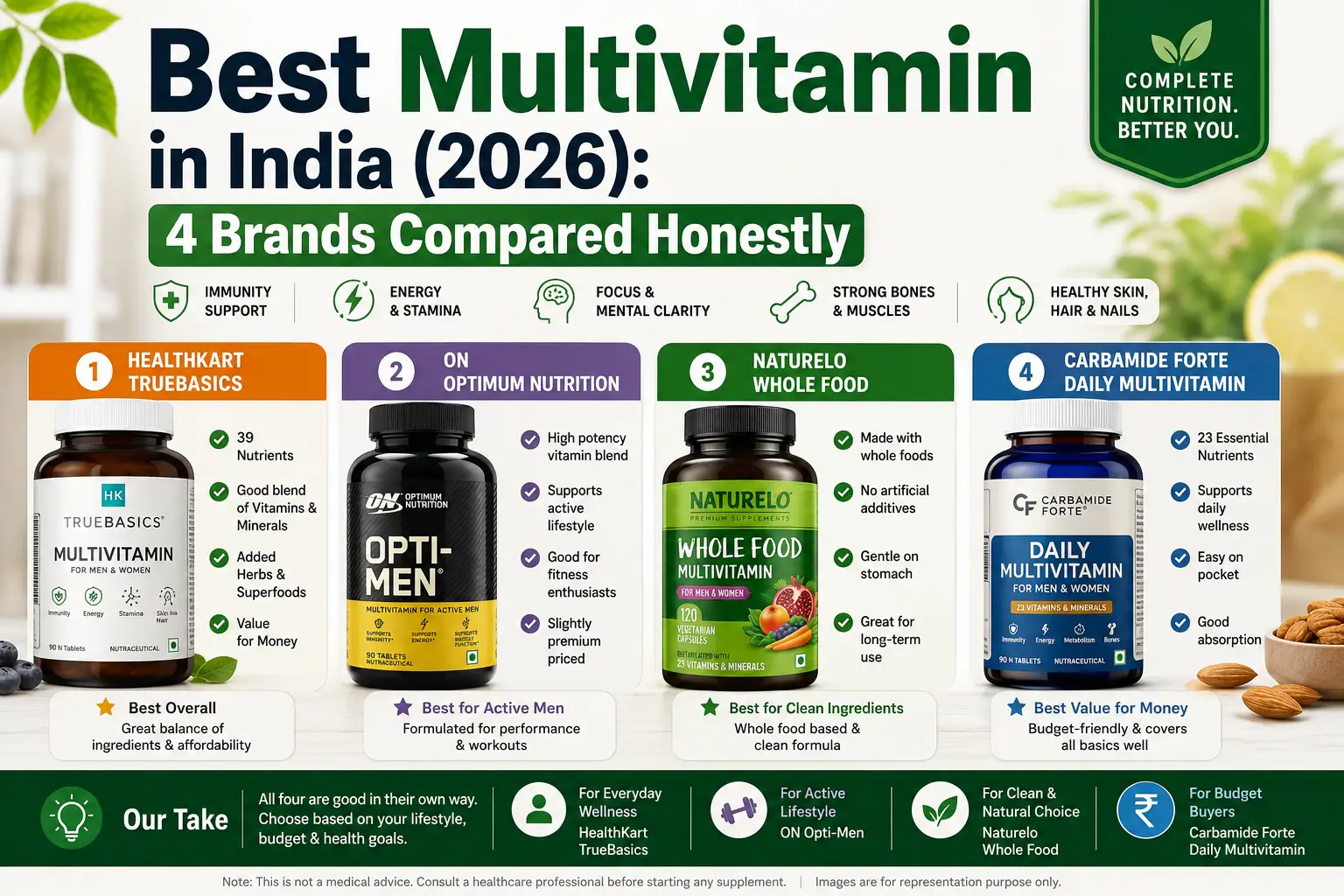
Best Multivitamin in India (2026): 4 Brands Compared Honestly
Centrum, Revital, HK Vitals and MuscleBlaze MB-Vite compared on what is actually in them — plus the honest answer to whether you need a multivitamin at all.
24 min read
Best Protein Bars in India 2026: RiteBite vs Yogabar vs MuscleBlaze
All three flagship bars deliver exactly 20g of protein, so the protein number tells you nothing. What separates them is saturated fat, fibre, polyol load — and a cost per gram of protein roughly three times what whey costs.