Body Recomposition: How to Lose Fat and Gain Muscle at the Same Time
Everyone says you cannot lose fat and gain muscle simultaneously. That is not entirely true. Body recomposition is real, achievable, and especially effective for certain groups. Here is exactly how it works and how to do it.

Medical Safety Note: This article is for general educational purposes only and is not a substitute for professional medical advice, diagnosis, or treatment. If you are pregnant, managing a condition like diabetes, PCOS, or thyroid disorder, or taking medication, please consult a qualified doctor or registered dietitian before changing your diet, supplements, or exercise routine.
The standard fitness advice goes like this: to build muscle, you need to eat more (bulk). To lose fat, you need to eat less (cut). You cannot do both at the same time. Pick one.
This advice is partially true — for advanced athletes who are already near their genetic maximum for muscle development.
For everyone else — beginners, people returning to training after a break, people who are overweight, and most women — body recomposition is not only possible but is the natural expected result of starting resistance training correctly.
Body recomposition means simultaneously reducing body fat percentage while increasing muscle mass. The result: you may not lose much scale weight, but your body looks dramatically different — leaner, more defined, more toned. The number on the scale tells you almost nothing about recomposition progress. Body measurements and photos tell you everything.
📖 Read Also:
Free Body Fat CalculatorSince the scale won't show recomposition progress, track your estimated body fat percentage instead — a far more useful number for this goal.
Who Can Achieve Body Recomposition Most Effectively
Body recomposition works best for specific groups. The further you are from your genetic muscle-building ceiling, the more effectively your body can recomposition.
1. Beginners to Resistance Training
The first 6–12 months of weight training produces what is called "newbie gains" — your nervous system becomes more efficient at recruiting muscle fibres and your muscles respond rapidly to the new stimulus. This adaptation happens even in a slight calorie deficit.
During this phase, a beginner can simultaneously:
- Lose 0.5–1kg of fat per month
- Build 0.5–1kg of muscle per month
From the outside, this looks like dramatic body transformation — smaller waist, more visible muscle definition — while the scale barely moves.
2. People Returning After a Break (Muscle Memory)
If you trained before and stopped for several months or years, muscle memory allows your muscles to rebuild to their previous size significantly faster than they built initially. This rebuilding can happen even in a slight deficit, making recomposition very achievable.
3. People Who Are Overweight or Obese
People with higher body fat have more stored energy available. Fat stores can provide the caloric surplus needed for muscle building while dietary intake remains at or below maintenance. This is why overweight individuals can make very impressive recomposition progress.
4. Women
Women build muscle more slowly than men (due to lower testosterone) but lose fat at a similar rate. This means women often see excellent recomposition results — the lean, toned appearance — because the scale changes slowly while body composition changes rapidly.
Why Recomposition Is Harder for Advanced Athletes
Advanced athletes who are already lean (8–12% body fat for men, 16–22% for women) and have trained for 3–5+ years have already captured most of their newbie gains. They are close to their genetic ceiling for muscle mass. At this point, truly simultaneous fat loss and muscle gain at significant rates requires very precise conditions. This is why advanced athletes typically cycle through bulk and cut phases.
If you are reading this guide, you are almost certainly not in this category. Continue.
The Physiology of Body Recomposition
Understanding the mechanism helps you apply it correctly.
Energy Partitioning
When you eat slightly below your maintenance calories, your body needs to source the deficit from somewhere. It can break down:
- Fat (preferred outcome)
- Muscle (bad outcome — happens when protein is insufficient or training is absent)
When you lift weights and eat sufficient protein, you signal to your body: keep the muscle, burn the fat. Resistance training essentially "protects" muscle from being broken down during a calorie deficit, while simultaneously providing the stimulus for the muscle to be maintained or slowly built.
Muscle Protein Synthesis and Breakdown
At any given time, your body is both building muscle (muscle protein synthesis) and breaking it down (muscle protein breakdown). Net muscle growth happens when synthesis exceeds breakdown.
During recomposition:
- Training drives muscle protein synthesis higher
- High protein intake provides the raw materials
- A small calorie deficit means fat is burned for energy
- The net effect: fat goes down, muscle stays or increases
The Role of Insulin Sensitivity
Higher insulin sensitivity means your body can partition nutrients more efficiently — carbohydrates go toward muscle glycogen (fuel for training) rather than fat storage. Beginners and people returning from breaks often have good insulin sensitivity, facilitating better nutrient partitioning.
How to Structure Nutrition for Body Recomposition
Calorie Target
The sweet spot for recomposition is a very small calorie deficit — not the aggressive cuts used for rapid fat loss.
Target: 100–300 calories below Total Daily Energy Expenditure (TDEE)
How to estimate your TDEE:
- Calculate your Basal Metabolic Rate (BMR): body weight in kg × 22 (rough estimate)
- Multiply by activity factor:
- Sedentary (desk job, minimal exercise): × 1.2
- Light activity (1–3 days exercise): × 1.375
- Moderate activity (3–5 days exercise): × 1.55
Example: 70kg person, moderate activity = 70 × 22 × 1.55 = ~2,387 kcal TDEE Recomposition target: 2,100–2,250 kcal
This is not very aggressive. The goal is barely below maintenance — fat loss is slow and steady while muscle is preserved or built.
Protein — The Most Critical Variable
Target: 1.6–2.2g of protein per kg of bodyweight per day
For a 70kg person: 112–154g protein per day. This is non-negotiable for recomposition.
Protein serves two purposes simultaneously:
- Provides amino acids to build and maintain muscle
- Has the highest satiety per calorie — keeps you full, reduces total calorie intake naturally
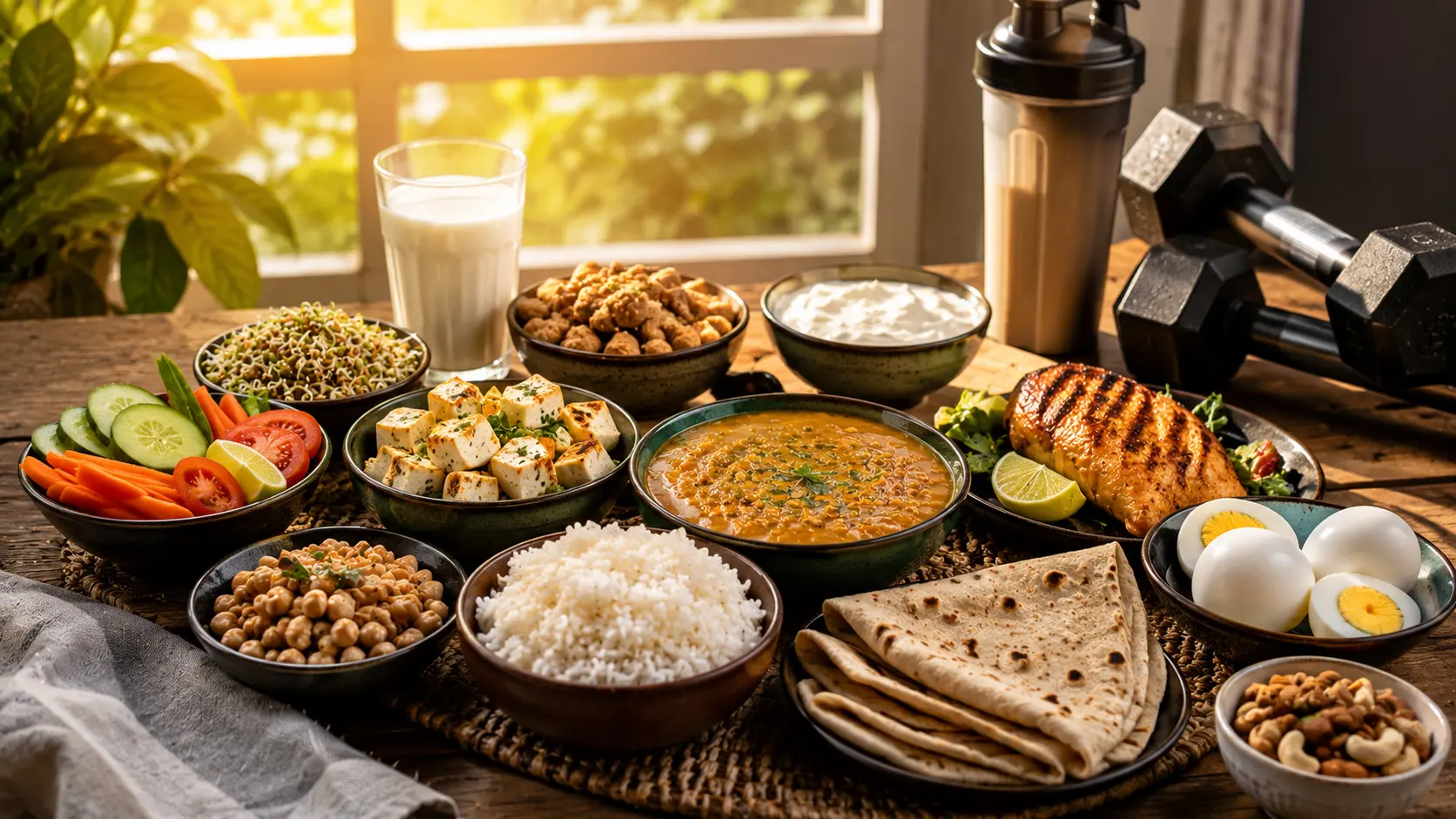
Indian high-protein options:
- Eggs: 6g per egg
- Chicken breast: 31g per 100g
- Paneer: 18g per 100g
- Soya chunks: 52g per 100g dry (20g per 100g cooked)
- Dal: 9g per 100g cooked
- Greek yogurt / hung curd: 10–15g per 100g
- Whey protein: 22–26g per scoop
Alongside protein, creatine is worth adding during a recomp phase — it helps you push more reps in training, which directly supports the muscle-building side of the equation while you're in a fat-loss deficit.
Carbohydrates and Fat
After hitting your protein target, divide remaining calories between carbohydrates and fat based on preference.
Carbohydrates: Prioritise around training. Eating carbs in the 1–2 hours before training ensures muscle glycogen is full for performance. Eating carbs post-workout helps recovery.
Fat: Essential for hormonal function. Do not drop fat below 20–25% of total calories.
Training for Body Recomposition
Diet alone without training will cause weight loss — but not recomposition. The training stimulus is what directs your body to maintain and build muscle while losing fat.
The Non-Negotiables
1. Resistance/weight training is essential This is the key differentiator. Without the muscle-building stimulus, a calorie deficit leads to both fat AND muscle loss. With resistance training, muscle is protected and built while fat is lost.
2. Progressive overload You must consistently challenge your muscles by gradually increasing weight, reps, or difficulty. Doing the same workout with the same weights forever produces no progress.
3. Frequency: 3–4 sessions per week This is the minimum effective dose. 5–6 days of intense training for a beginner leads to insufficient recovery and is counterproductive.
Sample 4-Day Recomposition Training Split
Day 1 (Upper Body — Push)
- Bench Press / Push-ups: 4 × 8–10
- Overhead Press: 3 × 10
- Incline Dumbbell Press: 3 × 12
- Tricep Dips / Cable Pushdown: 3 × 12
- Lateral Raises: 3 × 15
Day 2 (Lower Body — Quad Focus)
- Squat: 4 × 8–10
- Leg Press: 3 × 12
- Lunges: 3 × 12 each leg
- Leg Extension: 3 × 15
- Calf Raises: 4 × 20
Day 3 (Upper Body — Pull)
- Pull-ups / Lat Pulldown: 4 × 8–10
- Barbell or Dumbbell Row: 4 × 10
- Face Pulls: 3 × 15
- Bicep Curls: 3 × 12
- Rear Delt Flyes: 3 × 15
Day 4 (Lower Body — Posterior Chain)
- Deadlift or Romanian Deadlift: 4 × 8
- Hip Thrusts: 4 × 12
- Hamstring Curl: 3 × 12
- Step-ups: 3 × 10 each leg
- Plank + Ab work: 3 sets
Cardio: 2–3 × 20–30 minutes moderate cardio (brisk walking, cycling) on rest days or after training. Do not overdo cardio — it increases calorie expenditure, which can push your deficit too large and interfere with muscle building.
Tracking Recomposition Progress
Do NOT track only body weight. This is the most common mistake. The scale can stay the same while your body is completely transforming.
Track all of these:
← Swipe to compare →
| Metric | How to Track | Frequency |
|---|---|---|
| Body weight | Morning, same conditions | Daily average |
| Waist measurement | Tape at navel | Weekly |
| Hip measurement | Widest point | Weekly |
| Progress photos | Same pose, same lighting | Every 2 weeks |
| Strength in key lifts | Workout log | Every session |
Expect the scale to move slowly — perhaps 0.5–1kg per month or even stay flat. But photos will show clear changes. Waist goes down. Shoulders and arms look fuller. Clothes fit completely differently.
Realistic Timeline
← Swipe to compare →
| Timeframe | Expected Changes |
|---|---|
| Month 1 | Strength increases significantly, body begins to firm up |
| Month 2 | Visible muscle definition in arms and legs, waist measurement reduces |
| Month 3 | Noticeable body composition change, photos show clear difference |
| Months 4–6 | Significant transformation in how you look and feel |
For beginners: in 6 months of consistent training + high protein + slight deficit, the body transformation is dramatic even if scale weight barely changes.
Common Mistakes That Kill Recomposition Progress
1. Eating Too Little
An aggressive deficit (500–700 kcal) makes fat loss fast but prevents muscle building. Recomposition requires a gentle deficit. Eat more than you think you should.
2. Not Eating Enough Protein
Cannot be overstated. Without 1.6–2g/kg protein, your body cannot build muscle even with perfect training. This is the #1 nutritional mistake.
3. Not Lifting Heavy Enough
Doing light weights for high reps does not build muscle. The weight needs to be challenging. Your last 2–3 reps of each set should be genuinely difficult.
4. Giving Up Because the Scale Does Not Move
The scale is a terrible measure of recomposition progress. Take photos every 2 weeks and measure your waist. These will show you the real progress.
5. Too Much Cardio, Too Little Lifting
Cardio burns calories and does not build muscle. For recomposition, lifting is the priority and cardio is supplementary.
Final Word
Body recomposition is the ideal outcome for most people starting their fitness journey — you simultaneously look better, perform better, and feel better, even if the scale barely moves.
It requires patience, because the changes happen slowly compared to aggressive bulk/cut cycles. But the end result — a leaner, stronger, more muscular physique built over 6–12 months of consistent work — is more sustainable, more aesthetically pleasing, and better for long-term health than the aggressive weight-gain/weight-loss cycle.
High protein. Slight deficit. Progressive resistance training. Consistent execution. That is the entire formula.
📖 Read Also:
Protein Guide India: How Much You Actually NeedRecomp lives or dies on protein intake. The complete guide covers exactly how much you need and how to hit it on Indian food.
Frequently Asked Questions
Is body recomposition possible for everyone?
Body recomposition is most effective for beginners, people returning after a break, and those with higher body fat percentages. Advanced athletes who are already lean find it difficult because they have less fat to lose while trying to gain muscle. For most Indian adults starting fitness, it is very achievable.
How long does body recomposition take?
Noticeable body recomposition typically takes 3–6 months of consistent training and nutrition. You may not see the scale move much, but your body composition — the ratio of fat to muscle — changes significantly. Monthly progress photos are a better tracking method than the scale.
What should I eat for body recomposition?
Eat at maintenance calories or a very slight deficit (150–200 calories below maintenance). Prioritise protein at 1.6–2.2g per kg body weight. Focus on whole Indian foods: dal, paneer, eggs, chicken, vegetables, and complex carbs like oats and brown rice.
Can I do body recomposition without going to the gym?
Yes — progressive bodyweight training at home (push-ups, squats, lunges, pull-ups) combined with adequate protein can achieve body recomposition. A gym with weights makes it easier and faster, but is not mandatory, especially for beginners.
Is body recomposition better than traditional cutting or bulking?
For beginners and intermediate trainees, recomposition is often the better approach — you improve your physique without the extremes of a large calorie surplus or deficit. Advanced lifters who are already lean typically get better results from structured cut/bulk cycles.
Related Reading
- Calorie Deficit Explained — understanding energy balance for body recomposition
- Fat Loss vs Weight Loss: The Real Difference — why the scale lies during a recomp
- Muscle Gain Diet Plan for Indian Men — high-protein Indian diet to support muscle building
- Whey Protein Guide for Beginners India — how protein supplements support recomposition
- Strength Training for Women India — recomposition is especially effective for women who are new to lifting
Free Tools to Help You
Put this article into action — use our free calculators to get your personalized numbers.
Was this article helpful?
Want More Tips Like This?
Join 1,000+ readers getting weekly fitness, diet, and wellness tips + FREE meal plan
No spam, ever. Unsubscribe anytime.

About the Author: Ashwani
Fitness influencer and wellness writer helping Indians build healthier lifestyles.
Read more about us →Comments
Leave a Comment
Your email will not be published. Comments are reviewed before appearing.
You Might Also Like
Continue your wellness journey
30 min read
How to Build Muscle on an Indian Diet: The Complete 2026 Guide
Most Indians eat only 40–50g of protein daily when muscle building needs 100–140g. This complete guide covers exact protein targets, Indian food sources for vegetarians and non-vegetarians, a 7-day muscle gain meal plan, beginner supplement stack with real prices, and a 4-day workout structure.

19 min read
Is Paneer More Expensive Than Chicken? Price & Protein Compared (2026)
Market paneer costs ₹22 per 10g protein. Chicken costs ₹9. But homemade paneer matches chicken exactly. Complete 2026 India price breakdown, protein science, amino acid quality, and exact verdict — including low-fat paneer vs chicken breast.

10 min read
High Protein Vegetarian Indian Diet Plan: 7-Day Complete Guide
Dal and roti alone will not get you to your protein target. This 7-day vegetarian diet plan hits 120–150g of protein daily using Indian foods — no expensive imports, no chicken required.