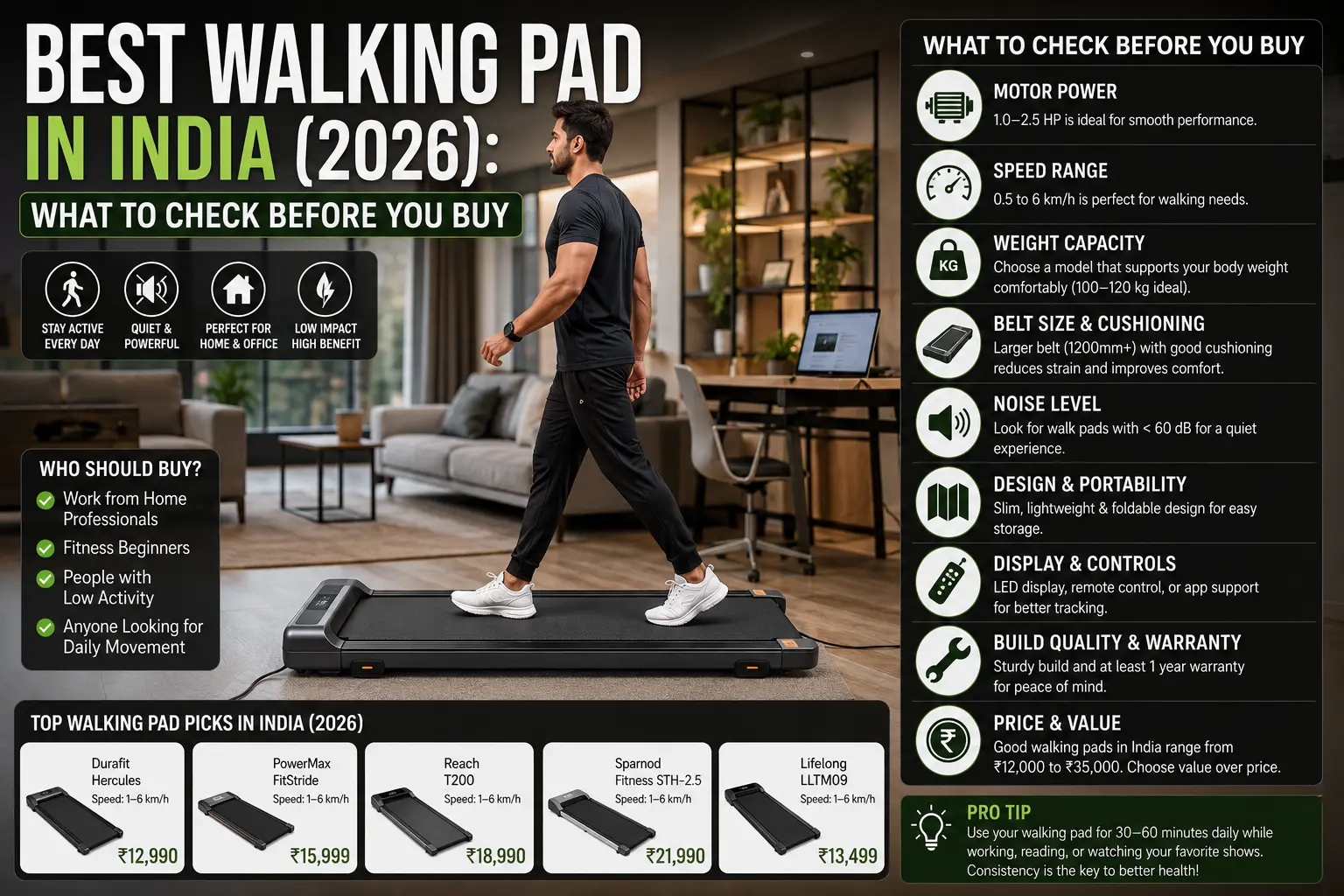
Best Walking Pad in India (2026): What to Check Before You Buy
Walking pads solve a real Indian problem — you cannot walk outdoors when the AQI is 300 or the monsoon has not stopped for a week. Here is what actually matters when buying one, and who should not buy one at all.
Affiliate Disclosure: This post contains affiliate links. If you buy through them, we may earn a small commission at no extra cost to you — this never affects our recommendations. We only suggest products we believe in. Learn more.
Quick Answer
Buy the Lifelong 4.5HP. It is the most-reviewed walking pad in India by a wide margin — 7,800+ ratings at 4.3 — which makes reliability a settled question rather than a gamble. Treat 4.5 HP as a peak figure: this is a walking pad, not a running machine. Above roughly 95 kg, look at the Cult Trek Motion instead.
Lifelong 4.5HP Walking Pad Treadmill — Under Desk, Foldable
The most proven option here — #1 best seller in Amazon India's treadmill category with 7,800+ ratings. 10 km/h top speed, LED display, 100 kg capacity, folds flat for under-bed storage. The 4.5 HP is a peak rating, so treat it as a walking pad rather than a running machine. Pick this if you want the option most people have already bought and reviewed.
Budget ₹10,000–20,000 for something that lasts, and add about ₹1,500 for a voltage stabiliser — the reason is in the warning below, along with all four compared.
There are roughly four months a year in most Indian cities when walking outdoors is genuinely unpleasant or unwise. Delhi and the NCR belt spend a good part of the winter above AQI 300. Mumbai and the coastal belt lose weeks to monsoon. Add peak summer afternoons across the north, and the "just go for a walk" advice quietly stops working for a large part of the year.
That is the actual problem a walking pad solves. It is not a treadmill replacement and it is not a fat-loss machine — it is a way to keep your daily step count from collapsing when going outside is not an option.
This guide covers what to check before buying one, and — just as importantly — who should not buy one at all.
How this guide was put together: unlike my resistance band and yoga mat reviews, I have not owned a walking pad long-term — so you will not find "I tested these for three months" claims here. What follows is a specification and buying-criteria comparison built from manufacturer data and current Indian listings: the homework I would do before spending ₹13,000 of my own money. Where I say one option is better than another, it is because the spec says so, not because I have worn one out.
Which Walking Pad Suits You
Four walking pads are worth considering in India right now, and which one is right for you comes down to two things: your body weight, and whether you ever intend to jog on it. Here is the short version — the spec reasoning behind each is further down.
← Swipe to compare →
| If this is you | The one to look at | What you have to accept |
|---|---|---|
| You want the safest, most-reviewed default | Lifelong 4.5HP | 4.5 HP is a peak figure — this is a walking pad, not a running machine, and there is no incline |
| You are above roughly 95 kg | Cult Trek Motion | The only one here with real headroom, but you pay for capacity a lighter user will never use |
| Pure under-desk walking during work calls | Fitkit Neo | Tops out at 6 km/h, and the warranty is void without a voltage stabiliser |
| You want the option to jog, not just walk | Flexnest Flexpad EZ Pro | 100 kg capacity only, which rules it out for heavier users |
Two things apply to all four: budget ₹10,000–20,000 for something that lasts, and add about ₹1,500 for a voltage stabiliser — the reason is in the warning under the comparison table.
Who should skip this page entirely: anyone who already walks outdoors most days, and anyone whose actual goal is running. Both cases are covered in "Who Should Not Buy One" below — a walking pad is the wrong purchase for you and no spec on this page changes that.
The Case for Walking, Briefly
Two findings worth knowing before you spend ₹13,000.
An umbrella review and meta-analysis in Preventive Medicine (2024) found a consistent inverse relationship between daily step count and all-cause mortality — more steps, lower risk, with benefits appearing well below the 10,000-step figure people usually quote.[1]
More relevant to this page: a 2026 study in the European Journal of Applied Physiology looked specifically at South Asian adults living with overweight or obesity, and found that substituting sitting with standing and walking in free-living conditions improved daily glucose concentrations.[2]
That second one matters because South Asians carry a well-documented higher risk of insulin resistance at a given BMI. If you sit for nine hours a day, breaking that sitting up is doing something specific for you — and a walking pad is one of the few tools that lets you do it without leaving your desk. If desk work is your main problem, our office worker fitness routine covers the posture and back-pain side that a walking pad alone will not fix.
A walking pad is a sitting-reduction tool, not a cardio machine. If you buy it expecting dramatic weight loss, you will be disappointed and it will end up under the bed. If you buy it to add 3,000–5,000 steps to a desk-bound day, it does that job well — a fitness tracker or smartwatch is worth pairing with it so that number is something you actually see.
What Actually Matters When Buying
1. Motor power — and why the big number on the listing is misleading
Listings advertise peak HP, which is a burst rating, not what the motor sustains. What matters is continuous duty (CHP), which is usually about half the peak figure and often not stated at all.
You can see this directly in the specs below. The Fitkit Neo is one of the few that publishes both numbers: 3.5 HP peak works out to 1.75 HP continuous — exactly half. Apply the same halving to every other listing on this page and you get the honest figure.
For walking at 4–6 km/h, 1.5–2.5 HP continuous is more than enough. A "4.5 HP" listing is almost always a peak number. Do not pay extra for a peak figure you will never use — pay attention to weight capacity instead, which is a better proxy for build quality.
BLDC vs brushed DC is a more useful distinction than headline HP. BLDC (brushless) motors run quieter and last longer because there are no brushes to wear down. Two of the four below use BLDC.
2. Weight capacity — the spec that predicts lifespan
This is the number most buyers skim past and it is the one that matters most. A pad rated for 100 kg being used by a 90 kg person is running near its limit every session; the motor and belt wear faster.
Rule of thumb: buy a pad rated at least 25–30 kg above your body weight. If you are 80 kg, look for 110 kg+ capacity.
3. Deck size — where cheap pads fail
Belt width under 40 cm feels precarious once you are walking naturally rather than concentrating. Belt length under 100 cm forces a shortened stride, which is uncomfortable for anyone above roughly 5'8".
If you are tall, deck length is the spec most likely to make you stop using the machine.
4. Noise — the one that decides whether you keep using it
You will use this in a flat, probably during work calls, possibly with people below you. Anything above roughly 60 dB becomes intrusive on a video call.
Belt and roller quality drive noise more than motor size. This is genuinely difficult to assess from a listing — reviews mentioning calls and neighbours are more useful here than the spec sheet.
5. Foldable or flat?
Flat pads (no handlebar) slide under a sofa or bed and are for walking only. Folding pads (with a raised handlebar) take more storage space but let you jog at higher speeds.
If you genuinely only want to walk while working, the flat version is less machine for less money. Do not buy a handlebar you will never hold.
6. Warranty and service — the India-specific one
This is where international buying guides are useless. A walking pad is a motor, a belt and a control board — all of which eventually need service.
Check that the brand has an Indian service network before buying. Indian brands (Lifelong, Powermax, Durafit, Cockatoo, Fitkit) generally do. An unbranded import at ₹8,000 usually means a dead machine when the board fails in year two, because nobody stocks the part.
Look for 2+ years on the motor and clarity on who performs on-site service.
Read the warranty conditions too, not just the duration. Fitkit, for example, states its 1-year warranty on electronic parts applies only if the machine is used with a stabiliser (1000 VA recommended). That is a realistic condition in Indian conditions rather than fine print designed to trap you — but it does mean budgeting for a stabiliser alongside the machine.
The Four Worth Considering
Quick comparison
← Swipe to compare →
| Model | Motor (peak) | Top speed | Capacity | Incline | Best for |
|---|---|---|---|---|---|
| Lifelong 4.5HP | 4.5 HP | 10 km/h | 100 kg | — | Most proven, safest default |
| Cult Trek Motion | 4 HP BLDC | 10 km/h | 130 kg | 2-level manual | Heavier users |
| Fitkit Neo | 3.5 HP BLDC | 6 km/h | 120 kg | 2-level | Pure under-desk walking |
| Flexnest Flexpad EZ Pro | 3 HP brushless | 10 km/h | 100 kg | 9% | Wanting to jog too |
Lifelong 4.5HP Walking Pad Treadmill — Under Desk, Foldable
The most proven option here — #1 best seller in Amazon India's treadmill category with 7,800+ ratings. 10 km/h top speed, LED display for time, speed, distance and calories, 100 kg capacity, folds flat for under-bed storage. The 4.5 HP is a peak rating, so treat it as a walking pad rather than a running machine. Pick this if you want the option most people have already bought and reviewed.
Cult Walking Pad with Trek Motion — 4HP BLDC, 130kg
The highest weight capacity of the four at 130 kg, which by the 25–30 kg headroom rule makes it the sensible choice if you are above 95 kg. Runs a BLDC motor, which is generally quieter and longer-lasting than a brushed DC motor — relevant if you will use it during calls. Adds 2-level manual incline, LED display, and folds for storage.
Check Price on Amazon →Fitkit by Cult Walking Pad Neo — BLDC, Remote Control
The only one here that is honest about being a walking pad: it tops out at 6 km/h, so there is no pretence of jogging. Its spec sheet also states the useful number the others hide — 3.5 HP peak equals 1.75 HP continuous. 120 kg capacity, BLDC motor, 2-level incline, LED display, and a remote so you can change speed without breaking stride. Note the warranty requires use with a stabiliser.
Check Price on Amazon →Flexnest Flexpad EZ Pro — 2-in-1 with Foldable Rail
The '2-in-1' is a foldable handrail: put it down and it is a walking pad, raise it and you have a compact treadmill you can jog on. It also has the steepest incline of the four at 9%, plus shock absorption and Bluetooth tracking. Capacity is 100 kg, so it suits lighter users who want the option to do more than walk.
Check Price on Amazon →Buy a voltage stabiliser with any of these. Fitkit explicitly states its warranty applies only when used with a stabiliser (1000 VA recommended), and the same electronics risk applies to every brand here. In most Indian homes a motor-driven appliance with a control board should not be run off unstabilised mains — a ₹1,500 stabiliser protects a ₹13,000 machine and your warranty claim.
Walking Pad vs Treadmill vs Just Walking Outside
← Swipe to compare →
| Factor | Walking pad | Treadmill | Outdoors |
|---|---|---|---|
| Price | ₹10,000–20,000 | ₹25,000+ | Free |
| Space | Under a bed | Permanent floor space | None |
| Can you run? | No | Yes | Yes |
| Works at AQI 300? | Yes | Yes | No |
| Works during monsoon? | Yes | Yes | No |
| Best for | Desk-bound step count | Actual cardio training | Everything, when conditions allow |
The honest position: if you already walk outdoors most days and enjoy it, you do not need this. Outdoor walking is free, gives you sunlight and is better for your head. A walking pad is insurance for the months and days when that option is closed — and if monsoon is your main blocker, our monsoon fitness guide covers the no-equipment alternatives first.
📖 Read Also:
Walking for Weight Loss: A Beginner's Guide for IndiansHow many steps actually matter, how to build the habit around a desk job, and what walking can and cannot do for fat loss.
Who Should Not Buy One
Being direct here, because these machines have a high abandonment rate:
- You want to run. Buy a proper treadmill, or run outdoors. Walking pads are not built for it and the short deck makes it unsafe.
- You already hit 8,000+ steps daily. You will not use it — put the money toward strength or mobility work instead, which a walking pad does not cover.
- You are buying it to lose weight on its own. At 150–250 kcal/hour, an hour of walking is roughly one plate of poha. Diet drives fat loss; this drives step count — our complete fat loss guide for Indians covers what actually moves the needle.
- Your budget is under ₹8,000. At that price you are buying a motor that will fail outside warranty with no service network behind it. Save longer, or buy a good pair of shoes instead.
- You have no flat storage space. "Folds flat" still means 120 cm of floor or under-bed clearance.
📖 Read Also:
Best Home Gym Under ₹5,000 in India (2026)If a walking pad is out of budget, this is the priority-ranked equipment list that gets you a working home setup for a fraction of the cost.
Frequently Asked Questions
Is a walking pad worth it in India?
It is worth it if your outdoor walking gets blocked for a meaningful part of the year — high AQI in the NCR belt, monsoon on the coast, extreme summer afternoons — and if you have a desk job that keeps your step count low. If you already walk outdoors most days, it is not worth the money or the floor space.
How much does a good walking pad cost in India?
Expect ₹10,000–20,000 for a machine with a real service network behind it. Below ₹8,000 you are generally buying an unbranded import where a failed control board means the whole unit is scrap.
Can you lose weight with a walking pad?
Indirectly. Walking at 4–6 km/h burns roughly 150–250 kcal per hour depending on body weight and speed. That helps, but fat loss is driven by your calorie intake. Treat the pad as a way to stop your daily activity collapsing rather than as a fat-burning device.
What speed should I use while working?
Most people can type comfortably at 2–4 km/h. Above about 5 km/h, typing accuracy drops for most people. Start at 2 km/h for the first week and build up — walking and working simultaneously takes some adaptation.
Do walking pads disturb neighbours downstairs?
They can, particularly in older buildings with thinner slabs. A rubber mat underneath reduces both noise and vibration significantly, and is worth buying at the same time.
How much weight capacity do I need?
At least 25–30 kg above your body weight. A machine constantly running near its rated limit wears out much faster, and capacity is a reasonable proxy for overall build quality.
Is 4.5 HP necessary for a walking pad?
No. Advertised HP figures are almost always peak ratings, not continuous. For walking speeds, 1.5–2.5 HP continuous is sufficient. Weight capacity and deck dimensions tell you more about quality than the headline HP number.
Do I need a voltage stabiliser for a walking pad?
Yes, and it is worth treating as part of the purchase rather than an optional extra. Fitkit states its electronics warranty applies only when the machine is used with a stabiliser (1000 VA recommended), and the same risk applies across brands — a control board is the most expensive part to replace and the most vulnerable to voltage fluctuation.
Can I use a walking pad every day?
Yes, walking is low-impact enough for daily use. Build up gradually — going from a sedentary day to two hours of walking immediately tends to cause foot and calf soreness. Add 15–20 minutes a week.
Final Word
A walking pad is a narrow tool that does one job well: it keeps a desk-bound day from being a 2,000-step day, in a country where outdoor walking is seasonally unavailable for a lot of people.
Buy it for that, check weight capacity and service network before the headline HP figure, and it will earn its place. Buy it expecting a gym replacement and it will be under your bed by October.
And if ₹13,000 is more than this problem is worth to you right now, that is a reasonable conclusion. A resistance band set at around ₹500 plus a decent mat covers strength and mobility at home for a fraction of the cost — it just will not solve the step-count problem, which is the one thing a walking pad is actually for.
References
- Daily steps and all-cause mortality: An umbrella review and meta-analysis. Preventive Medicine, 2024. PubMed: 38901742
- Substituting sitting with standing and walking in free-living conditions improves daily glucose concentrations in South Asian adults living with overweight/obesity. European Journal of Applied Physiology, 2026. PubMed: 40764840
Free Tools to Help You
Put this article into action — use our free calculators to get your personalized numbers.
Was this article helpful?
Want More Tips Like This?
Join 1,000+ readers getting weekly fitness, diet, and wellness tips + FREE meal plan
No spam, ever. Unsubscribe anytime.

About the Author: Ashwani
Fitness enthusiast and wellness writer. I research and write about home workout equipment and supplements — so you can make informed decisions without wasting money.
Read more about us →Comments
Leave a Comment
Your email will not be published. Comments are reviewed before appearing.
You Might Also Like
Continue your wellness journey
26 min read
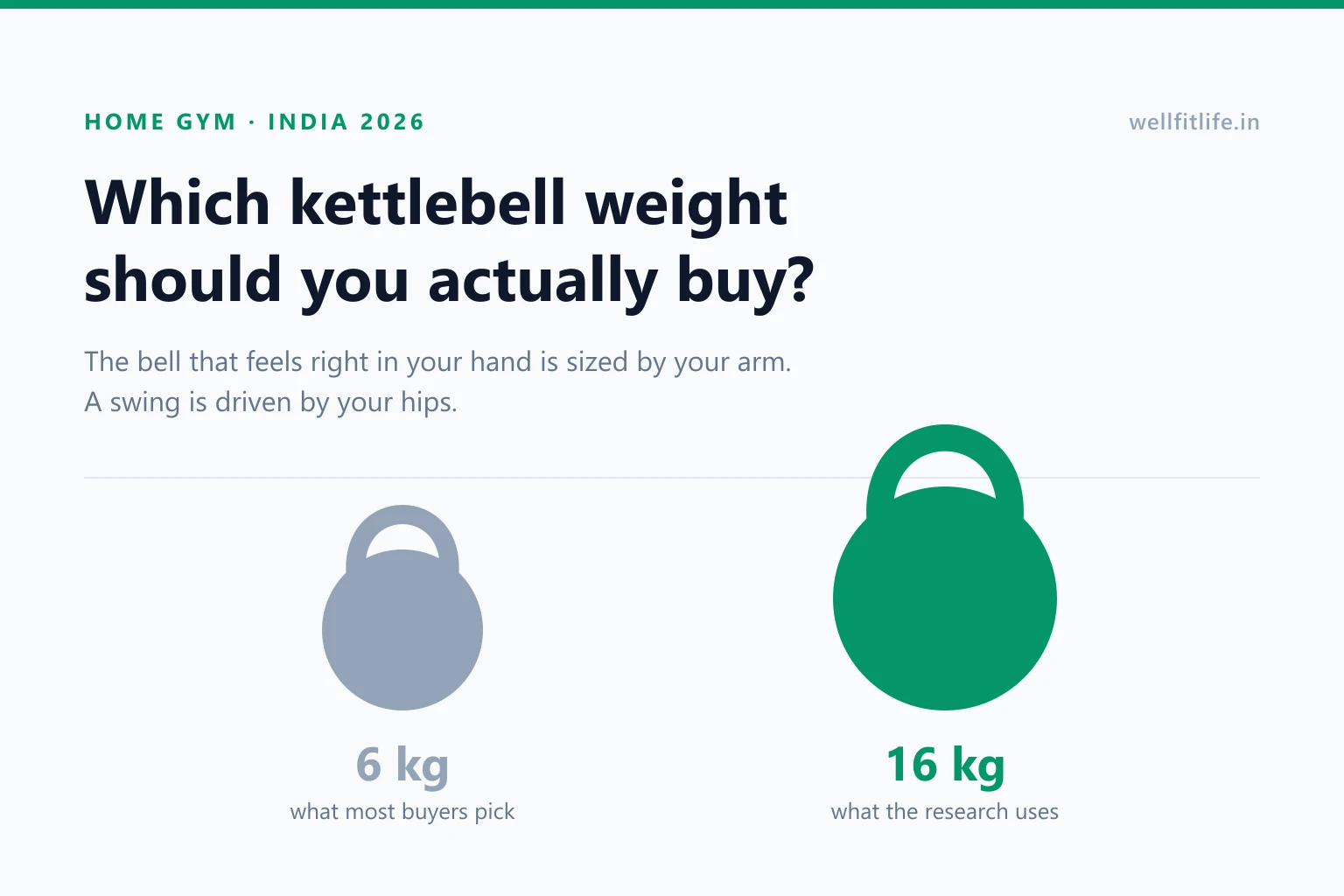
Best Kettlebells for Home Gym in India (2026): Which Weight to Buy
Almost every kettlebell sold in India is lighter than the ones the research is done with. The weight that feels right when you pick it up is roughly half the weight your hips need — and that single mistake is why most kettlebells end up under a bed.
15 min read
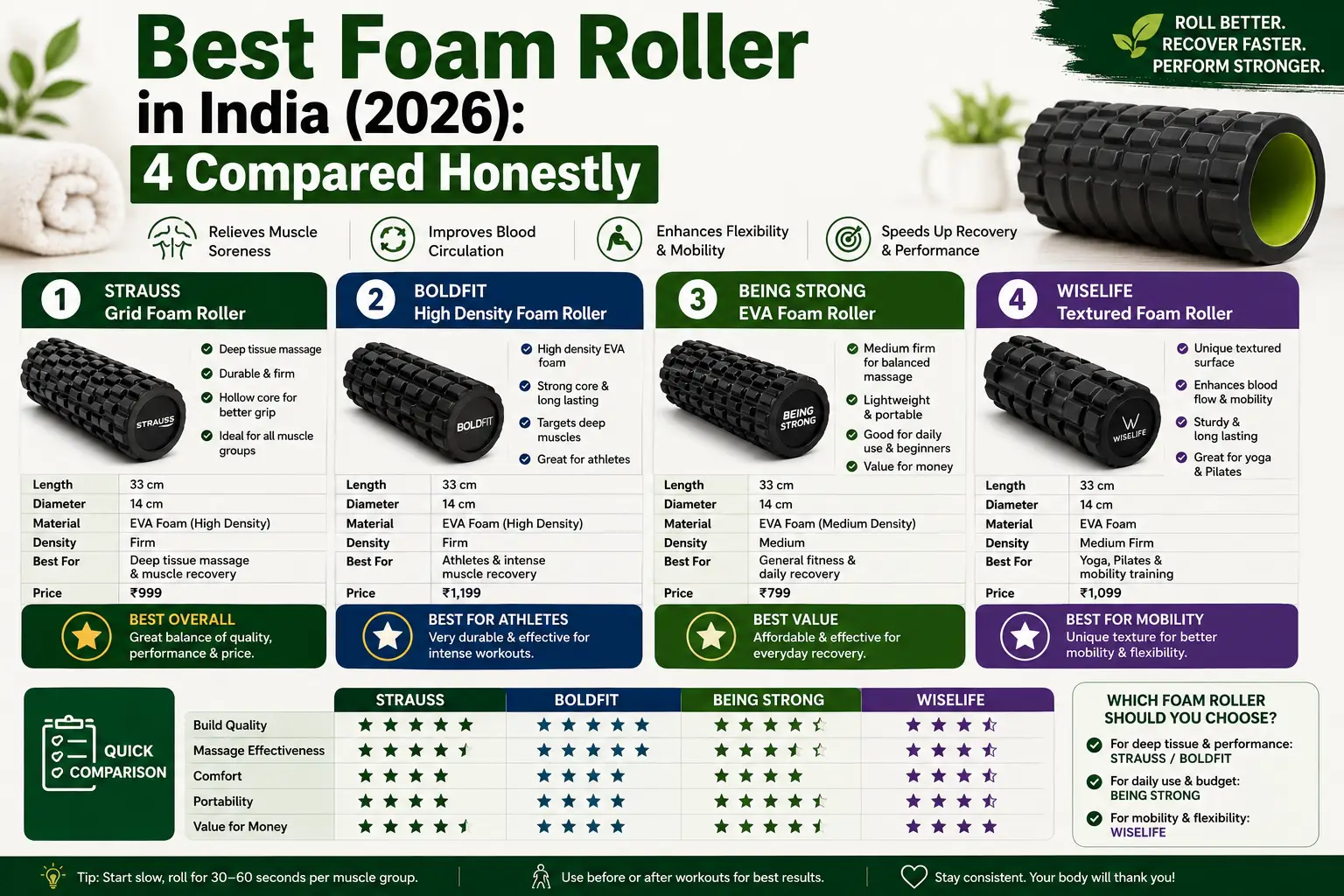
Best Foam Roller in India (2026): 4 Compared Honestly
Boldfit and Strauss foam rollers compared on density, size and rating data — plus what foam rolling actually does for sore muscles, and what it definitely does not.
17 min read
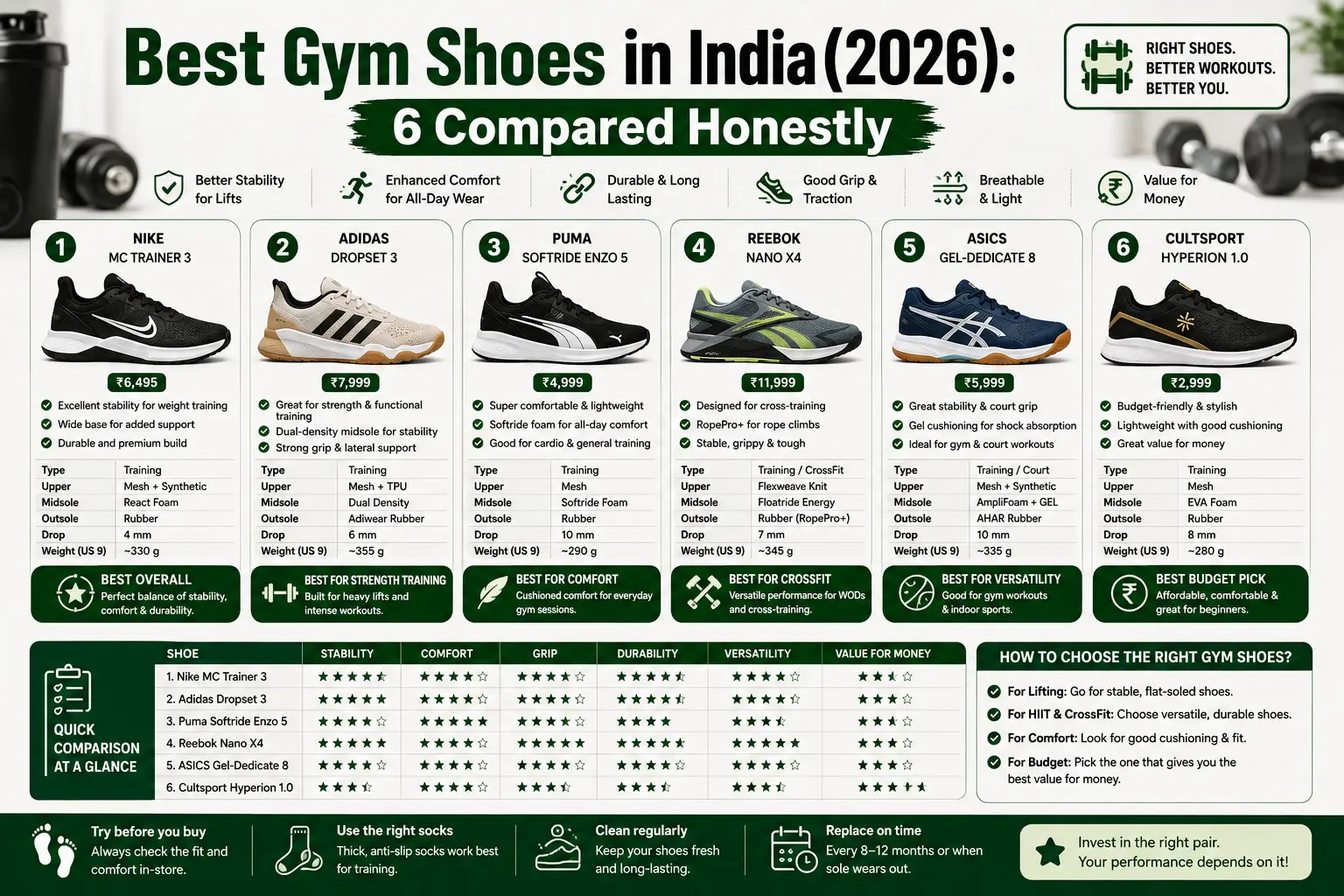
Best Gym Shoes in India (2026): 6 Compared Honestly
Most Indians buy a running shoe for the gym. Here is exactly when that is fine, when it costs you, and six options compared — from a ₹1,500 Campus to the Nike Metcon.