Best Fitness Tracker in India (2026): 4 Compared Honestly
Noise, boAt and two Amazfit smartwatches compared on the specs that decide whether a tracker is useful — built-in GPS, real battery life, and what wrist heart rate can and cannot measure.
Affiliate Disclosure: As an Amazon Associate I earn from qualifying purchases. This post contains affiliate links. If you buy through them, we may earn a small commission at no extra cost to you — this never affects our recommendations. We only suggest products we believe in. Read our full affiliate disclosure.
Quick Answer
Buy the Amazfit Bip Max. It holds the highest rating on this page at 4.4, runs up to twenty days on a charge, and has built-in GPS with offline maps — the feature that changes what a tracker can actually do, rather than how it looks. If budget is genuinely tight and you have never owned one, the Noise ColorFit Pulse 3 does the basics for a fraction of the price.
Amazfit Bip Max 50mm — 2.07 inch AMOLED, 20-Day Battery, Built-in GPS
The only tracker in this comparison pairing a large 2.07 inch AMOLED display with up to twenty days of battery. Built-in GPS plus 4GB storage and offline maps means you can run an unfamiliar route carrying nothing but the watch. The 50mm case is genuinely large — check that against your wrist before ordering.
Check Price on AmazonWrist heart rate has real limits, and one spec splits these four more than any other. Both are below, with all four compared.
Before you buy anything on this page, the one thing most fitness tracker articles will not tell you: the heart rate number on your wrist during a workout is an estimate, not a measurement.
Every wrist-based tracker — the ₹2,000 one and the ₹20,000 one alike — uses the same underlying technology, optical sensors reading blood flow through your skin. All of them lose accuracy during high-intensity intervals, weightlifting, and anything involving significant wrist movement. In a 2018 lab test of wrist trackers during weight training, only a chest strap and an in-ear monitor produced valid heart-rate readings (Boudreaux et al., 2018). If a listing promises "medical-grade accuracy" on a wrist wearable, that is marketing, not a spec.
With that established, trackers are still genuinely useful — at the things that drive consistency. Daily step counts, resting heart rate trends over weeks, sleep duration, and a nudge to move when you have been sitting for three hours. Those are real, and they are why the habit sticks.
There is one spec that genuinely separates these four, and it is not the display size everybody markets: built-in GPS. Two of the four have it, along with offline maps and onboard storage. Two do not. That single line splits this page in half, and it decides whether the extra money is worth it for you.
How this guide was put together: this is a specification and rating-data comparison built from current Amazon India listings, not a claim that I have worn all four for six months each. Where I rank one above another, the reasoning is in the text below. Nothing that oversells "blood pressure monitoring" or similar claims that wrist wearables cannot reliably deliver made this list. Specifications re-checked against each brand's own product page on 24 September 2026.
Which Tracker Suits How You Train
← Swipe to compare →
| If this is you | Start with | The catch you should know first |
|---|---|---|
| First tracker, want to test whether you will wear it daily | Noise ColorFit Pulse 3 | 5,571 ratings but only 3.9 stars — you are buying the basics, not accuracy |
| You run or cycle and want to leave the phone at home | Amazfit Bip Max | Best rated here at 4.4, with GPS, offline maps and 20-day battery — but only 418 ratings so far |
| You want a serious running watch in a smaller case | Amazfit Active 3 Premium | Sapphire display, GPS, 12-day battery — but four days less battery than the Bip Max for the smaller case |
| You want an AMOLED screen and a metal build from an Indian brand | boAt Valour Watch 1R | Aluminium build and AMOLED, but the dimmest AMOLED here at 1,000 nits, and 3.8 stars on just 280 ratings — the weakest data here |
The Only Spec That Really Splits These Four
Most tracker comparisons obsess over display size and watch faces. Here is the fork that actually matters:
Connected GPS (Noise, boAt) means the watch has no GPS chip of its own. It borrows your phone's GPS over Bluetooth to map a route. If you carry your phone on every run and walk, this works perfectly well and costs you nothing.
Built-in GPS (Amazfit Bip Max, Amazfit Active 3) means the watch tracks your route on its own. Leave the phone at home. Both Amazfits also carry offline maps, so you can go out with nothing but the watch and still see where you are. The Bip Max adds 4GB of storage for maps and podcasts (Amazfit).
That is the whole decision in this category, and it comes down to one question: do you want to exercise without carrying your phone?
If the answer is no — you take your phone to the gym anyway, you walk with it in your pocket, you have never once wished you could leave it behind — you should buy the cheapest device here that tracks steps, heart rate and sleep, and spend the difference on something else. Built-in GPS is the single largest cost driver in this comparison and it is genuinely useless to you.
If the answer is yes, the Indian budget brands cannot do it at any price, and you should skip straight to the Amazfits.
Band or smartwatch? All four picks here are smartwatch-shaped. If you specifically want a discreet band you forget you are wearing, this page is the wrong shortlist for you.
The Comparison
← Swipe to compare →
| Device | Display | Battery | Built-in GPS | Rating |
|---|---|---|---|---|
| Amazfit Bip Max | 2.07" AMOLED, up to 3,000 nits | Up to 20 days | Yes + offline maps, 4GB | 4.4 (418) |
| Amazfit Active 3 Premium | 1.32" AMOLED sapphire, up to 3,000 nits | Up to 12 days | Yes + offline maps | 4.3 (334) |
| Noise ColorFit Pulse 3 | 1.96" TFT | Up to 7 days | No (connected only) | 3.9 (5,571) |
| boAt Valour Watch 1R | 1.43" AMOLED, 1,000 nits | Up to 10 days | No (connected only) | 3.8 (280) |
Note what the rating column is doing here. The two Amazfits sit at 4.4 and 4.3 on a few hundred ratings each. The two Indian brands sit at 3.9 and 3.8 — Noise on a large 5,571-rating sample, boAt on just 280. Larger samples pull averages toward reality, so Noise's 3.9 is a more settled number than boAt's 3.8. Neither Indian brand's average is close to the Amazfits'.
Display, battery and GPS figures are from each brand's own product page, checked on 24 September 2026 (Amazfit Bip Max, Amazfit Active 3 Premium, Noise, boAt). Peak brightness is what separates the two AMOLED classes here: both Amazfits list up to 3,000 nits, three times the boAt's 1,000. Prices are deliberately not in this table — Amazon India reprices these weekly and festival sales move them by thousands. Check the live price on each card.
The Reviews
Amazfit Bip Max — Best Overall
The highest-rated device on this page at 4.4 stars, and the specification sheet explains why. It is the rare product that leads on the two things that are genuinely hard to do at once: a large 2.07-inch AMOLED display and up to twenty days of battery life. Most watches trade one for the other. The screen is also rated for up to 3,000 nits, which is what makes it readable in direct Indian sunlight.
Then it adds the feature set that costs money elsewhere. Built-in GPS, 4GB of onboard storage for maps and podcasts, and downloadable offline maps — meaning you can run or cycle an unfamiliar route with no phone and still see where you are. 150+ sports modes, hybrid training tracking, HYROX mode for anyone doing that specific format, and 5 ATM water resistance, which is rated for swimming rather than just surviving rain.
The 50mm case is the honest caveat: this is a physically large watch. On a smaller wrist it will look and feel like one, and the Active 3 below is the same brand's answer for that.
The other caveat is sample size. 418 ratings is a meaningful number but a fraction of what Noise has accumulated, because this is a newer product. A 4.4 average is a strong signal; it is not yet a settled one.
Amazfit Bip Max 50mm — 2.07 inch AMOLED, 20-Day Battery, Built-in GPS
The only tracker in this comparison pairing a large 2.07 inch AMOLED display with up to twenty days of battery. Built-in GPS plus 4GB storage and downloadable offline maps means you can run or cycle an unfamiliar route carrying nothing but the watch. 150+ sports modes, HYROX mode, and 5 ATM water resistance rated for swimming. The 50mm case is genuinely large — check that against your wrist before ordering.
Check Price on AmazonAmazfit Active 3 Premium — Best for Runners
Amazfit sells this sapphire-glass model as the Active 3 Premium, so check that the listing you land on says sapphire. It has the same core capability as the Bip Max in a much more wearable package. 1.32 inches instead of 2.07, which is the difference between a watch people notice and one they do not.
The display glass is the upgrade that matters here. Sapphire is significantly harder to scratch than the standard glass on everything else in this comparison, and a training watch spends its life catching door frames, gym equipment and barbell knurling. It is one of the few premium materials in wearables that earns its cost through durability rather than looks.
You still get built-in GPS, offline maps, 5 ATM water resistance, the same up-to-3,000-nit brightness, 170+ workout modes and up to twelve days of battery (Amazfit). That is shorter than the Bip Max, which is the direct trade for the smaller case and therefore smaller cell, but it is still comfortably beyond weekly charging.
At 4.3 stars across 334 ratings it sits just behind the Bip Max on both average and sample. In practice these two are the same recommendation in two sizes: pick on case size and battery priority, not on quality.
Buy this if: you run or train seriously, want built-in GPS, and prefer a normally-sized watch.
Skip this if: maximum battery life is your priority — the Bip Max gets eight more days for a larger case.
Amazfit Active 3 Premium — 1.32 inch AMOLED Sapphire, GPS, 12-Day Battery
The running watch of this group. Built-in GPS and offline maps in a normally-sized 1.32 inch case rather than the Bip Max's 50mm. The sapphire display glass is the real upgrade — far harder to scratch than standard glass, which matters on a watch that spends its life catching gym equipment and door frames. 170+ workout modes and up to 12 days of battery. 4.3 stars across 334 ratings.
Check Price on AmazonNoise ColorFit Pulse 3 — Best First Tracker
Noise has built its business on exactly this proposition: a smartwatch-shaped device with a genuinely large 1.96-inch display at a price the Amazfits cannot approach. It covers the core health suite — heart rate, SpO2, sleep, stress — plus automatic sport detection, Bluetooth calling and 170+ watch faces.
The 5,571 ratings behind it are the most useful thing on this page, and they say something specific. At 3.9 stars across that many buyers, this is not a great device and it is not a bad one. It is a device that does what it says at the price it costs, and enough people are satisfied with that.
What you give up is real: no built-in GPS, less consistent sensor readings than the Amazfits, and a companion app whose insights are basic by comparison. For daily step counts, a rough sense of your sleep pattern, and a resting heart rate trend over weeks, none of that matters. For running without your phone, it is disqualifying.
This is the right first tracker for most people, for one reason that has nothing to do with specs. The most common outcome in this category is not buying the wrong watch — it is buying a good watch and stopping wearing it after three weeks. Spend the small amount, find out whether you are someone who actually wears one daily, and upgrade with that question answered.
Noise ColorFit Pulse 3 — 1.96 inch Display, Bluetooth Calling
The sensible first tracker: a large 1.96 inch display, 24x7 heart rate, SpO2, sleep and stress tracking, automatic sport detection and Bluetooth calling, at a fraction of what the Amazfits cost. No built-in GPS, and sensor readings are less consistent than the pricier options. Buy it to find out whether you will actually wear a tracker daily before spending more.
Check Price on AmazonboAt Valour Watch 1R — Metal Build, Weakest Data
The build is the pitch here. A 1.43-inch 3D curved AMOLED in a lightweight aluminium case, up to 10 days of battery, 3 ATM water resistance, and boAt's AI Coach for nudging daily consistency (boAt). boAt also lists 700+ sports modes, the biggest number on this page, but mode counts are a marketing figure: most people use three. Its 1,000-nit peak brightness is a third of what both Amazfits list, so it is not the one to pick for outdoor readability.
Two honest cautions. First, at 3.8 stars across 280 ratings, this has both the lowest average and the smallest sample in the comparison — the weakest evidence on both dimensions at once, which is the combination worth being most careful about. That may simply reflect a recent launch, and it may improve. Right now there is not much data standing behind it.
Second, 3 ATM is a lower water rating than the 5 ATM on both Amazfits. It handles sweat and rain; it is not rated for swimming. If you swim, this one is out.
Buy this if: you want an AMOLED screen and a metal build from an Indian brand, and you have decided the rating data does not put you off.
Skip this if: you swim, you want built-in GPS, or you would rather buy where the evidence is stronger — the Amazfits are better-rated and the Noise is far cheaper.
boAt Valour Watch 1R — 1.43 inch AMOLED, 1000 Nits, Aluminium Build
A 1.43 inch 3D curved AMOLED in a lightweight aluminium case, with up to 10 days of battery and boAt's AI Coach. At 1,000 nits it is the dimmest AMOLED here, a third of the Amazfits. 3 ATM water resistance handles sweat and rain but is not rated for swimming.
Check Price on AmazonHow to Actually Choose
- Never owned a tracker? → Noise ColorFit Pulse 3. Confirm you will wear it daily before spending more. This is the most common mistake in the category and the cheapest one to avoid.
- Want to run, walk or cycle without carrying your phone? → Amazfit Bip Max or Active 3. The Indian budget brands cannot do this at any price.
- Want maximum battery above everything? → Amazfit Bip Max. Twenty days is eight more than the next best here, and nearly three times the Noise.
- Smaller wrist, or you train seriously and want durable glass? → Amazfit Active 3 Premium.
- Do you swim? → Bip Max or Active 3 only. Both are 5 ATM. The boAt is 3 ATM, the Noise does not claim a swim rating.
What a Tracker Is Actually Good At
Worth being precise about, because it shapes whether you will get value from any of these.
Genuinely reliable: step count, resting heart rate trends measured over weeks, sleep duration, sedentary reminders, and workout consistency logging. These are the things that build habits, and every device here does them adequately.
Roughly indicative: active heart rate during steady cardio, sleep stage breakdown, calories burned. Useful for comparing today against last week. Not useful as absolute numbers.
Not reliable, on any wrist device at any price: SpO2 as a clinical measure, stress scores, and heart rate during weightlifting or high-intensity intervals.
The highest-value thing on this list is the least glamorous: resting heart rate measured over weeks. It is the one metric a wrist device genuinely measures well, because it is taken when you are still, and a rising trend across a fortnight is a real signal about sleep, stress, illness or overtraining. Nobody markets it, and it is the number worth watching.
📖 Read Also:
Sleep, Recovery and Fat LossWhat to do with the sleep data your tracker collects — and why recovery moves results more than the workout itself.
Frequently Asked Questions
How accurate is the calorie count on a fitness tracker?
Not very, and this holds across every brand and price point, not just budget ones. A Stanford study of seven wrist devices found heart rate was mostly within 5% error, but calorie estimates were off by 27% on the most accurate device and 93% on the least (Shcherbina et al., 2017). Calorie figures are calculated from your heart rate, movement and personal stats run through a formula — they are not measured. Treat the number as a comparison between your own workouts (today burned more than yesterday), never as an absolute figure to plan your diet around. Building a calorie deficit on a tracker's estimate is one of the more common ways people stall. Set your calorie target with a TDEE calculator instead, and adjust it on the scale trend.
Do these track heart rate accurately during weightlifting?
This is where wrist-based optical sensors struggle most, on every device in this comparison. Repetitive wrist movement, grip tension and sudden position changes all interfere with the optical reading. For steady-state cardio like running or cycling, accuracy is meaningfully better. If precise heart rate during strength training genuinely matters to you, a chest strap paired to the watch will outperform any wrist sensor here — including the expensive ones. That is what the only lab test of wearables during weight training found: the chest strap was valid, and none of the devices produced a valid calorie figure (Boudreaux et al., 2018).
Do I need built-in GPS, or is connected GPS enough?
Connected GPS uses your phone's GPS while the watch syncs to it, and it works perfectly well provided you carry your phone during the activity. Built-in GPS matters only if you want to run or cycle without your phone. On this page, both Amazfits have built-in GPS plus offline maps; the Noise and boAt are connected-GPS only. If you always carry your phone anyway, this is the feature to stop paying for.
Will a fitness tracker work without my phone nearby?
For core tracking — steps, heart rate, sleep — yes. The watch stores data locally and syncs when your phone reconnects. Bluetooth calling, notifications and connected-GPS route mapping all need your phone within roughly ten metres. The two Amazfits go further: with built-in GPS and offline maps, they track and navigate a workout fully standalone.
Is SpO2 (blood oxygen) tracking on these devices medically useful?
No, and this applies to every device here, budget or premium. Wrist-based SpO2 sensors are a rough wellness trend indicator, not a diagnostic tool. If you have a genuine reason to monitor blood oxygen — a respiratory condition, for instance — use a dedicated, medically validated pulse oximeter and speak to your doctor. Do not make health decisions on a wrist reading.
What does 5 ATM water resistance actually mean?
5 ATM is rated for swimming and shallow-water activity, which is why both Amazfits here are safe in a pool. 3 ATM, as on the boAt Valour 1R, handles sweat, handwashing and rain but is not intended for swimming. Neither rating covers hot showers or steam — heat and pressurised water are harder on seals than depth, and this is the most common way people damage a watch they thought was waterproof.
Does a bigger display drain the battery faster?
Usually yes, which is what makes the Amazfit Bip Max unusual — it pairs the largest display here at 2.07 inches with the longest battery life at twenty days. That combination normally requires a trade-off, and the larger case is how it is done: the Bip Max carries a 550 mAh battery (Amazfit) against 300 mAh in the boAt (boAt). That is the real cost of the Bip Max's battery figure: physical size on your wrist, not shorter runtime.
Final Word
The honest summary of this category is that a tracker's value comes almost entirely from wearing it consistently, and almost not at all from which one you wear. The person who wears a ₹2,000 Noise every day for a year gets far more out of it than the person whose ₹15,000 watch lives in a drawer after March.
So there are really only two sensible strategies. If you have never owned one, buy the Noise, wear it for two months, and find out which single feature you actually wish it had. If you already know the answer — and for most people who train outdoors, that answer is built-in GPS — buy the Amazfit Bip Max and skip the intermediate step.
Whatever you buy, ignore the calorie counter, ignore the SpO2 score, and watch your resting heart rate over weeks. That is the number that tells you something true.
📖 Read Also:
30-Day Gym Workout Plan for BeginnersPair a tracker with an actual plan — the consistency data only means something if there is a programme behind it.
📖 Read Also:
Gym Essentials Every Indian Beginner Actually NeedsThe rest of the gym bag, with the same honest treatment of what you can skip.
📖 Read Also:
Best Gym Shoes in India — 6 ComparedThe other piece of kit worth getting right before you spend on electronics — including whether the running shoes you already own are actually a problem.
Free Tools to Help You
Put this article into action — use our free calculators to get your personalized numbers.
Was this article helpful?
Want More Tips Like This?
Join 1,000+ readers getting weekly fitness, diet, and wellness tips + FREE meal plan
No spam, ever. Unsubscribe anytime.

About the Author: Ashwani
Fitness enthusiast and wellness writer. I research and write about home workout equipment and supplements — so you can make informed decisions without wasting money.
Read more about us →Comments
Leave a Comment
Your email will not be published. Comments are reviewed before appearing.
You Might Also Like
Continue your wellness journey
26 min read
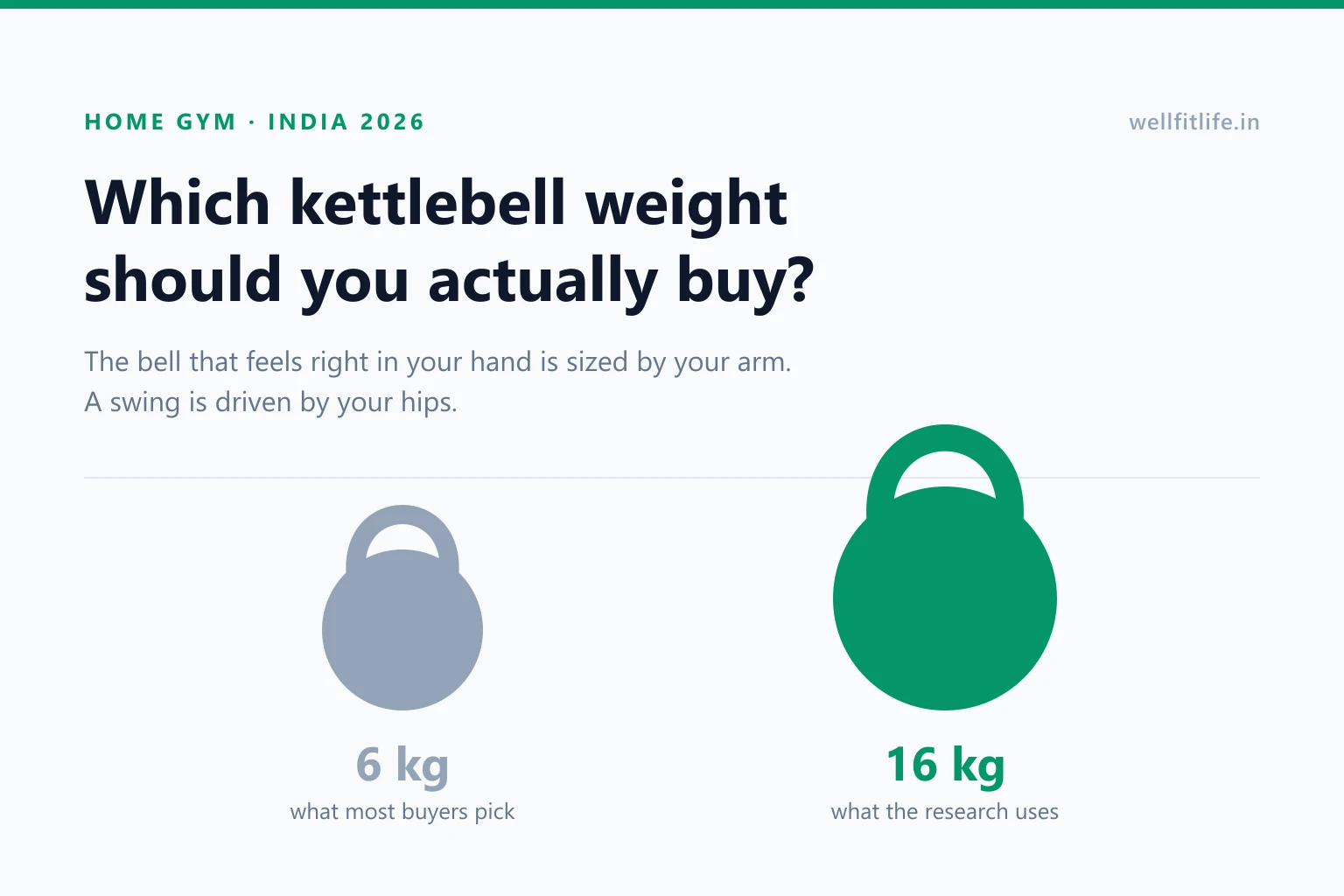
Best Kettlebells for Home Gym in India (2026): Which Weight to Buy
Almost every kettlebell sold in India is lighter than the ones the research is done with. The weight that feels right when you pick it up is roughly half the weight your hips need — and that single mistake is why most kettlebells end up under a bed.
15 min read
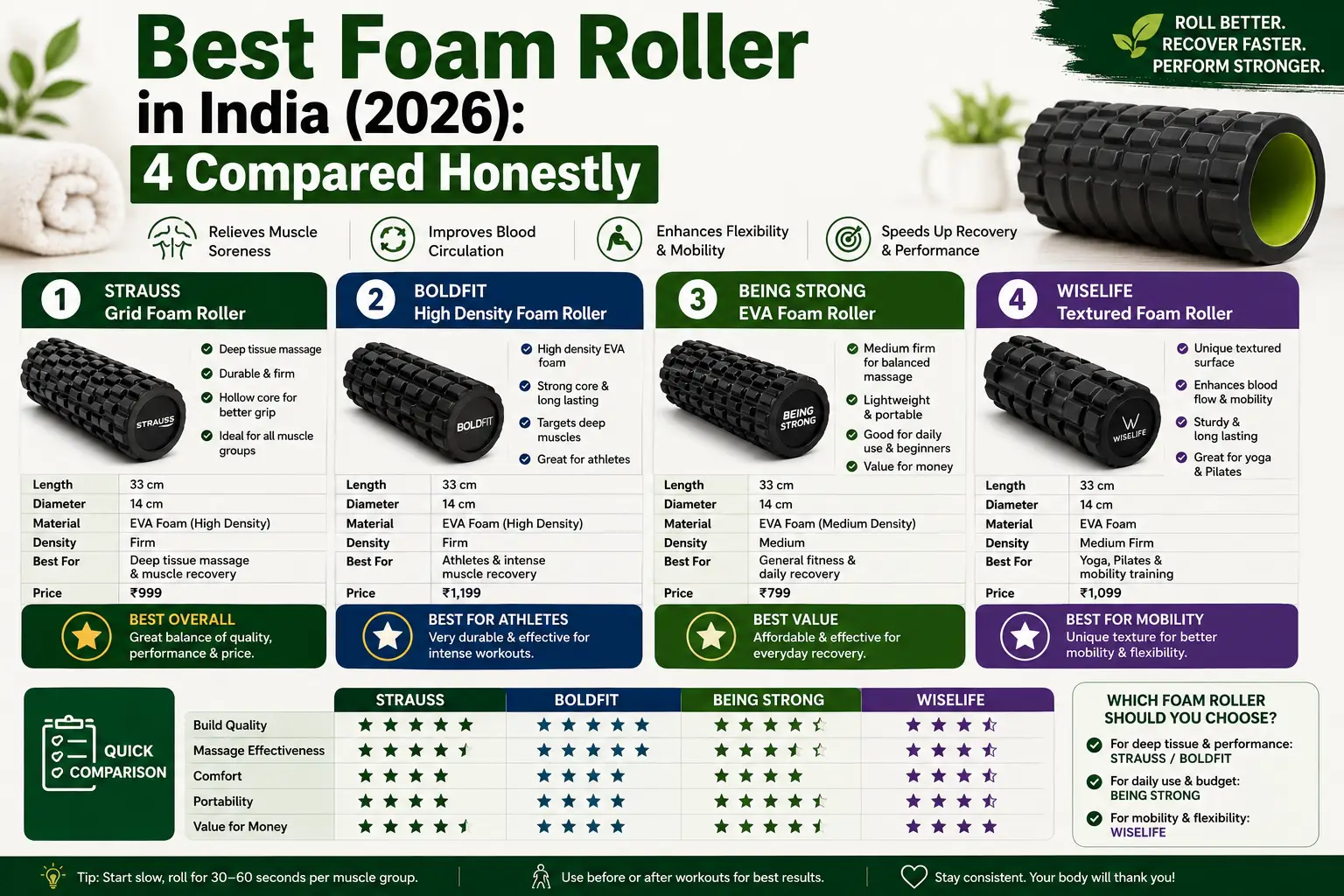
Best Foam Roller in India (2026): 4 Compared Honestly
Boldfit and Strauss foam rollers compared on density, size and rating data — plus what foam rolling actually does for sore muscles, and what it definitely does not.

18 min read
Amazon Great Indian Festival 2026: Home Gym Deals Worth Buying (and What to Skip)
The Great Indian Festival starts on 8 October 2026. The percentage off on a fitness listing is measured against MRP, which is a legal ceiling rather than a real price, so that number tells you very little. What tells you whether a deal is real is the price history and the bank offer. Here is the short list of home gym equipment worth buying in the sale, and how to check each deal before you pay.