15 Resistance Band Exercises for Full Body
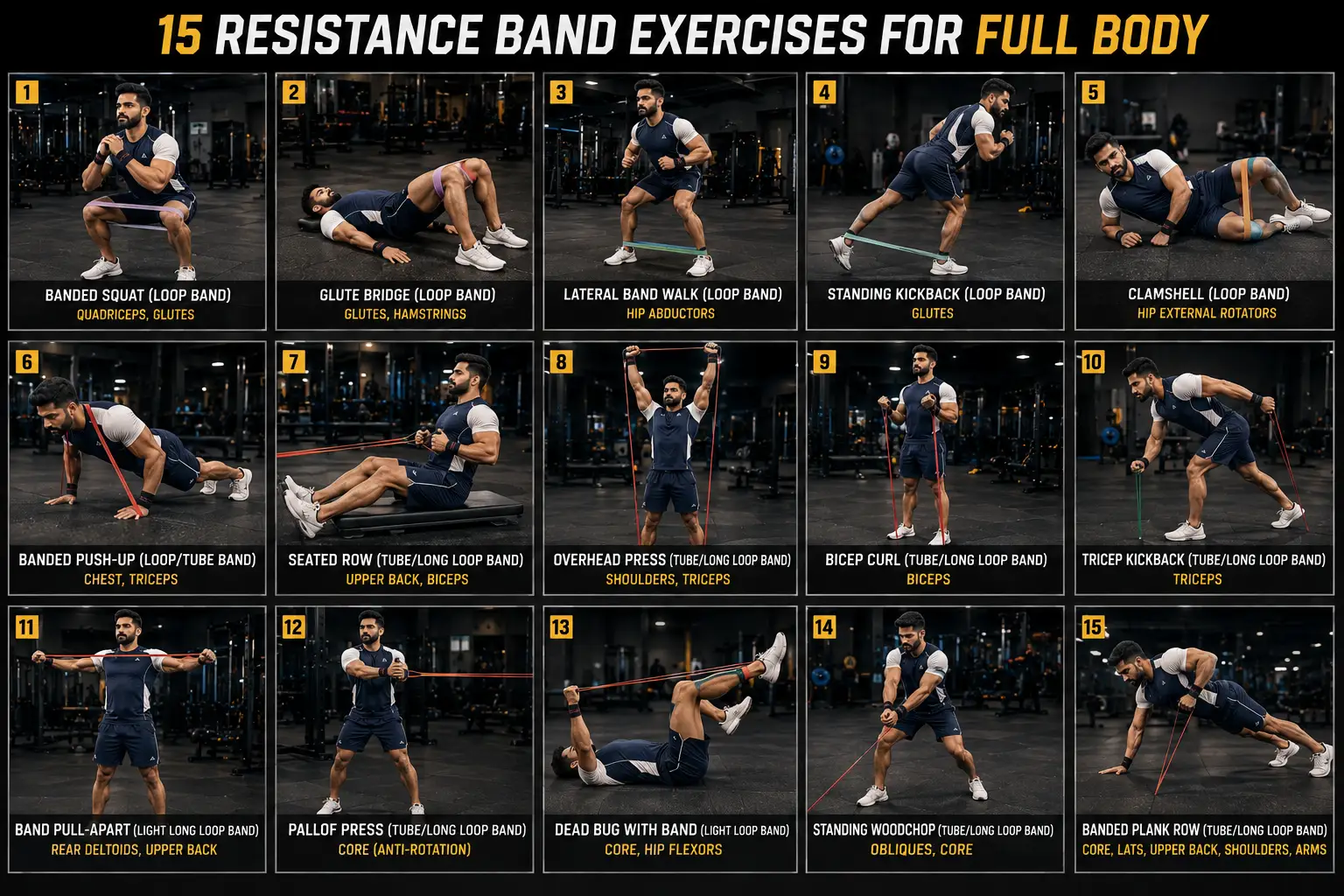
A complete full-body resistance band workout you can do in the space of a yoga mat — 15 exercises with form cues, sets and reps, and a 30-minute routine built for Indian homes with no bench, no rack and no door anchor.
Medical Safety Note: This article is for general educational purposes only and is not a substitute for professional medical advice, diagnosis, or treatment. If you are pregnant, managing a condition like diabetes, PCOS, or thyroid disorder, or taking medication, please consult a qualified doctor or registered dietitian before changing your diet, supplements, or exercise routine.
Affiliate Disclosure: This post contains affiliate links. If you buy through them, we may earn a small commission at no extra cost to you — this never affects our recommendations. We only suggest products we believe in. Learn more.
Most resistance band guides are written for homes that have a bench, a squat rack, or a door frame you can safely anchor a band to.
Indian flats usually have none of those. Door frames here are often shallow, and an anchor that slips at the wrong moment sends a stretched band straight back at you. So this guide assumes the realistic version: a two-by-two foot patch of floor, a set of loop bands, and neighbours below who would rather you did not do box jumps at 6 AM.
Every exercise below can be done standing or lying on a mat, with no anchor point, no bench and no partner.
Each one includes the setup, the form cue that actually matters, sets and reps, and the mistake most people make — because the difference between a band workout that builds something and one that just moves a rubber ring around is almost entirely in the execution.
Quick Answer — The 15 Exercises
← Swipe to compare →
| # | Exercise | Target | Band type |
|---|---|---|---|
| 1 | Banded squat | Quads, glutes | Loop |
| 2 | Glute bridge | Glutes, hamstrings | Loop |
| 3 | Lateral band walk | Hip abductors | Loop |
| 4 | Standing kickback | Glutes | Loop |
| 5 | Clamshell | Hip external rotators | Loop |
| 6 | Banded push-up | Chest, triceps | Loop or tube |
| 7 | Seated row | Upper back, biceps | Tube or long loop |
| 8 | Overhead press | Shoulders, triceps | Tube or long loop |
| 9 | Bicep curl | Biceps | Tube or long loop |
| 10 | Tricep kickback | Triceps | Tube or long loop |
| 11 | Band pull-apart | Rear delts, upper back | Light long loop |
| 12 | Pallof press | Deep core, anti-rotation | Tube or long loop |
| 13 | Dead bug with band | Core, hip flexors | Light loop |
| 14 | Standing woodchop | Obliques | Tube or long loop |
| 15 | Banded plank row | Core, upper back | Light loop |
A full-body session using these takes 30 minutes, three days a week. That sits comfortably inside the WHO recommendation of 150 minutes of moderate activity per week plus two muscle-strengthening sessions.
Do Bands Actually Build Strength, or Just "Tone"?
They build strength. A 2019 systematic review and meta-analysis in SAGE Open Medicine compared training with elastic resistance against conventional resistance — free weights and machines — and found no significant difference in strength gains between the two methods.[1]
A 2026 randomised controlled trial in Experimental Gerontology reached a similar conclusion comparing elastic band training with free weight training in community-dwelling older adults.[2]
The practical caveat: bands provide ascending resistance — tension increases as the band stretches. A band is hardest at the top of a curl and easiest at the bottom, which is the opposite of how a dumbbell behaves. That changes which part of the movement is hardest, and it is why band training feels different even when the strength outcome is comparable.
Bands are not a lesser version of weights. They are a different resistance profile that happens to fit in a drawer. For most people training at home, the limiting factor is consistency and space — not whether the resistance came from rubber or iron.
Before You Start — Which Band for Which Movement
Three formats, and they are not interchangeable:
Loop bands (mini bands) — short closed rings, worn above the knees or around the ankles. Best for lower body: squats, glute bridges, lateral walks, clamshells. Cheapest and most common in India.
Long loop bands — larger closed loops you can stand on. These handle upper body pulls and presses without needing handles, and can be doubled over to increase tension.
Tube bands with handles — closest to a cable machine. Best for rows, presses and curls where grip comfort matters over a longer set.
If you are buying one set to start, a 5-level loop band set covers the most exercises for the least money — it handles all five lower-body movements plus the core work, and can substitute for long loops on several upper-body exercises. We compared five sets available in India in our best resistance bands guide, including which ones hold up past the six-month mark.
Boldfit Loop Resistance Bands Set — 5 Bands
Five resistance levels in one set, which is what makes the progression in this guide possible — you move up a band instead of buying new equipment. Covers every lower-body and core exercise below, and doubles for several upper-body movements.
If you have ever reacted to latex gloves, balloons or elastic bandages, check the material before ordering. Almost every budget band set in India is natural rubber latex. Look for "TPE" or "latex-free" stated explicitly — many Indian listings do not state the material at all, and if it is not stated, assume latex.
📖 Read Also:
Best Resistance Bands in India (2026): Top 5 TestedFive band sets compared on build quality, resistance range and durability — with honest pros and cons, and which one to buy first depending on what you actually train.
Lower Body — 5 Exercises
1. Banded Squat
Setup: Band just above the knees, feet shoulder-width apart, toes turned slightly out.
Execution: Push your knees outward against the band as you sit back and down. Descend until your thighs are roughly parallel to the floor, then drive up through your heels.
Form cue: The band's job is to stop your knees caving inward. If they collapse in at the bottom, the band is too heavy — drop a level.
Sets and reps: 3 × 12–15
Common mistake: Letting the band go slack at the bottom. Tension should be constant through the whole rep.
2. Glute Bridge
Setup: Lie on your back, band above the knees, feet flat and hip-width, heels close to your glutes.
Execution: Press your knees out against the band, then drive your hips up until your body forms a straight line from knee to shoulder. Pause one second at the top.
Form cue: Squeeze at the top rather than arching your lower back to gain extra height.
Sets and reps: 3 × 15–20
Common mistake: Pushing through the toes instead of the heels, which shifts the work to the hamstrings.
3. Lateral Band Walk
Setup: Band above the knees or around the ankles, quarter-squat position, chest up.
Execution: Step sideways, keeping tension on the band throughout. Ten steps one way, ten back.
Form cue: Do not let the trailing foot snap in — control it back to hip width.
Sets and reps: 3 × 10 steps each direction
Why it matters: This targets the hip abductors, which are chronically underworked in people who sit for long hours.
4. Standing Kickback
Setup: Band around both ankles, hands on a wall for balance.
Execution: Drive one leg straight back, squeezing the glute at the end range. Return under control.
Form cue: Keep the torso upright. If you are leaning forward to get more range, the band is too heavy.
Sets and reps: 3 × 12 per leg
5. Clamshell
Setup: Lie on your side, band above the knees, knees bent about 45 degrees, feet together.
Execution: Keeping feet touching, open the top knee as far as the band allows. Lower slowly.
Form cue: Your hips should stay stacked. Rolling the top hip backwards is the most common cheat.
Sets and reps: 3 × 15 per side
Upper Body — 6 Exercises
6. Banded Push-Up
Setup: Band across your upper back, ends looped under each palm.
Execution: Standard push-up. The band adds resistance at the top of the press, where a normal push-up gets easy.
Form cue: Elbows at roughly 45 degrees from your body, not flared to 90.
Sets and reps: 3 × 8–12. Do them from the knees if needed — the band still adds load.
7. Seated Row
Setup: Sit on the floor, legs extended, band looped around both feet, one end in each hand.
Execution: Pull the band toward your waist, driving your elbows back and squeezing the shoulder blades together. Return slowly.
Form cue: Lead with the elbows, not the hands. Keep your chest tall rather than rounding forward at the end of the pull.
Sets and reps: 3 × 12–15
8. Overhead Press
Setup: Stand on the middle of a long band, one end in each hand at shoulder height.
Execution: Press straight overhead until your arms are extended. Lower under control.
Form cue: Brace your core. If your lower back arches as you press, reduce the tension by standing with feet closer together.
Sets and reps: 3 × 10–12
9. Bicep Curl
Setup: Stand on the band, arms at your sides, palms forward.
Execution: Curl toward your shoulders, keeping elbows pinned to your ribs.
Form cue: The band is hardest at the top — do not rush that part. Lower over a slow three-count.
Sets and reps: 3 × 12–15
10. Tricep Kickback
Setup: Stand on the band, hinge forward at the hips, upper arms parallel to your torso.
Execution: Extend the forearm back until the arm is straight. Squeeze, return slowly.
Form cue: Only the forearm moves. If the upper arm is swinging, the band is too heavy.
Sets and reps: 3 × 12 per arm
11. Band Pull-Apart
Setup: Hold a light band at shoulder height, arms extended in front, hands shoulder-width.
Execution: Pull the band apart until your arms are wide, squeezing the shoulder blades. Return slowly.
Form cue: Keep arms straight but not locked. This is a small-range movement — quality over load.
Sets and reps: 3 × 15–20
Why it matters: This is the single most useful exercise here for anyone at a desk all day. It directly opposes the rounded-shoulder posture that long sitting produces.
Core — 4 Exercises
12. Pallof Press
Setup: Anchor the band at chest height around a heavy furniture leg. Stand side-on, band held at your chest with both hands.
Execution: Press the band straight out in front of you and hold for three seconds. The band will try to rotate you — do not let it.
Form cue: This is an anti-rotation exercise. Success is measured by how still you stay, not by how far you press.
Sets and reps: 3 × 8 per side
13. Dead Bug with Band
Setup: Lie on your back, light band around both feet, arms extended toward the ceiling, knees at 90 degrees.
Execution: Extend one leg out against the band while keeping your lower back pressed into the floor. Alternate.
Form cue: The moment your lower back lifts off the floor, you have gone too far. Shorten the range.
Sets and reps: 3 × 8 per side
14. Standing Woodchop
Setup: Band anchored low, held with both hands at one hip.
Execution: Pull diagonally across your body to the opposite shoulder, rotating through the torso. Control the return.
Form cue: Rotate through the mid-back, not the lower back. Pivot the back foot to let the hips follow.
Sets and reps: 3 × 12 per side
15. Banded Plank Row
Setup: Plank position, light band looped around both wrists.
Execution: Hold the plank, lift one hand and pull it back toward your ribs against the band. Return, alternate.
Form cue: Widen your feet for stability. If your hips rock side to side, you are going too fast.
Sets and reps: 3 × 8 per side
The 30-Minute Full-Body Routine
Three days a week, non-consecutive. Rest 45–60 seconds between sets. Expect real soreness for the first two weeks — that is normal and it settles. If it is bad enough to make you skip the next session, a foam roller or a massage gun is the tool with actual trial evidence behind it for exactly that.
← Swipe to compare →
| Order | Exercise | Sets × Reps |
|---|---|---|
| 1 | Banded squat | 3 × 12 |
| 2 | Seated row | 3 × 12 |
| 3 | Glute bridge | 3 × 15 |
| 4 | Overhead press | 3 × 10 |
| 5 | Lateral band walk | 3 × 10 each way |
| 6 | Banded push-up | 3 × 10 |
| 7 | Pallof press | 3 × 8 each side |
| 8 | Band pull-apart | 3 × 15 |
Progression over 4 weeks:
- Week 1–2: Learn the movements. Use a band level where the last two reps are challenging but your form does not break.
- Week 3: Add one set to the first four exercises.
- Week 4: Move up a band level on the lower-body exercises, and return to three sets.
📖 Read Also:
Home Workout Plan for Indians 2026: No Gym, Real ResultsThe complete home training framework — fat loss, muscle building, HIIT and yoga routines, with an equipment list that stays under ₹5,000.
How to Progress Without Buying Heavier Bands
Once the heaviest band in your set stops being challenging, most people assume they need to buy more equipment. Usually they do not. Four ways to add difficulty with the same band:
1. Slow the eccentric. Take four seconds to return to the start position on every rep. This increases time under tension without changing the band.
2. Shorten the band. Wrap it once more around your hand or foot, or stand with your feet wider apart on a long band. Less slack means more tension through the whole range.
3. Go unilateral. One leg or one arm at a time doubles the load on the working side and adds a balance demand.
4. Double up. Two lighter bands together often gives a smoother resistance curve than one heavy band, and lets you make smaller jumps in difficulty.
When these stop working, that is the genuine signal to add free weights rather than more bands. A pair of adjustable dumbbells is the usual next purchase — our home gym under ₹5,000 guide covers what to buy in what order once bands alone stop being enough.
📖 Read Also:
Dumbbells vs Resistance Bands — Which is Better for Home Workouts?An honest comparison for Indian homes on cost, space, muscle-building potential and which one to buy first.
Frequently Asked Questions
Can resistance bands build muscle?
Yes. A 2019 systematic review and meta-analysis found no significant difference in strength gains between elastic resistance training and conventional resistance training with weights and machines.[1] Muscle growth follows the same principles regardless of resistance source — progressive overload, sufficient volume, and adequate protein.
How many days a week should I train with resistance bands?
Three non-consecutive days is the standard starting point for a full-body routine. That aligns with the WHO guidance of at least two muscle-strengthening sessions per week for adults.[3]
Which resistance band should a beginner start with?
Start with the lightest or second-lightest band in a multi-level set. Most beginners choose a band that is too heavy, which causes form to break down — particularly on lateral walks and clamshells, where the target muscles are usually weak to begin with.
Do I need a door anchor for these exercises?
No. Thirteen of the fifteen exercises here need no anchor at all. The Pallof press and woodchop can use a heavy furniture leg instead. Door anchors are worth avoiding in most Indian flats where door frames are shallow.
How long do resistance bands last?
Anywhere from a few months to a couple of years, depending on use and storage. Keep them out of direct sunlight, do not stretch beyond about 2.5 times resting length, and check for micro-tears before each session — a small tear becomes a snap under load.
Are resistance band workouts enough for weight loss?
They contribute, but nutrition drives most of the result. Band training builds and preserves muscle in a calorie deficit, which protects your metabolic rate while you lose fat. Pair it with a controlled diet rather than expecting the training alone to do the work — our complete fat loss guide for Indians covers the nutrition side in full.
Can I do these exercises if I have a latex allergy?
Look for TPE or fabric bands, which are latex-free. Fabric bands work for all the lower-body exercises here but cannot replace tube bands for upper-body pulling. Check the product listing for a stated material — if none is stated, assume natural rubber latex.
Loop bands or tube bands with handles — which should I buy first?
Loop bands, if you are buying one set. They cover every lower-body and core exercise in this guide and substitute for long loops on several upper-body movements. Tube bands with handles are a worthwhile second purchase once you are training upper body more seriously.
Final Word
The gap between a band set that sits in a drawer and one that produces results is not the equipment — it is having a specific routine and a way to make it harder over time. The 30-minute session above and the four progression methods cover both.
Start with three sessions a week for four weeks before changing anything. If the heaviest band still feels easy at the end of that, you have earned the upgrade.
📖 Read Also:
Build Muscle at Home Without a Gym — Complete Indian GuideHow to structure home training for actual muscle gain — progressive overload without machines, plus the Indian diet side of the equation.
References
- Lopes JSS, et al. Effects of training with elastic resistance versus conventional resistance on muscular strength: A systematic review and meta-analysis. SAGE Open Medicine, 2019. PubMed: 30815258
- Effects of elastic band training versus free weight training in community-dwelling older adults: A randomized controlled trial. Experimental Gerontology, 2026. PubMed: 42217686
- World Health Organization. Physical activity fact sheet. who.int
Free Tools to Help You
Put this article into action — use our free calculators to get your personalized numbers.
Was this article helpful?
Want More Tips Like This?
Join 1,000+ readers getting weekly fitness, diet, and wellness tips + FREE meal plan
No spam, ever. Unsubscribe anytime.

About the Author: Ashwani
Fitness enthusiast and wellness writer. I research and write about home workout equipment and supplements — so you can make informed decisions without wasting money.
Read more about us →Comments
Leave a Comment
Your email will not be published. Comments are reviewed before appearing.
You Might Also Like
Continue your wellness journey
26 min read
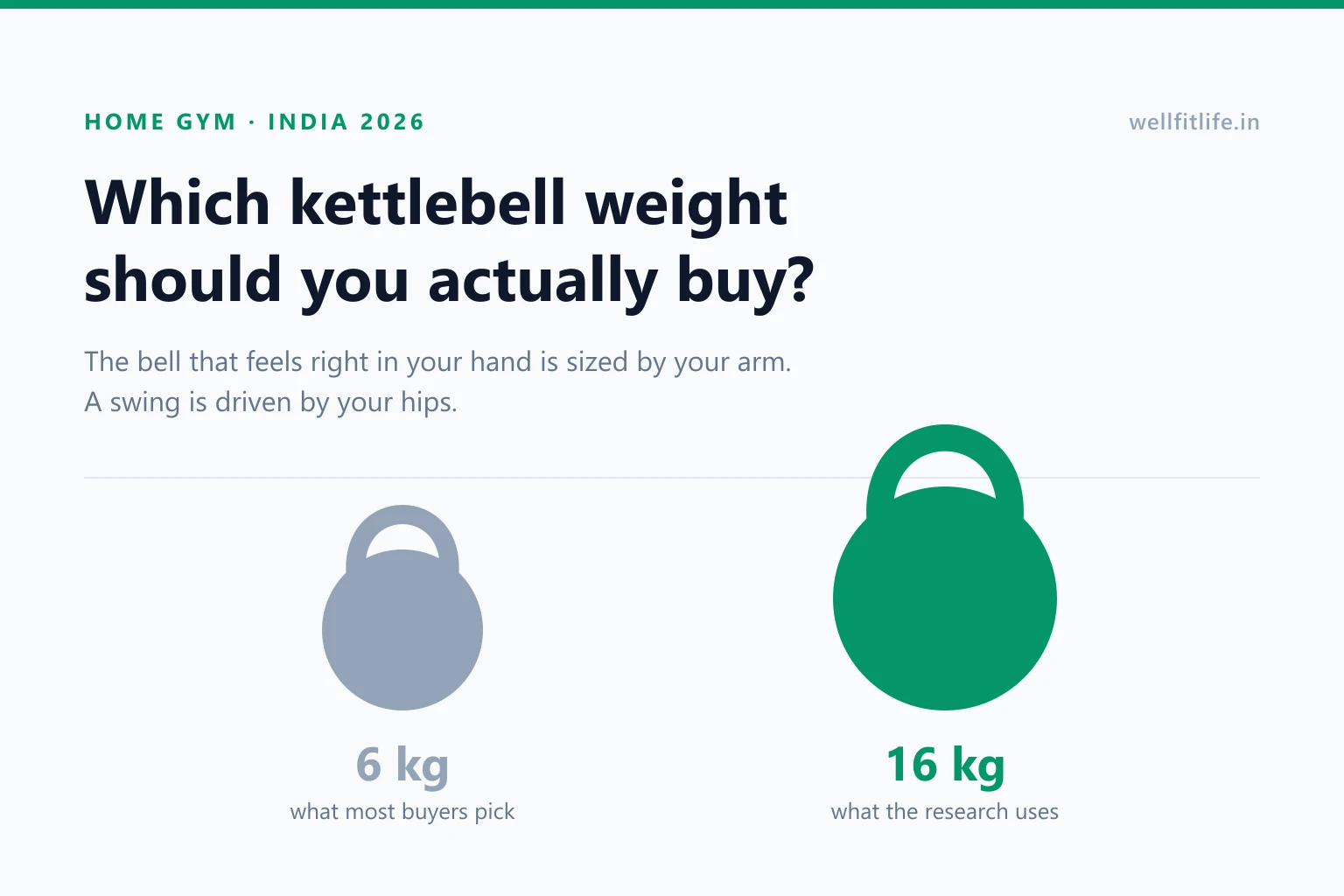
Best Kettlebells for Home Gym in India (2026): Which Weight to Buy
Almost every kettlebell sold in India is lighter than the ones the research is done with. The weight that feels right when you pick it up is roughly half the weight your hips need — and that single mistake is why most kettlebells end up under a bed.

17 min read
Best Gym Shoes in India (2026): 6 Compared Honestly
Most Indians buy a running shoe for the gym. Here is exactly when that is fine, when it costs you, and six options compared — from a ₹1,500 Campus to the Nike Metcon.
15 min read
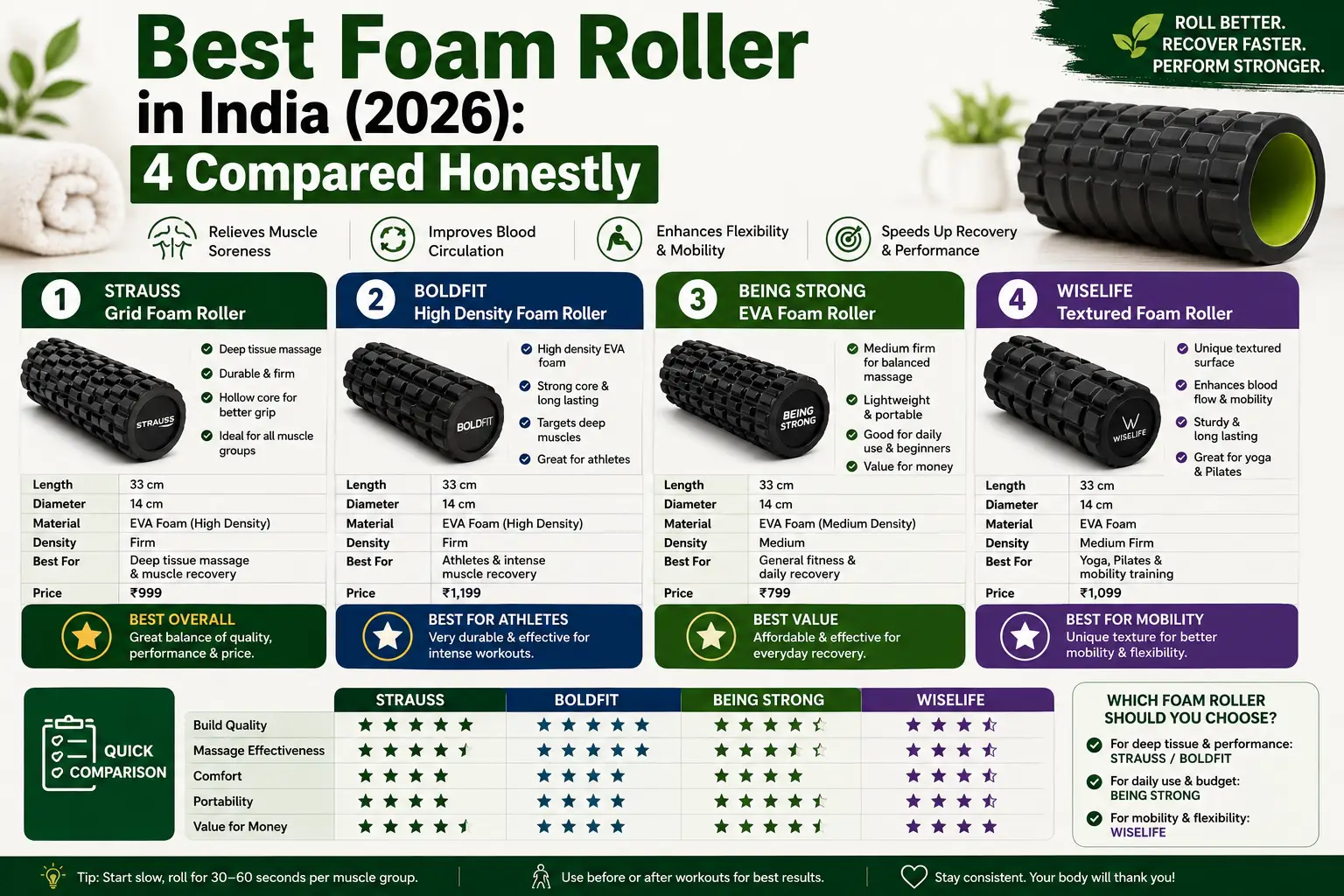
Best Foam Roller in India (2026): 4 Compared Honestly
Boldfit and Strauss foam rollers compared on density, size and rating data — plus what foam rolling actually does for sore muscles, and what it definitely does not.