Best Adjustable Dumbbells in India (2026): 5 Compared
The real decision is not the brand — it is the mechanism, and it splits this category into two products at wildly different prices. Here is how to pick, and the weight-range trap that wastes most purchases.
Affiliate Disclosure: This post contains affiliate links. If you buy through them, we may earn a small commission at no extra cost to you — this never affects our recommendations. We only suggest products we believe in. Read our full affiliate disclosure.
Quick Answer
Of the adjustable dumbbells sold in India in 2026, buy a Cube Club Powerkit cast-iron kit if you want a set that lasts — ideally the 20 kg kit, which is 10 kg per hand — or the Amazon Symactive 20 kg if price decides it. Spin-lock is the right mechanism for most Indian home gyms: it has nothing to break, you buy only the weight you need now, and the 30 seconds it costs to change weight only matters if you do supersets. A dial set costs about the same per kilogram, but you pay for all 24 kg per hand on day one, and the selector is its likeliest point of failure.
The Cube Club Adjustable Dumbbell 10 Kg Cast Iron Powerbells
Cast iron plates rather than PVC, and a spin-lock collar with nothing electronic or spring-loaded to fail. The 10 kg kit is 5 kg per hand, which is light for rows and presses — but Cube Club sells the same cast-iron plates in 20 kg and 50 kg kits, so you add to it instead of replacing it. 4.4 across 310 ratings is a thin history; the build is the reason to pick it.
Not sure a 10 kg starting set is enough, or whether a dial mechanism is worth the money for how you train? The full reasoning, the weight-range trap, and all five sets compared are below.
Search "adjustable dumbbells India" and you get results from ₹1,800 to ₹27,000. That is a 15× price spread on what looks, in the thumbnails, like the same product.
It is not the same product. The spread comes almost entirely from one design choice — how the weight actually changes — and that choice matters far more than the brand printed on the plate.
Get it right and you spend appropriately for how you actually train. Get it wrong and you either overpay by ₹12,000 for a convenience you never use, or you buy a set that makes the exact style of training you enjoy unbearable.
This guide covers the mechanism decision, the weight-range trap that quietly wastes a large share of these purchases, and five sets compared.
How this guide was put together: I have not owned all five of these sets long-term, so you will not find "I tested each of these for six months" claims here. What follows is a mechanism and specification comparison built from current Indian listings, published rating data, and reviewer reports — the homework I would do before spending my own money. Where I rank one above another, it is because of the reasoning below, not because I have worn one out. How we source claims and where AI is used is set out in our editorial policy.
Which One Suits How You Train
Every set here adjusts weight. They differ in how fast, how far, and how likely the mechanism is to be the thing that eventually breaks.
← Swipe to compare →
| If this is you | Start with | The catch you should know first |
|---|---|---|
| You rest 60–90 seconds between straight sets and want to spend the least | Amazon Symactive 20 kg | Lowest rated of the five at 3.9, and the plates are PVC rather than iron — that is the trade for the price |
| You want a set you can keep adding plates to for years | Cube Club cast-iron kit | The 10 kg kit is only 5 kg per hand — start with the 20 kg kit for rows and presses — and 310 ratings is a thin history |
| You do supersets, drop sets or circuits | Cockatoo ADB-01 | The dial selector is the moving part and the likeliest failure point, and 250 ratings is not much track record |
| You want the widest dial range and a design-led brand | Flexnest 2.5–24 kg | Reviewers flag plastic connectors sitting between the cast-iron plates |
| You are starting light and very short on space | Lifelong LLAD02 | Caps at 12.5 kg — you will outgrow it on rows and presses, and a dial set cannot be extended |
Who should skip this page entirely: if you have never trained with weights at all, adjustable dumbbells are not the first purchase. That case is covered near the end, and no spec here changes it.
📖 Read Also:
Amazon Great Indian Festival 2026: Home Gym Deals Worth BuyingBuying in the 8 October sale? How to tell whether a percentage off is real, and what the SBI offer is actually worth on this.
The One Question That Decides Everything
Before any spec, answer this: do you rest between sets, or do you superset?
If you train straight sets with 60–90 seconds of rest, you have 60–90 idle seconds between every set. Unscrewing a collar and sliding a plate on takes about 30 of them. The slowness of a spin-lock set costs you nothing — you were standing around anyway. Paying ₹15,000 to save time you were going to waste is a bad trade.
If you superset, drop-set, or run circuits, the calculation inverts completely. Drop sets need the weight to change in seconds, not half a minute. Spend 40 seconds fumbling with nuts between drops and the set is over — the whole stimulus you were chasing has dissipated. Here a dial set is not a luxury, it is what makes the training possible.
One number makes this concrete. ACSM's 2026 guidelines put muscle growth at roughly 10 sets per muscle group per week, training each group at least twice a week. Work that through a full-body session and you are changing weight dozens of times a week, every week. Whether 30 seconds per change is free or expensive depends entirely on whether you were resting anyway.
That single question decides whether you can buy weight gradually or must pay for all of it up front, and it has nothing to do with how serious a lifter you are.
What Actually Matters When Buying
1. Mechanism — spin-lock vs dial
Spin-lock / plate-loaded. A threaded rod, loose plates, and collars you screw on. Changing weight takes 30–60 seconds per dumbbell.
- Nearly nothing to break — a threaded rod has no moving parts
- Extendable. Buy more plates and the set grows with you, indefinitely
- Pay as you grow: a 10 kg cast-iron starter kit is about ₹3,200 at the brand's own store, and you add plates later
- Slow, and loose plates need somewhere to live
Dial / quick-adjust. A selector dial picks up the plates you want in one or two seconds.
- Genuinely fast — this is the whole point
- Compact; everything lives in one cradle
- Not extendable. 24 kg is 24 kg forever
- Paid up front: about ₹17,000–18,000 for a 2.5–24 kg pair at the brands' own stores
- The selector is a real failure point, and it is the expensive part
Here is the part that gets missed: the pay-as-you-go option is the one that scales, and the premium option is the one with a hard ceiling. That inverts how people usually think about "investing in good equipment."
2. Weight range — the trap that wastes the most money
This is where most adjustable dumbbell purchases go wrong in India.
A 12.5 kg-per-side set sounds like plenty when you are starting. For curls, lateral raises and triceps work, it genuinely is — you will be there for a long time.
But dumbbell rows, presses and goblet squats progress fast. A beginner rowing 10 kg can be rowing 14 kg or more within a few months. At that point a 12.5 kg cap is not a limitation you work around; it is the end of progressive overload on your biggest movements.
The research is blunt about how fast that happens. Kraemer and Ratamess, reviewing the resistance training literature in ACSM's journal, summarised strength gains of roughly 40% in untrained lifters against about 16% in already-trained lifters, over training periods ranging from four weeks to two years (Kraemer & Ratamess, Med Sci Sports Exerc, 2004, PMID 15064596); the same progression logic runs through ACSM's position stand on progression models. Beginners are exactly the people buying a first adjustable set, and they are the people whose numbers move fastest.
ACSM's 2026 resistance training guidelines — published 17 March 2026, the first update in 17 years, drawn from 137 systematic reviews covering over 30,000 participants — put the load for strength work at 80% of your one-rep max. That figure is what turns a weight ceiling into a real problem: as your 1RM on rows climbs, 80% of it climbs with it, and a 12.5 kg cap stops being a number you train under.
Worth planning for now if presses are in your future: a gym bench is usually the next purchase after adjustables, and its capacity rating has to carry your bodyweight plus whatever you are pressing — which catches a lot of people out.
With a plate-loaded set you buy more plates and carry on. With a dial set you buy a whole new set. If you are choosing a dial mechanism, treat 20 kg per side as the realistic minimum unless you are certain you will only ever use it for accessory work.
3. Cast iron vs PVC/vinyl plates
Iron is denser, so an iron plate is physically smaller than a PVC plate of the same weight. That matters more than it sounds — bulky PVC plates hit your forearms during curls and your chest during presses, and they make the loaded dumbbell awkwardly long.
PVC is quieter, kinder to tile floors, and cheaper. Iron lasts effectively forever and stays compact. For a set you intend to keep and extend, iron is the better long-term buy.
4. Rod length, knurling and collar quality
On spin-lock sets, the parts nobody photographs are the ones that decide whether you enjoy using it:
- Knurling — the crosshatch texture on the grip. Too smooth and sweaty hands slip; there is no fixing this after purchase.
- Collar quality — the collars are what stop plates sliding mid-rep. Cheap ones loosen under repeated load, which is exactly when you do not want them to.
- Rod length — a 14-inch rod fits a usable number of plates. Shorter rods run out of thread before you run out of strength.
5. Warranty — read what it actually covers
Dial sets typically carry a 12-month warranty. The question worth asking is whether it covers the mechanism or only manufacturing defects, because the mechanism is the thing that fails and it is the reason you paid the premium.
Spin-lock sets rarely carry meaningful warranties, and rarely need one. There is very little in a threaded steel rod that can fail.
6. Floor and space
Two practical points for Indian homes. Dropping any dumbbell on tile cracks the tile long before it damages the dumbbell — a mat is not optional, and thickness matters more than brand once weight is involved. And a plate-loaded set needs floor space for the loose plates, which people forget when comparing it against a dial set that stores everything in one cradle.
What a Set Actually Costs, by Tier
The 15× spread at the top of this page looks like a quality ladder. It is mostly a difference in how much weight you buy on day one. Compare the mechanisms per kilogram and the gap nearly disappears.
← Swipe to compare →
| Set | Brand-store price | Cost per kg of top weight | Extendable later? |
|---|---|---|---|
| Cube Club cast-iron spin-lock kit | 10 kg ₹3,199 · 20 kg ₹6,199 · 50 kg ₹14,999 | ~₹300–320 | Yes — buy more plates indefinitely |
| Cockatoo ADB-01 dial pair, 2 × 24 kg | ₹16,990 | ~₹354 | No — the top weight is fixed forever |
| Flexnest Flexibell dial pair, 2 × 24 kg | ₹17,998 | ~₹375 | No |
Prices are each brand's own store, retrieved 24 September 2026 (Cube Club, Cockatoo, Flexnest); Amazon's price on the day may differ.
Per kilogram, cast-iron spin-lock and dial sets are within about 20% of each other. The real difference is timing: a spin-lock kit lets you buy 10 or 20 kg now and add plates as you get stronger, while a dial set makes you pay for 48 kg of iron up front, including weight you will not lift for a year. PVC spin-lock sets such as the Symactive are cheaper again, which is where the lowest prices in this category come from. You are not really choosing a price point. You are choosing when you pay, and the mechanism decides that.
If your budget is under ₹5,000, the answer is a spin-lock set and it is not a compromise. Every dial set worth owning starts around ₹10,000, so the choice under ₹5,000 is not "cheap dial vs good spin-lock" — it is spin-lock, or nothing. Put the difference toward plates you will actually need in a year, or toward the bench that comes next.
If your budget stretches past ₹10,000, do not spend it on a dial set by default. Re-read the one question above first: if you train straight sets with rest, a 20 kg cast-iron kit at around ₹6,200 plus a bench beats a ₹17,000 dial set that saves you time you were going to spend standing still anyway.
A note on wording, because Indian listings are inconsistent: adjustable dumbbells, changeable dumbbells and adjustable dumbbell sets all describe the same two mechanisms above. A listing calling itself a "15-in-1 set" is counting the weight combinations a dial offers, not fifteen separate products.
The Five Compared
← Swipe to compare →
| Product | Ratings | Avg | Mechanism | Range | Plates |
|---|---|---|---|---|---|
| Cube Club Powerkit | 310 | 4.4 | Spin-lock | 10 kg total | Cast iron |
| Amazon Symactive | 1,653 | 3.9 | Spin-lock | 20 kg total | PVC |
| Flexnest | 665 | 4.3 | Dial | 2.5–24 kg | Cast iron |
| Lifelong LLAD02 | 240 | 4.4 | Dial | 2.5–12.5 kg | Iron |
| Cockatoo ADB-01 | 250 | 4.5 | Dial | 2.5–24 kg | Steel |
One thing to read carefully in that table: the averages fall as the sample grows. The three smallest samples — 240, 250 and 310 ratings — all score between 4.4 and 4.5. The two largest, at 665 and 1,653, score 4.3 and 3.9. The most-rated set by a wide margin is the lowest-rated of the five.
Small samples produce flattering averages, and in this category nobody has a large enough sample to be conclusive — which is itself worth knowing before you treat a 4.5 as proof of anything.
Amazon Brand Symactive 20 Kg Adjustable Dumbbell Set
1,653 ratings — by some distance the largest sample in this comparison. Spin-lock design with PVC plates (2 kg × 4 and 3 kg × 4), a secure weight-locking mechanism, and a pair of 14-inch rods with nuts. The cheapest sensible way into adjustable loading if you train straight sets with rest between them.
The Cube Club Adjustable Dumbbell 10 Kg Cast Iron Powerbells
Cast iron plates with an anti-slip rod, in a spin-lock design. Iron keeps the loaded dumbbell compact where PVC gets bulky, and because it is plate-loaded you can keep adding weight as you get stronger rather than replacing the set. The 10 kg kit is 5 kg per hand, so treat it as a base to build on — the 20 kg kit is the better start if rows and presses are in your plan.
Cockatoo ADB-01 Adjustable Dumbbell Set (2.5–24 kg)
A 15-in-1 steel-plate dial set with one-second weight adjustment and a 24 kg top end — the combination that makes supersets, drop sets and circuits actually workable at home. Carries a 1-year warranty. Check specifically whether that warranty covers the selector mechanism, since that is the part you are paying the premium for.
Flexnest Adjustable Iron Dumbbells (2.5–24 kg, Set of 2)
Dial set that Flexnest markets as designed in Germany, with the same useful 2.5–24 kg range, sold as a pair. Cast iron plates. Check the warranty term on the listing before buying. Worth knowing before you buy: reviewers have flagged the plastic connector pieces that sit between the iron plates as the part that does not inspire confidence over time. 4.3 across 665 ratings is the largest sample of the three dial sets here.
Lifelong LLAD02 Adjustable Dumbbells (2.5–12.5 kg)
Iron dial set with quick weight adjustment, from a brand with a wide Indian service footprint. Rated 4.4, but on the smallest sample here at 240 ratings. The real consideration is the 12.5 kg ceiling — fine for arms and shoulders, but you will meet that limit on rows and presses sooner than you expect, and a dial set cannot be extended.
The short version: straight sets with rest → buy spin-lock and put the savings elsewhere. Supersets, drop sets or circuits → buy a dial set, and buy one that reaches at least 20 kg per side so you are not replacing it in a year.
Adjustable Dumbbells vs Fixed Dumbbells vs Resistance Bands
← Swipe to compare →
| Option | Cost to start | Best at | Where it falls down |
|---|---|---|---|
| Adjustable dumbbells | ₹1,800–18,000 | Progressive overload without a rack; one purchase covers years of strength work | Changing weight always costs something — money or time |
| Fixed dumbbells | Priced per pair | Instant changes, indestructible, best feel in the hand | A usable range means several pairs, which gets expensive and eats a wall |
| Resistance bands | ₹300–700 | Budget, portability, joint-friendly volume, travel | Hard to progress in precise increments, and they wear out |
If you are still deciding between weights and bands entirely, that comparison is its own question and we have covered it in detail:
📖 Read Also:
Dumbbells vs Resistance Bands — Which is Better for Home Workouts in India?The honest breakdown by goal, space and budget — including why owning both usually beats choosing one.
Who Should Not Buy One
- You have never trained with weights. Start with resistance bands and bodyweight for two or three months. They cost a tenth as much and will tell you whether the habit sticks before you commit real money.
- You want to buy your way to consistency. Equipment has never fixed this. A ₹17,000 dial set used twice a month builds less than ₹500 bands used four times a week.
- Your training is purely accessory work. If you only do curls, raises and triceps, fixed 5 kg and 10 kg dumbbells cost less and change faster than anything here.
- You have not covered the basics yet. Shoes, a mat and somewhere to store plates come before a second set of weights — the beginner gym essentials list covers what actually gets used versus what gets bought and abandoned.
- You live on an upper floor with tile and no mat. Sort the floor out first. This is the purchase that damages Indian flooring, and a dropped 24 kg dumbbell settles the argument permanently.
For where a set like this fits into a complete home setup, and what to buy in what order:
📖 Read Also:
Best Home Gym Under ₹5000 in India: Complete Beginner Equipment GuideThe full budget build — what to buy first, which Indian brands are worth trusting, and what to skip entirely.
Frequently Asked Questions
Are adjustable dumbbells worth it in India?
Yes, if you intend to train with weights at home for more than a few months. A single adjustable pair replaces a rack of fixed dumbbells for a fraction of the cost and floor space. They are not worth it if you have never trained with weights before — bands and bodyweight will tell you whether the habit sticks first, at a tenth of the price.
Spin-lock or dial — which adjustable dumbbell should I buy?
It depends on one thing: whether you rest between sets. If you train straight sets with 60–90 seconds of rest, spin-lock costs you nothing in training time, lets you pay for only the weight you need now, and can be extended with extra plates. If you do supersets, drop sets or circuits, a 30–60 second plate change ruins the set and a dial mechanism is worth paying for.
How much weight do I need in an adjustable dumbbell set?
For arms and shoulders, 12.5 kg per side lasts a long while. For rows, presses and goblet squats it does not — these are the lifts where beginners progress fastest, and untrained lifters typically gain around 40% in strength. If you are buying a dial set, which cannot be extended, treat 20 kg per side as the practical minimum. Plate-loaded sets sidestep this entirely because you can keep adding plates.
Are cast iron plates better than PVC?
For a set you plan to keep, yes. Iron is denser, so the loaded dumbbell stays physically shorter and does not catch your forearms during curls or your chest during presses. PVC is cheaper, quieter and gentler on tile floors, which is a fair trade at the budget end — but iron lasts effectively forever.
Can adjustable dumbbells build real muscle?
Yes. Muscle responds to progressive tension and effort, not to the shape of the equipment. An adjustable pair that reaches 20–24 kg per side covers the productive range for most home trainees for years. The limitation is the top end for heavy compound lifts, not the tool itself.
What is the main problem with dial adjustable dumbbells?
The selector mechanism. It is the moving part, it is the expensive part, and it is what fails. Check whether the warranty covers the mechanism specifically rather than just manufacturing defects. The secondary issue is that dial sets have a fixed ceiling — when you outgrow 24 kg, you replace the entire set rather than buying another plate.
Do I need a mat under adjustable dumbbells?
Yes, particularly on tile, which is most Indian homes. A dropped dumbbell cracks the tile long before it damages the dumbbell, and iron plates mark flooring even when set down carefully. This is a genuine cost of the purchase, not an upsell.
Which is better — Cockatoo or Flexnest adjustable dumbbells?
Both are dial sets reaching 2.5–24 kg. Cockatoo rates 4.5 on about 250 ratings; Flexnest rates 4.3 on about 665 — a higher score on a quarter of the sample, which is not the clear win it looks like. The Cockatoo advertises one-second adjustment and a 1-year warranty. Reviewers have flagged the plastic connector pieces between Flexnest's iron plates as a durability concern. Neither has enough rating history for a confident verdict, so weigh warranty terms and service reach in your city more heavily than the star ratings.
Final Word
The industry sells this category on convenience, which is why the expensive sets get reviewed most warmly. But convenience only has value if you were actually going to use it, and a large share of home lifters rest 90 seconds between straight sets and would never notice a slower plate change.
Work out how you train first. Then buy the mechanism that matches — spin-lock and extendable if you rest between sets, dial and at least 20 kg per side if you do not. Both are correct answers. Paying premium money for the wrong one is the mistake this category is built on.
Once you are training heavy at home three days a week, the thing that derails people is not the equipment — it is recovery:
📖 Read Also:
Best Massage Gun in India (2026): 5 Compared HonestlyWhat the research actually supports for soreness and range of motion, plus the spec Indian listings never publish.
📖 Read Also:
Gym Gloves, Straps & Bags — What's Actually Worth BuyingOnce dumbbell rows get heavy, grip becomes the limiter before your back does. That is the point lifting straps start earning their price.
📖 Read Also:
Best Kettlebells for Home Gym in India (2026): Which Weight to BuyThe same weight-range trap shows up here in a cheaper form — and the mainstream Indian ladder stops one rung below the standard starting weight.
Free Tools to Help You
Put this article into action — use our free calculators to get your personalized numbers.
Was this article helpful?
Want More Tips Like This?
Join 1,000+ readers getting weekly fitness, diet, and wellness tips + FREE meal plan
No spam, ever. Unsubscribe anytime.

About the Author: Ashwani
Fitness enthusiast and wellness writer. I research and write about home workout equipment and supplements — so you can make informed decisions without wasting money.
Read more about us →Comments
Leave a Comment
Your email will not be published. Comments are reviewed before appearing.
You Might Also Like
Continue your wellness journey
27 min read
Best Kettlebells for Home Gym in India (2026): Which Weight to Buy
Almost every kettlebell sold in India is lighter than the ones the research is done with. The weight that feels right when you pick it up is roughly half the weight your hips need — and that single mistake is why most kettlebells end up under a bed.
15 min read
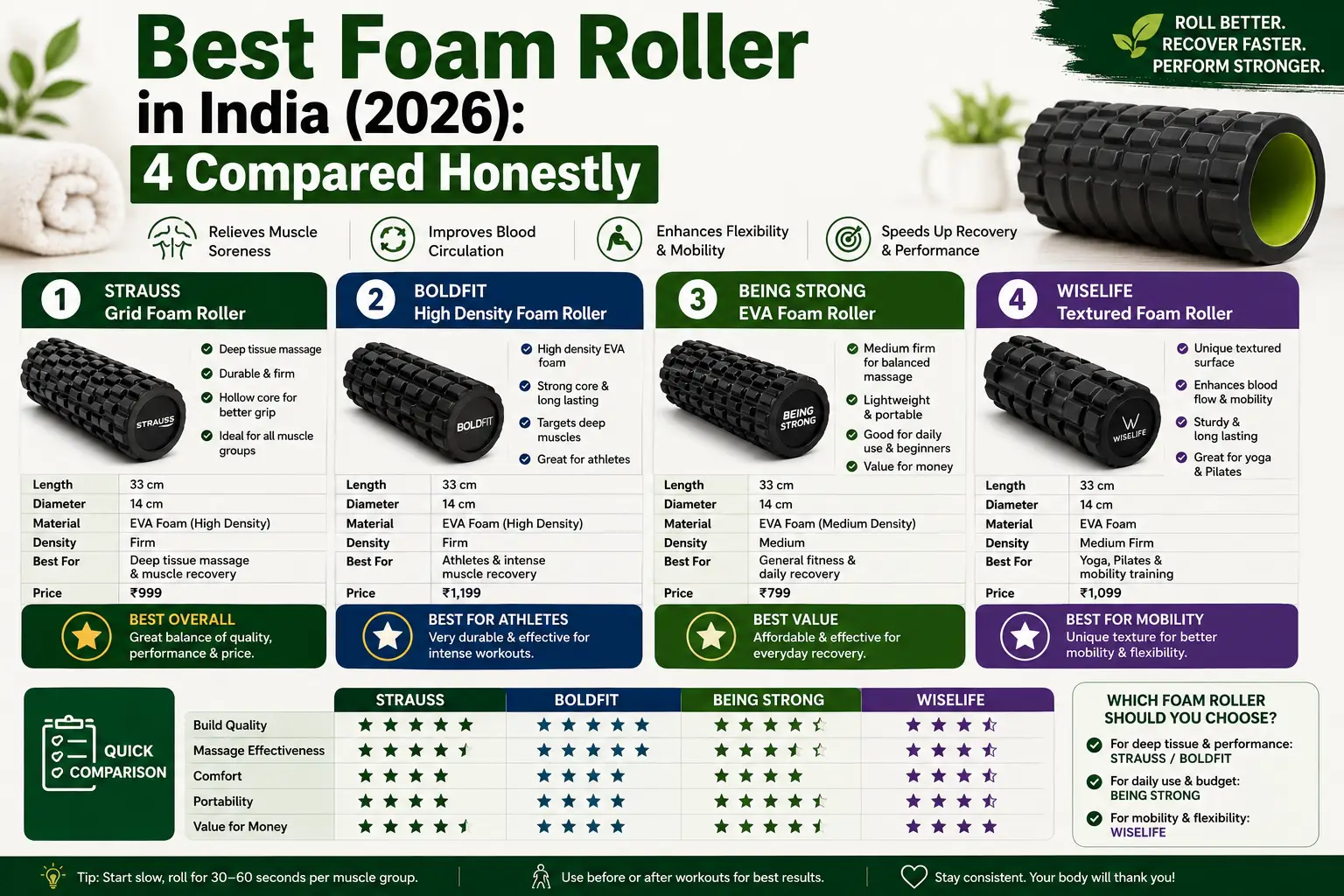
Best Foam Roller in India (2026): 4 Compared Honestly
Boldfit and Strauss foam rollers compared on density, size and rating data — plus what foam rolling actually does for sore muscles, and what it definitely does not.

18 min read
Amazon Great Indian Festival 2026: Home Gym Deals Worth Buying (and What to Skip)
The Great Indian Festival starts on 8 October 2026. The percentage off on a fitness listing is measured against MRP, which is a legal ceiling rather than a real price, so that number tells you very little. What tells you whether a deal is real is the price history and the bank offer. Here is the short list of home gym equipment worth buying in the sale, and how to check each deal before you pay.