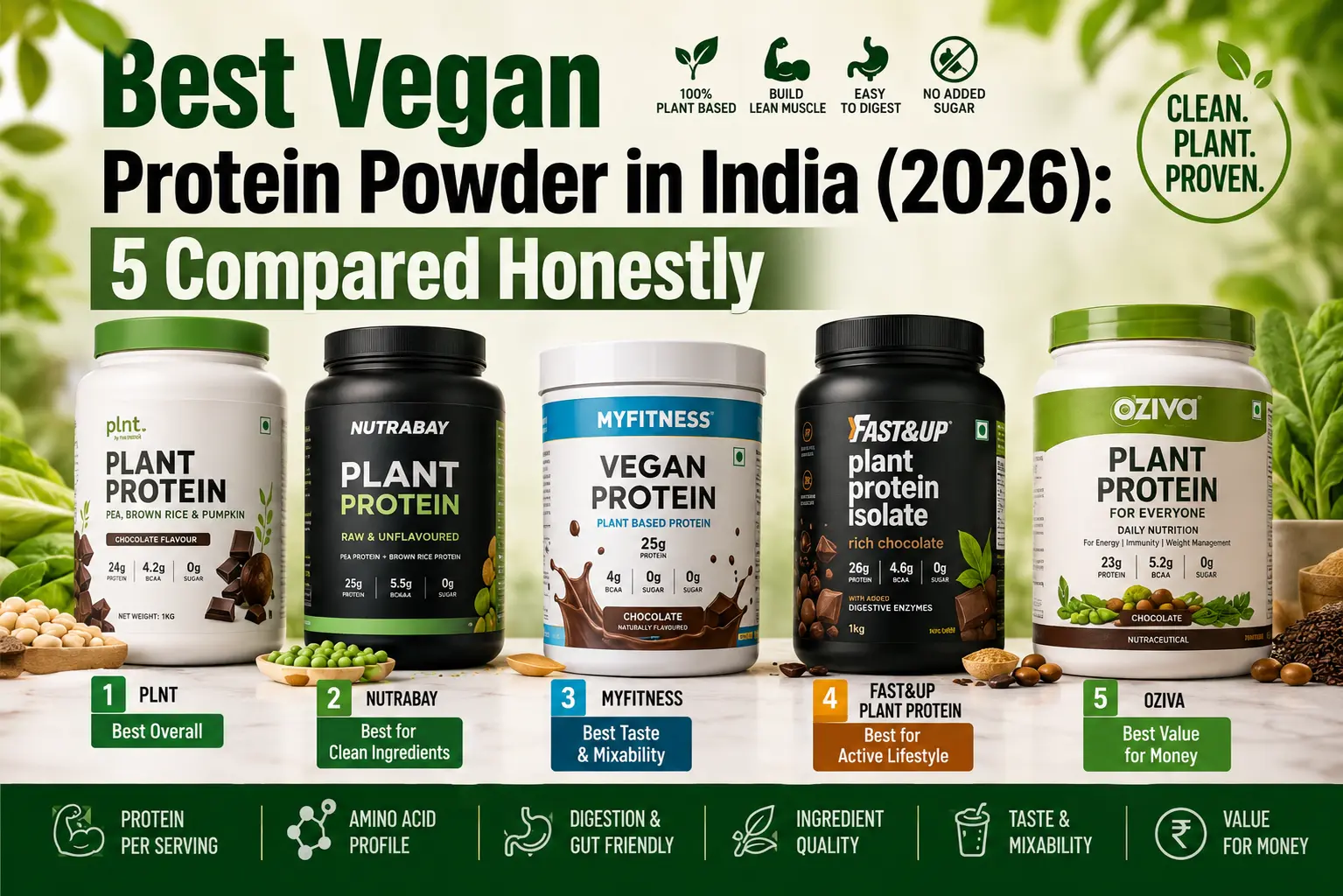
Best Vegan Protein Powder in India (2026): 5 Compared Honestly
Pea, soy and blended plant proteins sold in India, compared on protein per scoop, amino acid completeness, and the thing every other guide skips — whether you will actually finish the tub.
Medical Safety Note: This article is for general educational purposes only and is not a substitute for professional medical advice, diagnosis, or treatment. If you are pregnant, managing a condition like diabetes, PCOS, or thyroid disorder, or taking medication, please consult a qualified doctor or registered dietitian before changing your diet, supplements, or exercise routine.
Affiliate Disclosure: As an Amazon Associate I earn from qualifying purchases. This post contains affiliate links. If you buy through them, we may earn a small commission at no extra cost to you — this never affects our recommendations. We only suggest products we believe in. Read our full affiliate disclosure.
Quick Answer
Start with the Fast&Up Plant Protein 500g. It is the highest-rated here at 4.3 across 992 ratings, and the pea-and-rice blend covers the complete amino acid profile that single-source pea protein misses. The 500g pouch costs more per serving than the 1kg tubs — that is the point, since it lets you find out whether you will finish it before committing to a kilo. Once you know you like it, NAKPRO is the better value per serving.
Fast&Up Plant Protein — Rich Chocolate, Pea Isolate & Rice Protein, 500g
Highest rated plant protein in this comparison at 4.3 across 992 ratings. 26g protein and 4.6g BCAA per serve from a pea isolate and rice blend, which covers the complete amino acid profile that single-source pea protein misses. No added sugar. Buy it as your first plant protein to find out whether you like the taste before committing to a kilo.
Cost per serving — not cost per kilo — is the number that reorders this whole category. That calculation, and all six compared, are below.
Ask ten people in an Indian gym what protein they use and nine will say whey. The tenth — usually someone lactose intolerant, actually vegan, or just tired of the bloating — is quietly hunting for a plant option that doesn't taste like wet besan and doesn't cost double for less protein.
This guide is for that tenth person.
There is one number that decides whether a plant protein purchase works out, and almost no listing shows it: cost per serving, not cost per kilogram. A 500g pouch and a 1kg tub can look like the same product on a search results page and differ by more than double once you divide by how many scoops you actually get. That single calculation reorders this entire category, and it is why one of the picks below beats options that look cheaper on the front page.
How this guide was put together: I have not used all five of these long-term, so you will not find "I tested each for three months" claims here. What follows is a comparison built from current Amazon India listings, published customer rating data, and the nutrition science on plant protein amino acid profiles. Where I rank one above another, it is because of the data below. Last verified: August 2026.
Which Plant Protein Suits You
There is no single winner here, because these five fail in different directions — one is cheap but rated 3.6, one tastes good but gives you 13 servings, one is the highest-rated but the smallest tub. Pick the row that matches your actual constraint.
← Swipe to compare →
| If this is you | Start with | The catch you should know first |
|---|---|---|
| First plant protein, worried about the taste stories | Fast&Up Plant Protein | 500g pouch — best-rated here, but not the cheapest per serving |
| You want a full kilo of flavoured protein | NAKPRO Plant Protein (Chocolate) | 1kg tub at a fair price, but only 395 ratings so far |
| Absolute lowest cost per gram of protein | AS-IT-IS Soy Protein Isolate | Rated 3.6 across 1,963 ratings — the lowest here, and taste is why |
| Clean label, no sweeteners, you mix your own | Pure Nutrition Pea Protein Isolate | Unflavoured, and only 47 ratings — the least proven on this page |
| You care most about no added sugar and easy digestion | Yogabar ProClean | 13 servings per pouch makes it the most expensive per shake |
Who should skip this page entirely: if you already eat dal, paneer, curd, rajma and soya chunks daily and you are hitting your protein target, a scoop of plant protein is a convenience, not a requirement. That case is covered below, and no product on this page changes it.
Do You Actually Need Vegan Protein Powder?
Before buying anything, ask the same question I raise in the whey protein guide: are you genuinely short on protein, or does it just feel like you should be "doing something"?
Most Indian vegetarian diets already lean on dal, paneer, curd, soya chunks and rajma. If your total daily protein — food plus supplement combined — is already at 1.2 to 1.6g per kg of bodyweight, a scoop is a convenience. Here is where plant protein actually earns its place:
- You're vegan, not just vegetarian. No paneer, no curd, and whey is off the table entirely.
- You're lactose intolerant and whey causes bloating or gas, even the isolate versions.
- You struggle to hit protein targets through food alone because of work schedule, appetite, or dietary restriction.
- You have PCOS, IBS, or a sensitive gut and dairy protein makes things worse. My PCOS diet plan guide covers the wider food picture there.
If none of these apply, save the money and add another bowl of dal. That is not me being contrarian — it is genuinely the better return on ₹1,500.
📖 Read Also:
Protein-Rich Vegetarian Foods in IndiaWork out what you are already getting from food before you decide how many scoops you actually need.
The Cost Per Serving Trap
This is the section I would read first if I were buying today, because it is where most of the money gets wasted in this category.
Plant protein in India is sold in two very different pack formats, and search results display them identically:
- 1kg tubs — NAKPRO, AS-IT-IS, Pure Nutrition
- 500g pouches — Yogabar ProClean, Fast&Up
A 1kg tub at roughly 30g per scoop gives you about 33 servings. A 500g pouch at the same scoop size gives you about 16 — and Yogabar states 13 servings for its pouch outright, because its scoop is larger. So a 500g pouch has to be less than half the price of the 1kg tub to be the better deal, and it almost never is.
The maths that matters, in one line: divide the price by the number of servings on the label, not by the weight. Do that once, in the Amazon app, before you tap buy.
This does not automatically make the 1kg tubs the right answer. If you are new to plant protein, a 500g pouch is a genuinely sensible way to find out whether you can tolerate the taste before committing to a kilo of something you might abandon. Pay the premium deliberately as the cost of a trial, not by accident because you did not check the servings count.
First plant protein ever? Buy the smallest pack of a flavoured blend, not the biggest tub of the cheapest powder. The most expensive plant protein is the 1kg tub sitting unopened at the back of your cupboard.
The Real Problem Nobody Writes About: Taste
Every "best vegan protein" article online skips this, and it is the single biggest reason people buy a tub, use it twice, and abandon it.
Pea protein on its own is chalky and slightly earthy — closer to besan than to a milkshake. Soy protein is smoother but leaves a distinct aftertaste some people genuinely cannot get past. Brown rice protein alone is gritty and does not dissolve properly in water.
You can see this play out directly in the rating data on this page. The cheapest option here, AS-IT-IS Soy Protein Isolate, sits at 3.6 stars across 1,963 ratings — the largest sample in this comparison and the lowest average. That gap is not a manufacturing defect. It is unflavoured soy protein doing exactly what unflavoured soy protein does, bought by people who expected it to taste like a shake.
Meanwhile Fast&Up, a flavoured pea-and-rice blend, sits at 4.3 across 992 ratings. Same category, same country, nearly a full star apart. Flavouring is not a luxury feature in plant protein — it is most of the product.
Three fixes that actually work:
- Blend it, don't shake it. Cold milk (dairy or oat) plus half a frozen banana in a mixer cuts the grittiness far more than a shaker bottle ever will.
- Use less water than you would for whey. Plant protein thickens more. 200ml, not 300ml.
- Let it sit for two minutes after mixing. Pea and rice protein hydrate slowly, and a lot of the "grittiness" is just powder that has not dissolved yet.
Quick Comparison
← Swipe to compare →
| Product | Source | Protein/Serve | Pack | Rating |
|---|---|---|---|---|
| Fast&Up Plant Protein | Pea isolate + rice | 26g | 500g | 4.3 (992) |
| NAKPRO Plant Protein | Pea isolate | 26g | 1kg | 4.0 (395) |
| AS-IT-IS Soy Protein Isolate | Soy isolate | ~25g | 1kg | 3.6 (1,963) |
| Yogabar ProClean | Plant blend + herbs | 25g | 500g (13 servings) | 3.8 (384) |
| Pure Nutrition Pea Protein Isolate | Pea isolate | ~25g | 1kg | 4.0 (47) |
Prices move weekly on Amazon India, so there is no price column here — it would be wrong within days. Check the live price on each card below and divide by servings.
The Reviews
Fast&Up Plant Protein — Best First Buy
The highest-rated product in this comparison, and by a margin that is hard to ignore: 4.3 stars across 992 ratings, in a category where 3.6 to 3.9 is normal.
The formula explains most of it. It is a pea isolate and rice protein blend, which is the pairing that solves plant protein's actual nutritional weakness — pea protein is naturally low in methionine, rice protein is low in lysine, and together they cover each other to give you a complete amino acid profile. At 26g protein and 4.6g BCAA per serve with no added sugar, this is a properly formulated product rather than a bag of single-source powder with a flavour dumped on top.
The listing describes it as tested and certified. Take that as the manufacturer's own quality-control claim rather than a specific third-party sport certification — if you compete under a testing body and need verified banned-substance screening, confirm the exact certification with the brand directly before relying on it.
The trade-off is the pack. 500g means you are paying more per shake than the 1kg tubs here, and you will reorder roughly twice as often.
Fast&Up Plant Protein — Rich Chocolate, Pea Isolate & Rice Protein, 500g
Highest rated plant protein in this comparison at 4.3 across 992 ratings. 26g protein and 4.6g BCAA per serve from a pea isolate and rice blend, which covers the complete amino acid profile that single-source pea protein misses. No added sugar. The 500g pouch costs more per serving than the 1kg tubs here — buy it as your first plant protein to find out whether you like the taste before committing to a kilo.
NAKPRO Plant Protein — Best Full-Size Flavoured Tub
If Fast&Up is the trial pack, this is the reorder. A full kilogram of chocolate-flavoured pea protein isolate at 26g protein per scoop, which puts it level with Fast&Up on protein content while roughly doubling the number of servings you get.
Pea protein isolate on its own is the honest caveat here — as covered above, pea is low in methionine, so this is not as complete an amino acid profile as a pea-rice blend or soy isolate on paper. In practice, if you eat any grains at all during the day — roti, rice, oats — you are getting methionine from those, and the gap closes. This matters far more for someone eating an extremely restricted diet than for a normal Indian eating pattern.
At 395 ratings and 4.0 stars, it is less proven than the top two by sample size, but there is nothing in that data suggesting a problem.
NAKPRO Plant Protein — Chocolate, Pea Protein Isolate, 1kg
A full kilo of chocolate-flavoured pea protein isolate at 26g protein per scoop, which is roughly double the servings of the 500g pouches here for a much smaller price gap. Pea isolate alone is low in methionine, so pair it with grains during the day — roti, rice or oats cover the gap for anyone on a normal Indian diet. 4.0 stars across 395 ratings.
AS-IT-IS Soy Protein Isolate — Cheapest Protein, Hardest to Drink
Soy protein isolate is one of the few plant proteins with a naturally complete amino acid profile on its own. It does not need blending with rice to make up for missing methionine the way pea protein does, and it is the cheapest source of complete plant protein you can buy in India. On the nutrition science, this is genuinely the strongest formula on this page.
On the experience, it is the weakest. 3.6 stars across 1,963 ratings is the lowest average and the largest sample here, and unflavoured soy is why. AS-IT-IS has built its brand on no-frills, lab-tested basics at aggressive pricing, and this product is exactly that — including the "no frills" part where the frill in question is making it palatable.
Buy this one with a plan. It works well stirred into a smoothie with banana and cocoa, or into oats and dalia, where it disappears into something that already has flavour. Bought as a straight water shake, it is the product most likely to end up abandoned.
On soy specifically: the concern most people have heard about soy and hormones is not supported for normal dietary intake in men, and moderate soy intake is broadly considered safe. If you have a diagnosed thyroid condition, soy can interfere with the absorption of thyroid medication — that is a real and documented interaction, and the practical fix is timing separation, which your doctor should advise on. My thyroid diet guide covers the wider food picture.
AS-IT-IS Soy Protein Isolate — Unflavoured, 1kg
The cheapest complete plant protein in India — soy isolate has a full amino acid profile on its own, unlike pea, so nothing needs blending in to fix it. The catch is honest and visible in the data: 3.6 stars across 1,963 ratings, because unflavoured soy is hard to drink in plain water. Buy it only if you will actually mix it into smoothies, oats or dalia rather than shaking it with water.
Yogabar ProClean — Cleanest Label, Smallest Pack
Yogabar built this around a specific buyer: someone who reads ingredient lists and does not want artificial sweeteners, added sugar or preservatives in their protein. It delivers on that — 25g protein per serve, sweetened with monk fruit rather than sucralose, with added herbs positioned for easier digestion.
Two honest caveats. First, the pouch contains 13 servings, which is the lowest serving count on this page by a wide margin and makes it the most expensive option per shake even when the sticker price looks mid-range. Second, at 3.8 stars across 384 ratings it sits mid-pack, not top — monk fruit has a distinct aftertaste of its own that not everyone prefers to conventional sweeteners.
The digestive herbs are worth calibrating expectations on. They are present, and plant protein genuinely can cause bloating, but ingredient blends like these are usually included at modest doses relative to what research on those herbs actually uses. If bloating is your specific problem, a product with stated digestive enzyme content is a more direct fix than a herb blend.
Yogabar ProClean Plant Protein — Chocolate with Monk Fruit, 500g
25g protein per serve, sweetened with monk fruit instead of sucralose, no added sugar or preservatives, with herbs added for digestion. The cleanest label in this comparison. The catch is the serving count — 13 per pouch, the lowest here, which makes it the most expensive option per shake despite a mid-range sticker price. 3.8 stars across 384 ratings.
Pure Nutrition Pea Protein Isolate — Unflavoured Base for Recipes
This is the pick if you want plain pea protein isolate with nothing added — no flavour system, no sweetener, no blend — to stir into things you are already making. Unflavoured pea protein disappears into chilla batter, oats, smoothies and even dal in a way flavoured chocolate powder simply cannot.
It is dairy-free and gluten-free, sold as a 1kg unflavoured tub, and it fills the same role AS-IT-IS soy does but with pea protein instead — better tolerated by people who react to soy, at the cost of the incomplete amino acid profile discussed above.
The honest limitation is evidence. 47 ratings is the smallest sample on this page by an order of magnitude, and 4.0 stars on 47 ratings tells you much less than 4.0 stars on 395. That is not a mark against the product; it is a reason to buy the smaller pack first if the brand offers one, rather than committing a kilo to something so few people have reviewed.
Pure Nutrition Pea Protein Isolate — Unflavoured, 1kg
Plain pea protein isolate with nothing added — no sweetener, no flavour system — which is exactly what you want if you plan to stir it into chilla batter, oats or smoothies rather than drinking it as a shake. Dairy-free and gluten-free, and a good soy-free alternative to the AS-IT-IS isolate. Rated 4.0, but on only 47 ratings, the smallest sample on this page.
If You'd Rather Eat Your Protein Than Drink It
Worth knowing before you buy any powder at all: a meaningful number of people who abandon plant protein do so because they never actually liked drinking a shake. If that sounds like you, the fix is not a better-flavoured powder.
Nourish You makes a high-protein chocolate oats that is a genuinely different product from everything above — rolled oats, cocoa, almonds, raisins and soy protein, at 25g protein and 11g fibre per serving. It is a breakfast, not a supplement, and it is the only item on this page you would eat with a spoon.
The comparison that matters: a scoop of the powders above gives you 25 to 26g of protein and essentially no fibre or carbohydrate. This gives you comparable protein plus 11g of fibre and the oats themselves, which means it replaces a meal rather than topping one up. For someone who skips breakfast and then struggles to hit a protein target by evening, that is often the more useful purchase — and 11g of fibre is a serious number in a country where most people fall well short of the daily target.
It is not a substitute for a post-workout shake if fast absorption is what you are after, and it carries the calories of a real breakfast, which is the point but is worth knowing if you are in a deficit.
Nourish You High Protein Chocolate Oats — Soy Protein, 1kg
Not a protein powder — a high-protein breakfast cereal made from rolled oats, cocoa, almonds, raisins and soy protein, at 25g protein and 11g fibre per serving. Worth considering if the reason your last tub of plant protein went unfinished is that you do not enjoy drinking shakes. It replaces a meal rather than topping one up, so it carries breakfast-sized calories. No artificial colours, flavours or preservatives.
Pea vs Soy vs Rice vs Blends
The four-line version of the nutrition science, because it decides which of the above suits you:
- Pea protein is naturally low in methionine, easy on digestion for most people, and a decent source of iron. Best as part of a blend, or paired with grains across the day.
- Soy protein has a naturally complete amino acid profile on its own and is the cheapest complete plant protein per gram. Some people notice taste or digestion sensitivity. If you take thyroid medication, discuss timing with your doctor.
- Brown rice protein is rarely used alone because of poor solubility, but pairs well with pea — rice supplies the methionine pea lacks, pea supplies the lysine rice lacks.
- Blends (pea plus rice) are the most balanced choice for most people: complete amino acids, better taste than single-source powders, and the safest first purchase.
The practical takeaway: amino acid completeness matters much less than the internet suggests if you eat a varied diet, because you are not eating protein in isolation. It matters a lot if plant protein powder is doing most of the heavy lifting in a restricted diet.
How Much Protein Do You Actually Need?
Most sedentary adults need roughly 0.8 to 1g per kg of bodyweight daily. Regular gym-goers should aim for around 1.6g/kg, and serious strength training pushes that to 1.6–2.2g/kg.
For a 65kg person training four to five times a week, that is roughly 104 to 143g of protein a day. A single scoop of plant protein at 25 to 26g is a top-up, not the plan.
📖 Read Also:
Muscle Gain Diet Plan for Indian MenWork out how much protein you are already getting from food before deciding how many scoops you actually need.
Brands Worth a Word of Caution
Not naming names, but one pattern is worth flagging because it is common in this specific category.
Several heavily-marketed "superfood" plant protein brands sold through influencer content deliver noticeably less protein per scoop — sometimes 12 to 15g — than their marketing implies. They pad the label with turmeric, ashwagandha or "greens" blends that sound impressive and dilute the actual protein content.
How to check in ten seconds: ignore the front of the box entirely. Find the Nutrition Facts panel, read protein per serving, then read serving size. A product giving 15g protein in a 40g scoop is 37% protein. A good isolate is 75–85%. That one ratio tells you everything the packaging is trying not to.
If a listing does not state protein per serving and serving size in the same place, treat that as the answer. Genuine isolates lead with those numbers because they are the selling point.
Frequently Asked Questions
Is plant protein as effective as whey for building muscle?
Yes, when total daily protein intake is matched and the plant protein has a complete amino acid profile — which blends and soy isolate both do. Studies comparing whey and pea protein have found similar muscle protein synthesis when total intake is equal. The gap people worry about is real on paper and largely closes in practice, provided you are hitting your total daily protein target.
Does vegan protein cause bloating?
It can. Pea protein in particular is a common culprit for some people, and it has nothing to do with lactose — plant protein is not automatically gentler on digestion than whey. If it happens to you, look for a product with stated digestive enzymes, try soy isolate instead of pea, or simply halve the scoop for a week and let your gut adapt.
Can I take vegan protein if I'm not vegan or vegetarian?
Yes. Plenty of people choose it purely because they are lactose intolerant, or because whey's dairy-heavy taste does not agree with them, regardless of the rest of their diet. There is no rule that says a non-vegetarian must use whey.
Is unflavoured or flavoured better for beginners?
Flavoured, almost always. Unflavoured plant protein is genuinely harder to drink than unflavoured whey, and a bad first experience is why most people give up on the category entirely. The rating data on this page shows it plainly — the unflavoured soy isolate sits nearly a full star below the flavoured blend. Buy unflavoured only when you have a specific plan to cook or blend with it.
How do I know if I'm getting a good deal on plant protein?
Divide the price by the number of servings stated on the label, never by the weight of the pack. A 500g pouch with 13 servings and a 1kg tub with 33 servings look similar in a search result and are not remotely comparable. Do that one calculation before buying and you will avoid most of the money wasted in this category.
Is soy protein safe for men?
For normal dietary and supplemental intake, yes — the concern about soy affecting hormones in men is not supported by the evidence at typical intake levels. The interaction that is genuinely documented is with thyroid medication absorption, which is a timing issue rather than a reason to avoid soy entirely. If you take thyroid medication, raise it with your doctor.
Final Word
Plant protein in India has improved enormously, but it is still a category where the buying decision gets made on the wrong number. People compare price per kilogram, buy the cheapest thing, discover they cannot drink it, and conclude that plant protein is bad.
It is not. The rating data on this page tells the real story: a well-formulated flavoured blend sits at 4.3 stars, and the cheapest unflavoured isolate sits at 3.6 — same category, same shoppers, nearly a full star apart, and taste explains almost all of it.
So buy for the shake you will actually drink thirty times, not the one that looks cheapest once. Check servings per pack, not weight. And if you genuinely do not enjoy drinking protein, stop trying to find a powder that fixes that — eat it instead.
📖 Read Also:
Best Whey Protein Brands in IndiaIf dairy is not actually a problem for you, whey is still cheaper per gram of protein and easier to drink. Worth checking before you commit to plant.
Free Tools to Help You
Put this article into action — use our free calculators to get your personalized numbers.
Was this article helpful?
Want More Tips Like This?
Join 1,000+ readers getting weekly fitness, diet, and wellness tips + FREE meal plan
No spam, ever. Unsubscribe anytime.

About the Author: Ashwani
Fitness enthusiast and wellness writer. I research and write about home workout equipment and supplements — so you can make informed decisions without wasting money.
Read more about us →Comments
Leave a Comment
Your email will not be published. Comments are reviewed before appearing.
You Might Also Like
Continue your wellness journey
25 min read
Best 1000mg Omega-3 Fish Oil in India (2026): EPA+DHA Compared
A capsule labelled 1000mg fish oil can contain as little as 300mg of actual omega-3. Here is what the EPA+DHA numbers really say, what a gram of it costs across the strength tiers, and the dose-response finding that argues against the biggest bottle.
24 min read
Best Protein Bars in India 2026: RiteBite vs Yogabar vs MuscleBlaze
All three flagship bars deliver exactly 20g of protein, so the protein number tells you nothing. What separates them is saturated fat, fibre, polyol load — and a cost per gram of protein roughly three times what whey costs.
19 min read
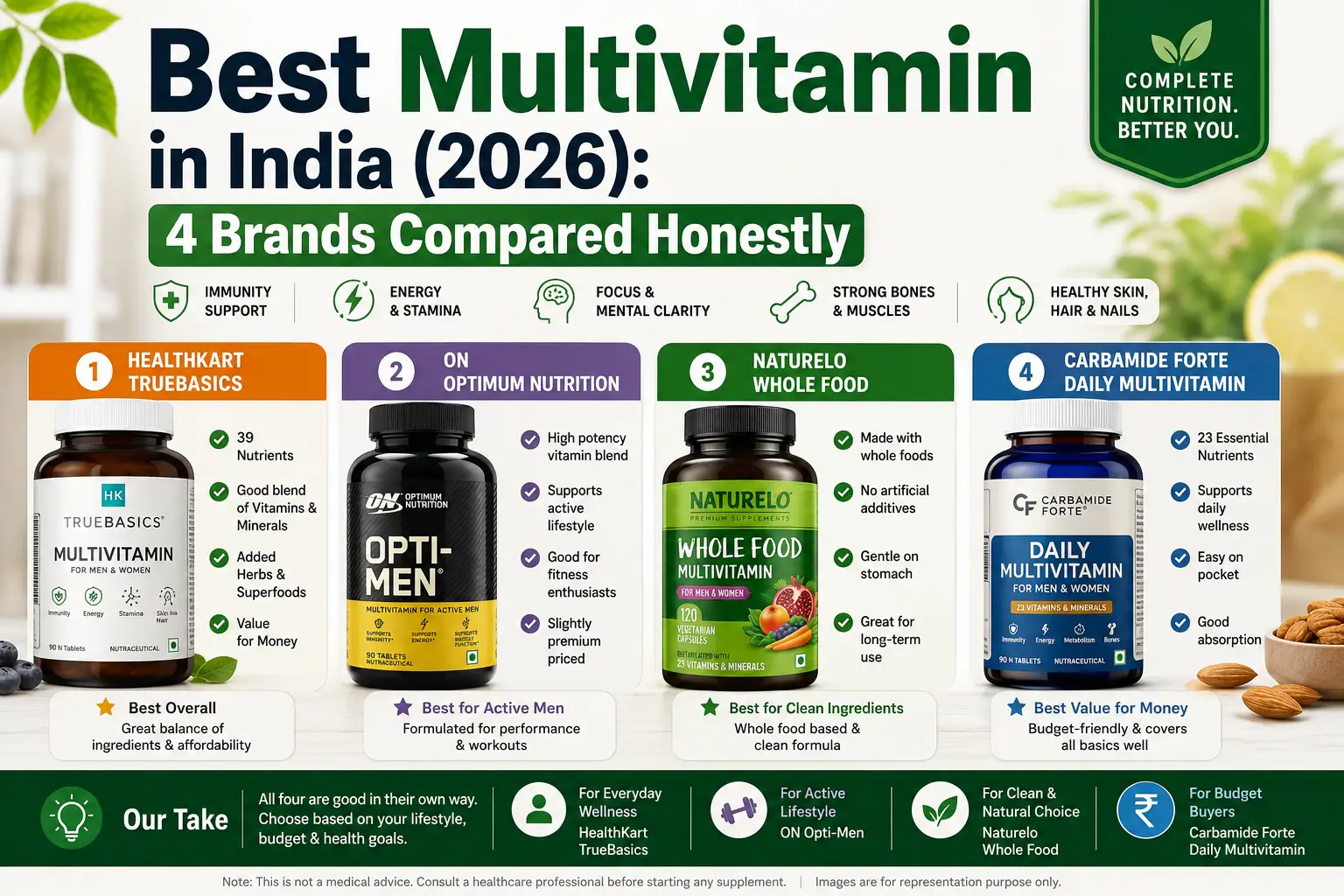
Best Multivitamin in India (2026): 4 Brands Compared Honestly
Centrum, Revital, HK Vitals and MuscleBlaze MB-Vite compared on what is actually in them — plus the honest answer to whether you need a multivitamin at all.