Best 1000mg Omega-3 Fish Oil in India (2026): EPA+DHA Compared
A capsule labelled 1000mg fish oil can contain as little as 300mg of actual omega-3. Here is what the EPA+DHA numbers really say, what a gram of it costs across the strength tiers, and the dose-response finding that argues against the biggest bottle.
Medical Safety Note: This article is for general educational purposes only and is not a substitute for professional medical advice, diagnosis, or treatment. If you are pregnant, managing a condition like diabetes, PCOS, or thyroid disorder, or taking medication, please consult a qualified doctor or registered dietitian before changing your diet, supplements, or exercise routine.
Affiliate Disclosure: This post contains affiliate links. If you buy through them, we may earn a small commission at no extra cost to you — this never affects our recommendations. We only suggest products we believe in. Learn more.
Quick Answer
Stop buying omega-3 by the number on the front of the bottle, and start buying it by EPA+DHA. A capsule sold as "1000mg fish oil" commonly contains 300mg of actual omega-3 — the other 700mg is oil that does nothing you bought it for. Judged on what a gram of real EPA+DHA costs, the 1000mg capsules are the most expensive way to buy it, roughly 37% dearer than the same brand's triple-strength version.
Carbamide Forte Triple Strength Omega-3 Fish Oil 1400mg (90 Softgels)
495mg EPA + 330mg DHA = 825mg of actual omega-3 per capsule, which works out near ₹15.14 per 1,000mg of EPA+DHA — the lowest of every SKU compared here. One capsule a day keeps you inside the dose band where the atrial fibrillation signal is smallest, and 90 capsules is a three-month supply.
There is a second question that matters more than price, though, and almost no omega-3 guide in India raises it. It is below.
Pick up any fish oil bottle in India and the biggest number on it is the one that matters least. "1000mg." "1400mg." "2730mg." Those describe the weight of the oil in the capsule, not the weight of the omega-3 inside it.
The two things you are actually buying are EPA and DHA. The rest of the capsule is filler oil. And the ratio varies hugely between products that look identical on a shelf.
So this comparison ignores the front of the bottle entirely. It ranks by EPA+DHA per capsule, then by what 1,000mg of that really costs. Then it takes on a dose question the best evidence answers uncomfortably.
What "1000mg Fish Oil" Actually Contains
How this comparison was built: I have not taken these products, so there are no first-hand notes here on aftertaste, capsule size or how anyone felt after three months. Every figure below is label data from the manufacturers' own listings and brand-listed prices retrieved on 19 September 2026, plus peer-reviewed trial evidence for the dose section. The rankings are computed cost per milligram, nothing else. How we source claims and where AI is used is set out in our editorial policy.
Carbamide Forte is useful here because it sells the same oil at three strengths, so nothing is confounded by brand.
Its Salmon Fish Oil 1000mg capsule contains 180mg EPA and 120mg DHA — 300mg of omega-3 in a 1000mg capsule, or 30%. Its Triple Strength 1400mg capsule contains 495mg EPA and 330mg DHA, so 825mg of omega-3 in a 1400mg capsule, or 59%. Its 5X Strength 2730mg delivers 900mg EPA and 600mg DHA, or 1,500mg — but note that 2,730mg is the weight of a two-softgel serving, roughly 1,365mg per softgel, not one capsule.
That is the same company, the same category, and a swing from 30% to 59% active ingredient. All three figures come from Carbamide Forte's own product listings (Carbamide Forte fish oil range, retrieved 19 September 2026).
The label rule in one line: ignore the milligram figure on the front, find EPA and DHA on the back, and add them together. If a product does not print both numbers, that is itself the answer — a brand with a good ratio always advertises it.
What a Gram of Real Omega-3 Costs
Once you convert to EPA+DHA, the value ranking inverts. The cheapest bottle becomes the most expensive omega-3.
← Swipe to compare →
| Product | EPA+DHA per serving | Servings | Price | Cost per 1,000mg EPA+DHA |
|---|---|---|---|---|
| Triple Strength 1400mg (90 caps) | 825mg | 90 | ₹1,124 | ₹15.14 |
| Triple Strength 1400mg (60 caps) | 825mg | 60 | ₹779 | ₹15.74 |
| 5X Strength 2730mg (60 softgels) | 1,500mg | 30 | ₹749 | ₹16.64 |
| Salmon Fish Oil 1000mg (150 caps) | 300mg | 150 | ₹949 | ₹21.09 |
| Salmon Fish Oil 1000mg (60 caps) | 300mg | 60 | ₹389 | ₹21.61 |
All five are Carbamide Forte products at the brand's own listed prices (mycf.in, retrieved 19 September 2026). The 5X serving is two softgels, so a 60-softgel bottle is 30 servings.
One limitation worth stating plainly: this is one brand's tier ladder, not a survey of the Indian market. Holding the brand constant is what makes the ratio argument clean — nothing here is explained by one company sourcing better oil than another — but it means the rupee figures are a within-brand comparison, not a national price benchmark.
The ₹389 bottle is the worst value on this page. Per 1,000mg of EPA+DHA it costs about 37% more than the ₹779 bottle sitting next to it. It looks cheaper because it is a smaller purchase, not because it is better priced — the same mistake people make comparing a 340g peanut butter jar to a 1kg one.
📖 Read Also:
How to Read Nutrition Labels and Stop Getting FooledThe same trick in other aisles — serving-size games, 'sugar-free' claims, and front-of-pack numbers that do not mean what they look like.
The Dose Question This Category Avoids
Here is where the advice in most Indian omega-3 guides runs ahead of the evidence. "Triple strength" and "5X" are sold as straightforwardly better. The strongest trial evidence says the relationship is not that simple.
Two reviews of the trial evidence found that in older adults who already had heart disease or a high risk of it, omega-3 supplements raised the risk of atrial fibrillation — an irregular heartbeat — by about 25%. The risk rose with the dose.
The larger review pooled seven heart-outcome trials covering 81,210 people, followed for 4.9 years on average. Taking omega-3 raised the risk of atrial fibrillation, hazard ratio 1.25 (95% CI 1.07–1.46). The dose split matters more than that headline. Trials testing above 1g a day showed HR 1.49 (1.04–2.15). Trials at or below 1g a day showed HR 1.12 (1.03–1.22). The gap between the two was statistically significant, and the risk rose by about 11% for every extra gram a day (Gencer et al., Circulation, 2021, PMID 34612056).
A second review, of 15 randomised trials, put it at RR 1.25 (1.10–1.41) (Yan et al., Cardiovascular Drugs and Therapy, published online 2022, in print 2024, PMID 36103100). That is consistent rather than independent evidence — the two reviews draw on many of the same underlying trials, so their agreement is close to arithmetic.
Three things have to be said about that before anyone panics or dismisses it.
It is a relative increase on a small baseline. Atrial fibrillation is uncommon in healthy adults under 50. A 25% rise on a small number is still a small number. None of this makes fish oil dangerous in the way that phrase sounds.
The people in these trials were not young gym-goers. Average age across the seven trials was 65, and they enrolled people who already had heart disease or a high risk of it. Applying the finding to a healthy 30-year-old in Mumbai is a stretch in both directions. The risk may well be lower. Nobody has run the trial that would tell us.
It cuts directly against the upsell. The dose bands in that analysis map almost exactly onto the Indian product tiers. A triple-strength capsule at 825mg EPA+DHA keeps you under 1g. Two of them, or one 5X serving at 1,500mg, puts you in the band where the pooled hazard ratio was 1.49 rather than 1.12.
The safety figure the marketing quotes is old. Supplement copy likes to cite EFSA's line that supplemental EPA and DHA "at doses up to 5g a day do not raise safety concerns for adults." The quote is accurate. The date is the problem: EFSA published it on 27 July 2012 (EFSA), nine years before the Circulation analysis. EFSA also said plainly that it could not set an upper limit from the data it had. Quoting the 2012 number without the 2021 one is not wrong. It is just half the picture.
So What Dose Makes Sense?
Start from the reference intake rather than the marketing. EFSA sets an Adequate Intake of 250mg of EPA+DHA a day for adults (EFSA, Summary of Dietary Reference Values, Table 3). That is the floor, and it is far below what any product on this page is selling you per capsule.
So the defensible window runs from 250mg at the low end to about 1g at the top, where the atrial fibrillation signal starts to grow. Inside that window, two reasonable positions exist:
- One triple-strength capsule a day (825mg). Comfortably inside the window, the lowest cost per milligram, and one capsule to remember.
- One 1000mg capsule a day (300mg). Close to the reference intake, about ₹6.50 a day, and the option to take if you would rather not sit near the top of the band.
What does not follow from any of this is a 5X serving taken daily as a matter of course.
Go higher only for a specific reason and ideally with a doctor who knows your history. One more honest finding from that review is worth knowing. Across all 15 trials pooled — prescription and over-the-counter together — major cardiovascular events fell at RR 0.95 (0.91–0.99) and heart attacks at RR 0.90 (0.83–0.98). Those are modest effects to begin with. The important caveat is that the authors attributed the benefit primarily to prescription EPA ethyl ester formulations, not to retail softgels. So the effect you can expect from a bottle bought on Amazon is smaller than even those numbers, and the review does not isolate it.
📖 Read Also:
Best Gym Supplements for Beginners in India (2026)Where omega-3 sits against whey, creatine and vitamin D3 when you are deciding what to actually spend on — with a full beginner stack and budget.
Do You Need a Fish Oil At All?
For a meaningful share of readers, no — and this is the part the category never leads with.
EPA and DHA come from oily fish. If you eat bangda (mackerel), mathi (sardine), surmai or hilsa a couple of times a week, you are already getting these fatty acids in the form the research studied, alongside protein, iodine and selenium that no capsule provides. A supplement exists to close a dietary gap, not to improve on the fish.
The gap is real for a lot of India, though, and that is the honest case for buying one. Vegetarian households get essentially no EPA or DHA. Large parts of inland India eat little oily fish, and freshwater fish like rohu and catla carry far less of it than marine species. If that describes your week, a capsule is a reasonable ₹200-a-month fix.
If it does not describe your week, spend the money on the fish.
📖 Read Also:
Best Protein Foods for Indians: Veg & Non-Veg SourcesWhere oily fish sits among 18 Indian protein sources, with realistic serving sizes for each.
The Products, Compared Across the Tiers
Carbamide Forte Triple Strength 1400mg — Best Value
825mg of EPA+DHA in a single capsule, at the lowest cost per milligram in this comparison. One a day covers a sensible intake without a second capsule, and it keeps you under the 1g band.
The 90-capsule bottle is the one to buy: marginally better value than the 60 at ₹15.14 against ₹15.74 per 1,000mg, and a three-month supply at one a day.
Best for: people who have decided to supplement and want the lowest cost per milligram.
Carbamide Forte Triple Strength Omega-3 Fish Oil 1400mg (90 Softgels)
495mg EPA + 330mg DHA per capsule — 825mg of actual omega-3, or 59% of the capsule weight. At roughly ₹15.14 per 1,000mg EPA+DHA this 90-count is the cheapest SKU on the page, and one capsule daily keeps intake below the 1g mark where the atrial fibrillation hazard ratio was lowest. 4.3 across 3,941 ratings is a deep history.
Carbamide Forte Salmon Fish Oil 1000mg — The Literal 1000mg Pick
If you specifically want a 1000mg capsule, this is the one to understand rather than the one to buy by default. 180mg EPA + 120mg DHA is 300mg of omega-3, so hitting a sensible daily intake means two or three capsules, and the cost per milligram is the highest here.
It does add vitamin D and vitamin E, which has some value given how common vitamin D insufficiency is in India — but you can buy vitamin D far more cheaply on its own.
Best for: people who want a low upfront price and a smaller capsule, and who understand they are paying more per milligram for it.
Carbamide Forte Salmon Omega-3 Fish Oil 1000mg with Vitamin D3 & E (60 Capsules)
180mg EPA + 120mg DHA — 300mg of omega-3 in a 1000mg capsule, so 30% active. The lowest upfront price here and the highest cost per milligram at about ₹21.60 per 1,000mg. Adds vitamin D3 and E, and the brand markets it as deliberately non-enteric-coated, which can mean more fishy repeat than a coated softgel. 4.3 across 9,550 ratings.
Neuherbs Deep Sea Fish Oil 2500mg — High-Strength Alternative
Neuherbs is the other serious name in this category in India. Its Deep Sea 2500mg delivers 892mg EPA and 594mg DHA per serving — 1,486mg of omega-3, sourced from sardine and anchovy, at ₹899 for 60 softgels (Neuherbs, retrieved 19 September 2026).
One caveat on the arithmetic, and it is worth real money. Neuherbs quotes EPA and DHA "per serving" without stating plainly whether a serving is one softgel or two, and its dosage guidance suggests two a day. If a serving is one softgel, the cost works out near ₹10.08 per 1,000mg of EPA+DHA — the cheapest on this page by a wide margin. If it is two, the same bottle costs ₹20.17, which is worse than the triple-strength. The label ambiguity is worth roughly 2× to the buyer, which is why this product is not in the table above. That is a limitation of the label, not of the oil.
Best for: buyers who want a high-EPA formulation and have a reason to be above 1g a day.
Neuherbs Deep Sea Omega-3 Fish Oil 2500mg Triple Strength (60 Softgels)
892mg EPA + 594mg DHA per serving — 1,486mg of omega-3, from sardine and anchovy, lemon flavoured. The most-reviewed option here at 13,273 ratings. The listing does not state whether a serving is one softgel or two, which swings the cost between roughly ₹10 and ₹20 per 1,000mg — work out which before comparing it against anything else.
Neuherbs Veg Omega Algal Oil — For Vegetarians
Fish oil is not an option for a large share of Indian households, and the substitutes are not equivalent. Flaxseed, chia and walnut provide ALA, a different omega-3 that the body converts to EPA and DHA at a famously poor rate. Algal oil skips the conversion problem entirely, because microalgae are where fish get their omega-3 in the first place.
The trade is dose and price, and it is steep. Neuherbs’ algal option provides 200mg of DHA per softgel at ₹849 for 60 — about ₹71 per 1,000mg of DHA, against roughly ₹15 for fish oil. Algal products also skew heavily to DHA with little EPA. That is a supply constraint on the whole category rather than a failing of any one brand, but it is worth knowing before you switch.
Best for: vegetarians and anyone who cannot tolerate fish oil. Check the DHA figure on the pack, because it varies widely.
Neuherbs Deep-Sea Veg Omega-3 1000mg Algal Oil (60 Capsules)
200mg of DHA per capsule from microalgae rather than fish, so it delivers DHA directly instead of relying on the body's poor conversion of ALA from flax or chia. Gelatin-free, with added vitamin D3 and E. Roughly ₹71 per 1,000mg of DHA — about four times fish oil per milligram, which is the algal category rather than this product. Rated 4.4, but across only 24 ratings, so treat that score as thin.
📖 Read Also:
Sleep, Recovery & Fat Loss: The Most Underrated Fitness PillarBefore adding another capsule, the free lever most people are still ignoring — and what it actually does for recovery.
📖 Read Also:
Indian Diet & Nutrition Complete Guide (2026)Where fats and omega-3 sit in a balanced Indian plate — macros, oils, and what to change before you buy a supplement.
📖 Read Also:
Protein-Rich Vegetarian Foods in IndiaIf you are building a vegetarian diet around supplements, start with the foods — the veg sources that actually carry weight in an Indian kitchen.
The Freshness Problem Nobody Prints on the Label
Fish oil oxidises. That is not a defect of cheap brands, it is chemistry — long-chain polyunsaturated fats react with oxygen, heat and light, and the process starts the day the oil is pressed.
The industry measures it with three numbers: peroxide value (PV) for early oxidation, anisidine value (AV) for the later breakdown products, and TOTOX, which combines them. The trade body GOED sets voluntary maximums of PV 5, AV 20 and TOTOX 26.
How often are those exceeded? The most relevant published survey for Indian buyers was done in the UAE, because it is the nearest large market with a comparable climate. Across 44 fish oil supplements, average peroxide value came out at 6.4 (95% CI 4.2–8.7) against the maximum allowable 5 meq/kg — over the limit on average. Average TOTOX was 23.8, under the 26 ceiling, but with a confidence interval reaching 30.3 (Jairoun et al., PLoS One, 2020, PMID 33382790).
What this means in practice. No Indian brand I looked at prints PV, AV or TOTOX on the pack or the listing, so you cannot screen for freshness before buying. Heat makes it worse, and Indian summers are hotter than the conditions most of these products were formulated and tested in. Buy the smallest pack that lasts you two to three months rather than the 150-count, store it away from the kitchen window, and treat a sharp rancid smell on opening as a reason to return the bottle rather than push through it.
One related wrinkle worth knowing: enteric coating stops the capsule dissolving until past the stomach, which is what prevents fishy repeat. Some brands treat it as a feature; Carbamide Forte explicitly markets its Salmon 1000mg as non-enteric-coated on absorption grounds. Neither position is wrong, but if fishy burps are what stopped you last time, the coated products are the ones to look at.
How to Read an Omega-3 Label in Thirty Seconds
Standing in a pharmacy or scrolling a listing, in order:
- Find EPA and DHA and add them. This is the only number that matters. If the listing shows only "fish oil 1000mg" or only "total omega-3", assume a weak ratio — a brand with a good one always prints the split. Note that "total omega-3" on a fish oil can include DPA, which is not what the research on EPA and DHA is about.
- Check what counts as a serving. One softgel or two changes the price per milligram by 100%. Several Indian brands quote EPA+DHA "per serving" without defining it clearly.
- Divide price by total EPA+DHA in the pack. Bottle price ÷ (servings × EPA+DHA per serving) tells you the real cost. On the tiers priced here, anything much above ₹20 per 1,000mg is the expensive end.
- Check the EPA:DHA ratio against your reason for buying. EPA-dominant formulations are the ones studied for cardiovascular and inflammatory endpoints; DHA matters more for brain and eye development, which is why prenatal products are DHA-led.
- Check the source fish. Small, short-lived fish — sardine, anchovy, mackerel — sit lower in the food chain and carry less accumulated contaminant load than large predatory species.
- Buy the smallest pack you will finish in two to three months. Nothing on an Indian label tells you how oxidised the oil already is, so turnover is the only freshness control you actually have.
Who Should Talk to a Doctor First
Not a formality on this one. Four groups:
- Anyone on a blood thinner — warfarin, clopidogrel, apixaban and similar. Omega-3 can affect platelet function. Large trials have not shown a clear rise in major bleeding, but the combination is worth clearing with whoever prescribed the thinner.
- Anyone with a history of atrial fibrillation or palpitations. Given the dose-response finding above, this is the group with the clearest reason to get advice before starting, and to avoid high-dose products in particular.
- Anyone with a scheduled surgery. Surgeons routinely ask patients to stop fish oil beforehand.
- Anyone with a fish or shellfish allergy. Fish oil is the obvious thing to avoid, and algal oil is the substitute to ask about.
- Anyone pregnant or trying to conceive. DHA matters a great deal here, but the right product and dose are different from a general-health one, and standard fish oil is not automatically the right choice.
📖 Read Also:
Whey Protein Guide for Beginners in IndiaThe other supplement where the number on the tub and the number you absorb are not the same thing — protein per scoop, compared.
📖 Read Also:
PCOS Diet Plan for Indian Women: 7-Day Meal PlanOmega-3 comes up constantly in PCOS advice — here is where it fits alongside the diet changes that carry most of the effect.
📖 Read Also:
Best Multivitamin in India (2026): 4 Brands Compared HonestlyThe same what-is-actually-in-it treatment applied to multivitamins — including the honest answer on whether you need one.
Final Word
Omega-3 is one of the few supplements with a real evidence base behind it. It is also one of the easiest to overpay for. The number the packaging leads with is simply not the number you are buying. Convert everything to EPA+DHA and the ranking reorders itself: the ₹389 bottle becomes the most expensive option, and the triple-strength bottles the cheapest at roughly ₹15 per 1,000mg.
On dose, the honest position is less exciting than the marketing. EFSA’s reference intake for adults is 250mg of EPA+DHA a day, and the atrial fibrillation signal grows above 1g — so anywhere in that window is defensible, and one triple-strength capsule at 825mg sits inside it at the lowest cost per milligram. The bigger bottles are not a better version of the same thing. Above 1g a day you are buying a different risk profile for a benefit the trial data describes as modest.
Buy the strength tier that gets you to roughly a gram without two capsules, check the EPA and DHA numbers before you check the price, and put the money you save into fish you actually eat.
Frequently Asked Questions
How Much Omega-3 Should I Take Daily in India?
EFSA sets an Adequate Intake of 250mg of combined EPA+DHA a day for adults, which is the floor rather than a target. In practice anywhere between that and about 1g a day is defensible, and one triple-strength capsule at roughly 825mg sits comfortably inside the window. Go above 1g only for a specific reason: in seven trials of older adults who already had heart disease or a high risk of it, the atrial fibrillation hazard ratio was 1.49 above 1g a day against 1.12 at or below it. If you have a diagnosed condition, the right dose is a question for your doctor rather than a label.
Does a 1000mg Fish Oil Capsule Contain 1000mg of Omega-3?
No, and this is the single most common misunderstanding in the category. The milligram figure on the front describes the weight of the oil, not the omega-3 in it. Carbamide Forte's Salmon Fish Oil 1000mg contains 180mg EPA and 120mg DHA, so 300mg of actual omega-3 — 30% of the capsule. Its Triple Strength 1400mg capsule contains 825mg, or 59%. Always add EPA and DHA together and ignore the front-of-pack number.
Which Is the Best Omega-3 Supplement in India in 2026?
On cost per milligram of actual omega-3, Carbamide Forte Triple Strength 1400mg leads the products compared here at roughly ₹15.14 to ₹15.74 per 1,000mg of EPA+DHA, delivering 825mg in one capsule. Neuherbs Deep Sea 2500mg offers more EPA per serving at 892mg if you want a higher-strength option. For vegetarians, an algal DHA product is the right category, accepting a lower dose and a higher price per milligram.
Is Fish Oil Bad for Your Heart?
Not straightforwardly, but the picture is more mixed than the packaging suggests. A meta-analysis of 15 randomised trials, published online in 2022 and in print in 2024, found reductions in major cardiovascular events (RR 0.95), heart attacks (RR 0.90) and cardiovascular death (RR 0.94), alongside an increased risk of atrial fibrillation (RR 1.25). Two things qualify that. The benefits were attributed primarily to prescription EPA ethyl ester formulations rather than over-the-counter softgels, and the trials enrolled older adults who already had heart disease or a high risk of it. So the upside for retail fish oil is real but modest, and the atrial fibrillation signal is worth taking seriously at higher doses.
How Do I Know If My Fish Oil Has Gone Rancid?
Smell and taste are the only tools most buyers have, because Indian labels do not print oxidation values. A sharp, acrid or paint-like smell when you open the bottle, or a strong metallic aftertaste, means the oil has oxidised and the bottle should go back. This is not a rare problem: in a survey of 44 fish oil supplements in the UAE — the closest large market to India by climate — average peroxide value was 6.4 against an industry maximum of 5 (Jairoun et al., PLoS One, 2020). Buy smaller packs, keep them out of heat and light, and finish them within two to three months.
What Is the Difference Between EPA and DHA?
Both are long-chain omega-3 fatty acids from marine sources, but they do different jobs. EPA is the one most studied for cardiovascular and inflammatory endpoints, which is why prescription cardiovascular formulations are EPA-based. DHA is a structural component of the brain and retina, which is why prenatal and infant products are DHA-led. Most general-health fish oils carry more EPA than DHA, commonly in a 3:2 ratio.
Can Vegetarians Take Omega-3 Supplements?
Yes, through algal oil, which is derived from the microalgae that fish obtain their omega-3 from originally. Flaxseed, chia and walnuts supply ALA instead, which the body converts to EPA and DHA very inefficiently, so they are not an equivalent substitute for a supplement. Algal products in India generally deliver a few hundred milligrams of DHA with little EPA and cost more per milligram than fish oil.
Why Does Fish Oil Cause Burping and a Fishy Aftertaste?
Usually because the oil is oxidising, the capsule is dissolving in the stomach rather than further down, or both. Enteric-coated softgels largely solve it by dissolving past the stomach. Taking the capsule with a meal rather than on an empty stomach helps, and so does refrigeration, which matters more in Indian summers than in the climates most of these products were formulated for. A strongly rancid smell on opening the bottle is a reason to return it, not to persist with it.
Nutrition and composition figures are taken from the manufacturers' own product listings as of September 2026; formulations change, so check the pack. Prices are brand-listed and move frequently on Amazon and quick-commerce — check the live listing before buying. This article is not medical advice.
Free Tools to Help You
Put this article into action — use our free calculators to get your personalized numbers.
Was this article helpful?
Want More Tips Like This?
Join 1,000+ readers getting weekly fitness, diet, and wellness tips + FREE meal plan
No spam, ever. Unsubscribe anytime.

About the Author: Ashwani
Fitness enthusiast and wellness writer. I research and write about sports nutrition, Indian diet strategies, and evidence-based health habits — making expert knowledge accessible for everyday Indians.
Read more about us →Comments
Leave a Comment
Your email will not be published. Comments are reviewed before appearing.
You Might Also Like
Continue your wellness journey
19 min read
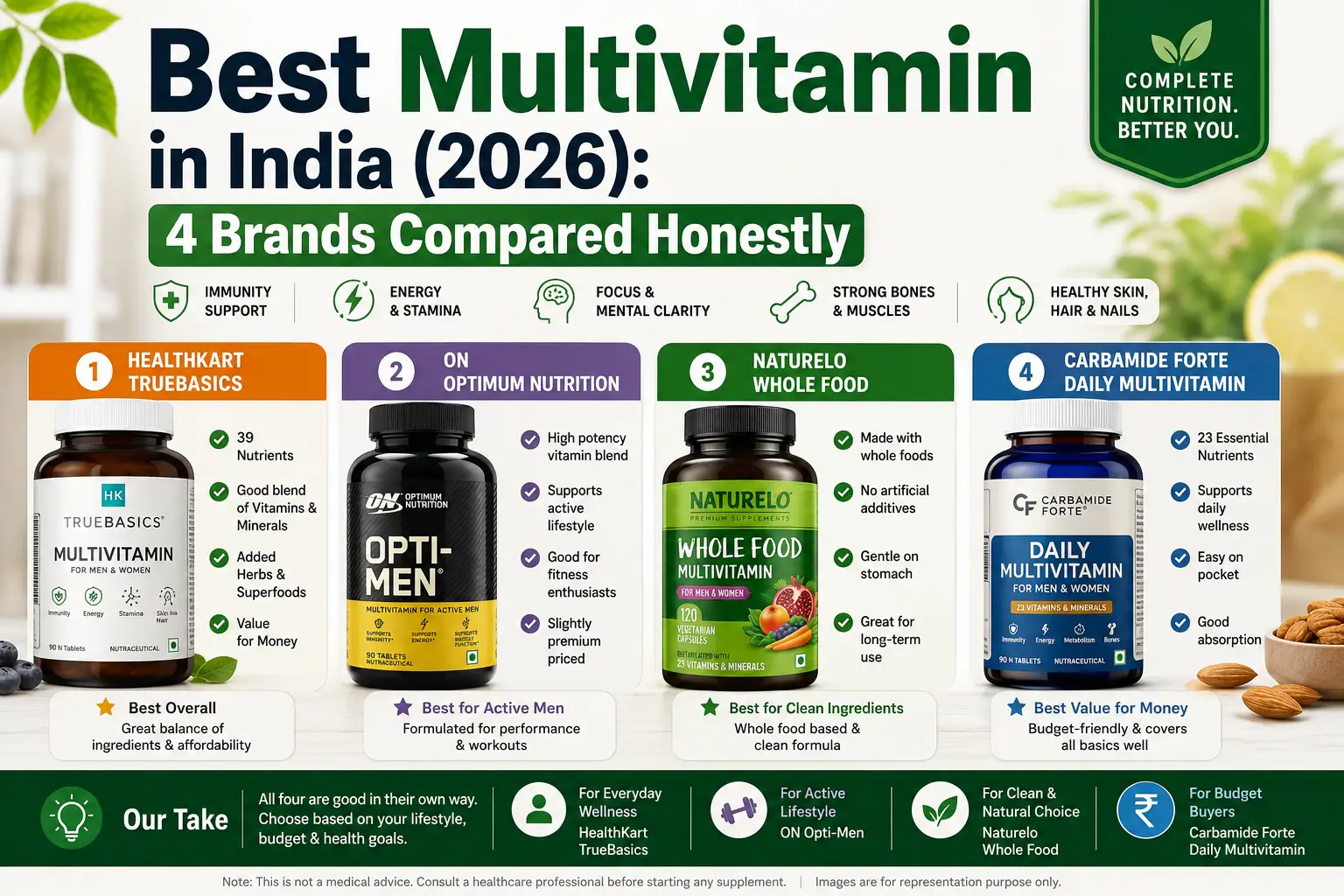
Best Multivitamin in India (2026): 4 Brands Compared Honestly
Centrum, Revital, HK Vitals and MuscleBlaze MB-Vite compared on what is actually in them — plus the honest answer to whether you need a multivitamin at all.
22 min read
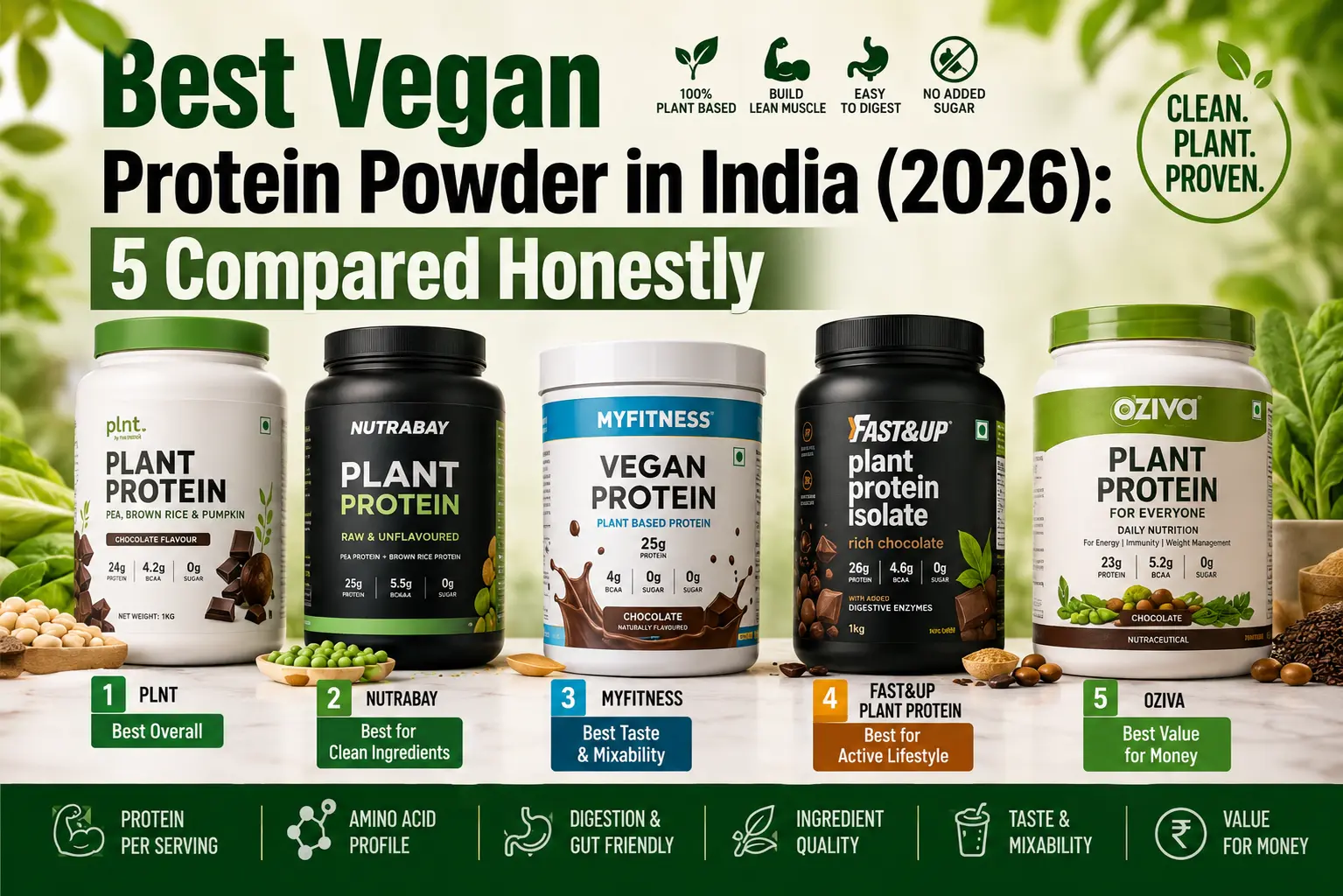
Best Vegan Protein Powder in India (2026): 5 Compared Honestly
Pea, soy and blended plant proteins sold in India, compared on protein per scoop, amino acid completeness, and the thing every other guide skips — whether you will actually finish the tub.
24 min read
Best Protein Bars in India 2026: RiteBite vs Yogabar vs MuscleBlaze
All three flagship bars deliver exactly 20g of protein, so the protein number tells you nothing. What separates them is saturated fat, fibre, polyol load — and a cost per gram of protein roughly three times what whey costs.