Best Kettlebells for Home Gym in India (2026): Which Weight to Buy
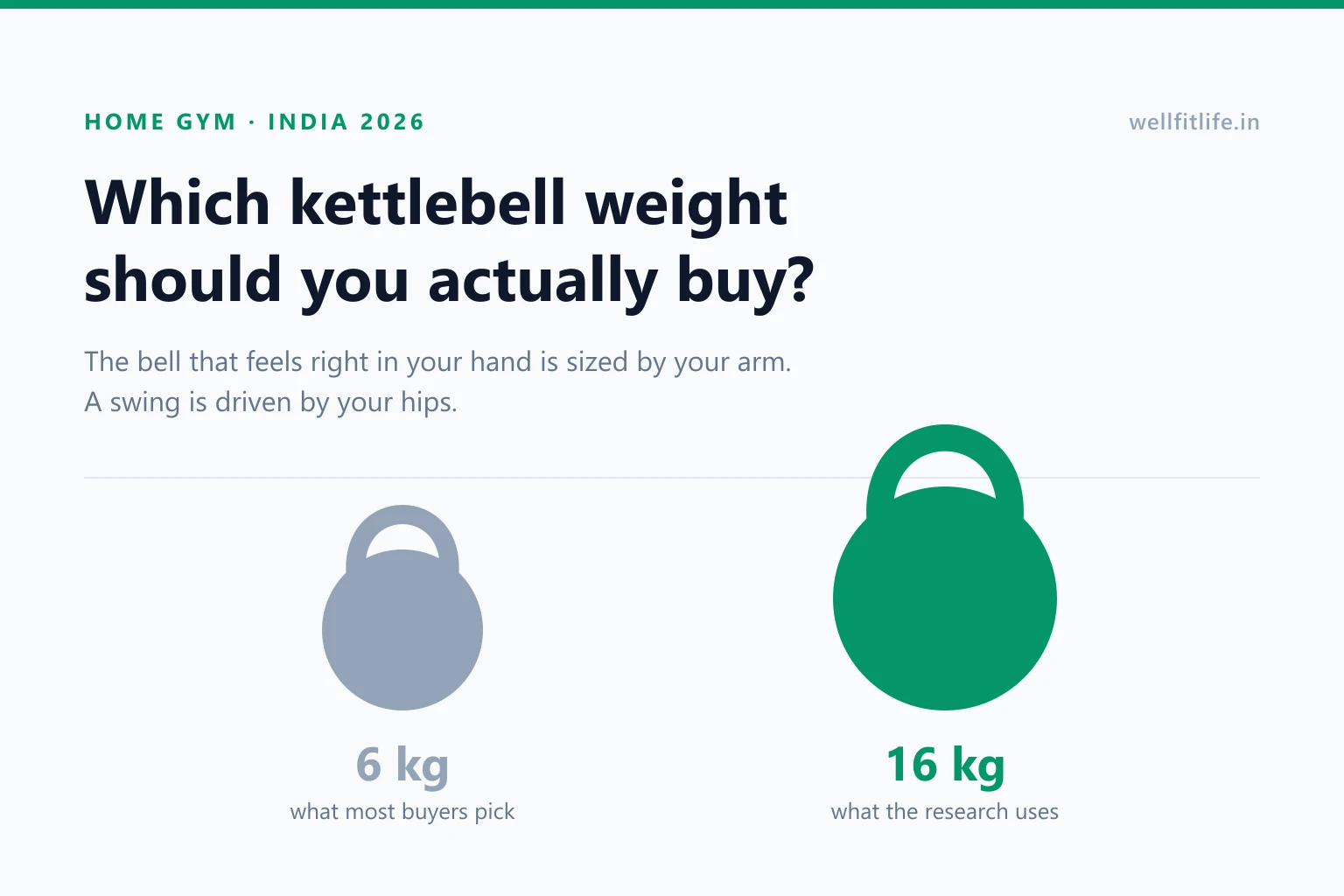
Almost every kettlebell sold in India is lighter than the ones the research is done with. The weight that feels right when you pick it up is roughly half the weight your hips need — and that single mistake is why most kettlebells end up under a bed.
Medical Safety Note: This article is for general educational purposes only and is not a substitute for professional medical advice, diagnosis, or treatment. If you are pregnant, managing a condition like diabetes, PCOS, or thyroid disorder, or taking medication, please consult a qualified doctor or registered dietitian before changing your diet, supplements, or exercise routine.
Affiliate Disclosure: This post contains affiliate links. If you buy through them, we may earn a small commission at no extra cost to you — this never affects our recommendations. We only suggest products we believe in. Learn more.
Quick Answer
Most adults in India should buy a 12 kg or 16 kg kettlebell, not the 4–8 kg bell that feels comfortable in the shop — and should plan on owning two bells, not one. A kettlebell swing is a hip movement, so the weight your hips can handle is roughly double what your arms tell you is sensible. The benchmark biomechanics study on the swing was run with a 16 kg bell (McGill and Marshall, 2012), and StrongFirst's standard starting weights are 16 kg for men and 8 kg for women, progressing upward from there. The second bell is needed because presses and get-ups require roughly half the load a swing does — one bell cannot do both jobs well.
Amazon Basics Cast Iron Kettlebell, 16 kg
The standard male starting weight, and the load the reference spine-biomechanics study on the swing was run with. Heavy enough that your hips rather than your arms do the work. It also carries the largest rating sample of any kettlebell sold in India by a wide margin — though, as below, that pool is shared across the whole cast-iron range rather than the 16 kg alone.
There is also a pricing quirk worth knowing before you shop: at Indian prices in September 2026, two fixed cast-iron bells can cost less than one adjustable kettlebell that tops out below the heavier of them. The numbers are below.
How this guide was put together: I have not owned every bell mentioned here, so you will not find durability claims based on years of use. What follows is the published research on kettlebell training, plus current prices and weight ranges read directly off Indian retailers' own listings on 20 September 2026 — the homework I would do before spending my own money. Prices on these sites move constantly, so treat every figure as a snapshot with a date on it. How we source claims and where AI is used is set out in our editorial policy.
Which Weight Suits How You Will Actually Train
A kettlebell is one of the few pieces of equipment where buying the wrong size is not a downgrade — it is a different product that does a different thing badly.
← Swipe to compare →
| If this is you | Start with | The catch you should know first |
|---|---|---|
| Man, no real lifting background, mainly wants swings | 16 kg | It will feel absurd overhead — that is correct, because it is not your pressing weight. If you genuinely cannot hinge it, 12 kg is the fallback and you will pass through it |
| Woman, no real lifting background | 12 kg | StrongFirst starts women at 8 kg, but you outgrow it as a swing weight within weeks — buy the 12 first and add the 8 later as your pressing bell |
| You already train with weights | 20 kg (men) or 16 kg (women), once the hinge is solid | These are progression targets rather than starting points; spend a few weeks at the beginner weight first even if it feels easy |
| Over 50, or returning after a long gap | 6–8 kg, ideally with coaching for the first month | In the trial that tested exactly this population, 71% reported muscle soreness and four non-serious injuries occurred |
| Flat or apartment, noise and flooring matter | Coated 8–12 kg, on a mat | Coated bells usually have a narrower handle window, which is the part that matters for two-hand swings |
| You want one purchase and hate clutter | Adjustable — but read what actually ships | Indian adjustables cost 2–2.4× as much per kilogram, and some quote a ceiling you have to buy add-on weights to reach |
Who should skip this page entirely: if you cannot yet hinge at the hips without rounding your lower back, no weight on this page is the right one. That is covered near the end, and no amount of budget changes it.
Walk into any sports shop in India, pick up a kettlebell, and your arm makes the decision for you. It curls the 6 kg comfortably. The 12 kg feels heavy. The 16 kg feels ridiculous. So the 6 kg goes home.
That test is measuring the wrong muscle group. The movement kettlebells exist for — the swing — is driven by the hips, and your hips are far stronger than your forearm's opinion of them. Which is how a large number of Indian homes end up with a bell that is too light to do the one thing it was bought for, and how those bells end up under beds.
Getting this right is a ₹3,000 decision. Getting it wrong is a ₹1,200 decision that you make twice.
Why the Bell That Feels Right Is Too Light
The weight the research uses is heavier than the weight most people buy. When Stuart McGill's spine biomechanics lab at the University of Waterloo produced the reference study on what a kettlebell swing does to the body, the bell they used was 16 kg. Seven healthy male participants, swings and snatches, and the result was gluteal muscle activation peaking around 80% of a maximal voluntary contraction with roughly 50% for the low back extensors, producing about 3,200 N of compression at the L4/L5 joint (McGill and Marshall, Journal of Strength and Conditioning Research, 2012;26(1):16–27).
That 80% figure is the important one. A kettlebell swing is a near-maximal glute contraction repeated quickly — that is the entire point of the exercise. A bell light enough for your shoulder to lift comfortably cannot produce it.
How much difference does the weight actually make? A 2025 study put 15 experienced women through swings at 12 kg and 16 kg and measured hip joint kinetics directly. Peak hip extension power was 34.1% greater with the 16 kg bell than with the 12 kg (95% CI 0.93–5.8 W·kg⁻¹, p=0.010), for a mass difference of just 4 kg (Murphy and Riemann, International Journal of Sports Physical Therapy, 2025;20(1):30–39). Peak hip extension velocity, interestingly, did not differ — the heavier bell did not slow them down, it just made them produce more.
If a 4 kg step up buys a third more hip power, the gap between a 6 kg bell and a 12 kg one is not a matter of preference.
StrongFirst, the certifying body that trains most hardstyle kettlebell instructors, publishes starting weights of 16 kg for men progressing to 20–24 kg, and 8 kg for women progressing to 12–16 kg. Their SFG Level I preparation guidance expects women to be confident with a 16 kg bell and men with a 24 kg by the time they test (StrongFirst SFG certification prep guide).
I am not suggesting you need to pass a certification. The point is narrower: every published reference point in this sport starts at 8 kg for women and 16 kg for men — well above the 4–6 kg bell most first-time buyers carry home.
The Weight Ladder Indian Shops Actually Stock
This is where the Indian market shapes the decision in a way the international guides never mention.
I read three Indian retailers' own kettlebell listings on 20 September 2026. They do not stock the same sport.
- Cult Store lists fixed kettlebells in 4, 6, 8, 10 and 12 kg. That is the whole ladder. There is no 16 kg, no 20 kg, no 24 kg.
- Decathlon runs 4, 6, 8, 12, 16, 20, 24 and 28 kg, and its 12 kg and 16 kg bells carry the largest verified rating samples in the Indian market — 641 and 462 reviews, both at 4.8.
- SF HealthTech, a specialist, lists a single cast-iron line running 4, 6, 8, 10, 12, 14, 16, 18, 20, 24, 28, 32 and 40 kg (36 kg was sold out), rated 4.7 from 56 reviews.
So the ladder you are shown depends entirely on which shop you land in, and the difference is not cosmetic. Land on the lifestyle-led retailer and the ladder stops one rung below where the standard male starting weight begins — the correct bell for an average adult man is not on the menu at all, and the heaviest thing offered is what he should be treating as a stepping stone. Land on the sports retailer and the full useful range is there at similar prices.
This is the single most useful thing to know before you open a shopping app. Check the top of the weight range before you check the price. A retailer whose range ends at 12 kg is not selling you a starter bell — it is selling you the only bell it has, and you will be back within a year.
📖 Read Also:
Best Adjustable Dumbbells in India (2026): 5 ComparedThe same ceiling problem, in a category where it costs a lot more to get wrong — plus the spin-lock versus dial decision.
What a Kettlebell Actually Costs Per Kilogram
Run SF HealthTech's full cast-iron ladder through a division and something clean falls out.
← Swipe to compare →
| Weight | Price | Cost per kg |
|---|---|---|
| 4 kg | ₹971 | ₹242.8 |
| 8 kg | ₹1,943 | ₹242.9 |
| 12 kg | ₹2,912 | ₹242.7 |
| 16 kg | ₹3,888 | ₹243.0 |
| 20 kg | ₹4,854 | ₹242.7 |
| 24 kg | ₹5,820 | ₹242.5 |
| 32 kg | ₹7,760 | ₹242.5 |
| 40 kg | ₹9,703 | ₹242.6 |
Prices read from the SF HealthTech Cast Iron Kettlebells 2.0 listing on 20 September 2026. The 28 kg bell is the one exception in the range at about ₹218 per kg, which looks like a discount rather than a pattern.
Cast iron is sold by the kilo, at a flat rate, with no discount for starting light. There is no economy in the small bell. You are paying the same ₹243 per kilogram whether you buy 4 kg or 40 kg, which means the light bell you buy "just to learn on" is not cheap iron — it is the same iron, in a quantity you will stop using.
That reframes the whole purchase. The question is not "what can I afford to start with." It is "what will I still be using in a year," because the per-kilo cost of being wrong is identical either way.
One Adjustable, or Two Fixed Bells?
Adjustable kettlebells solve a real problem — a single object instead of a growing pile of iron in a flat that does not have room for it. In India they solve it at a price.
Cult Store's adjustable bells on 20 September 2026: 10 kg for ₹4,699 (rated 4.8 from 39 reviews), 12 kg for ₹5,399 (4.5 from 45 reviews), and an 18 kg six-in-one for ₹8,999. Work those out per kilogram of maximum load and you get roughly ₹450 to ₹500 — about twice the ₹243 the fixed cast-iron line charges.
Decathlon's is the one to read carefully, because it shows how the headline number is built. Its 12–24 kg adjustable is ₹6,999 and rated 4.6 from 167 reviews — but the listing title says it plainly: 12 kg base, additional weights sold separately. The 24 kg in the name is what the product can become, not what arrives. On what is actually in the box that is ₹583 per kilogram, and reaching the advertised ceiling costs more again.
Read adjustable kettlebell listings as two numbers, not one. There is the weight you receive and the weight in the product name, and on Indian listings they are regularly not the same figure. Divide the price by the weight that actually ships before you compare anything.
Now put the actual baskets side by side. These are two different retailers selling two different products, so this is not a like-for-like brand comparison — it is a comparison of what a given budget buys you.
A 12 kg and an 8 kg fixed bell together cost ₹4,855 — about ₹550 less than a single adjustable that tops out at 12 kg. Add ₹976 and you are at a 16 kg plus 8 kg pair, which covers swings and presses properly and has no ceiling problem at all, because the next bell is a separate purchase rather than a design limit.
The adjustable still wins on one thing, and it is not a small thing: floor space. If you live somewhere that genuinely cannot absorb two lumps of iron, pay the premium knowingly. Just do not pay it believing it is the economical choice.
There is a second reason two bells beat one adjustable that nobody mentions in the listings. Swings and presses need different weights at the same time. With two fixed bells you swing the 16 and press the 8 in the same session. With one adjustable you stop mid-workout and rebuild it, twice, every time you alternate.
Why One Bell Cannot Do Both Jobs
This is the part the phrase "which weight should I buy" hides, and it is the reason the honest answer is a number of bells rather than a number of kilograms.
Kettlebell exercises split into two families:
Ballistic movements — swings, cleans, snatches. Driven by the hips, fast, and they tolerate heavy loads because your hips are the strongest hinge you own.
Grinds — presses, get-ups, windmills. Driven by the shoulder and slow, so they are limited by a much weaker set of muscles.
The gap between the two is roughly a factor of two for most untrained adults. A man who swings a 16 kg comfortably will usually not press it overhead for reps. A woman swinging 12 kg is often pressing 6–8 kg. So a single bell is either too light to make swings worth doing or too heavy to press at all — and in practice people resolve that by buying the pressing weight and quietly abandoning swings, which removes the reason they bought a kettlebell.
The standard fix is a light bell and a heavy bell, bought together. For most Indian adults that is 8 kg plus 16 kg for men, or 8 kg plus 12 kg for women. At the cast-iron rates above, those pairs come to ₹5,831 and ₹4,855 respectively.
📖 Read Also:
Complete Home Gym Under ₹5,000 in IndiaIf a kettlebell pair is more than you want to spend right now, this is what ₹5,000 buys across bands, dumbbells and a pull-up bar instead.
What to Check Before You Pay
Weight settled, four things separate a bell you keep from one you resent.
1. The handle window, not the handle diameter
The gap between handle and bell body is where both hands have to fit for two-hand swings. Coated and decorative bells frequently narrow it, because the coating thickens the handle bar and eats the opening from both sides. If your hands are crowded together at the bottom of the swing, the bell will bruise your forearms on every clean and you will stop doing cleans.
This is the specification almost no Indian listing publishes, so you are judging it from the product photographs. Here is what you are looking for.
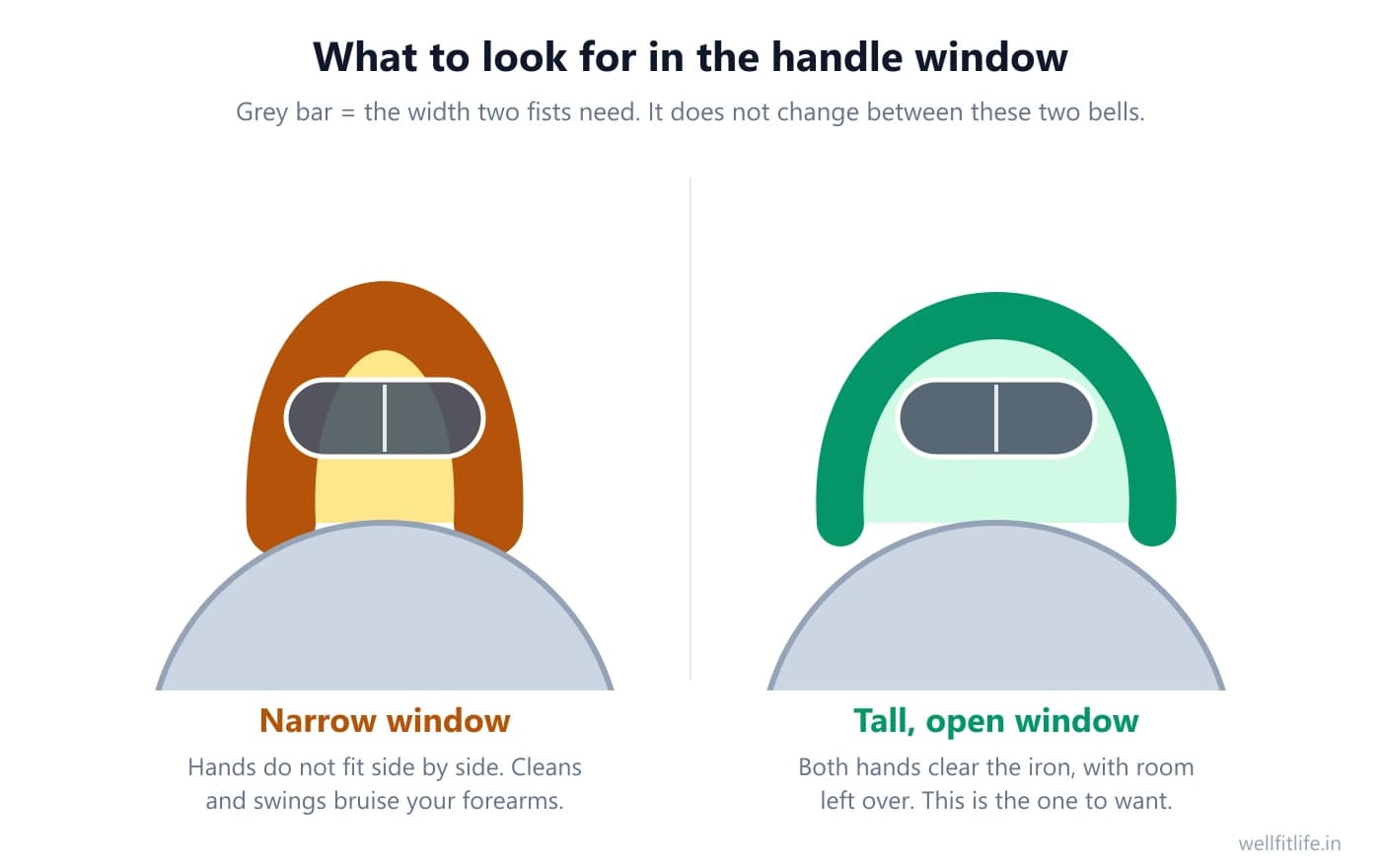
Judge the opening against the thickness of the handle bar in the same photograph, not against the size of the bell. A thick bar sitting in a small opening is the combination to avoid, because it costs you clearance from both sides at once. A tall, open window is the thing to want.
2. Single-piece casting
The best bells are cast in one piece, handle and body together, with no weld line where the handle meets the bell. Welds are the failure point under repeated ballistic load. On a bell you plan to swing hard and let drop, this matters more than the finish.
3. Coating is a floor decision, not a quality decision
Neoprene and vinyl coatings exist to protect flooring and reduce noise — worth having in a flat, irrelevant in a garage. They are not an indicator of a better bell. Whether a coated bell costs more or less per kilogram moves with discounting rather than with quality: Cult's black neoprene line worked out to about ₹175–₹202 per kilogram on 20 September 2026, below cast iron's steady ₹243 — but that was against a heavily discounted MRP, so it is not a rate to count on next month.
4. Your floor
A 16 kg cast-iron bell dropped once will mark tile and can crack it. Kettlebell training also means the bell is travelling at speed near the ground on every rep. A dense mat is not optional equipment here — it is the cheapest insurance on the whole purchase.
📖 Read Also:
Best Yoga Mat in India (2026): 5 Mats Compared & RankedFor kettlebell work you want thickness and density over grip — the comparison table here covers both.
If You Are Over 50 or Coming Back After a Long Gap
The usual advice to deconditioned adults is to avoid ballistic training. The evidence does not support that, but it does come with conditions worth reading.
The BELL trial put 32 insufficiently active adults aged 59–79 through 12 weeks of supervised hardstyle kettlebell training — three 45-minute group sessions a week plus two home sessions. Grip strength rose by 7.1 kg in the right hand (95% CI 4.9–9.3) and 6.3 kg in the left (95% CI 4.1–8.4), both above the 5.0–6.5 kg threshold the authors cite as clinically meaningful (Meigh et al., BMC Geriatrics, 2022).
The conditions: every session was supervised, 71% of participants reported some degree of delayed-onset muscle soreness, and there were four non-serious adverse events — a low back pain flare that caused one withdrawal at week seven, two intercostal strains, and one case of shoulder pain. The authors themselves note that a community programme is unlikely to replicate the trial's intensity or rate of progression.
So the practical reading is: start at 6–8 kg, get the hinge coached by somebody who can see you, and expect to be sore. The strength gains are real and worth having. The supervision is not an optional part of the protocol that produced them.
📖 Read Also:
Fitness After 40: A Beginner's Guide for IndiansWhere strength training fits alongside joint health and recovery when you are restarting later.
Who Should Not Buy a Kettlebell
Three groups, and the first one is large.
If you cannot hip hinge yet. The swing is a hinge performed fast. Learning a hinge under speed with 12 kg in your hands is how people hurt their backs. Learn the pattern unloaded or with a light dumbbell first — then buy the bell.
If you have a shear-sensitive back. McGill and Marshall's data showed that the shear forces kettlebell swings place on the lumbar joints are opposite in polarity to those from lifting a barbell, which they suggest may explain why the swing irritates some people's backs specifically. If your back has a history, this is a conversation with a physiotherapist before it is a purchase.
If you are buying it for cardio. A randomised controlled trial put 40 adults through eight weeks of ballistic kettlebell training, three times a week. Neck and shoulder pain fell by 2.1 points and low back pain by 1.4 points on a 0–10 scale, and trunk extensor strength improved significantly. But aerobic fitness did not change (Jay et al., Scandinavian Journal of Work, Environment & Health, 2011;37(3):196–203).
Kettlebells are a strength tool with a useful side effect on musculoskeletal pain. They are not a substitute for walking or running.
📖 Read Also:
Best Resistance Bands in India (2026): Top 5 TestedIf the hinge is the thing you need to learn first, banded work is the cheaper and safer place to build it.
The Weights to Buy, by Budget
Prices below are the SF HealthTech cast-iron rates read on 20 September 2026 and will have moved; use them as ratios, not quotes.
← Swipe to compare →
| Budget | Buy | Why this and not something else |
|---|---|---|
| Under ₹2,000 | Nothing yet — spend it on bands and learn the hinge | ₹2,000 buys 6–8 kg, which is below the swing weight every standard in this article starts at |
| ₹2,900–3,900 | One bell: 12 kg (women or smaller men) or 16 kg (most men) | The single most useful object in this category; presses come later |
| ₹4,800–5,900 | Two bells: 8 + 12 kg, or 8 + 16 kg | Covers ballistics and grinds from day one, and costs about what one capped adjustable does |
| ₹5,400–9,000 | An adjustable, if and only if floor space is the binding constraint | You are paying 2–2.4× per kilogram for the footprint — and check whether the advertised top weight is included |
| ₹9,000+ | Three bells: 8 + 16 + 24 kg | This is a complete kettlebell gym for one person for several years |
One thing to know about kettlebell star ratings before you read the ones below. Amazon sells most kettlebells as a single listing covering every weight — 2 kg to 92 kg on one of the cast-iron listings here — and every weight in that listing shares one pool of ratings. So a four-figure rating count on a kettlebell tells you about the product line, not about the specific bell you are putting in your basket. Ratings were read from the live listings on 20 September 2026 and are quoted with their sample size for exactly that reason.
The one bell most men should buy
Amazon Basics Cast Iron Kettlebell, 16 kg
Covered at the top of this guide — the standard male starting weight and the load the swing research is built on. If you only ever buy one kettlebell, this is the one.
The one bell most women should buy
Kakss Cast Iron Kettlebell, 12 kg
The right single bell for most women, and the fallback for a man who cannot yet hinge 16 kg. Bare cast iron, which is what the per-kilogram maths in this guide is built on. It is also the lighter bell in the 2025 hip-kinetics comparison, where 16 kg produced 34% more hip extension power — so treat 12 kg as a rung rather than a destination.
The second, lighter bell
Kakss Cast Iron Kettlebell, 8 kg
Not a starter bell — the second bell. Presses, get-ups and windmills are limited by the shoulder, which handles roughly half what the hips do. This is what makes a 16 kg swing bell usable for the rest of the session instead of something you put down after the swings. Same listing as the 12 kg above, so its rating covers the full weight range.
If you train in a flat
Kakss Vinyl Half-Coated Kettlebell, 12 kg
The flat-dweller option: a vinyl half-coating that protects tile and cuts noise, in the 12 kg most beginners should be swinging anyway. Worth the premium only where a dropped bell reaches a neighbour or a hard floor — the coating thickens the handle bar and narrows the window both hands share, which is the trade you are making for it.
Only if floor space is the constraint
XRT65 Adjustable Kettlebell, 4.5 to 18.1 kg
Adjusts across 4.5 to 18.1 kg, so one object spans beginner swings through to a respectable working weight, and the listing quotes that whole range as the product rather than as a ceiling you buy extra plates to reach. Buy it only when you genuinely have nowhere to put a second bell. Note the sample size: 68 ratings is a thin track record next to the four-figure counts on the fixed bells above.
📖 Read Also:
Dumbbells vs Resistance Bands for Home Workouts in IndiaIf you are still deciding what the first load-bearing purchase should be, this is the comparison that comes before this one.
Frequently Asked Questions
What weight kettlebell should a beginner buy in India?
Most beginner men should buy 16 kg and most beginner women 12 kg, then add a lighter 8 kg bell for presses and get-ups. StrongFirst's published starting weights are 16 kg for men and 8 kg for women — the 8 kg is worth owning, but as a woman's pressing bell rather than her swing bell, because it is outgrown on swings within weeks. The common Indian purchase of 4–6 kg is too light for swings, which is the exercise kettlebells exist for.
Is a 16 kg kettlebell too heavy for a beginner?
For swings, usually not — 16 kg is the standard male starting weight and the load used in the reference biomechanics study on the swing. For overhead presses and get-ups it is too heavy for most beginners, which is the reason the standard recommendation is two bells rather than a single one.
Should I buy one kettlebell or two?
Two, if you can. Swings are hip-driven and tolerate roughly double the load that shoulder-driven presses do, so one bell is always the wrong weight for half your exercises. At Indian prices in September 2026, a 12 kg plus 8 kg pair of fixed cast-iron bells cost about ₹4,855 — less than a single adjustable kettlebell capped at 12 kg.
Are adjustable kettlebells worth it in India?
Only if floor space is the thing stopping you. Adjustable bells listed in India in September 2026 worked out to roughly ₹450–₹583 per kilogram against about ₹243 for fixed cast iron. Check what actually ships, too: Decathlon's 12–24 kg adjustable is ₹6,999 for a 12 kg base, with the weights that reach 24 kg sold separately. You are buying a smaller footprint, not a lower price.
What is a good kettlebell price in India?
Fixed cast iron ran at a flat ₹243 per kilogram across an entire 4–40 kg range at one specialist retailer on 20 September 2026 — so roughly ₹2,900 for 12 kg and ₹3,900 for 16 kg. Coated and mainstream-brand bells vary far more because they discount heavily against MRP.
Can kettlebell training replace cardio?
No. In a randomised controlled trial of eight weeks of ballistic kettlebell training, neck and shoulder pain and low back pain both improved and trunk extensor strength rose significantly, but aerobic fitness was unchanged. Treat kettlebells as strength work and keep walking or running separately.
Are kettlebell swings bad for your back?
Not inherently. Swings with a 16 kg bell produced about 3,200 N of L4/L5 compression in McGill and Marshall's study, which is modest by lifting standards. The caution is specific: the researchers found the shear loading is opposite in polarity to barbell lifting, which may explain why swings irritate some backs in particular. If you have a history of back problems, get the movement assessed before you buy.
What is the difference between a kettlebell and a dumbbell?
The kettlebell's centre of mass sits outside your hand rather than in it, which is what makes fast ballistic movements like swings and cleans possible and what loads the grip and trunk differently. For slow, controlled exercises the two are largely interchangeable, and a dumbbell is usually cheaper per kilogram.
Final Word
The decision that matters here is not which brand. It is refusing to let your forearm choose the weight.
Pick up the heaviest bell in the shop that you can hinge — not curl — and buy that one. For most Indian men that is 16 kg and for most women it is 12 kg, and the research, the certification standards and the shape of your own hips all point at the same numbers. Then buy the second, lighter bell in the same order, because the alternative is discovering three weeks later that you own exactly one weight and need two.
The one thing not to do is buy the 6 kg because it is ₹1,455 and feels manageable. You are paying the same price per kilogram as everyone else, for a quantity of iron you will have outgrown before the month is out.
📖 Read Also:
Best Gym Bench in India (2026): 5 Compared on Safety FirstThe next piece most home setups add, and the one category where the wrong pick causes injury rather than just waste.
📖 Read Also:
Build Muscle at Home Without a GymHow to structure the training once the equipment is in the house.
Free Tools to Help You
Put this article into action — use our free calculators to get your personalized numbers.
Was this article helpful?
Want More Tips Like This?
Join 1,000+ readers getting weekly fitness, diet, and wellness tips + FREE meal plan
No spam, ever. Unsubscribe anytime.

About the Author: Ashwani
Fitness enthusiast and wellness writer. I research and write about home workout equipment and supplements — so you can make informed decisions without wasting money.
Read more about us →Comments
Leave a Comment
Your email will not be published. Comments are reviewed before appearing.
You Might Also Like
Continue your wellness journey
15 min read
Best Foam Roller in India (2026): 4 Compared Honestly
Boldfit and Strauss foam rollers compared on density, size and rating data — plus what foam rolling actually does for sore muscles, and what it definitely does not.
17 min read
Best Gym Shoes in India (2026): 6 Compared Honestly
Most Indians buy a running shoe for the gym. Here is exactly when that is fine, when it costs you, and six options compared — from a ₹1,500 Campus to the Nike Metcon.
15 min read
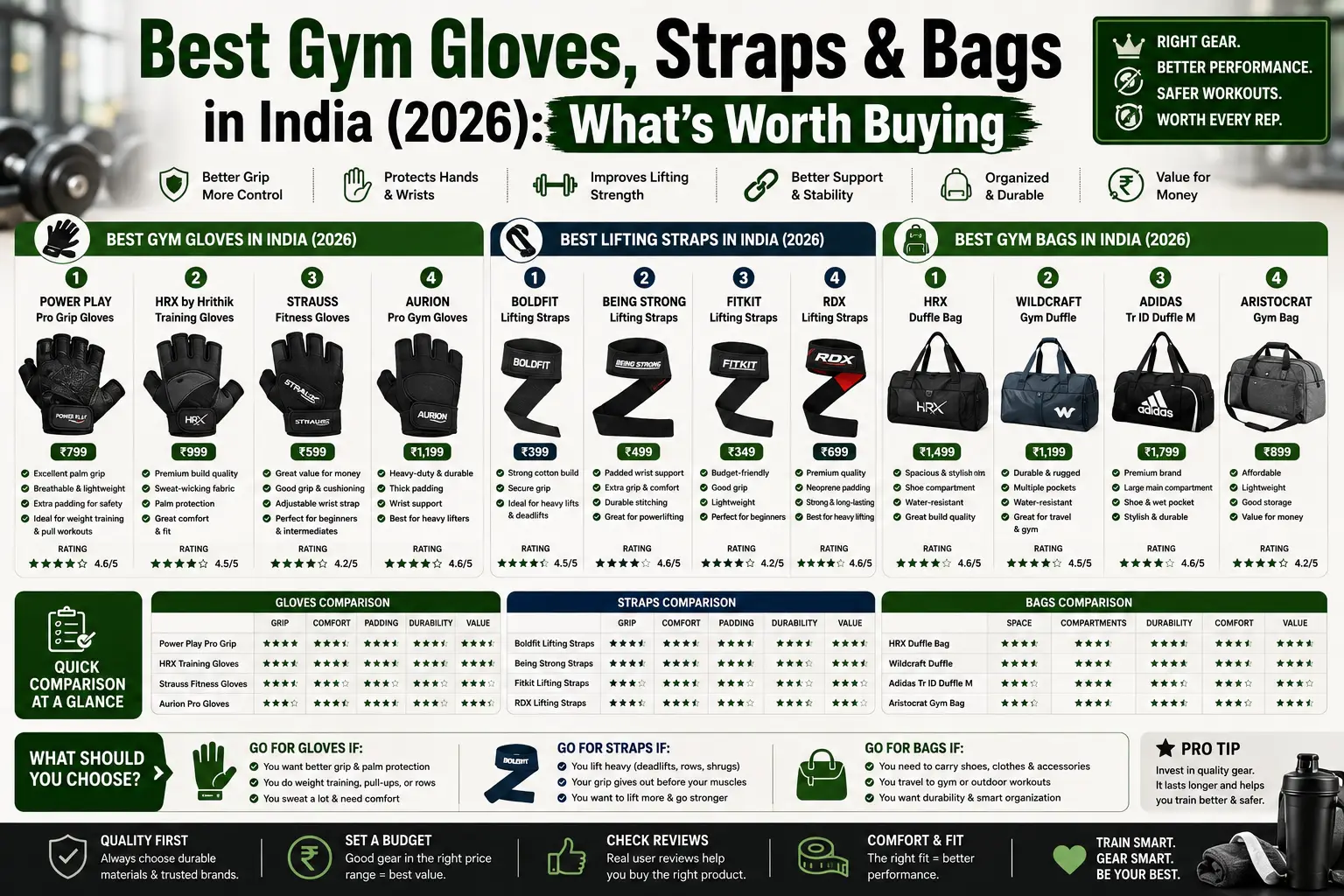
Best Gym Gloves, Straps & Bags in India (2026): What's Worth Buying
Gloves, lifting straps and gym bags — an honest answer on whether you need each one yet, plus the straps-versus-wraps distinction almost every guide gets wrong.