Protein Guide India: How Much You Actually Need
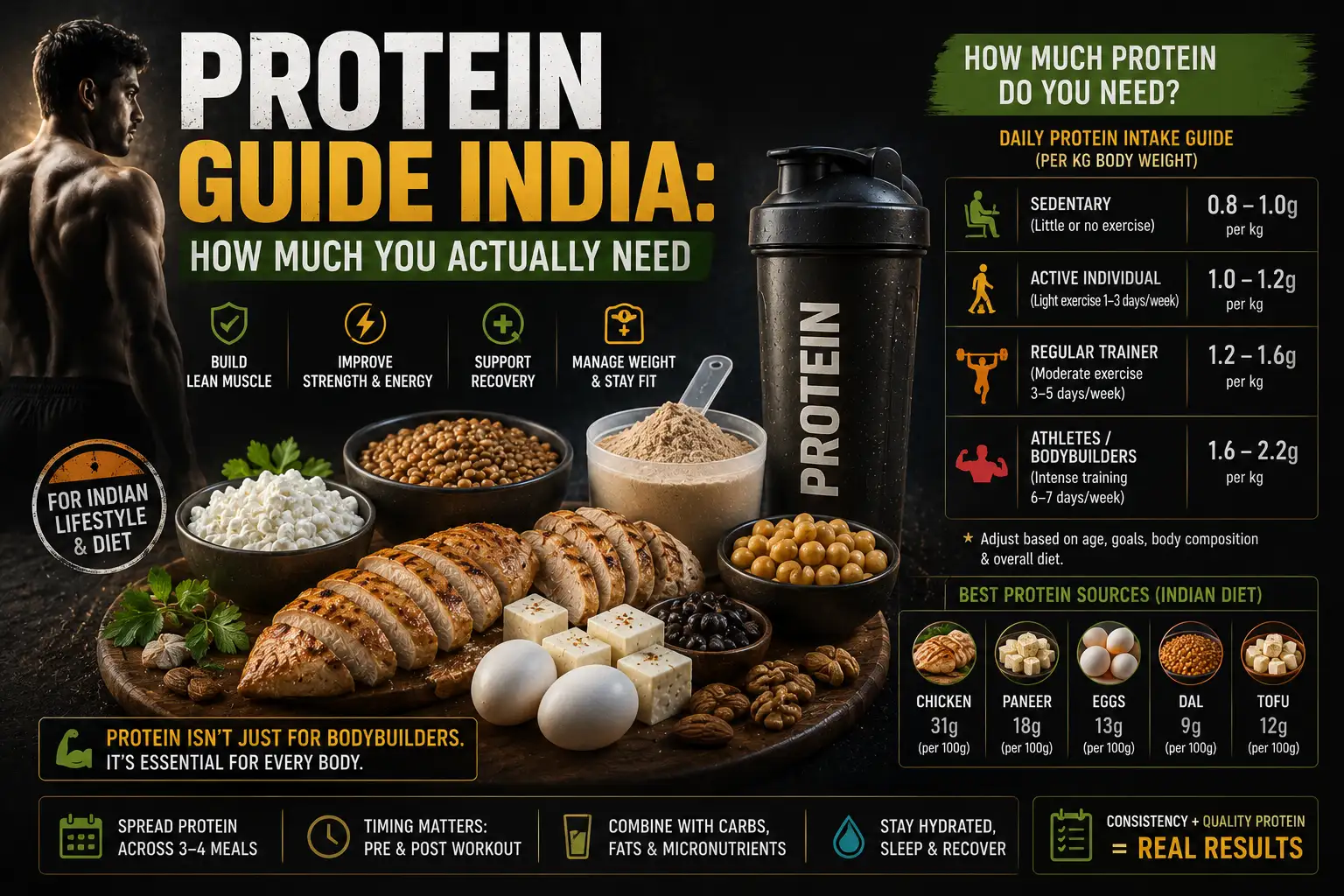
ICMR says 0.83g per kg. Sports science says 1.6g. Both are right — for different people. Here is how much protein you actually need, the cheapest ways to hit it on an Indian diet, and whether you need powder at all.
Medical Safety Note: This article is for general educational purposes only and is not a substitute for professional medical advice, diagnosis, or treatment. If you are pregnant, managing a condition like diabetes, PCOS, or thyroid disorder, or taking medication, please consult a qualified doctor or registered dietitian before changing your diet, supplements, or exercise routine.
Most Indian adults who do not train need roughly 0.8–1g of protein per kg of body weight per day — that is 56–70g for a 70kg person. If you lift weights or train seriously, the number roughly doubles to 1.4–2.0g per kg, or 98–140g for that same 70kg person.
Both numbers are correct. They are just answers to two different questions, and almost every protein article you have read online picks one and pretends the other does not exist.
The Indian Council of Medical Research, through the National Institute of Nutrition, sets the Recommended Dietary Allowance for adults at about 0.83g per kg of body weight. That figure exists to prevent deficiency in the general population. The International Society of Sports Nutrition, looking at people who resistance train, recommends 1.4–2.0g per kg to build and maintain muscle mass. Neither body is wrong. They are describing different people with different goals.
So the only question that actually matters is: which of those two people are you?
This guide answers that first, then works through everything downstream of it — where to get the protein cheaply in India, how vegetarians close the gap, what a real day of eating looks like at 60g, 100g and 140g, and whether you need powder at all.
How Much Protein Do You Actually Need?
Start with the two anchors.
The ICMR/NIN baseline: ~0.83g per kg. This is the RDA for Indian adults. An RDA is a floor, not a target — it is the amount calculated to meet the needs of nearly everyone in a healthy population so that deficiency does not occur. It assumes a sedentary or lightly active life. It is not designed around building muscle, protecting muscle during a fat loss phase, or recovering from four gym sessions a week.
The sports science range: 1.4–2.0g per kg. The ISSN position stand on protein and exercise recommends this range for individuals doing resistance training, with the higher end useful when you are in a calorie deficit or training hard. A 2018 meta-analysis by Morton and colleagues in the British Journal of Sports Medicine looked across studies of protein supplementation during resistance training and found that the additional benefit to lean mass largely plateaus somewhere around 1.6g per kg per day. In other words, more protein helps — up to a point, and then it mostly stops helping.
Put those together and you get a usable table.
Protein requirement by goal
← Swipe to compare →
| Who you are | Protein per kg | 60kg person | 70kg person | 80kg person |
|---|---|---|---|---|
| Desk job, little or no exercise | 0.8–1g | 48–60g | 56–70g | 64–80g |
| Walks / light activity, no weights | 1–1.2g | 60–72g | 70–84g | 80–96g |
| Gym 3–4x per week, fat loss | 1.6–2g | 96–120g | 112–140g | 128–160g |
| Gym 4–5x per week, muscle gain | 1.6–2.2g | 96–132g | 112–154g | 128–176g |
| Vegetarian and training | 1.8–2.2g | 108–132g | 126–154g | 144–176g |
| Age 50+ | 1–1.2g | 60–72g | 70–84g | 80–96g |
The arithmetic is deliberately simple: bodyweight in kg × the multiplier. A 70kg man training four times a week at 1.6g/kg needs 70 × 1.6 = 112g per day. A 58kg woman with a desk job at 0.9g/kg needs 58 × 0.9 = about 52g.
Which number should you use? Pick based on what you did in the last month, not what you plan to do next month. If you have not trained in six weeks, you are the 0.8–1g person right now. Start there, and move up when your training actually starts.
📖 Read Also:
Free Protein Calculator for IndiansEnter your weight, activity level and goal to get your exact daily protein number in grams — no maths required.
Two adjustments worth knowing
If you are overweight, use a corrected weight. Fat tissue does not have the same protein requirement as muscle. Somebody at 110kg who applies 1.6g/kg lands at 176g, which is unnecessarily high and hard to eat. A practical shortcut is to calculate against your target weight or your lean body mass rather than your current scale weight.
If you are vegetarian, aim a notch higher. Plant proteins are generally less well absorbed than animal proteins and lower in leucine, the amino acid that acts as the main trigger for muscle protein synthesis. The fix is not complicated — eat a bit more total protein and vary your sources. This is why the vegetarian row in the table sits at 1.8–2.2g/kg rather than 1.6–2.0g/kg.
The kidney question, addressed early
The most common objection anybody raises when you say "eat more protein" is that it will damage your kidneys.
In people with normal, healthy kidney function, there is no good evidence that higher protein intakes within the ranges discussed here cause kidney damage. The concern is real and clinically important for people who already have chronic kidney disease — in that population, protein is often deliberately restricted under medical supervision. But that is a treatment for an existing condition, not a warning for a healthy 30-year-old eating 120g of protein a day.
If you have any diagnosed kidney condition, diabetes with kidney involvement, or you simply do not know your kidney status, get a basic blood test and speak to your doctor before making a large change. That is sensible for anyone.
Why Most Indians Fall Short
Here is the part that makes the problem concrete. Take a genuinely decent Indian day of eating — not junk food, not skipped meals — and add up the protein.
← Swipe to compare →
| Meal | What you eat | Protein |
|---|---|---|
| Breakfast | 2 aloo parathas + tea | ~9g |
| Lunch | 2 rotis + 1 katori dal + 1 katori aloo-gobi + 1 katori rice | ~22g |
| Evening | Tea + 2 biscuits | ~2g |
| Dinner | 2 rotis + 1 katori rajma + salad + 100g curd | ~20g |
| Total | ~53g |
That is a full, satisfying, home-cooked day. Nobody would look at it and say it was a bad diet. And it lands at roughly 53g of protein.
For a 65kg person with a desk job, 53g is fine. It clears the RDA. For a 70kg person going to the gym four times a week and wondering why nothing is changing after five months, 53g is less than half of what their training is asking for. The training is not the problem. The arithmetic is.
Three structural reasons this happens in Indian kitchens:
1. Our staples are carbohydrate-led. Roti, rice, poha, upma, idli, dosa, paratha. These are cheap, filling, fast to cook and culturally central. Protein is treated as an accompaniment — a katori of dal beside the plate — rather than the thing the plate is built around.
2. The dal portion is smaller than people think. One thin katori of dal is around 7–9g of protein. Most people mentally file dal under "protein food" and assume the box is ticked. Two thick bowls instead of one thin one is one of the single highest-leverage changes available to a vegetarian Indian household, and it costs almost nothing.
The confusion usually comes from dry versus cooked numbers. Dal labels and most protein lists (including the tables further down this guide) quote dry weight, around 22–24g per 100g. Cooking adds water and makes it roughly 2.5–3 times heavier, so the same dal on your plate carries far less per 100g:
← Swipe to compare →
| Cooked (per 100g) | Protein |
|---|---|
| Masoor dal | ~9g |
| Kabuli chana | ~9g |
| Rajma | ~9g |
| Chana dal | ~8g |
| Urad dal | ~8g |
| Moong dal | ~7g |
| Toor dal | ~7g |
A thin katori holds roughly 100g of cooked dal, which is where the 7–9g figure comes from.
3. Breakfast is nearly protein-free. Poha, upma, plain paratha, bread and jam, tea and biscuits — these run 4–9g. Start the day at 5g and you are already behind by 9am, and you spend the rest of the day trying to catch up at dinner, which does not work as well.
The fastest diagnostic: track everything you eat for three ordinary days — not "good" days — using any calorie app. Most people are genuinely surprised. The gap is almost never where they expect it to be, and it is usually at breakfast.
Best Protein Sources in India, Ranked by Cost
Protein is the most expensive macronutrient, which is exactly why the ranking that matters is not "protein per 100g" but cost per 10 grams of protein. That is the number that decides whether a high-protein diet is sustainable on your budget or not.
The maths is straightforward: take the price per 100g of the food, divide by the grams of protein in 100g, multiply by 10.
Soya chunks, for example: at roughly ₹120 per kg, 100g costs ₹12 and contains about 52g of protein. So ₹12 ÷ 52 × 10 = ₹2.3 per 10g of protein.
Cost per 10g of protein
Prices below are typical Indian city market rates and will vary by city, brand and season — treat them as a ranking, not a quotation. All values are on an as-purchased basis (dry weight for dals and soya, raw weight for meat).
← Swipe to compare →
| Food | Protein per 100g | Approx. price | Cost per 10g protein | Type |
|---|---|---|---|---|
| Soya chunks (dry) | 52g | ₹120/kg | ₹2.3 | Veg |
| Peanuts | 26g | ₹140/kg | ₹5.4 | Veg |
| Kabuli chana / rajma (dry) | 19–22g | ₹110/kg | ₹5.5 | Veg |
| Toor / moong / masoor dal (dry) | 22–24g | ₹160/kg | ₹7.0 | Veg |
| Eggs | ~6g per egg | ₹7 per egg | ₹11.7 | Non-veg |
| Chicken breast (raw) | 22g | ₹280/kg | ₹12.7 | Non-veg |
| Rohu / bangda fish (raw) | 17g | ₹220/kg | ₹12.9 | Non-veg |
| Milk (toned) | 3.4g per 100ml | ₹60/litre | ₹17.6 | Veg |
| Curd (dahi) | 3.5g | ₹70/kg | ₹20.0 | Veg |
| Paneer | 18g | ₹400/kg | ₹22.2 | Veg |
| Whey concentrate (80%) | 80g per 100g | ₹1,800/kg | ₹22.5 | Veg |
| Tofu | 9g | ₹250/kg | ₹27.8 | Veg |
Four things fall out of this table immediately.
Soya chunks are not close to anything else. At roughly ₹2.3 per 10g of protein they are more than twice as cheap as the next best option and nearly ten times cheaper than paneer. 100g of dry soya chunks cooked into a curry delivers around 52g of protein for about ₹12. If cost is your binding constraint, this one food largely solves it.
Paneer is a premium product. Excellent protein, genuinely useful — but at around ₹22 per 10g it sits at the expensive end alongside whey. Vegetarians who build their entire strategy around paneer spend far more than they need to.
Whey is not the expensive option people assume. At ₹22.5 per 10g it costs roughly the same as paneer and less than tofu. The "supplements are a scam for rich people" position does not survive contact with this table — whey is priced like a normal protein food, because it is one.
Eggs and chicken are the best non-vegetarian value. Both land near ₹12 per 10g, making them the practical backbone of most non-vegetarian high-protein diets in India.
📖 Read Also:
Best Protein Bars in India 2026: RiteBite vs Yogabar vs MuscleBlazeWhere protein bars land on this same cost-per-10g scale — roughly ₹60–80, against ₹22.5 for whey. Three brands compared on label data.
📖 Read Also:
Is Chicken Really Cheaper Than Paneer? India Price + Protein BreakdownA deeper cost-per-gram comparison of the two foods Indians argue about most, including protein quality and how each fits into a muscle-building diet.
Vegetarian Protein: The Complete Picture
India has one of the largest vegetarian populations in the world, and the vegetarian protein conversation online is full of two opposite errors: people who insist it is impossible, and people who insist there is no difference at all. The truth is in between, and it is not complicated.
Complete vs incomplete protein, without the jargon
Protein is made of amino acids. Nine of them are essential, meaning your body cannot manufacture them and has to get them from food.
A complete protein contains all nine in useful amounts. Eggs, dairy, meat, fish and soya are complete.
An incomplete protein is low in one or more of them. Most dals and legumes are low in methionine. Most grains — wheat, rice — are low in lysine. Neither is a deficient food; each is simply missing something the other has.
Which is why dal-chawal works. The grain covers what the dal lacks and the dal covers what the grain lacks. This was not designed by a nutritionist. It emerged because it works.
The combining myth, corrected
For years the advice was that you must combine complementary proteins within the same meal or the protein "does not count." That is not how it works. Your body maintains a pool of circulating amino acids, and what matters is the total mix across the day, not the composition of each individual plate.
So you do not need to engineer every meal. If you eat dal at lunch and roti at dinner, you are fine. Eat a variety of protein sources across the day and the amino acid profile takes care of itself.
What does remain true for vegetarians:
- Total protein should be slightly higher — 1.8–2.2g/kg rather than 1.6–2.0g/kg, to account for lower digestibility.
- Leucine matters for training. Soya, dairy and whey are the vegetarian sources highest in leucine. If you train, these should be doing the heavy lifting, not aloo and roti.
- Variety is the strategy. Dal alone, every day, is a narrower amino acid profile than dal plus soya plus curd plus peanuts.
The vegetarian protein hierarchy
← Swipe to compare →
| Rank | Food | Protein | Why it earns the place |
|---|---|---|---|
| 1 | Soya chunks (dry) | 52g/100g | Complete protein, cheapest per gram in India, easy to cook into any sabzi |
| 2 | Paneer | 18g/100g | Complete, versatile, high in slow-digesting casein — good at night |
| 3 | Greek yogurt / hung curd | 10–11g/100g | Complete, no cooking, works as a snack |
| 4 | Moong sprouts | 14g/100g | Cheap, no cooking, easy to digest |
| 5 | Dals (dry) | 22–24g/100g | The everyday base — but only if the portion is large enough |
| 6 | Rajma / chana (dry) | 19–22g/100g | Filling, high fibre, pairs naturally with rice |
| 7 | Peanuts | 26g/100g | Cheapest snack protein, calorie-dense |
| 8 | Milk | 3.4g/100ml | Low per 100ml, but 500ml a day quietly adds 17g |
| 9 | Tofu | 9–15g/100g | Vegan paneer substitute, complete protein |
Tofu varies more than any other food on this list: soft or silken tofu sits near 9g per 100g, while firm tofu, with more water pressed out, is closer to 15g. Check the label on the pack you buy.
Hung curd at home: strain ordinary dahi through a muslin cloth for 2–3 hours. What stays behind is thick hung curd with roughly 2.5 times the protein of regular curd (about 10g per 100g against 4g). It costs nothing extra and needs no special ingredient.
A vegetarian eating two thick bowls of dal, 100g of dry soya chunks, 200g of curd and a handful of peanuts across a day is at roughly 100g of protein without touching a supplement or eating anything unusual.
Foods that help, but won't carry your target
Nuts, seeds and some grains appear on almost every "protein foods" list. Per 100g their numbers look impressive, but nobody eats 100g of chia seeds. At the serving sizes people actually use, this is what they contribute:
← Swipe to compare →
| Food | Realistic serving | Protein |
|---|---|---|
| Peanut butter | 2 tbsp (~32g) | ~8g |
| Quinoa (dry) | 50g | ~7g (complete protein) |
| Oats (dry) | 40g | ~5g |
| Walnuts | 28g (a small handful) | ~4g |
| Almonds | 10 pieces | ~2.5g |
| Chia seeds | 1 tbsp | ~2g |
| Flax seeds | 1 tbsp | ~1.5g |
They are good additions to a meal. Oats with milk and a spoon of peanut butter is a better breakfast than plain poha. But they round out a diet. They cannot replace dal, soya, dairy or eggs as the main protein of a meal. If your plan depends on almonds and chia to close a 50g gap, the plan will not work.
📖 Read Also:
7-Day High Protein Vegetarian Diet Plan (Indian)A full week of vegetarian Indian meals built to hit a high protein target, with portion sizes and a grocery list so you can copy it directly.
Non-Vegetarian Protein: Eggs, Chicken, Fish
If you eat eggs or meat, the job is easier. All three of these are complete proteins, and they carry more protein per calorie than most vegetarian sources.
← Swipe to compare →
| Food | Protein | Notes |
|---|---|---|
| Egg (whole) | 6–7g per egg | Three eggs give ~20g |
| Chicken breast (cooked) | ~31g per 100g | ~165 kcal per 100g, very little fat |
| Canned tuna | ~26g per 100g | No cooking, but check the sodium on the label |
| Salmon | ~20g per 100g | Mostly imported in India |
| Bangda (mackerel) | ~19g per 100g | One of the more affordable fish in coastal markets |
| Rohu | ~17g per 100g | Widely available freshwater fish |
Raw vs cooked chicken. The cost table earlier uses 22g per 100g because that is raw weight, the way you buy it. Cooking drives out water, so the same piece weighs less and reads ~31g per 100g on the plate. The protein has not changed, only the weight around it. When you track, use the raw figure with the raw weight, or the cooked figure with the cooked weight, never a mix.
Eggs: eat the whole egg. Egg protein is among the best-absorbed of any common food, and the yolk is where most of the egg's vitamin D, vitamin B12 and choline sit. Throwing away the yolk to "save calories" also throws away around 40% of the egg's protein.
Fish twice a week covers more than protein. Oily fish such as bangda and salmon also supply the omega-3 fats EPA and DHA, which are hard to get from any other common Indian food.
📖 Read Also:
Best 1000mg Omega-3 Fish Oil in India: EPA+DHA ComparedIf oily fish is not part of your week, this explains how to read EPA and DHA on a fish oil label and buy one without overpaying.
A Day of Eating That Hits Your Protein Target
Numbers on a page are easy to agree with and hard to act on. Here are three full days at three different targets, in both vegetarian and non-vegetarian versions.
Day 1 — Around 60g (sedentary adult, ~65kg)
← Swipe to compare →
| Meal | Vegetarian | Non-vegetarian | Protein |
|---|---|---|---|
| Breakfast | 2 besan chillas + 1 glass milk | 2 boiled eggs + 1 slice toast + milk | ~18g |
| Lunch | 2 rotis + 1 thick katori dal + sabzi + 100g curd | 2 rotis + 100g chicken curry + sabzi | ~22g |
| Snack | Handful of peanuts (30g) | Handful of peanuts (30g) | ~8g |
| Dinner | 2 rotis + rajma + salad | 2 rotis + dal + 100g fish | ~15g |
| Total | ~63g |
Nothing here is a "fitness meal." This is ordinary home food with the protein portions merely being deliberate rather than accidental.
Day 2 — Around 100g (fat loss, ~65kg, training 3x per week)
← Swipe to compare →
| Meal | Vegetarian | Non-vegetarian | Protein |
|---|---|---|---|
| Breakfast | 150g paneer bhurji + 1 roti | 3 whole eggs + 1 roti | ~24g |
| Mid-morning | 200g curd | 200g curd | ~8g |
| Lunch | 50g dry soya chunks curry + 1 katori rice + sabzi | 150g chicken breast + 1 katori rice + sabzi | ~28g |
| Snack | 30g roasted chana + 1 glass milk | 2 boiled eggs | ~14g |
| Dinner | 1 thick katori dal + 2 rotis + 100g paneer sabzi | 150g fish + dal + 1 roti | ~28g |
| Total | ~102g |
Protein is deliberately spread across five feeds here rather than loaded into dinner. In a fat loss phase this does double duty — it protects muscle while you are in a deficit, and it is the most filling macronutrient, which makes the deficit easier to hold.
Day 3 — Around 140g (muscle gain, ~75kg, training 4–5x per week)
← Swipe to compare →
| Meal | Vegetarian | Non-vegetarian | Protein |
|---|---|---|---|
| Breakfast | 150g paneer bhurji + 2 rotis + 250ml milk | 4 eggs + 2 toasts + 250ml milk | ~35g |
| Mid-morning | 200g Greek curd + banana + 1 tbsp peanut butter | Same | ~16g |
| Lunch | 100g dry soya chunks curry + rice + sabzi | 200g chicken breast + rice + sabzi | ~45g |
| Post-workout | 1 scoop whey OR 3 boiled eggs + banana | 1 scoop whey OR 3 boiled eggs | ~25g |
| Dinner | 2 rotis + rajma + 150g curd | 150g fish curry + dal + roti + curd | ~28g |
| Total | ~149g |
Aim for 25–40g of protein per meal rather than one large hit. Muscle protein synthesis responds to a meaningful dose of amino acids at a time. Eating 15g at breakfast, 20g at lunch and 90g at dinner is not equivalent to 35g at three meals, even though the daily total looks identical on paper.
Breakfast is where almost everyone leaks protein, and it is also the easiest meal to fix because you eat roughly the same thing every day.
📖 Read Also:
Healthy Indian Breakfast Recipes: High-Protein OptionsHigh-protein Indian breakfasts — chilla with curd, eggs, hung curd and oats — with approximate protein for each.
📖 Read Also:
Post-Workout Meal Guide for IndiansWhat to eat after training, how strict the timing really is, and whether you need a shake or whether food does the job just as well.
Do You Need Protein Powder?
The honest answer: no, if you are hitting your target through food. Yes, if you are not — which describes most Indians who start training.
Protein powder is not a magic compound. It is a food product — dried, concentrated dairy protein, in the case of whey — with a very high protein density and almost no preparation time. That is the entire value proposition. It solves a logistics problem, not a biological one.
The Morton meta-analysis is instructive here. Protein supplementation during resistance training produced meaningful additional gains in lean mass and strength — but the effect was driven by getting total daily protein higher, and the benefit tapered off once intake was already adequate. Powder helps people who are short. It does very little for people who are not.
When powder makes sense — and when it does not
It earns its place if your target is 130g and you consistently land at 90g through food, if you are vegetarian and the last 30g of the day is the hard part, or if you train late and a proper meal afterwards is not realistic.
It does not if you are sedentary with a 60g target, or if you are using it to replace meals rather than top them up — whole foods bring fibre, micronutrients and satiety that powder does not.
Whey vs plant protein
Whey is a complete protein, digests fast, is high in leucine, and is the most researched protein supplement available. It is dairy-derived, so it is vegetarian but not vegan. People with lactose sensitivity often do better on isolate than concentrate.
Plant protein blends — usually soya, pea, brown rice, or a combination — are the vegan option. A blend beats a single-source plant powder, because blending covers the amino acid gaps any one plant source has. Soya protein isolate on its own is complete and performs well.
How much and when: one scoop, roughly 24–27g of protein, once a day is enough for most people. Two if your target is high and food intake is genuinely constrained. Within a couple of hours of training is a reasonable habit, but the daily total matters far more than the timing — the "30-minute anabolic window" is much softer than gym culture suggests.
📖 Read Also:
Whey Protein Guide for Indian BeginnersConcentrate vs isolate vs hydrolysate, how to read a label, what to ignore on the tub, and how to take it — written for someone buying their first kilo.
📖 Read Also:
Best Whey Protein Brands in India 2026A current comparison of the whey brands available in India on price per gram of protein, purity testing, and honest value — once you have decided you actually need one.
📖 Read Also:
Whey or Creatine — Which Should You Buy First?If your supplement budget only stretches to one product, this breaks down which of the two gives a beginner more return, and why the answer depends on your diet.
Protein by Goal
The target changes depending on what you are training for. Here is how the same nutrient does different jobs.
For fat loss
Protein is the macronutrient that matters most during a deficit, for two reasons.
First, satiety. A review by Leidy and colleagues in the American Journal of Clinical Nutrition examined the role of higher-protein diets in weight loss and maintenance, and appetite regulation is central to why they work. Protein keeps you fuller for longer than an equivalent number of calories from carbohydrate or fat — and a deficit you can sustain beats a better-designed one you abandon in three weeks.
Second, muscle retention. When you eat less than you burn, your body draws on stored energy — and without sufficient protein and a training stimulus, some of what it draws on is muscle. Losing 6kg of which 2kg is muscle leaves you lighter but softer, with a lower metabolic rate than you started with.
For fat loss, the upper half of the range — 1.6–2.0g/kg — is the right place to be. This is one of the few situations where eating more protein while eating fewer total calories is exactly the correct move.
For muscle gain
Muscle gain needs three things at once: progressive overload in training, a modest calorie surplus, and 1.6–2.2g/kg of protein. Miss any one and the other two underperform.
The most common failure mode in India is not training. It is a person training hard four days a week, eating 55g of protein, and concluding after six months that they have bad genetics. They do not have bad genetics. They have a 60g daily protein gap.
The opposite mistake is just as common. Protein is the raw material, not the signal. Eating 140g a day builds very little unless something is asking your muscles to grow, and that something is resistance training with a load that gets heavier over time. If you train at home, a resistance band set is the cheapest way to provide that load. Adjustable dumbbells are the next step once bands stop being challenging on rows and presses.
📖 Read Also:
Gym Diet Plan for Beginners (Indian Veg + Non-Veg)The full beginner muscle-building diet — protein targets, vegetarian and non-veg meal plans, a 7-day chart, supplement priorities, and how to track progress.
For women
The protein guidance for women is the same guidance, scaled to bodyweight. There is no separate, lower female requirement — a 60kg woman training four times a week needs roughly what a 60kg man training four times a week needs.
Two myths worth retiring. Eating more protein does not make women bulky; muscle gain is slow, deliberate and difficult regardless of sex, and it requires a training stimulus that most people are not accidentally providing. And protein supplements are not a men's product — whey is dairy protein, and creatine, similarly, is as well-evidenced for women as for men.
Where women's needs do genuinely differ is around iron, calcium and, during pregnancy, higher overall protein requirements — all worth discussing with a doctor rather than an article.
For age 50 and above
This is the group most likely to be under-eating protein and most likely to be harmed by it.
From around the fourth decade, muscle mass declines gradually — a process called sarcopenia. Lost muscle in older adults is not a cosmetic issue: it affects balance, fall risk, bone loading, and the ability to live independently. Older adults also show a blunted response to protein, meaning a given dose triggers less muscle protein synthesis than it would in a younger person.
Both facts point the same way — 1–1.2g/kg is a better floor than 0.83g/kg after 50, with 25–30g at each main meal rather than one protein-heavy dinner, and resistance training alongside it.
Common Protein Mistakes
1. Loading all the protein into dinner. Most Indian households eat their protein-heaviest meal at night. Spreading 30g each across breakfast, lunch and dinner produces a better result than 10g, 20g and 70g, even at an identical daily total.
2. Trusting powder over food. Powder is a top-up. If your food is delivering 50g and your target is 130g, no reasonable amount of powder fixes that — you would need three or four scoops a day, at which point you are eating a supplement instead of a diet.
3. Believing the "high protein" label. High-protein biscuits, chips, cereals and bars are typically snack food with a modest protein addition and a strong marketing budget. Turn the pack over and read protein per 100g against calories per 100g. Most of them do not survive that comparison.
4. Underestimating dal, then overestimating it. People either dismiss dal entirely or treat one thin katori as a complete protein source. Neither is right. Dal is a good, cheap protein — but the portion has to be substantial. Thicken it, and eat two bowls instead of one.
5. Ignoring water. Higher protein intake increases your body's need to process and excrete nitrogen. Not dangerous in healthy people, but it does mean fluid intake matters more. Three to four litres a day is a sensible baseline when protein is high.
6. Chasing a target you have no reason to chase. Desk job, no training, no intention of starting? 150g of protein a day is not a health goal — it is an expensive habit. Match the number to the life.
7. Fixing protein while ignoring everything else. WHO's healthy diet guidance is built around adequate fruit and vegetables, limited free sugars, limited salt and controlled saturated fat. A diet of whey, eggs and paneer with no vegetables in it is not a good diet just because the protein column looks impressive.
Frequently Asked Questions
How much protein per day for a 70kg Indian man?
It depends entirely on activity. Sedentary: 56–70g per day (70 × 0.8 to 70 × 1.0). Training with weights 3–4 times a week: 112–140g (70 × 1.6 to 70 × 2.0). Building muscle: 112–154g. Over 50 and lightly active: 70–84g. The ICMR/NIN RDA of about 0.83g/kg puts a 70kg man at roughly 58g, but that figure is a deficiency-prevention floor for sedentary adults, not a target for someone who trains.
Is 100g of protein a day enough?
For most Indian adults, yes — comfortably. 100g covers a sedentary person of almost any body weight several times over, and it meets the training requirement for anyone up to about 62kg at 1.6g/kg. If you weigh 80kg and are actively building muscle, 100g is on the low side and 128–176g would be the appropriate range. Divide 100 by your bodyweight in kg to see where you actually land.
Can vegetarians get enough protein in India?
Yes, and it is not particularly hard once the sources are chosen deliberately. Soya chunks alone provide around 52g of protein per 100g dry. Add two thick bowls of dal, 200g of curd and a handful of peanuts and a vegetarian is near 100g without any supplement. The two adjustments that matter: aim slightly higher on total protein (1.8–2.2g/kg if you train), and vary your sources rather than relying on dal alone.
Can vegetarians build muscle without meat?
Yes. Muscle gain needs the same three things whether or not you eat meat: progressive resistance training, a modest calorie surplus, and 1.6–2.2g of protein per kg of bodyweight. What changes for vegetarians is where the protein comes from. Soya, paneer, curd and (if you use it) whey are the highest-leucine vegetarian sources, so they should carry most of the target, with dal and legumes filling in. Sitting toward the upper end of that range helps make up for the lower digestibility of plant protein. Most vegetarians who fail to gain muscle are not missing meat; they are missing total protein, or the training stimulus.
What is the cheapest protein source in India?
Soya chunks, by a wide margin. At roughly ₹120 per kg and 52g of protein per 100g, the cost works out to about ₹2.3 per 10g of protein — around half the cost of peanuts or chana, and roughly a tenth the cost of paneer. Peanuts, dry chana and rajma follow. Among non-vegetarian options, eggs and chicken breast are the best value at around ₹12 per 10g of protein.
Does too much protein damage your kidneys?
In people with normal kidney function, there is no good evidence that protein intakes in the ranges discussed here cause kidney damage. Protein restriction is a genuine and important part of managing existing chronic kidney disease, which is where the concern originates — but it is a treatment for a diagnosed condition, not a general warning. If you have a kidney condition, diabetes with kidney involvement, or you do not know your kidney status, get tested and speak to your doctor before increasing protein substantially.
Paneer vs chicken — which is better?
Chicken breast wins on protein density and cost: about 31g per 100g cooked, roughly 165 kcal, and around ₹12.7 per 10g of protein. Paneer delivers about 18g per 100g with considerably more fat and calories, at around ₹22 per 10g of protein. If you eat non-vegetarian food, chicken is the better daily driver. If you are vegetarian, paneer is excellent — but soya chunks should be doing more of the work than paneer if budget is a concern.
Do I need protein powder if I already eat well?
No. If your food is hitting your daily target, powder adds nothing meaningful. It is a convenience product that solves a logistics problem — high protein density, zero preparation. The useful test: track your food for three days. If you are consistently 30g or more short of your target and have already tried fixing it with food, powder is a reasonable and reasonably priced solution. If you are hitting your number, save the money.
How much protein does Virat Kohli eat?
There is no reliably verified public figure for his exact daily protein intake, and most numbers circulating online are estimates rather than sourced facts. What is publicly known is that he follows a high-protein, largely plant-forward diet with strict portion discipline. The more useful point: a professional athlete's intake is calibrated to a training load nothing like yours. Calculate against your own bodyweight and training — 1.6–2.2g/kg if you lift — rather than copying an athlete's number.
What is the best high protein Indian breakfast?
Paneer bhurji (150g paneer, around 27g of protein) and a three-egg omelette (around 19g) are the two highest-protein options that still feel like normal Indian breakfast. Besan chilla with a glass of milk lands around 18g. Moong sprouts with lemon and chaat masala give 14–16g with no cooking at all. The common thread is that the protein source is the base of the dish rather than a garnish — which is exactly what poha, upma and plain paratha are missing.
What are the best plant-based protein sources in India?
Ranked by protein content: soya chunks (52g per 100g dry), peanuts (26g), dals such as moong, masoor and toor (22–24g dry), rajma and chana (19–22g dry), moong sprouts (14g), tofu (9g). Among these, soya and tofu are complete proteins; the dals and legumes are lower in methionine and pair naturally with grains such as rice and roti. For a vegan diet, a soya-based or blended plant protein powder is the most practical way to close a remaining gap.
The Short Version
If you take one thing from this guide, take the sorting question at the top.
If you do not train, the ICMR number is genuinely fine. 0.8–1g per kg, met through ordinary home food with slightly larger dal portions and a protein-carrying breakfast. You do not need supplements, apps or a spreadsheet.
If you do train, the sports science number applies. 1.6–2.0g per kg, which for most Indians means finding an extra 50–70g a day. Soya chunks, eggs, curd, chicken and one scoop of whey handle almost all of it, and they do so for less money than most people assume.
The reason this article exists is that Indian protein advice keeps giving one of those two answers to everybody. Work out which person you are first. Everything else is downstream of that.
What to Read Next
- Best Creatine in India 2026 — the second supplement worth considering once protein is sorted
- Best Vegan Protein Powder in India — if dairy is off the table, the pea and soy options compared honestly
References
The guidance in this article draws on the following peer-reviewed research and public health sources. Please consult a doctor or registered dietitian before making significant changes to your diet, particularly if you have an existing health condition.
- International Society of Sports Nutrition. Position Stand: Protein and Exercise. JISSN (2017)
- Morton RW, et al. A systematic review, meta-analysis and meta-regression of the effect of protein supplementation on resistance training-induced gains in muscle mass and strength in healthy adults. Br J Sports Med (2018)
- Leidy HJ, et al. The role of protein in weight loss and maintenance. Am J Clin Nutr (2015)
- National Institute of Nutrition (ICMR), Hyderabad — Dietary Guidelines for Indians and Recommended Dietary Allowances
- World Health Organization — Healthy Diet fact sheet
Free Tools to Help You
Put this article into action — use our free calculators to get your personalized numbers.
Was this article helpful?
Want More Tips Like This?
Join 1,000+ readers getting weekly fitness, diet, and wellness tips + FREE meal plan
No spam, ever. Unsubscribe anytime.

About the Author: Ashwani
Fitness influencer and wellness writer helping Indians build healthier lifestyles.
Read more about us →Comments
Leave a Comment
Your email will not be published. Comments are reviewed before appearing.
You Might Also Like
Continue your wellness journey
36 min read
Indian Diet Plan for Weight Loss: The Complete 2026 Guide
Most Indians gain weight not from indulgence but from not knowing their portions. This complete Indian diet plan covers calorie targets, 7-day meal charts, 1200 and 1500 calorie plans, vegetarian options, and the 10 mistakes keeping you stuck.

23 min read
Virat Kohli Diet Plan 2026: Full Vegetarian Chart
Virat Kohli has been vegetarian since 2018 — and his performance has only improved since. Here is what he has said he eats, plus a complete Kohli-style Indian vegetarian meal plan — match-day meals, pre-match timing and post-match recovery foods included.

11 min read
Millet Diet Plan for Weight Loss: Ragi, Jowar & Bajra Complete Guide
Millets are India's original superfoods — ancient grains that are higher in protein and fibre than rice, lower on the glycaemic index, and far better for weight loss. Here is everything you need to know and a complete diet plan to start using them.