Creatine for Women India 2026: Will It Make You Bulky? (Honest Answer)
Should Indian women take creatine? The honest answer to every concern — weight gain, bloating, hormonal effects, and bulking myths. Plus dosage, timing, best brands, and why vegetarian women benefit most.

Medical Safety Note: This article is for general educational purposes only and is not a substitute for professional medical advice, diagnosis, or treatment. If you are pregnant, managing a condition like diabetes, PCOS, or thyroid disorder, or taking medication, please consult a qualified doctor or registered dietitian before changing your diet, supplements, or exercise routine.
Affiliate Disclosure: As an Amazon Associate I earn from qualifying purchases. This post contains affiliate links. If you buy through them, we may earn a small commission at no extra cost to you — this never affects our recommendations. We only suggest products we believe in. Read our full affiliate disclosure.
Every gym bro in India knows about creatine. But mention it to most Indian women and you get a very different reaction — "Won't it make me bulky?" "Is it safe for hormones?" "Isn't that for bodybuilders only?"
The truth is that creatine may actually benefit women more than men in several key ways. The problem is that 30 years of creatine research has been done almost exclusively on men, so the messaging has always been male-centric. That changes here.
This is the complete guide to creatine specifically for Indian women — the benefits, the myths, the right dose, and who should and should not take it.
📖 Read Also:
Creatine for Beginners India: What It Is, How to Take It & Is It Safe?For the general fundamentals — dosage, loading vs no loading, brands — see our complete beginner's guide.
What Is Creatine and Why Does It Matter?
Creatine is a naturally occurring compound made in your liver and kidneys from amino acids (arginine, glycine, methionine). It is stored primarily in your muscles and brain as phosphocreatine, which serves as a rapid energy reserve.
When you do any high-intensity activity — a sprint, a heavy squat, a fast staircase climb — your muscles burn through ATP (your body's energy currency) in seconds. Phosphocreatine rapidly replenishes ATP, allowing your muscles to sustain effort for slightly longer before they give out.
Creatine supplementation saturates these stores beyond what diet alone can provide (the body typically sits at 60–80% capacity). This leads to:
- Better performance during short, high-intensity efforts
- More reps completed before failure
- Faster recovery between sets
- Over time: more strength gains and muscle built
For context on diet sources: Non-vegetarian foods contain creatine naturally (beef and herring have the highest amounts). Vegetarians and vegans have consistently lower creatine stores than omnivores — meaning Indian vegetarian women have even more to gain from supplementation.
5 Science-Backed Benefits of Creatine for Women
1. Stronger Muscles Without Bulking
This is the biggest fear — and it is unfounded. Creatine builds strength and muscle. But muscle gain in women is limited by biology: women have significantly lower testosterone levels than men, meaning the "bulky" response is simply not possible for most women without years of dedicated heavy lifting.
What creatine will do: help you lift slightly heavier, recover faster, and build leaner, denser muscle over months. The result is a toned, defined look — not bulk.
2. Bone Health Benefits
This is where creatine genuinely shines for women. Post-menopausal women are at high risk of osteoporosis. A 2021 systematic review found that creatine supplementation combined with resistance training significantly improved bone mineral density markers compared to resistance training alone. Indian women are already at higher baseline osteoporosis risk than Western women due to lower average Vitamin D levels and lower dairy intake in many populations.
3. Brain and Mental Health Benefits
Creatine is not just a muscle supplement — it plays a critical role in brain energy metabolism. Research is growing on creatine's role in:
- Reducing symptoms of depression (particularly relevant — women experience depression at 2x the rate of men)
- Improving cognitive performance under sleep deprivation or stress
- Potential benefit for women during hormonal shifts (menstrual cycle, perimenopause)
Women's brains naturally have lower creatine levels than men's, which may partly explain why these benefits appear stronger in women.
4. Reduced Fatigue During Menstrual Cycle
A 2023 study found that creatine supplementation reduced fatigue and improved exercise performance specifically during the luteal phase (the week before menstruation), when energy levels and exercise capacity naturally decline for many women.
5. Faster Recovery from Exercise
Women generally take longer than men to recover between training sessions at equivalent intensities. Creatine's role in ATP regeneration means faster recovery of muscle glycogen and reduced exercise-induced muscle damage, allowing you to train more frequently.
Is Creatine Safe for Indian Women? Side Effects Explained
This is the most important question — and the answer is yes, creatine is safe for healthy adult women. Here is a complete picture of what to expect.
Expected effects (not side effects):
- Water weight gain of 0.5–1.5 kg in the first 1–2 weeks — this is water inside muscle cells, not fat or subcutaneous bloating. It is normal and expected.
- Muscles may look slightly fuller — most women report this positively as a more "toned" appearance.
Actual side effects (rare and dose-dependent):
- Digestive discomfort — if you experience bloating or stomach upset, split the dose (1.5g morning + 1.5g evening). This resolves the issue in most cases.
- Creatinine elevation in blood tests — creatinine is a metabolic byproduct of creatine metabolism. If your doctor runs a kidney panel while you are taking creatine, creatinine will be elevated. This is expected and does not indicate kidney damage. Tell your doctor you are taking creatine before any blood test.
What creatine does NOT do:
- It does not cause fat gain
- It does not affect oestrogen, progesterone, or testosterone
- It does not cause acne, hair loss, or masculinisation
- It does not damage kidneys in people with healthy kidney function
If you have existing kidney disease, consult your doctor before taking creatine. For everyone else with healthy kidneys, three decades of research has not shown kidney damage at standard doses.
Myths About Creatine That Indian Women Believe
Myth 1: "Creatine makes you retain water and look bloated"
Partially true, completely misunderstood. Creatine causes intramuscular water retention — water is drawn INTO your muscle cells, not under your skin. This is not the puffy, soft bloating you see from excess sodium. Your muscles look fuller and slightly larger. Total body weight may increase by 0.5–2 kg in the first 1–2 weeks, which is water in muscles.
This water weight is not fat. It is not visible bloating. And for many women, the muscle-fullness effect actually improves how they look in the mirror.
If you are doing a strength training programme, creatine's intramuscular water retention helps your muscles look fuller and more defined — not softer.
Myth 2: "Creatine is a steroid or hormone"
Completely false. Creatine has zero hormonal activity. It is not a steroid, not a growth hormone, not a testosterone booster. It is a naturally occurring compound found in meat and fish. It has no impact on your oestrogen, progesterone, or testosterone levels.
Myth 3: "Creatine damages kidneys"
This myth persists despite decades of evidence to the contrary. In healthy individuals with normal kidney function, creatine supplementation at standard doses has not been shown to impair kidney function in any study. The confusion comes from creatine increasing creatinine levels in blood tests — creatinine is a metabolic byproduct of creatine, so this is expected and does not indicate kidney damage.
Important: If you have existing kidney disease, consult your doctor before taking creatine.
Myth 4: "It's only for bodybuilders and heavy gym users"
Creatine benefits any physical activity involving bursts of effort — which includes everything from gym workouts to playing badminton to climbing stairs quickly. Even for cognitive performance, benefits are documented in people who do not exercise at all.
Myth 5: "Indian vegetarian women don't need creatine"
Actually the opposite is true. Vegetarians have consistently 20–30% lower muscle creatine stores than omnivores because plant foods contain almost no creatine. This means the response to creatine supplementation is typically larger and faster in vegetarians.
Creatine for Women and Weight Loss — Does It Help?
This is a common question and the answer is nuanced — creatine does not directly burn fat, but it supports fat loss in important ways.
What creatine does during a fat loss phase:
- Preserves muscle mass while you are in a calorie deficit — this is its most valuable application for women trying to get leaner
- Improves training performance even when eating less — so you can maintain workout intensity while dieting
- The small water weight increase (0.5–1.5 kg) is intramuscular, not fat — it does not cancel out your fat loss
What creatine does not do:
- It does not directly increase fat burning
- It does not suppress appetite
- It does not create a calorie deficit by itself
The practical reality: A woman taking creatine while in a 400-calorie deficit, training 3x per week, will lose fat and preserve more muscle than the same woman in the same deficit without creatine. The end result — lower body fat percentage with better muscle definition — is exactly what most Indian women are trying to achieve.
Body recomposition — losing fat while building or maintaining muscle — is where creatine is most useful for women. See our guide on body recomposition for how to combine creatine with the right training approach.
Creatine and PCOS — What Indian Women Need to Know
PCOS (Polycystic Ovary Syndrome) affects an estimated 1 in 5 Indian women — one of the highest rates globally. If you have PCOS and are considering creatine, here is what the research currently shows.
Is creatine safe with PCOS? PCOS is not a contraindication for creatine. The supplement has no impact on the hormonal pathways involved in PCOS — it does not affect LH, FSH, testosterone, or insulin directly.
Potential benefits for PCOS:
- PCOS is strongly associated with insulin resistance. Resistance training combined with creatine supplementation improves insulin sensitivity — one of the most important levers for PCOS management.
- Women with PCOS often struggle with exercise fatigue and motivation. Creatine's performance and mood-related benefits may help maintain training consistency.
- Muscle mass helps regulate blood sugar — creatine supports building and preserving muscle.
The current evidence: No large studies have specifically studied creatine in women with PCOS. The safety data is reassuring, but the specific PCOS benefits are extrapolated from general creatine and insulin resistance research.
Recommendation: Discuss with your gynaecologist or endocrinologist before starting creatine if you have PCOS, particularly if you are on metformin or hormonal treatment. For most women with PCOS, creatine is likely safe and potentially beneficial — but personalised medical guidance is appropriate for any hormonal condition.
Creatine Dosage for Women
Women are typically smaller than men, so the "standard male dose" may be more than necessary. Here is the recommended approach:
Option A: Simple daily dose (recommended)
- 3g of creatine monohydrate per day, every day
- No loading phase needed
- Takes 3–4 weeks to fully saturate muscle stores
Option B: Loading phase (faster but more GI discomfort)
- 15–20g per day split into 4–5 doses for 5–7 days (loading)
- Then 3g per day (maintenance)
- Saturates stores in 7 days but more likely to cause stomach upset
When to take it: Timing does not significantly matter. Post-workout with food is marginally better in some studies, but consistency matters far more than timing. Take it at whatever time you will actually remember it.
With what: Mix in water, juice, protein shake, or curd. Does not matter — creatine monohydrate dissolves and is absorbed regardless of the carrier.
Best Creatine Products in India for Women
Women should use exactly the same product as men — creatine monohydrate in plain powder form.
Avoid "creatine HCL", "Kre-Alkalyn", or any form claiming to be superior. The research base for monohydrate is vastly superior to all alternatives.
Disclosure: The links below are Amazon affiliate links. If you purchase through them, WellFitLife earns a small commission at no extra cost to you. I only recommend products I have independently researched.
AS-IT-IS ATOM Creatine Monohydrate 250g
Pure micronized creatine monohydrate for better mixability, strength, workout performance, and muscle recovery. Best entry-level option for beginners — 83 days supply at 3g/day.
Check Price on AmazonAS-IT-IS ONE Creatine Monohydrate 500g — Unflavoured
Same pure formula, larger pack. 5 months supply at 3g/day. Significantly cheaper per gram than the 250g pack — better value for anyone committed to long-term use.
Check Price on AmazonMuscleBlaze Micronised Creatine Monohydrate 250g
Most popular creatine brand in India. Lab-tested, widely available, consistent quality across batches. Good option if AS-IT-IS is out of stock. Better mixability than standard monohydrate.
Check Price on AmazonCost breakdown: A 250g tub at 3g/day lasts ~83 days — well under ₹10 per day. One of the most cost-effective supplements available for women.
Quick Price Comparison
← Swipe to compare →
| Product | Pack Size | Price | Cost per Day | Days Supply |
|---|---|---|---|---|
| AS-IT-IS ATOM | 250g | ₹611 | ₹7.4/day | 83 days |
| AS-IT-IS ONE | 500g | ₹874 | ₹5.2/day | 166 days |
| MuscleBlaze | 250g | ₹949 | ₹11.4/day | 83 days |
Verdict: AS-IT-IS ONE 500g is the best value for anyone planning to use creatine long-term. AS-IT-IS ATOM 250g is the right starting point if you want to test your response before committing to a larger pack.
Look for "Creapure" on the label — this indicates German-sourced pharmaceutical-grade creatine, the most tested and pure form available. Slightly more expensive but worth it for quality assurance.
Who Should Not Take Creatine
- People with chronic kidney disease (consult nephrologist first)
- Pregnant or breastfeeding women (insufficient safety data; avoid as precaution)
- Anyone under 18 without medical guidance
- People with rare genetic disorders affecting amino acid metabolism
What to Realistically Expect as a Woman Taking Creatine
Week 1–2: Slight weight increase (0.5–1.5 kg) from water in muscles. May notice muscles look slightly fuller.
Week 3–4: Performance improvements become noticeable — more reps, slightly more weight, less fatigue toward end of sets.
Month 2–3: Strength gains and muscle definition improvements visible, especially combined with a good training programme.
Month 3–6: Continued strength progress; bone density improvements are measurable in research settings. Brain-related benefits (less fatigue, better mood during PMS) reported by many women.
Important: Creatine works significantly better with a structured training programme. Taking creatine while being sedentary provides minimal benefit. Pair it with at least 3 resistance training sessions per week.
Creatine vs Protein Powder: Which Should Indian Women Choose First?
← Swipe to compare →
| Factor | Creatine | Protein Powder |
|---|---|---|
| Primary benefit | Performance + recovery | Meeting daily protein intake |
| Essential for most women? | No, but highly beneficial | Often yes (Indian diets are protein-poor) |
| Works without exercise | Minimal | Yes (protein always needed) |
| Side effects | Minimal | Minimal (unless lactose intolerant) |
| Cost | ₹5–10/day | ₹30–80/day |
| Priority | Second | First |
Bottom line: If you are choosing one supplement, prioritise protein. If your diet already provides 1.2–1.6g of protein per kg of bodyweight, creatine is the next most evidence-backed addition.
For protein-rich vegetarian options that complement creatine, see our guide on high-protein vegetarian foods in India.
📖 Read Also:
Whey Protein vs Creatine: Which Should You Buy First? (India 2026)A more detailed decision framework and cost breakdown if you want the full picture beyond this quick comparison.
📖 Read Also:
Protein Guide India: How Much You Actually NeedCreatine works best when protein intake is already sorted — the complete protein guide covers how much women need and the best Indian sources.
Frequently Asked Questions
Will creatine make my periods irregular?
No. Creatine has no documented effect on the menstrual cycle, ovarian function, or reproductive hormones. In fact, research suggests creatine may reduce period-related fatigue and mood changes during the luteal phase.
Can I take creatine if I have PCOS?
PCOS is not a contraindication for creatine. Creatine combined with resistance training may actually help with PCOS-related insulin resistance and body composition. Discuss with your gynaecologist or endocrinologist before starting, particularly if you are on hormonal medication.
How long should I take creatine?
Creatine is safe for long-term use — studies have tracked participants for 4+ years with no adverse effects. You can take it indefinitely. If you stop, muscle creatine levels return to baseline within 4–6 weeks and the performance benefits fade. You do not need to cycle it.
I am vegetarian. Is there a plant-based creatine option?
Creatine monohydrate powder is synthetically produced in laboratories — it is not derived from animal sources. All major creatine monohydrate products are vegetarian and vegan. Check the label for any added ingredients, but pure creatine monohydrate is plant-safe.
Can I take creatine while trying to lose fat?
Yes. Creatine does not cause fat gain. The small water-weight increase is intramuscular and not body fat. Preserving or building muscle while in a calorie deficit (body recomposition) is one of creatine's most useful applications for women trying to get leaner.
My creatine is not dissolving properly. Is that normal?
Creatine monohydrate has relatively low water solubility and may appear slightly cloudy or have undissolved particles. This is normal and does not affect absorption. Using warm water and stirring vigorously helps. Micronised creatine monohydrate (finer grind) dissolves more easily if this bothers you.
Is creatine safe to take daily without breaks?
Yes. Unlike caffeine or pre-workouts, creatine does not cause receptor downregulation. Daily consistent use (3g every day) is the correct protocol — not cycling on and off. Taking rest days from creatine reduces muscle saturation and reduces the benefit.
Can creatine cause acne or hair loss in women?
No. The hair loss concern comes from one study showing elevated DHT (a hormone linked to hair loss in men) in male rugby players. The study did not measure hair loss directly, the effect in women is not established, and subsequent research has not confirmed this concern. Acne is not a documented side effect of creatine. Both concerns are myths that have spread disproportionately in Indian fitness communities.
Conclusion
Creatine is one of the most misunderstood supplements among Indian women — feared for reasons that have no scientific basis, avoided by the very people who could benefit most from it.
The evidence is clear: creatine is safe, effective, and particularly beneficial for vegetarian Indian women who start with lower baseline creatine stores. It builds strength, supports bone health, aids brain function, reduces fatigue during the menstrual cycle, and costs under ₹10 per day.
Key takeaways:
- Take 3g of creatine monohydrate daily — no loading needed
- It will not make you bulky, damage your kidneys, or affect hormones
- Vegetarian women benefit more than omnivores — higher response rate
- Pair with resistance training 3x/week for best results
- Choose monohydrate over fancy formulations — save the marketing money
📖 Read Also:
AS-IT-IS vs MuscleBlaze Creatine — Which is Better for Indians?Already decided to try creatine? Here is the honest comparison of the two most popular creatine brands in India — exact prices, purity, mixability, and a clear verdict.
Free Tools to Help You
Put this article into action — use our free calculators to get your personalized numbers.
Was this article helpful?
Want More Tips Like This?
Join 1,000+ readers getting weekly fitness, diet, and wellness tips + FREE meal plan
No spam, ever. Unsubscribe anytime.

About the Author: Ashwani
Fitness influencer and wellness writer helping Indians build healthier lifestyles.
Read more about us →Comments
Leave a Comment
Your email will not be published. Comments are reviewed before appearing.
You Might Also Like
Continue your wellness journey
25 min read
Best 1000mg Omega-3 Fish Oil in India (2026): EPA+DHA Compared
A capsule labelled 1000mg fish oil can contain as little as 300mg of actual omega-3. Here is what the EPA+DHA numbers really say, what a gram of it costs across the strength tiers, and the dose-response finding that argues against the biggest bottle.
24 min read
Best Protein Bars in India 2026: RiteBite vs Yogabar vs MuscleBlaze
All three flagship bars deliver exactly 20g of protein, so the protein number tells you nothing. What separates them is saturated fat, fibre, polyol load — and a cost per gram of protein roughly three times what whey costs.
19 min read
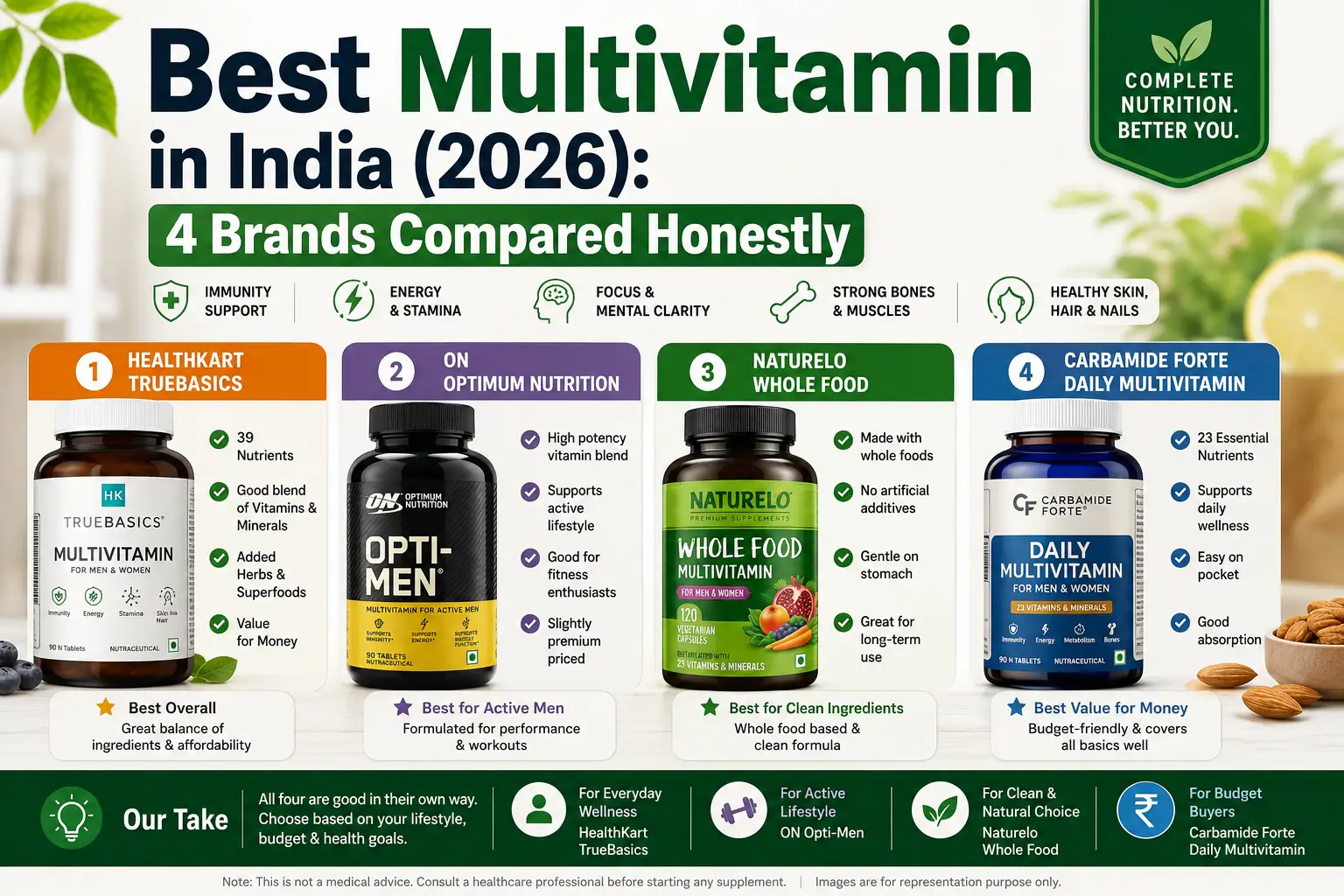
Best Multivitamin in India (2026): 4 Brands Compared Honestly
Centrum, Revital, HK Vitals and MuscleBlaze MB-Vite compared on what is actually in them — plus the honest answer to whether you need a multivitamin at all.