Best Shilajit Brand in India (2026): Top 3 Compared
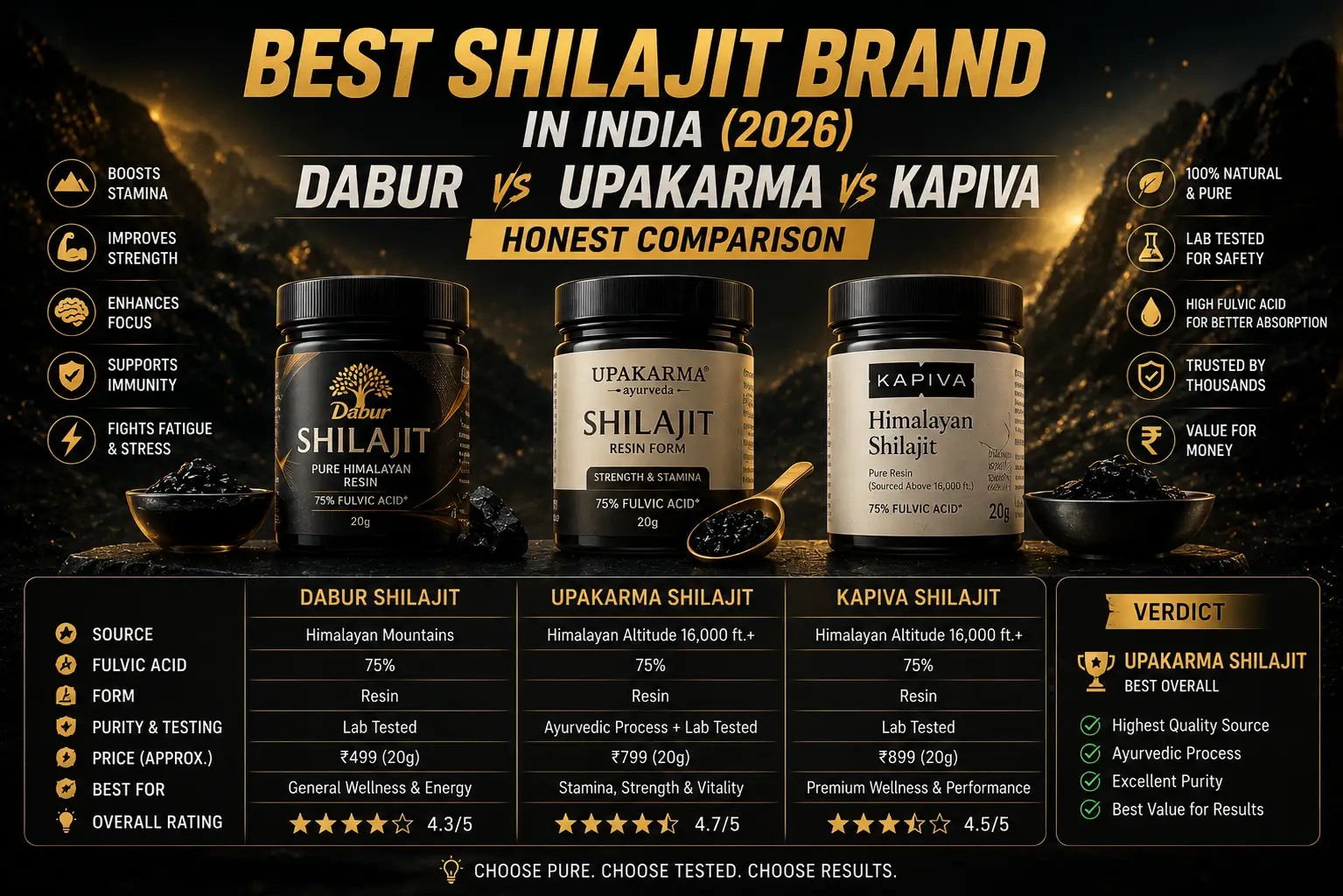
Looking for pure Shilajit in India? We compare the top 3 brands — Kapiva, Upakarma, and Dabur — based on fulvic acid content, heavy metal testing, price, and real-world results.
Medical Safety Note: This article is for general educational purposes only and is not a substitute for professional medical advice, diagnosis, or treatment. If you are pregnant, managing a condition like diabetes, PCOS, or thyroid disorder, or taking medication, please consult a qualified doctor or registered dietitian before changing your diet, supplements, or exercise routine.
Affiliate Disclosure: As an Amazon Associate I earn from qualifying purchases. This post contains affiliate links. If you buy through them, we may earn a small commission at no extra cost to you — this never affects our recommendations. We only suggest products we believe in. Read our full affiliate disclosure.
If there is one Ayurvedic supplement that has exploded in popularity over the last few years, it is Shilajit. Promising everything from enhanced stamina and gym performance to better sleep, it has moved from traditional medicine cabinets into the daily supplement stacks of athletes, gym-goers, and busy professionals.
But finding the best Shilajit brand in India is harder than it should be, because popularity has brought a massive problem: adulteration.
Raw Shilajit is a sticky exudate found high in the Himalayas. Because it takes centuries to form, high-quality, pure Shilajit is rare and expensive. Consequently, the Indian market is flooded with cheap imitations, heavily processed powders, and products containing dangerously high levels of heavy metals.
To help you cut through the marketing noise — just like we did for ashwagandha brands — I have analysed the three biggest names in the Indian Shilajit market for 2026: Kapiva, Upakarma, and Dabur. We will look at their sourcing, lab testing transparency, fulvic acid content, and real-world value for money.
Let's get into it.
Medical Disclaimer: This article is for informational purposes only and is not medical advice. Shilajit should only ever be consumed in its purified form. Avoid it entirely if you are pregnant or breastfeeding, have gout or high uric acid, an iron-overload condition (like hemochromatosis), or kidney disease — and consult a doctor before starting if you take any regular medication.
Quick Verdict — Which Brand Should You Buy?
If you are short on time, here is the immediate breakdown of how the big three stack up.
← Swipe to compare →
| Pick | Brand / Product | Best For | Approx. Price |
|---|---|---|---|
| 🥇 Best Overall | Kapiva Himalayan Shilajit Resin | Gym-goers, lab-test transparency | ~₹999 (20g) |
| 🥈 Best Value | Upakarma Pure Shilajit Resin | Everyday energy, pure resin purists | ~₹999 (20g) |
| 🥉 Best for Tradition | Dabur Himalayan Shilajit Resin | Brand trust, first-time buyers | ~₹999 (often discounted) |
Prices are approximate at the time of writing and fluctuate heavily with discounts — always check the live listing.
One number worth knowing before you compare: at the standard 250–500mg daily dose, a 20g jar gives you 40–80 servings. So even at full MRP of ₹999, all three brands cost roughly ₹12–25 per day — the price gap between them matters far less than the purity gap.
Disclosure: This post contains Amazon affiliate links. If you purchase through them, WellFitLife earns a small commission at no extra cost to you. Every recommendation here is based on independent research — no brand has paid to be on this list.
What to Look For Before Buying Shilajit in India
Not all Shilajit is created equal. Before you buy any brand, you must evaluate it on these three non-negotiable criteria:
1. Resin vs. Capsules vs. Powder
Always opt for Resin. Pure Shilajit in its natural state is a sticky, tar-like substance. Resin is the least processed and most potent form. Capsules and powders undergo heavy processing and often contain binders, fillers, or lower-quality extracts. While capsules are convenient, resin is where the actual benefits lie.
2. Fulvic Acid Content
The primary active compound in Shilajit is Fulvic Acid — researchers estimate it makes up 60–80% of purified Shilajit — and it is responsible for driving nutrients into your cells and acting as a powerful antioxidant. A high-quality Shilajit should clearly state its fulvic acid content — ideally above 60%. One honest caveat: lab methods for measuring fulvic acid vary widely across the industry, so treat every brand's percentage as a claim, and give more weight to brands that publish the actual lab reports behind it.
3. Heavy Metal Testing
Since Shilajit is sourced from mountain rocks, raw Shilajit naturally contains heavy metals. This is not a hypothetical risk: a JAMA study found roughly 1 in 5 Ayurvedic products sold online contained detectable lead, mercury, or arsenic. The Ayurvedic purification process (Shodhana) is designed to remove these. If a brand does not proudly display third-party NABL lab tests proving their product is free from dangerous levels of lead, arsenic, and mercury, do not buy it.
The Big 3: Brand-by-Brand Comparison
Let's dive deep into Kapiva, Upakarma, and Dabur to see who delivers the best quality in 2026.
1. Kapiva — The Modern Gold Standard
Kapiva has successfully bridged the gap between traditional Ayurveda and modern, transparent supplement standards. They are currently the favourite among the 20s-30s demographic, particularly gym-goers and athletes.
Product Offerings: Kapiva offers standard Himalayan Shilajit Resin and a premium Shilajit Gold Resin (which includes Ashwagandha, Swarna Bhasma, Gokshura, and Black Musli).
Purity & Testing: This is where Kapiva wins. They rigorously test their resin and even include an NABL lab report confirming safety from heavy metals inside many of their premium packs. They claim over 60% fulvic acid.
My Experience: I have personally used Kapiva's Shilajit Resin, and honestly, the results showed up faster than I expected. Within about a week of consistent use, I could feel the difference in the gym — heavy sets that usually felt like a grind became noticeably more manageable, and my squat strength in particular took a clear jump. I'll be honest: shilajit is supposed to be a slow-burn supplement, so I wasn't expecting anything in week one — take that early timeline with a pinch of salt and judge it over a full 2–3 months. But the strength difference was real enough that this is the resin I now reach for first.
The Verdict: If you want to enhance muscle recovery, boost stamina in the gym, or simply want the peace of mind that comes with visible lab testing, Kapiva is the best choice.
Pros:
- Excellent transparency with NABL lab reports
- High claimed Fulvic Acid content (>60%)
- Gold version includes complementary herbs like Ashwagandha and Gokshura
Cons:
- Premium pricing on their "Gold" range
- Taste is quite strong and earthy (as expected from pure resin)
Kapiva Shilajit Gold Resin (with Ashwagandha, Swarna Bhasma & Gokshura)
Kapiva's premium Gold variant — pure Himalayan resin blended with Ashwagandha, Swarna Bhasma and Gokshura, with NABL lab reports included in the pack. Their standard Himalayan Shilajit Resin is also available on the same page.
2. Upakarma Ayurveda — The Pure Resin Purist
Upakarma has built a massive following by focusing purely on high-quality, unadulterated Shilajit resin without the aggressive fitness-focused marketing of Kapiva.
Product Offerings: Their flagship product is the Upakarma Pure Shilajit Resin. They do not heavily push blended formulations, focusing instead on delivering the raw ingredient.
Purity & Testing: Upakarma claims over 75% fulvic acid and 85+ trace minerals in their resin. The product undergoes a natural purification process designed to retain essential minerals while removing physical impurities and toxins.
The Verdict: Upakarma is fantastic for general wellness. If you aren't a hardcore gym-goer but want Shilajit to combat daily fatigue, improve cognitive focus, and support healthy ageing, Upakarma offers incredible value.
Pros:
- Extremely high claimed fulvic acid content (>75%)
- Often runs great multi-pack discounts (drops to ~₹32/gram on bulk buys)
- Excellent for general daily energy and reducing fatigue
Cons:
- Packaging can sometimes make it difficult to get the last bits of resin out
- Fewer "blended" options if you wanted added herbs
Upakarma Ayurveda Pure Shilajit Resin (Lab-Tested)
Pure, unadulterated Himalayan resin with a claimed 75%+ fulvic acid and 85+ trace minerals. The best pick for daily energy and fatigue — and multi-pack deals bring the per-gram cost down significantly.
3. Dabur Himalayan Shilajit Resin — The Traditional Giant Goes Modern
Dabur is one of India's oldest and most trusted Ayurvedic houses — the company has been formulating traditional medicine since 1884, decades before "supplements" were even a category. For years their Shilajit presence meant the classic Shilajit Gold capsules, but Dabur has now entered the modern resin race with the Dabur Himalayan Shilajit Resin — and that changes the equation for a lot of buyers.
Product Offerings: The flagship for serious users is now the pure Himalayan Shilajit Resin — the same potent, raw format that Kapiva and Upakarma built their reputation on. The legacy Shilajit Gold capsule blend (with Kesar and Swarna Bhasma) still exists for convenience-first buyers, but if you're reading a ranking like this one, the resin is the product that matters.
Purity & Testing: Dabur operates at a manufacturing scale and regulatory maturity that startups simply can't match — GMP-certified facilities, FSSAI compliance, and decades of Ayurvedic quality-control infrastructure. What it doesn't do (yet) is lead its marketing with a headline fulvic acid percentage or bundle NABL reports in the pack the way Kapiva does. You're trusting the institution rather than a printed lab number.
The Verdict: This is the resin for the buyer who trusts a 140-year-old Ayurvedic house over a D2C startup — or who's buying for parents who will only accept a name they've known their whole life. The format is potent, the brand is bulletproof; the only real trade-off is that Dabur's resin is newer to the market, with a shorter public track record than the other two.
Pros:
- India's most established Ayurvedic brand — unmatched institutional trust and QC scale
- Pure resin format, competitively priced and frequently discounted
- Easy to find both online and at local chemists
Cons:
- Newer entrant in the resin category — shorter public track record than Kapiva/Upakarma
- No headline fulvic acid disclosure or in-pack NABL reports like Kapiva
Dabur Himalayan Shilajit Resin
The pure, potent resin format backed by India's most established Ayurvedic brand — GMP-certified manufacturing and 140 years of formulation heritage. The safest 'first shilajit' for brand-loyal buyers and older family members.
Full Comparison Table
← Swipe to compare →
| Feature | Kapiva Himalayan Resin | Upakarma Pure Resin | Dabur Himalayan Resin |
|---|---|---|---|
| Form | Semi-liquid Resin | Semi-liquid Resin | Semi-liquid Resin |
| Price (approx) | ₹999 for 20g | ₹999 for 20g | ~₹999 (often discounted) |
| Fulvic Acid (claimed) | >60% | >75% | Not headline-disclosed |
| Best For | Gym-goers, recovery | Daily vitality, fatigue | Brand trust, first-timers |
| Lab Tested | Yes (NABL reports) | Yes | Not published (GMP/FSSAI certified) |
| Taste | Earthy, bitter | Earthy, bitter | Earthy, bitter |
| Track Record (resin) | Established | Established | Newer entrant |
How to Consume Shilajit Safely for Best Results
All three picks on this list are resins, and the consumption protocol is identical for each:
- The Dosage: Take a pea-sized amount (approx 250mg to 500mg) using the provided measuring spoon.
- The Mix: Dissolve it thoroughly in a glass of lukewarm water or warm milk. (Genuine resin will dissolve completely.)
- The Timing: Consume it once a day. Many prefer it in the morning on an empty stomach or as a pre-workout.
- Consistency: Shilajit is not a pre-workout stimulant; it works through accumulation. Take it consistently for at least 2 to 3 months for visible results.
Who should skip it: pregnant or breastfeeding women, anyone with gout/high uric acid, iron-overload disorders, or kidney conditions. And never consume raw, unpurified shilajit — the heavy metal risk is real.
📖 Read Also:
Ashwagandha Benefits, Dosage & Side Effects: The Honest Guide for Indians (2026)Shilajit and Ashwagandha are the two pillars of the modern Ayurvedic stack — and they pair well together. Here's our equally honest, no-hype breakdown of Ashwagandha.
📖 Read Also:
Ashwagandha vs Shilajit: Which Do You Need? (2026)Not sure shilajit is what you need? Compare it against ashwagandha on stress, energy, testosterone, and price before you buy.
Frequently Asked Questions
How can I check if my Shilajit is authentic?
Genuine Shilajit resin will dissolve completely in warm water or milk without leaving gritty residue. It has a very distinct earthy, bitter taste. Furthermore, real Shilajit responds to temperature: it becomes sticky and soft in warm weather, and hardens in the cold.
Does Shilajit help with muscle building?
Yes, indirectly. Shilajit does not build muscle on its own, but its high mineral content and fulvic acid help improve oxygen delivery to tissues, delay fatigue, and enhance nutrient absorption. This allows you to train harder and recover faster.
Is Shilajit a replacement for Creatine?
No. While both improve athletic performance, they work differently. Creatine directly resynthesizes ATP for explosive energy, while Shilajit works holistically to improve metabolism, reduce stress, and aid cellular health. They can actually be stacked together effectively — see our best creatine in India guide if you're building that stack.
Can women consume Shilajit?
Yes. Despite being heavily marketed for male vitality, pure Shilajit can be a useful supplement for women — it helps combat fatigue, and a 48-week randomized controlled trial found it dose-dependently preserved bone mineral density in postmenopausal women with osteopenia. Avoid it during pregnancy and breastfeeding. If you're building an Ayurvedic routine for hormonal health, our ashwagandha brand comparison is the right companion read.
What are the side effects of Shilajit?
Purified, lab-tested Shilajit is well tolerated by most healthy adults at the recommended 250–500mg dose. Possible issues include increased uric acid (a problem if you have gout), excess iron intake with long-term use, and digestive discomfort if overdosed. The bigger risk is unpurified or fake Shilajit containing lead, arsenic, or mercury — which is exactly why lab-tested brands matter.
What is the shelf life of Shilajit resin?
High-quality purified Shilajit resin generally has a shelf life of about 2 years from the date of manufacturing.
Final Recommendation
When it comes to Ayurveda, cutting corners is dangerous.
If you want the absolute highest peace of mind regarding purity, heavy metal testing, and athletic performance, Kapiva Himalayan Shilajit Resin is the winner for 2026. It is thoroughly modern in its transparency while respecting traditional sourcing.
If you are a purist who simply wants the highest stated concentration of fulvic acid for daily energy and holistic wellness, Upakarma is a fantastic, highly-rated alternative.
And if you (or your parents) simply won't buy Ayurveda from a brand younger than you are, Dabur's Himalayan Shilajit Resin gives you the potent format with 140 years of institutional trust behind it.
If you're building your supplement stack from scratch, start with our beginner's guide to gym supplements in India to see where Shilajit actually fits in the priority order.
Avoid unbranded cheap powders, respect the dosage, stay consistent, and let this ancient Himalayan superfood do its work.
Free Tools to Help You
Put this article into action — use our free calculators to get your personalized numbers.
Was this article helpful?
Want More Tips Like This?
Join 1,000+ readers getting weekly fitness, diet, and wellness tips + FREE meal plan
No spam, ever. Unsubscribe anytime.

About the Author: Ashwani
Fitness enthusiast and wellness writer. I research and write about supplements, workouts, and Indian diet strategies, and share my own experience where I have it — so you can make informed decisions without wasting money.
Read more about us →Comments
Leave a Comment
Your email will not be published. Comments are reviewed before appearing.
You Might Also Like
Continue your wellness journey
25 min read
Best 1000mg Omega-3 Fish Oil in India (2026): EPA+DHA Compared
A capsule labelled 1000mg fish oil can contain as little as 300mg of actual omega-3. Here is what the EPA+DHA numbers really say, what a gram of it costs across the strength tiers, and the dose-response finding that argues against the biggest bottle.
19 min read
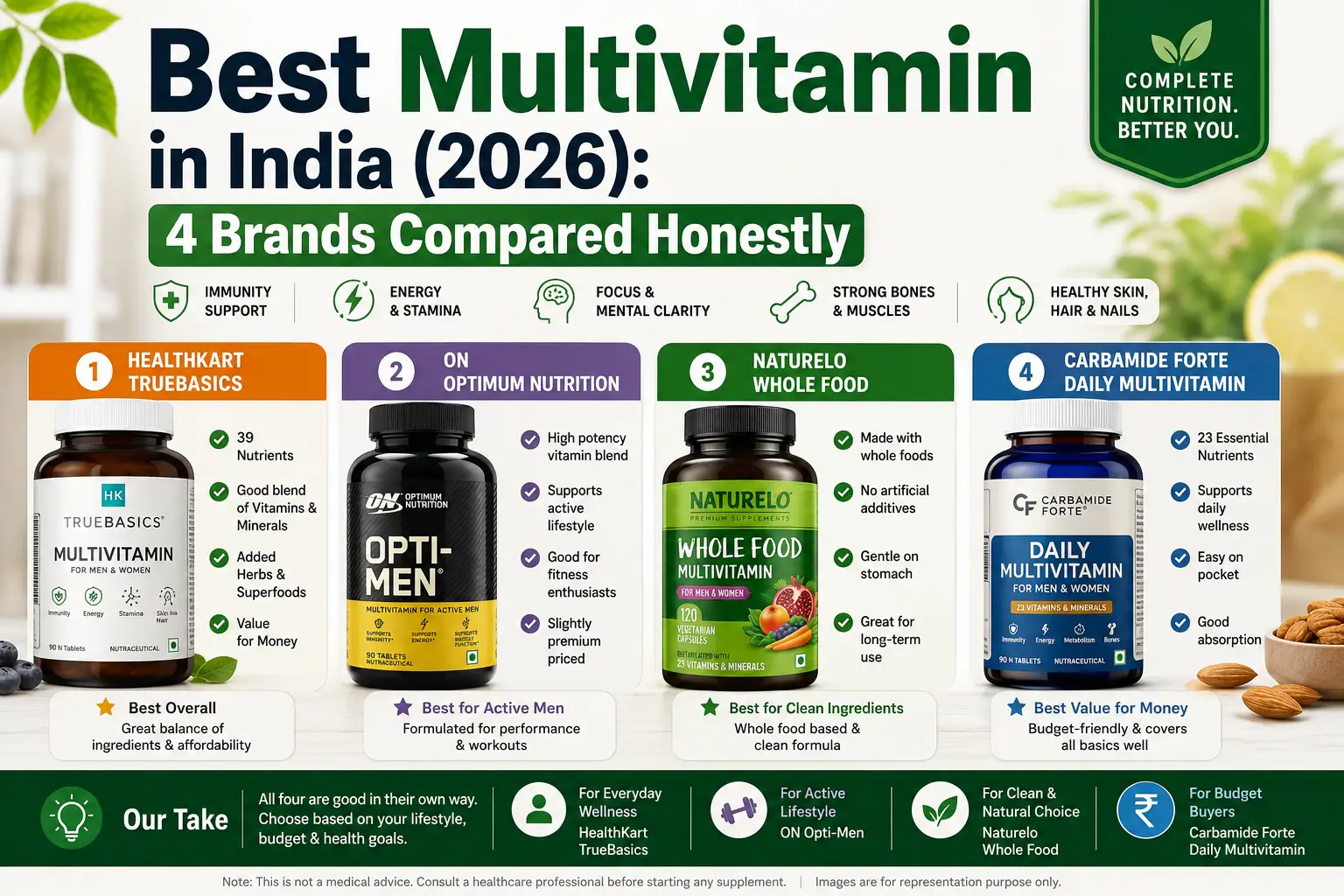
Best Multivitamin in India (2026): 4 Brands Compared Honestly
Centrum, Revital, HK Vitals and MuscleBlaze MB-Vite compared on what is actually in them — plus the honest answer to whether you need a multivitamin at all.
28 min read
Best Protein Bars in India 2026: RiteBite vs Yogabar vs MuscleBlaze
All three flagship bars deliver exactly 20g of protein, so the protein number tells you nothing. What separates them is saturated fat, fibre, polyol load — and a cost per gram of protein roughly three times what whey costs.