KSM-66 vs Himalaya vs Patanjali Ashwagandha — Which is Best in India? (2026)
KSM-66, Himalaya, and Patanjali are the three ashwagandha options most Indians actually buy. One is a clinically studied premium extract; two are affordable whole-herb classics. Here's the honest comparison — potency, evidence, price, and exactly which one to pick for your goal.

Medical Safety Note: This article is for general educational purposes only and is not a substitute for professional medical advice, diagnosis, or treatment. If you are pregnant, managing a condition like diabetes, PCOS, or thyroid disorder, or taking medication, please consult a qualified doctor or registered dietitian before changing your diet, supplements, or exercise routine.
Affiliate Disclosure: This post contains affiliate links. If you buy through them, we may earn a small commission at no extra cost to you — this never affects our recommendations. We only suggest products we believe in. Read our full affiliate disclosure.
When I first tried ashwagandha for stress and sleep, I bought the cheapest tub I could find — and felt nothing after a month. I assumed ashwagandha was overhyped. It wasn't. I'd just bought a low-potency, non-standardised powder and taken too little of it.
The three ashwagandha options most Indians actually choose between are KSM-66, Himalaya, and Patanjali. They are genuinely different products — not just different prices — and picking the wrong one is the most common reason people think ashwagandha "doesn't work."
This is the honest comparison: what each one actually is, what the evidence says, and which makes sense for your goal and budget.
Ashwagandha is a potent herb, not a casual supplement. Avoid it if you are pregnant or breastfeeding, have an autoimmune condition, or take thyroid or sedative medication — and speak to your doctor first if you have any health condition. This article is educational, not medical advice.
Quick Verdict (For Those Who Just Want the Answer)
Bottom Line: If you want results backed by actual clinical studies — for stress, cortisol, sleep, or strength — buy a KSM-66 standardised extract. It costs more, but it's the form used in most published research. Himalaya is a trustworthy, affordable whole-herb option for general daily wellness. Patanjali is the budget pick for traditional Ayurvedic use. For most people chasing a noticeable stress/sleep effect: go KSM-66.
Rasayanam Ashwagandha KSM-66 Root Extract — 60 Capsules
Full-spectrum, root-only ashwagandha standardised to 5% withanolides — the most clinically studied ashwagandha extract in the world. Best choice if you want evidence-backed results for stress, sleep, and strength.
First — Understand What You're Actually Comparing
The biggest mistake Indian buyers make is comparing these three on price alone. They're not the same kind of product.
- KSM-66 is a branded, standardised root extract — it guarantees a specific concentration of withanolides (the active compounds), is made root-only, and is the form used in most modern clinical trials.
- Himalaya uses a whole-herb / aqueous extract approach — a trusted, doctor-recommended Ayurvedic preparation, but not standardised to a high, fixed withanolide percentage.
- Patanjali is typically whole-herb churna/capsules — the most affordable, traditional preparation, with the least standardisation and batch consistency.
Potency and consistency are exactly what determine whether you feel an effect. That's why this matters more than the rupee difference.
KSM-66 Ashwagandha — Detailed Review
KSM-66 is not a brand you buy directly — it's a patented extract (made by Ixoreal Biomed) that many Indian supplement brands license and put in their capsules. So you'll see "KSM-66" listed on the label of brands like HealthKart, Wellbeing Nutrition, Nutrabay, and others.
Why It's the Gold Standard
KSM-66 is standardised to ≥5% withanolides, uses only the root (not leaves), and is produced through a "green chemistry" process without alcohol or harsh solvents. Critically, most well-known ashwagandha studies — on cortisol reduction, stress, sleep quality, and strength/testosterone in men — used KSM-66 specifically.
What to Expect
In studies, KSM-66 at 300–600mg daily showed meaningful reductions in perceived stress and cortisol over 8 weeks, with improvements in sleep quality. Strength and recovery benefits appeared in resistance-training men. These are modest, real effects — not a sedative or a miracle.
Price
You pay a premium: roughly ₹400–₹800 for a month depending on the brand and dose. Per "effective dose," it's the most expensive — but it's the one with the evidence behind it.
Rasayanam Ashwagandha KSM-66 Root Extract — 60 Capsules
Standardised to 5% withanolides, root-only, the extract used in most ashwagandha clinical research. Take 300–600mg daily for stress, sleep, and recovery support.
Himalaya Ashvagandha — Detailed Review
Himalaya is one of India's most trusted herbal brands, and its Ashvagandha tablets are a staple in pharmacies nationwide.
What You Get
Himalaya uses a whole-plant, water-based extract standardised to its own internal spec (not the high fixed withanolide percentage KSM-66 guarantees). It's affordable, widely available offline, and backed by Himalaya's quality reputation and its own research.
What to Expect
A gentler, general-wellness effect. Many users report calmer stress response and better sleep over time, but because the active concentration is lower than a 5% standardised extract, results can be subtler and more variable person-to-person.
Price
Around ₹150–₹250 for a bottle — excellent value if you want a trusted, everyday Ayurvedic option without the premium.
Himalaya Ashvagandha — 60 Tablets
Trusted Ayurvedic whole-herb ashwagandha from one of India's most reputable herbal brands. Affordable daily-wellness option for general stress support.
Patanjali Ashwagandha — Detailed Review
Patanjali's ashwagandha (capsules or churna) is the budget end of the market.
What You Get
A traditional whole-herb preparation at the lowest price point. It's authentic ashwagandha, but with the least standardisation and the most batch-to-batch variability of the three. Quality-control transparency is lower than KSM-66 or Himalaya.
What to Expect
Fine for traditional Ayurvedic use and very budget-conscious buyers. If you're after a measurable, study-level effect on stress or strength, this is the least likely of the three to deliver it consistently.
Price
The cheapest — often under ₹150.
Patanjali Ashwagandha — Capsules / Churna
Budget whole-herb ashwagandha for traditional Ayurvedic use. Lowest price of the three, with the least standardisation — best for cost-conscious, traditional users.
Head-to-Head Comparison
← Swipe to compare →
| Factor | KSM-66 | Himalaya | Patanjali |
|---|---|---|---|
| Type | Standardised root extract | Whole-herb extract | Whole-herb churna/caps |
| Withanolides | ≥5% (fixed) | Lower / brand spec | Not standardised |
| Clinical evidence | Strong (used in studies) | Brand research | Minimal |
| Consistency | High | Good | Variable |
| Price (month) | ~₹400–₹800 | ~₹150–₹250 | Under ₹150 |
| Best for | Evidence-backed results | Trusted daily wellness | Budget / traditional use |
| Overall | ⭐⭐⭐⭐⭐ | ⭐⭐⭐⭐ | ⭐⭐⭐ |
Which One Should You Actually Buy?
Choose KSM-66 if:
- You want the form used in actual clinical studies
- Your goal is measurable stress/cortisol reduction, better sleep, or training recovery
- You'd rather pay more once than waste money on something you don't feel
Choose Himalaya if:
- You want a trusted brand at an affordable price
- You're after general daily wellness rather than a study-level effect
- You prefer buying offline from a pharmacy you know
Choose Patanjali if:
- Budget is the deciding factor
- You're using ashwagandha in a traditional Ayurvedic context
📖 Read Also:
Ashwagandha Benefits, Dosage & Side Effects: The Honest Guide for IndiansBefore you buy — exactly what ashwagandha does and doesn't do, the right dosage, timing, and the safety cautions that matter (thyroid, pregnancy, autoimmune).
How to Take Ashwagandha Correctly
- Dose: 300–600mg of a standardised extract (like KSM-66) once or twice daily; higher whole-herb amounts for non-standardised forms
- Timing: Evening or before bed is popular for sleep/stress; with food to avoid stomach upset
- Consistency: Effects build over 4–8 weeks — it's not a same-day supplement
- Cycling: Many people cycle 8–12 weeks on, then a short break, though this isn't strictly required
- Safety first: Avoid in pregnancy/breastfeeding, autoimmune conditions, and alongside thyroid or sedative medication without medical guidance
Why dose and form matter: A non-standardised whole-herb powder at a low dose is the #1 reason people feel "nothing" from ashwagandha. If you've tried it before and felt no effect, a properly dosed KSM-66 extract is worth trying before giving up on the herb entirely.
📖 Read Also:
Ashwagandha vs Shilajit: Which Do You Need? (2026)Before choosing a brand, make sure ashwagandha is even the right herb for your goal — this head-to-head with shilajit goes goal by goal on the trial evidence.
📖 Read Also:
Best Shilajit Brand in India (2026): Top 3 ComparedIf shilajit makes your list after the comparison above, this compares the three biggest Indian brands on purification and lab testing.
Frequently Asked Questions
KSM-66 itna mehnga kyun hai jab Himalaya/Patanjali sasta milta hai?
KSM-66 ek patented, standardised root extract hai jisme withanolides ki fixed concentration (≥5%) guaranteed hoti hai, aur yahi form zyadatar clinical studies me use hua hai. Himalaya aur Patanjali whole-herb preparations hain — cheaper, par lower aur variable potency. Aap evidence aur consistency ke liye extra pay kar rahe ho.
Is KSM-66 actually better, or is it just marketing?
It's genuinely better-evidenced. The reason KSM-66 appears in so many studies is its standardisation and consistency — qualities that whole-herb powders can't guarantee. That doesn't make Himalaya or Patanjali "bad," but for study-level results, KSM-66 is the rational choice.
Can I take ashwagandha every day long-term?
Most healthy adults tolerate daily ashwagandha well for several weeks to months. Some people cycle it. If you have any health condition — especially thyroid, autoimmune, or you're pregnant — talk to your doctor before daily long-term use.
Which ashwagandha is best for stress and sleep specifically?
A KSM-66 standardised extract at 300–600mg has the most direct study support for stress, cortisol, and sleep quality. Take it consistently for 6–8 weeks to judge the effect.
Does ashwagandha really boost testosterone?
Some studies (using KSM-66) showed modest testosterone and strength improvements in resistance-training men. The effect is real but moderate — it supports training, it doesn't replace it.
Final Verdict
All three are real ashwagandha — but they are not interchangeable.
For anyone who wants ashwagandha to actually do something noticeable — calmer stress response, better sleep, training recovery — KSM-66 is the one worth buying, because it's standardised and it's the form the research is built on. Himalaya is the smart, affordable everyday option from a brand you can trust. Patanjali is the budget, traditional-use pick.
If you've tried ashwagandha before and felt nothing, don't write off the herb — try a properly dosed KSM-66 extract and give it six honest weeks.
Rasayanam Ashwagandha KSM-66 Root Extract — 60 Capsules
The most clinically studied ashwagandha — standardised to 5% withanolides, root-only. Our top pick for anyone who wants evidence-backed stress, sleep, and recovery support.
Himalaya Ashvagandha — 60 Tablets
Trusted, affordable Ayurvedic whole-herb ashwagandha for general daily wellness. Best value from a reputable Indian brand.
📖 Read Also:
Ashwagandha for Women: PCOS, Hormones, Thyroid & Dosage GuideWomen have specific considerations with ashwagandha — PCOS, hormones, thyroid, and pregnancy. Read this before starting if you're a woman.
📖 Read Also:
Best Supplements for Beginners in India — What's Actually Worth ItBuilding a supplement stack? See where ashwagandha fits alongside whey, creatine, and the few others actually backed by evidence.
Free Tools to Help You
Put this article into action — use our free calculators to get your personalized numbers.
Was this article helpful?
Want More Tips Like This?
Join 1,000+ readers getting weekly fitness, diet, and wellness tips + FREE meal plan
No spam, ever. Unsubscribe anytime.

About the Author: Ashwani
Fitness enthusiast and wellness writer. I research and write about supplements, workouts, and Indian diet strategies, and share my own experience where I have it — so you can make informed decisions without wasting money.
Read more about us →Comments
Leave a Comment
Your email will not be published. Comments are reviewed before appearing.
You Might Also Like
Continue your wellness journey
25 min read
Best 1000mg Omega-3 Fish Oil in India (2026): EPA+DHA Compared
A capsule labelled 1000mg fish oil can contain as little as 300mg of actual omega-3. Here is what the EPA+DHA numbers really say, what a gram of it costs across the strength tiers, and the dose-response finding that argues against the biggest bottle.
19 min read
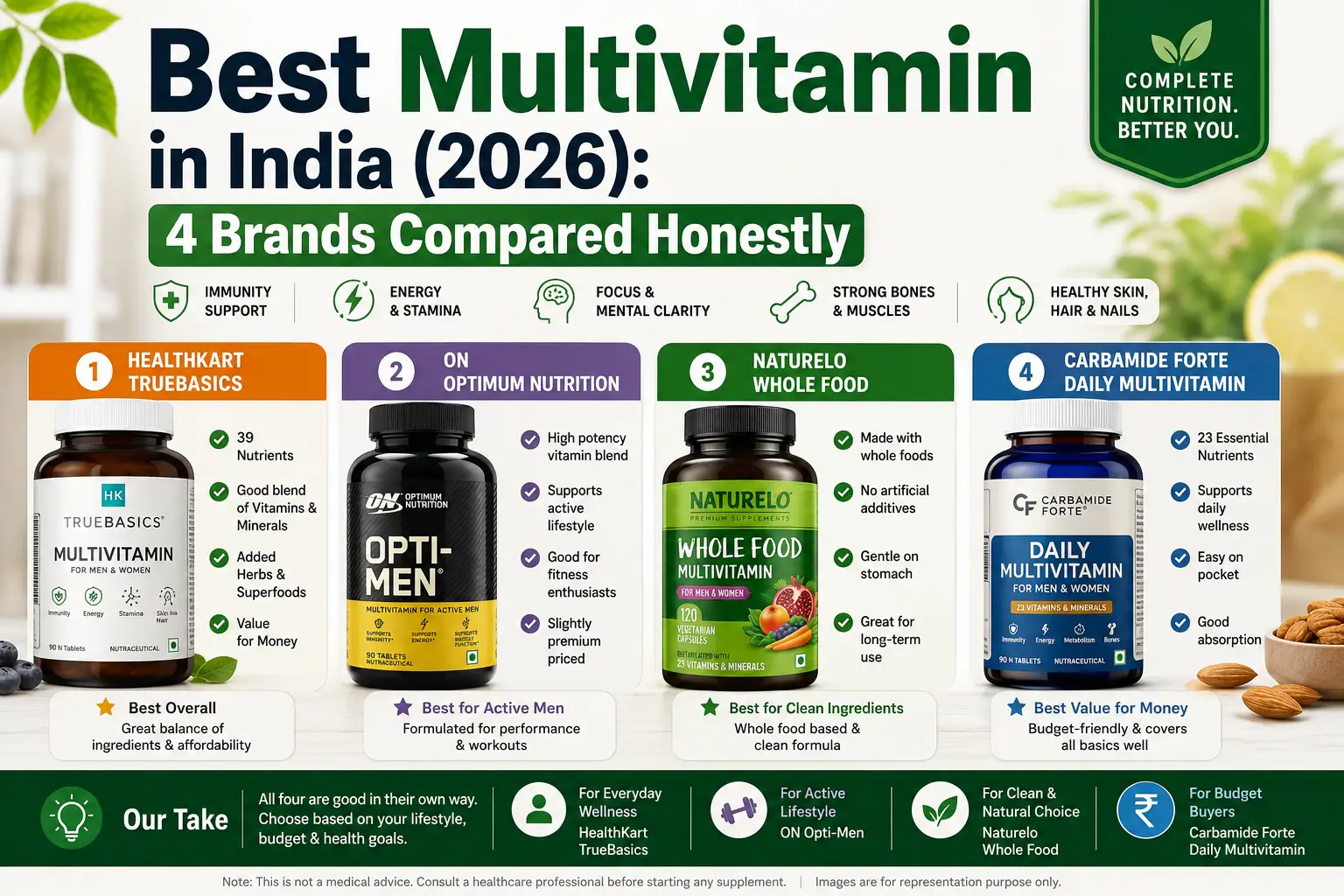
Best Multivitamin in India (2026): 4 Brands Compared Honestly
Centrum, Revital, HK Vitals and MuscleBlaze MB-Vite compared on what is actually in them — plus the honest answer to whether you need a multivitamin at all.
24 min read
Best Protein Bars in India 2026: RiteBite vs Yogabar vs MuscleBlaze
All three flagship bars deliver exactly 20g of protein, so the protein number tells you nothing. What separates them is saturated fat, fibre, polyol load — and a cost per gram of protein roughly three times what whey costs.