How to Build Muscle on an Indian Diet: The Complete 2026 Guide
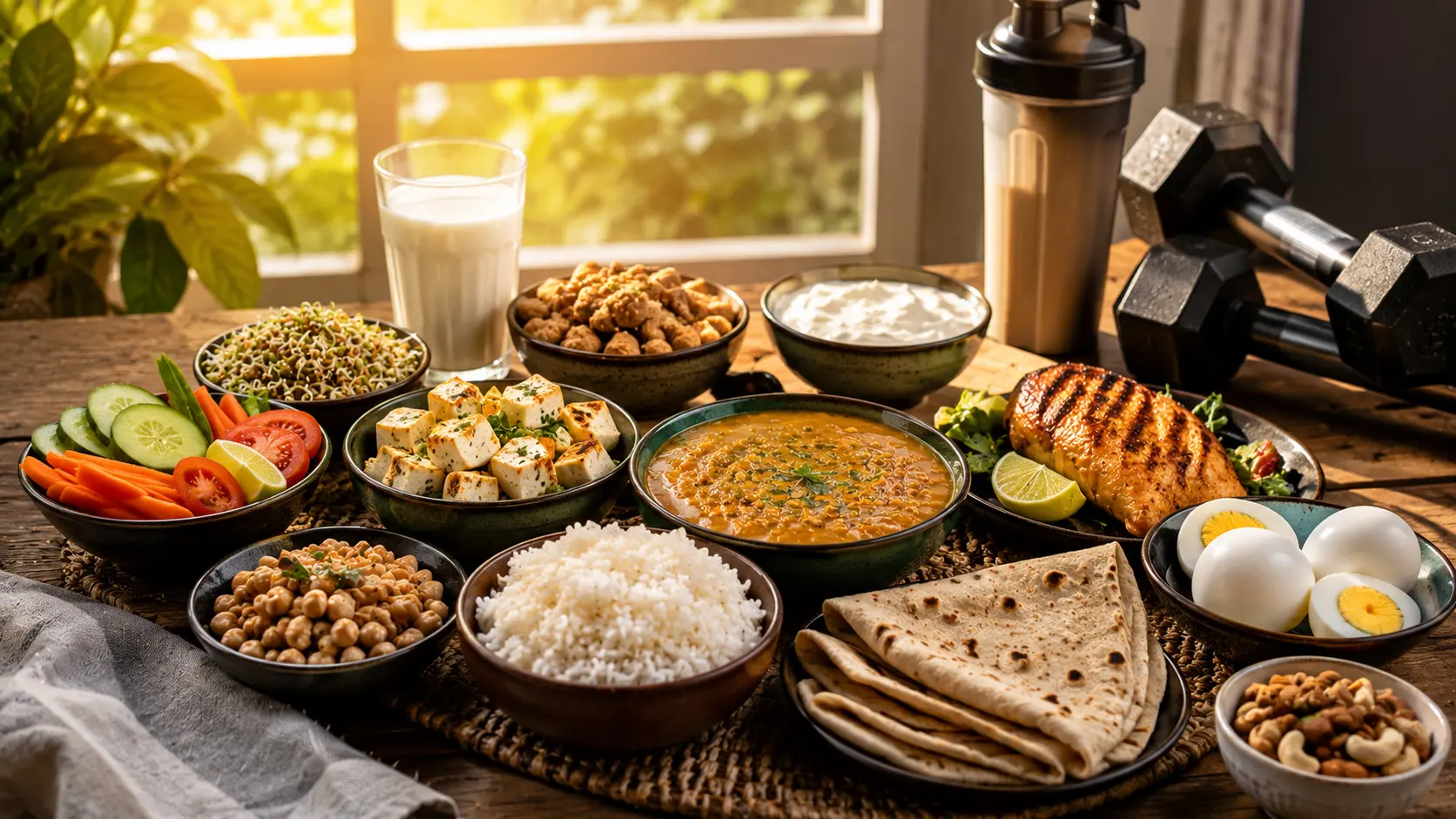
Most Indians eat only 40–50g of protein daily when muscle building needs 100–140g. This complete guide covers exact protein targets, Indian food sources for vegetarians and non-vegetarians, a 7-day muscle gain meal plan, beginner supplement stack with real prices, and a 4-day workout structure.
Medical Safety Note: This article is for general educational purposes only and is not a substitute for professional medical advice, diagnosis, or treatment. If you are pregnant, managing a condition like diabetes, PCOS, or thyroid disorder, or taking medication, please consult a qualified doctor or registered dietitian before changing your diet, supplements, or exercise routine.
Affiliate Disclosure: This post contains affiliate links. If you buy through them, we may earn a small commission at no extra cost to you — this never affects our recommendations. We only suggest products we believe in. Learn more.
Here is something that surprises almost everyone who tracks their food for the first time.
A typical Indian day — two rotis, a bowl of dal, some sabzi, rice, curd — sounds balanced. And in many ways, it is. But when you actually count the protein in that meal, you get roughly 45–55 grams for the entire day.
For someone trying to build muscle, that number needs to be closer to 100–140 grams.
That gap — roughly 60–90 grams of daily protein — is why most Indians who train consistently for months see very little change in their body composition. It is not a training problem. It is a nutrition problem. And it is almost entirely fixable through food, with smart supplement use as a supporting layer.
This guide covers everything: the science of muscle building, how much protein you actually need, the best Indian food sources (vegetarian and non-vegetarian), a complete 7-day meal plan, a beginner supplement stack with real prices, and a workout structure to pair with it all.
Recommended Reading for This Goal
📖 Read Also:
Muscle Gain Diet Plan for Indian Men (2026): Beginner to Advanced — Veg & Non-Veg Meal Plans + Grocery ListA more detailed, men's-focused breakdown of this same diet — beginner to advanced meal plans plus a full grocery list.
📖 Read Also:
Is Chicken Really Cheaper Than Paneer? (2026 India Price + Protein Breakdown)A practical cost-per-gram-of-protein comparison if you're deciding between vegetarian and non-vegetarian sources while building this diet.
📖 Read Also:
Free One-Rep Max CalculatorNutrition is only half the equation — use this to track real strength progress on your lifts as your training advances.
The Real Reason Indians Struggle to Build Muscle
Before getting into what to eat, it helps to understand why the standard Indian diet makes muscle building harder than it needs to be.
According to ICMR data, the average Indian adult consumes only 0.6g of protein per kg of body weight per day — which is 25% below even the basic recommended intake for a sedentary person, let alone someone training four days a week.
The problem is structural, not personal. Indian food culture is built around carbohydrates — roti, rice, poha, upma, idli, bread. These are cheap, filling, easy to cook, and deeply familiar. Protein sources — paneer, dal, eggs, chicken, soya — either cost more, require more preparation, or are eaten in portions too small to matter.
Consider the protein math of a "good" Indian lunch:
← Swipe to compare →
| Food | Quantity | Protein |
|---|---|---|
| 2 whole wheat rotis | Medium size | 8g |
| 1 katori dal (thin) | 150ml | 8g |
| 1 katori sabzi (aloo gobi) | 150g | 3g |
| 1 small bowl curd | 100g | 4g |
| Total | ~23g |
That is one meal. To hit 120g of protein across a day, you need to get roughly 30–40g from every major meal. That requires deliberate planning — and most Indians have never been taught to plan meals around protein.
The other issue is muscle protein synthesis — the biological process through which your body actually builds new muscle tissue. For this process to work optimally, your body needs amino acids available consistently throughout the day, not all at once. Skipping breakfast or eating a carb-heavy one means several hours where muscle repair is happening at a lower rate than it could be.
None of this is complicated once you understand it. The rest of this guide is about fixing it.
How Muscle Building Actually Works (The Short Version)
You do not need a biology degree for this. Here are the three things that must happen for muscle growth:
1. Progressive Overload in Training You must consistently challenge your muscles with more resistance than they are used to. This creates microscopic damage in muscle fibres — which is what triggers the repair and growth response. Without progressive overload, no amount of protein or supplements will produce muscle growth.
2. Adequate Protein Intake Protein provides the amino acids your body uses to repair and rebuild those damaged muscle fibres — slightly larger and stronger than before. Without enough protein, training breaks muscle down without fully rebuilding it.
3. Sufficient Recovery (Sleep + Rest) Muscle is not built during training. It is built during recovery — specifically during deep sleep, when growth hormone is released. Training is the stimulus. Sleep and rest are when the adaptation actually happens.
Get all three right simultaneously, and muscle growth becomes relatively straightforward. Miss any one of them consistently, and results stall.
How Much Protein Do You Actually Need to Build Muscle?
The research on this is now well-established. For muscle building, the optimal protein intake range is 1.6 to 2.2 grams per kilogram of body weight per day.
For most Indian adults training regularly, a practical working target of 1.8g/kg covers the majority of people well.
Here is what that looks like for different body weights:
← Swipe to compare →
| Body Weight | Protein Target (1.8g/kg) | Practical Daily Goal |
|---|---|---|
| 55 kg | 99g | ~100g |
| 60 kg | 108g | ~110g |
| 65 kg | 117g | ~120g |
| 70 kg | 126g | ~130g |
| 75 kg | 135g | ~135g |
| 80 kg | 144g | ~145g |
| 85 kg | 153g | ~155g |
Compare that to the national average of 45–55g and you can see the gap immediately.
Protein distribution matters as much as total intake. Research suggests that muscle protein synthesis is maximised when you consume 30–40g of protein per meal, 3–4 times a day — rather than eating 20g at most meals and trying to compensate with a large amount at dinner. Plan each meal around its protein source first, then build the rest of the meal around it.
Best Indian Protein Sources for Muscle Building
Vegetarian Protein Sources
The biggest myth in Indian fitness culture is that vegetarians cannot build significant muscle. They can — it just requires understanding which plant sources are high enough in protein and combining them correctly.
← Swipe to compare →
| Food | Protein per 100g | Notes |
|---|---|---|
| Soya chunks (dry) | 52g | The highest plant protein available in India. Underused. |
| Paneer (low-fat) | 18g | Versatile, widely available, high in casein |
| Greek-style curd / hung curd | 10–11g | Great for breakfast and snacks |
| Rajma (cooked) | 8–9g | Complete protein when combined with rice |
| Chana (chickpeas, cooked) | 8–9g | High fibre too — very filling |
| Moong dal (cooked) | 7g | Easiest to digest, excellent for post-workout |
| Masoor dal (cooked) | 9g | Higher protein among common dals |
| Tofu (firm) | 8g | Excellent paneer substitute for vegans |
| Tempeh | 19g | Less common but increasingly available in Indian cities |
| Peanuts / peanut butter (natural) | 26g / 25g | Affordable, calorie-dense — good for hardgainers |
| Milk (full-fat) | 3.4g | Useful volume when consumed 500ml and daily |
The key insight for vegetarian muscle building: Combine dals and legumes with grains (rice, roti) at the same meal to create complete protein profiles — all essential amino acids covered without any supplements.
Highest-value vegetarian protein move per meal: 100g of dry soya chunks cooked into a bhurji or curry = 52g protein. One meal nearly handles a third of your daily target.
Non-Vegetarian Protein Sources
← Swipe to compare →
| Food | Protein per 100g | Cost Efficiency | Notes |
|---|---|---|---|
| Chicken breast (cooked) | 31g | ★★★★★ | Leanest option, low fat, highly versatile |
| Whole eggs | 13g per 100g (~6g per egg) | ★★★★★ | Complete protein, affordable, fast to cook |
| Egg whites | 11g | ★★★★☆ | Zero fat — useful when bulking carefully |
| Fish (rohu, surmai, pomfret) | 20–25g | ★★★★☆ | Omega-3 fatty acids are a bonus |
| Tuna (canned in water) | 26g | ★★★★★ | Extremely convenient, low cost |
| Paneer (for non-veg eaters too) | 18g | ★★★★☆ | Useful to combine with non-veg for variety |
📖 Read Also:
Paneer vs Chicken for Muscle Building - Which Is Better for Indians?A direct comparison of paneer and chicken across protein quality, amino acid profiles, cost, and practical meal planning - with a verdict for both vegetarians and non-vegetarians.
The 4 Muscle Building Meal Principles for Indians
Before looking at specific meal plans, understanding these four principles will help you adapt any meal to work for your goals.
Principle 1: Protein First, Everything Else Second
When planning any meal, start with the protein source and build the rest of the meal around it. Not the other way around. If you plan a meal as "roti + dal + sabzi" and then think about protein, you will always fall short. If you plan as "100g paneer + supporting carbs + vegetables," you will hit your target.
Principle 2: Distribute Protein Evenly Through the Day
Aim for 30–40g of protein at each major meal. Eating 10g at breakfast, 25g at lunch, and 70g at dinner does not produce the same result as 35g at each meal. Your body can only effectively use a certain amount of amino acids for muscle synthesis at one time.
Principle 3: Eat in a Calorie Surplus (For Muscle Gain)
To build muscle, you need to eat slightly more than your maintenance calories — typically 200–300 calories above your TDEE. This provides energy for training and the raw materials for growth. If you are simultaneously trying to lose fat and gain muscle (body recomposition), this does not apply — but progress will be slower.
Principle 4: Time Carbohydrates Around Training
Eat complex carbohydrates before and after training. Before: provides energy for the session. After: replenishes glycogen stores and supports recovery. This is not magical meal timing — it is practical nutrition management.
📖 Read Also:
Pre-Workout Foods for Indians - What to Eat Before TrainingThe best Indian foods to eat 1-2 hours before a workout for energy, performance, and avoiding the crash mid-session.
Complete Muscle Gain Meal Plan — Vegetarian (2,500 Calories, ~130g Protein)
This plan is designed for a 70–75 kg male vegetarian training 4 days a week. Adjust portions up or down based on your body weight and targets.
On Waking Up (6:30 AM)
- 1 glass warm water
- 5 soaked almonds + 2 soaked walnuts
Breakfast (7:30–8:00 AM) — 35g Protein
- 150g paneer bhurji (cooked with onion, tomato, capsicum, minimal oil)
- 2 whole wheat rotis
- 1 glass full-fat milk (250ml)
Nutrition: ~550 cal | 35g protein | 55g carbs | 20g fat
Mid-Morning Snack (10:30 AM) — 15g Protein
- 200g hung curd / Greek-style dahi
- 1 banana
- 1 tbsp peanut butter (natural, no added sugar)
Nutrition: ~350 cal | 15g protein | 40g carbs | 12g fat
Pre-Workout Snack (12:30 PM, if training at 2 PM) — Optional
- 1 banana + 5 dates
- OR 1 slice whole wheat toast with peanut butter
Nutrition: ~200 cal | 5g protein | 40g carbs | 5g fat
Lunch (1:00–1:30 PM) — 40g Protein
- 100g dry soya chunks curry (cooked — provides ~40g protein alone)
- 1 katori brown rice (¾ cup cooked)
- 1 katori sabzi (any vegetable)
- Salad (cucumber, tomato, onion)
Nutrition: ~650 cal | 40g protein | 75g carbs | 8g fat
Post-Workout (4:00–4:30 PM) — 25g Protein
- Whey protein shake (1 scoop, 25g protein) with water or milk
- OR: 3 boiled eggs + 1 banana (if not using supplements)
Nutrition: ~200–300 cal | 25g protein | 15–30g carbs | 3–5g fat
Evening Snack (5:30 PM)
- Roasted chana (30g) + 1 apple
- OR: Sprouts salad (50g dry weight) with lemon and chaat masala
Nutrition: ~180 cal | 8g protein | 25g carbs | 3g fat
Dinner (8:00 PM) — 30g Protein
- 2 whole wheat rotis
- 1 large katori rajma or chole (¾ cup cooked)
- 1 katori palak/methi sabzi
- 150g low-fat curd
Nutrition: ~550 cal | 30g protein | 75g carbs | 10g fat
Before Bed (10:00 PM) — Optional
- 200g curd with 1 tsp flaxseed powder
- OR: 1 glass warm milk
Nutrition: ~130 cal | 7g protein | 10g carbs | 4g fat
Daily Total: ~2,810 cal | ~155g protein | ~320g carbs | ~62g fat
Adjust rice/roti portions down slightly if you find you are gaining too much fat. Increase dal and soya if protein target is not being hit.
Complete Muscle Gain Meal Plan — Non-Vegetarian (2,600 Calories, ~145g Protein)
Designed for a 75–80 kg male training 4 days a week.
Breakfast (7:30 AM) — 35g Protein
- 4 whole eggs (scrambled or omelette, 1 tsp oil)
- 2 whole wheat toasts or 1 paratha (no ghee, made with atta)
- 1 glass milk (250ml)
Nutrition: ~550 cal | 35g protein | 45g carbs | 22g fat
Mid-Morning (10:30 AM) — 10g Protein
- 200g curd + 1 banana + handful of almonds
Nutrition: ~330 cal | 10g protein | 40g carbs | 12g fat
Lunch (1:00 PM) — 45g Protein
- 200g chicken breast (cooked — grilled, tandoor, or curry without heavy gravy)
- 1 katori brown rice or 2 rotis
- 1 katori sabzi + salad
Nutrition: ~650 cal | 45g protein | 60g carbs | 12g fat
Post-Workout (4:30 PM) — 25g Protein
- Whey protein shake (1 scoop)
- OR: 4 boiled egg whites + 1 whole egg + banana
Nutrition: ~250 cal | 25g protein | 25g carbs | 4g fat
Dinner (7:30 PM) — 35g Protein
- 150g fish curry (rohu / surmai / pomfret) or chicken
- 1–2 rotis
- 1 katori dal
- Green salad + 100g curd
Nutrition: ~580 cal | 35g protein | 55g carbs | 15g fat
Before Bed (Optional)
- 200g curd
Nutrition: ~120 cal | 7g protein | 8g carbs | 3g fat
Daily Total: ~2,480 cal | ~157g protein | ~233g carbs | ~68g fat
7-Day Indian Muscle Gain Diet Chart
A week-at-a-glance view — mix and match from the meal templates above. Target 2,400–2,800 calories and 120–150g protein depending on your body weight.
← Swipe to compare →
| Day | Breakfast | Lunch | Dinner | Notes |
|---|---|---|---|---|
| Monday | Paneer bhurji + 2 rotis + milk | Soya chunks curry + brown rice + sabzi | Rajma + 2 rotis + curd | Training day — add post-workout shake |
| Tuesday | 4 eggs omelette + toast + milk | Chicken breast + rice + sabzi | Moong dal + roti + palak sabzi | Training day |
| Wednesday | Besan chilla (3) + curd | Chole + brown rice + salad | Dal makhani (small) + 2 rotis | Rest day — slightly reduce carbs |
| Thursday | Greek curd + banana + peanut butter | Fish curry + rice + sabzi | Paneer bhurji + 2 rotis | Training day |
| Friday | 4 eggs + paratha + milk | Soya bhurji + roti + sabzi | Chicken + roti + dal + curd | Training day — highest volume |
| Saturday | Protein oats (oats + milk + whey) | Egg curry + rice + salad | Dal + 2 rotis + paneer sabzi | Active rest — lighter training |
| Sunday | Paneer paratha (2, minimal ghee) + curd | Rajma rice | Dal khichdi + curd | Full rest day |
📖 Read Also:
Muscle Gain Diet Plan for Indian Men - Full 30-Day BreakdownA month-long muscle gain diet plan for Indian men - week-by-week calorie and protein progression, meal prep strategies, and a grocery list that stays under Rs.4,000 per month.
Supplement Stack for Indian Beginners
Let us be direct about this: you do not need supplements to build muscle. Food comes first. But the right supplements can plug real gaps efficiently — especially when hitting 130–150g of protein through food alone is genuinely difficult.
Here is the priority order:
Tier 1 — The Foundation (Worth It From Day One)
Whey Protein — 1 scoop per day post-workout
Whey protein is the most researched supplement in existence. It provides fast-absorbing complete protein — all essential amino acids — which makes it ideal post-workout when your muscles need amino acids quickly.
For Indian beginners, the sweet spot is an unflavoured or simply flavoured whey concentrate. Clean ingredients, no proprietary blends, third-party tested.
AS-IT-IS Nutrition Whey Protein Concentrate 80 percent - 1kg
27g protein per scoop, zero fillers, Labdoor tested for purity. Unflavoured - mix with milk, curd, or a smoothie. The cleanest entry-level whey available in India. 33 servings per kg.
Creatine Monohydrate — 5g daily
Creatine is the single most researched supplement in sports science — over 1,000 peer-reviewed studies confirm its safety and effectiveness. It works by increasing phosphocreatine stores in your muscles, which means more energy for explosive strength work (your compound lifts).
Result: heavier lifts, more reps, faster strength progression. Over months, this compounding effect translates into measurably more muscle mass.
Take 5g daily with water or your post-workout shake. No loading phase needed. It takes 2–4 weeks to saturate your muscles — then the benefits maintain as long as you keep taking it.
AS-IT-IS Creatine Monohydrate - 500g (100 Servings)
Pure creatine monohydrate, no fillers, unflavoured. Mixes easily, no bloating. At Rs.9.20 per serving, this is the most cost-effective high-impact supplement for Indian lifters. Labdoor certified.
Common creatine myths debunked: Creatine does not cause hair loss (this claim comes from one outlier study on DHT in rugby players — it has never been replicated). It does not damage kidneys in healthy individuals at 5g daily doses. It is not a steroid. It is one of the safest, most studied supplements available.
Tier 2 — Useful if Gaps Exist
Multivitamin — 1 daily with food
The Indian diet is notoriously deficient in Vitamin D, Vitamin B12 (especially vegetarians), iron (especially women), and zinc. These micronutrients directly affect energy levels, testosterone production, and muscle recovery. A basic daily multivitamin covers these gaps without drama.
Vitamin D3 — if your blood test confirms deficiency
Most Indians are deficient in Vitamin D — partly genetics, partly indoor lifestyles, partly that darker skin produces less D from sun exposure. Low Vitamin D impairs muscle protein synthesis, reduces testosterone, and worsens recovery. Get a blood test. If you are below 30 ng/mL, supplement 2,000–4,000 IU daily.
Tier 3 — Optional / Situational
BCAA — Generally Not Needed
If you are hitting your daily protein target through food and whey, BCAAs are redundant. Your whey already contains BCAAs. They are a useful supplement only if you train fasted, are consuming very low protein, or are cutting aggressively while trying to preserve muscle. Otherwise, skip and save the money.
Mass Gainer — Only for Genuine Hardgainers
Mass gainers are mostly sugar and calories with some protein. They are useful if you literally cannot eat enough food to stay in a calorie surplus — which is rare but real for some underweight individuals. If you can eat 2,500 and calories through regular food, you do not need one.
📖 Read Also:
Whey Protein Guide for Indian Beginners - Types, Brands and When to TakeConcentrate vs isolate, MuscleBlaze vs AS-IT-IS vs MyProtein - a no-nonsense guide to choosing the right whey protein in India with current prices and honest brand comparisons.
The Beginner Workout Structure to Pair With This Diet
Diet without training is just eating more. Here is the beginner-friendly 4-day programme that pairs directly with the meal plans above.
The structure is a Upper/Lower split — efficient, well-researched, and appropriate for beginners through intermediate lifters.
4-Day Upper/Lower Split
← Swipe to compare →
| Day | Session | Focus |
|---|---|---|
| Monday | Upper Body — Push + Pull | Chest, shoulders, back, arms |
| Tuesday | Lower Body | Quads, hamstrings, glutes, calves |
| Wednesday | Rest / Active recovery | Walking, yoga, stretching |
| Thursday | Upper Body — Compound Focus | Bench, rows, overhead press |
| Friday | Lower Body + Core | Deadlifts, squats, core work |
| Saturday | Active rest | Surya Namaskar, swimming, sport |
| Sunday | Full rest |
Sample Monday — Upper Body Session (45–55 Minutes)
← Swipe to compare →
| Exercise | Sets × Reps | Notes |
|---|---|---|
| Bench Press or Push-Up Variations | 3 × 8–12 | Add weight progressively each week |
| Bent-Over Dumbbell Row | 3 × 10–12 | Pull elbows back, squeeze shoulder blade |
| Overhead Dumbbell Press | 3 × 10–12 | Control the descent |
| Pull-Ups or Lat Pulldown | 3 × 6–10 | Most beginners need assisted version initially |
| Bicep Curl | 2 × 12 | After compound work only |
| Tricep Pushdown | 2 × 12 | Isolation at the end |
| Plank | 3 × 30–60 sec | Brace core, don't let hips sag |
Sample Tuesday — Lower Body Session (45–55 Minutes)
← Swipe to compare →
| Exercise | Sets × Reps | Notes |
|---|---|---|
| Barbell or Goblet Squat | 4 × 8–10 | Depth matters more than weight early on |
| Romanian Deadlift | 3 × 10 | Hip hinge, not a back exercise |
| Walking Lunges | 3 × 12/leg | Add dumbbells as strength improves |
| Leg Press | 3 × 12 | Machine alternative to barbell squat |
| Calf Raises | 3 × 15 | Slow and controlled |
| Core — Hanging Knee Raise | 3 × 10–12 |
Progressive overload is not optional. Write down your weights and reps every session. Every week, try to add 1–2 reps or a small amount of weight to at least one set of each exercise. If you train with the same weights for months, your muscles have no reason to grow — regardless of how much protein you eat.
This kind of disciplined, every-single-day training structure is exactly what separates elite Indian athletes from casual gym-goers.
📖 Read Also:
Virat Kohli's 4:45 AM Daily Routine (2026): Exact Time Table, Diet Plan & The 2018 Turning PointA detailed look at how one of India's fittest athletes structures training, recovery, and a protein-focused diet around a fixed daily schedule — proof that consistency compounds.
Gym Essentials — What You Actually Need to Start
You do not need Rs.50,000 worth of equipment to build a meaningful physique. Here is what actually matters:
If You Have a Gym Membership: A barbell, dumbbells, and a cable machine cover 95 percent of what you need. Focus on compound movements. Ignore the complicated machines until you have 6 months of consistent training.
If You Are Training at Home: A resistance band set and a pair of adjustable dumbbells take you further than you might expect. Add a pull-up bar and you have a complete home gym for under Rs.3,000.
Boldfit Resistance Bands Set - 5 Bands (Loop)
5 resistance levels from light to extra-heavy. Covers warm-up activation, lower body work, shoulder rehabilitation, and home HIIT sessions. Fabric construction - doesn't snap or roll up during use.
📖 Read Also:
Home Gym Setup Under Rs.5,000 India - Complete Equipment GuideBuild a functional home gym for under Rs.5,000 - the exact equipment list, where to buy, what to skip, and a 4-week home workout plan to get started immediately.
How to Track Muscle Gain Progress
The scale is the worst way to measure muscle-building progress. Here is a better system:
What to Track Weekly
Bodyweight (once a week, same conditions): Your weight may stay the same or even increase slightly when you first start lifting — especially if you were previously sedentary. This is normal. Muscle is denser than fat.
Strength numbers: This is the most reliable indicator. If your squat went from 40 kg to 60 kg over 8 weeks, you built muscle. If the weights are not moving, something in your nutrition or recovery is wrong.
Monthly photos: Take front and side photos in the same light every 4 weeks. Muscle change is slow — weekly photos show nothing. Monthly photos show everything.
Measurements (optional): Chest, waist, arms, thighs with a measuring tape monthly. Waist staying same while chest and arms increase = you are building muscle without gaining fat. Ideal.
Realistic Muscle Gain Expectations
← Swipe to compare →
| Training Experience | Monthly Muscle Gain (Realistic) |
|---|---|
| Complete beginner (Year 1) | 0.8–1.5 kg/month |
| Intermediate (Year 2) | 0.4–0.7 kg/month |
| Advanced (Year 3+) | 0.1–0.3 kg/month |
These numbers account for real, drug-free, natural muscle gain. Anyone promising 5 kg of muscle in a month is either lying or selling something that is not legal.
Year 1 is the best year you will ever have for muscle building — beginners respond faster to training stimulus than any other group. Do not waste it.
10 Mistakes Indians Make When Trying to Build Muscle
1. Overestimating dal protein. A bowl of thin dal has 8g. That feels like a lot but it is not. Thicken your dal significantly, or switch to soya chunks and paneer as primary protein sources.
2. Skipping breakfast protein. Poha, upma, and paratha have 5–8g of protein each. Starting the day with near-zero protein means you are already behind by 8 AM. Add eggs, paneer, or a glass of milk every morning.
3. Treating the gym as optional. You cannot out-eat poor training. Protein without progressive resistance training produces minimal muscle growth. Both are required.
4. Going to the gym without a plan. Wandering between machines and doing random exercises is not a programme. Write down your exercises, sets, and reps before you walk in. Follow a structured plan for at least 3 months before modifying it.
5. Inconsistency. Two weeks on, one week off, then restart — this cycle produces nothing. The stimulus for muscle growth accumulates over months of consistent training, not weeks of intense effort followed by breaks.
6. Not sleeping enough. Less than 7 hours of sleep measurably reduces growth hormone secretion and increases cortisol — a muscle-breakdown hormone. You cannot build muscle effectively on 5–6 hours of sleep regardless of how well you eat and train.
7. Drinking protein shakes instead of eating whole food. Whole food protein sources come with micronutrients, fibre, and satiety that shakes cannot replicate. Shakes fill a gap — they are not a replacement for actual meals.
8. Ignoring vegetables and micronutrients. Zinc, magnesium, vitamin D, and B vitamins all directly affect testosterone, energy, and muscle protein synthesis. A diet of just dal, roti, and whey protein is not adequate. Include a wide range of vegetables daily.
9. Copying an advanced bodybuilder's programme. Six days a week, two-hour sessions, split routines designed for people on performance-enhancing drugs — this is not appropriate for a natural beginner. 3–4 days a week of structured training is enough to produce excellent results for the first 2 years.
10. Expecting results in 4 weeks. Building meaningful muscle takes months, not weeks. The people with impressive physiques typically have 2–5 years of consistent training behind them. Set a 6-month minimum commitment before evaluating your results.
Frequently Asked Questions
Can vegetarians build as much muscle as non-vegetarians?
Yes — with planning. The main disadvantage for vegetarians is that plant proteins are generally lower in leucine (a key amino acid for muscle protein synthesis) and are less bioavailable than animal proteins. The practical fix is simple: eat slightly more total protein (aim for 2.0–2.2g/kg rather than 1.6–1.8g/kg) and use varied protein sources across the day. Soya chunks, paneer, Greek curd, and a quality whey protein together make the vegetarian approach entirely viable.
How long before I see muscle gain results?
Most beginners notice strength increases within 2–3 weeks. Visible muscle changes in the mirror typically take 8–12 weeks of consistent training and nutrition. Measurable changes in body composition (confirmed by measurements and photos) are usually clear by the 12–16 week mark. Anyone promising visible results in 2–3 weeks is referring to water retention, bloating reduction, or posture improvement — not actual muscle growth.
Is whey protein safe for Indians?
Yes — for healthy adults with no kidney disease. Whey protein is a food-derived supplement made from the liquid byproduct of cheese production. Decades of research confirm its safety at normal doses (1–2 scoops daily). The concern about kidney damage applies only to people who already have compromised kidney function — for healthy individuals, dietary protein including whey is completely safe.
Can I build muscle without going to a gym?
Yes, especially in the first 1–2 years of training. Bodyweight training with progressive overload (more reps, harder variations, added resistance via bands) produces real muscle growth for beginners. After the first year or so, adding external load (dumbbells, barbells) becomes increasingly important to continue progressing.
How many meals a day should I eat to build muscle?
3 large meals with 1–2 snacks works well for most people. The key is hitting your daily protein and calorie targets — the exact meal frequency matters less than once thought. If you prefer 3 large meals, eat larger protein portions at each. If you prefer 5–6 smaller meals, keep each one protein-focused.
Is creatine safe for Indian beginners?
Yes — creatine monohydrate is the most studied supplement in sports science. It is safe for healthy adults at 5g daily, does not damage kidneys in healthy individuals, does not cause hair loss (this claim comes from a single unreplicated study), and is not a steroid or a hormone. Stay hydrated — creatine pulls water into muscles, so drink an extra glass or two of water daily when taking it.
Should I bulk first or cut first?
If your body fat is above 20% (men) or 28% (women), prioritise losing fat first before a dedicated muscle-building phase. If you are lean or average body fat, start with a lean bulk — 200–300 calorie surplus, high protein, structured training. If you are a true beginner (never trained consistently), body recomposition — building muscle and losing fat simultaneously — is possible and works well for the first 6–12 months.
What should I eat immediately after a workout?
Your post-workout meal should contain 25–40g of protein and 40–60g of carbohydrates within 1–2 hours of finishing training. Practical options: whey shake + banana, chicken + rice, or paneer + roti. The "anabolic window" is less strict than gym culture suggests — within 2 hours is perfectly adequate.
📖 Read Also:
Post-Workout Meal Guide for Indians - What to Eat After TrainingThe best Indian post-workout meals for muscle recovery - quick options, full meals, protein timing, and whether you actually need a shake immediately after training.
The Honest Summary
Building muscle on an Indian diet is not complicated once you understand the gap. Most Indians train reasonably well but eat 60–80 grams of protein short of what muscle building requires.
Fix that one thing first. Get your protein to 1.6–2.0g per kg through food. Add creatine and a basic whey protein to fill the gap efficiently. Train with a structured programme that uses progressive overload. Sleep 7–8 hours. Stay consistent for at least 6 months before evaluating your results.
The physique you want is built in the kitchen as much as the gym. You have access to some of the best protein foods in the world — paneer, dal, soya, eggs, chicken, curd. You just need to eat more of them, more strategically, every single day.
What to Read Next
📖 Read Also:
Paneer vs Chicken for Muscle Building - Complete ComparisonA direct comparison of paneer and chicken across protein quality, amino acid profiles, cost, and practical meal planning - with a verdict for both vegetarians and non-vegetarians.
📖 Read Also:
Whey Protein Guide for Indian Beginners - Types, Brands and When to TakeConcentrate vs isolate, MuscleBlaze vs AS-IT-IS vs MyProtein - a no-nonsense guide to choosing the right whey protein in India with current prices and honest brand comparisons.
📖 Read Also:
Creatine Guide for Indian Beginners - Everything You Need to KnowHow creatine works, how to take it, which brand to buy in India, myths debunked, and the real results you can expect in the first 4-8 weeks. No hype, just science.
📖 Read Also:
Gym Diet Plan for Indian Beginners - What to Eat on Training DaysA practical day-by-day diet plan for Indian gym beginners - pre-workout meals, post-workout nutrition, protein targets, and a sample week of meals that work around a busy schedule.
⚠️ Medical Disclaimer: The information in this article is for general educational purposes only and does not constitute medical advice. Protein and supplement needs vary based on individual health conditions, age, and goals. Consult a qualified doctor, registered dietitian, or certified fitness professional before making significant changes to your diet or starting a new exercise programme — particularly if you have kidney conditions, diabetes, or any chronic health issue.
🔗 Affiliate Disclosure: This post contains affiliate links. If you purchase through our links, we earn a small commission at no extra cost to you. We only recommend products we have researched and genuinely believe provide good value for Indian consumers.
📖 Read Also:
Protein Guide India: How Much You Actually NeedProtein is the piece most people get wrong. The complete protein guide covers exact targets by bodyweight, best sources ranked by cost, and vegetarian options.
References
The guidance in this article is based on the following peer-reviewed research and public health guidance. Always discuss changes to your diet, supplements, or medication with a qualified doctor or registered dietitian.
- International Society of Sports Nutrition. Position Stand: Protein and Exercise. JISSN (2017)
- Morton RW, et al. A systematic review, meta-analysis and meta-regression of the effect of protein supplementation on resistance training-induced gains in muscle mass and strength. Br J Sports Med (2018)
- International Society of Sports Nutrition. Position Stand: Safety and Efficacy of Creatine Supplementation in Exercise, Sport, and Medicine. JISSN (2017)
- National Institute of Nutrition (ICMR), Hyderabad — Dietary Guidelines for Indians
Free Tools to Help You
Put this article into action — use our free calculators to get your personalized numbers.
Was this article helpful?
Want More Tips Like This?
Join 1,000+ readers getting weekly fitness, diet, and wellness tips + FREE meal plan
No spam, ever. Unsubscribe anytime.

About the Author: Ashwani
Fitness enthusiast and wellness writer. I research and write about workouts, Indian diet strategies, and evidence-based health habits — so you can make practical changes without expensive gym memberships.
Read more about us →Comments
Leave a Comment
Your email will not be published. Comments are reviewed before appearing.
You Might Also Like
Continue your wellness journey

12 min read
Body Recomposition: How to Lose Fat and Gain Muscle at the Same Time
Everyone says you cannot lose fat and gain muscle simultaneously. That is not entirely true. Body recomposition is real, achievable, and especially effective for certain groups. Here is exactly how it works and how to do it.

10 min read
High Protein Vegetarian Indian Diet Plan: 7-Day Complete Guide
Dal and roti alone will not get you to your protein target. This 7-day vegetarian diet plan hits 120–150g of protein daily using Indian foods — no expensive imports, no chicken required.

19 min read
Is Paneer More Expensive Than Chicken? Price & Protein Compared (2026)
Market paneer costs ₹22 per 10g protein. Chicken costs ₹9. But homemade paneer matches chicken exactly. Complete 2026 India price breakdown, protein science, amino acid quality, and exact verdict — including low-fat paneer vs chicken breast.