Best Collagen Supplements in India (2026): Complete Guide
Which collagen supplement is actually worth buying in India? Compare marine vs bovine, get the right dose for skin and joints, and find the best brands for every budget. Science-backed, India-specific guide.

Medical Safety Note: This article is for general educational purposes only and is not a substitute for professional medical advice, diagnosis, or treatment. If you are pregnant, managing a condition like diabetes, PCOS, or thyroid disorder, or taking medication, please consult a qualified doctor or registered dietitian before changing your diet, supplements, or exercise routine.
Affiliate Disclosure: As an Amazon Associate I earn from qualifying purchases. This post contains affiliate links. If you buy through them, we may earn a small commission at no extra cost to you — this never affects our recommendations. We only suggest products we believe in. Read our full affiliate disclosure.
Disclosure: This article contains affiliate links. If you purchase through our links, we may earn a small commission at no additional cost to you. Our recommendations are based on research and merit — we only suggest products we believe are genuinely worth considering.
Medical Disclaimer: This article is for informational purposes only and is not a substitute for professional medical advice. Consult a registered dietitian or doctor before starting any supplement, especially if you are pregnant, breastfeeding, or managing a health condition.
Collagen has become one of the biggest supplement trends in India. Walk into any pharmacy or browse any health app and you will find collagen powders, capsules, gummies, drinks, and even collagen-fortified biscuits — all promising glowing skin, stronger joints, thicker hair, and even weight loss.
But which of these claims actually hold up? And which specific product should an Indian consumer buy in 2026?
This guide answers both questions honestly — what the science supports, which brands are worth the money, who genuinely benefits, and how to avoid the most common mistakes Indian buyers make when buying collagen.
Quick Picks — Best Collagen Supplements in India (2026)
← Swipe to compare →
| Pick | Product | Best For | Rating |
|---|---|---|---|
| 🥇 Best Overall | Wellbeing Nutrition Marine Collagen | Skin hydration & elasticity | 4.1 |
| 💰 Best Budget | Wellbeing Nutrition Pure Korean Marine Collagen | Budget-conscious buyers | 4.3 |
| 🌊 Best Marine Collagen | OZiva Marine Collagen | All-round marine collagen with built-in Vitamin C | 4.2 |
| 🦴 Best for Joints | TrueBasics Advanced Joint Strength (UC-II) | Joint pain, osteoarthritis | 4.1 |
| 🌱 Best for Vegetarians | OZiva Vegan Collagen (Tangy Amla) | Plant-based collagen support | 3.9 |
In a hurry? If skin ageing is your main concern, go with the Wellbeing Nutrition Marine Collagen (Best Overall). If joint pain is the priority, TrueBasics UC-II is the most clinically-aligned choice at the correct studied dose. Full reviews, dosage, and the science behind each pick are below.
What Is Collagen and Why Does It Matter?
Collagen is the most abundant protein in the human body, making up approximately 30% of your total protein content. It is the structural scaffold that holds your skin, bones, joints, and connective tissue together.
Where collagen is found in your body:
- Skin: 70–80% of your skin's dry weight is collagen (primarily Type I and III), which gives skin its firmness and elasticity
- Joints and cartilage: Type II collagen cushions and absorbs shock in your knees, hips, and other joints
- Bones: Collagen provides the flexible protein matrix that calcium mineralises into hard bone
- Tendons and ligaments: Type I collagen provides tensile strength for movement
- Gut lining: Collagen maintains the structural integrity of the intestinal wall
- Blood vessels: Collagen provides structure and elasticity to artery walls
The ageing problem: Your body produces collagen continuously throughout life, but production begins declining in your mid-20s and accelerates significantly after 40. By your 50s, collagen production can be 30–35% lower than peak levels. This is why skin becomes thinner and more wrinkled with age, joints stiffen, and recovery from injury slows down.
What destroys collagen faster:
- Sun exposure (UV radiation): UV rays break down collagen fibres in the skin — Indians in high-UV regions like Tamil Nadu, Rajasthan, and Maharashtra face higher UV-induced collagen loss
- Smoking: Dramatically accelerates collagen degradation throughout the body
- Chronic high blood sugar: Sugar molecules bind to and stiffen collagen fibres (a process called glycation)
- Vitamin C deficiency: Vitamin C is biologically essential for collagen synthesis — without it, your body cannot build new collagen regardless of how much you supplement
- Chronic stress: Elevated cortisol breaks down collagen in skin and connective tissue
How Do Collagen Supplements Actually Work?
This is the part most brands skip over, because it is more complicated than their marketing suggests.
When you eat collagen — in food or supplement form — your digestive system breaks it down into amino acids and small peptides. It cannot be absorbed as intact collagen protein. So the real question is: can these broken-down fragments specifically trigger your body to make more collagen?
The old thinking: Your body pools all amino acids and uses them wherever needed. Eating collagen is no different from eating any protein — it just adds amino acids to the pool. Nothing special.
What the research now suggests: Hydrolysed collagen (collagen broken into small peptides through enzymatic or acid hydrolysis) appears to behave differently. Small peptides — particularly dipeptides and tripeptides of hydroxyproline, an amino acid unique to collagen — survive digestion partially intact, enter the bloodstream, and appear to signal fibroblasts (your body's collagen-producing cells) in skin, joints, and connective tissue to increase collagen production.
This signalling mechanism is why clinical trials on hydrolysed collagen show results that plain protein supplements do not replicate. The critical word is hydrolysed — intact collagen protein or gelatin does not produce the same effect. This is the most important thing to check on any product label before buying.
What Does the Evidence Actually Show?
Skin Health
This is where the evidence for collagen supplementation is strongest. Multiple randomised controlled trials¹ have shown:
- Skin elasticity: 10g of hydrolysed collagen daily for 8–12 weeks measurably improved skin elasticity in women over 35
- Wrinkle depth: Modest but consistent reduction in wrinkle depth (not elimination, but measurable improvement)
- Skin hydration: Improved skin moisture content at 12 weeks of supplementation
Who benefits most: Women over 35, particularly those with significant cumulative sun exposure. People under 30 with already-high collagen production see minimal noticeable benefit.
Joint Pain and Osteoarthritis
Collagen for joint health has a reasonably strong evidence base:
- Osteoarthritis: Studies on Type II collagen supplementation (5–10g/day of hydrolysed or 40mg/day of UC-II undenatured collagen) consistently show reduced pain scores and improved joint function²
- Exercise-related joint pain: Athletes supplementing with hydrolysed collagen report less exercise-induced joint pain and faster connective tissue recovery — though in most of those studies the supplement sits alongside structured recovery work, not instead of it
📖 Read Also:
Best Massage Gun in India (2026): 5 Compared HonestlyIf exercise-related soreness is the reason you are looking at collagen, percussion therapy addresses it more directly — with what the evidence does and does not support.
- Cartilage degradation: Some evidence of stabilisation of cartilage breakdown markers in people with knee osteoarthritis
Indian relevance: Joint problems are extremely prevalent in India — driven by high rates of prolonged sitting, heavy physical labour, widespread Vitamin D deficiency, and high rates of obesity. Collagen supplementation is more likely to produce meaningful benefit in this population than in younger, active Westerners without joint issues.
Muscle and Body Composition
Some research suggests collagen peptides combined with resistance training may support muscle protein synthesis and recovery³. However, the effect is smaller than whey protein and the evidence is less conclusive. Collagen is low in leucine — the amino acid most critical for muscle building — so it should not replace a quality protein supplement.
Hair and Nails
Marketing claims here are considerably stronger than the science. There is modest evidence of improved nail strength and some studies showing hair-related benefits, but the effects are inconsistent and the research quality is lower than for skin and joints. Collagen provides amino acid building blocks for hair, but hair loss in India is more commonly caused by iron deficiency, Vitamin D deficiency, PCOS, thyroid dysfunction, or chronic stress — not collagen deficiency.
Types of Collagen: What to Buy in India
← Swipe to compare →
| Collagen Type | Source | Best For |
|---|---|---|
| Type I | Marine (fish skin/scales), bovine hide | Skin, hair, nails, bones |
| Type II | Chicken cartilage, bovine cartilage | Joint health, cartilage support |
| Type III | Bovine hide | Skin elasticity, gut health |
| Multi-collagen | Combination of sources | General daily use |
For most Indians seeking skin and general wellness benefits: Type I + III hydrolysed collagen, typically bovine or marine sourced, at 5–10g per day.
For joint health specifically: Type II collagen — either as UC-II (undenatured Type II collagen at 40mg/day) or as hydrolysed Type II at higher doses (5–10g/day). UC-II at 40mg is the most clinically studied format for osteoarthritis.
Marine vs Bovine Collagen
← Swipe to compare →
| Factor | Marine Collagen | Bovine Collagen |
|---|---|---|
| Source | Fish skin, fish scales | Cow hide, cow bones |
| Type | Primarily Type I | Type I + Type III |
| Absorption | Slightly superior (smaller peptide size) | Good |
| Religious/cultural suitability | Not suitable for vegetarians; check halal certification | Not suitable for vegetarians; not halal |
| Cost in India | Higher — ₹1,200–4,000/month | Moderate — ₹700–2,500/month |
| Best for | Skin, anti-ageing (non-veg, non-halal) | Skin + general connective tissue (non-veg) |
For vegetarians and vegans: There is currently no true plant-based collagen. Plant cells do not produce collagen. Products marketed as "vegan collagen" either contain collagen synthesis precursors (Vitamin C, zinc, proline, glycine — these are genuinely useful!) or are simply mislabelled. Look specifically for products labelled "collagen builder" or "collagen booster" rather than "collagen."
Best Collagen Supplements in India (2026)
These are the most widely available, well-reviewed options across different categories. All are hydrolysed collagen peptides — the form with actual clinical evidence.
Best Budget Marine Collagen
Wellbeing Nutrition Pure Korean Marine Collagen
Wellbeing Nutrition’s Platinum-Grade Korean Marine Collagen Peptides are derived from sustainably sourced, wild-caught fish. This single-ingredient formula is unflavored, easy to blend into beverages, and enzymatically processed to preserve peptide integrity. The collagen is hydrolyzed and agglomerated for enhanced absorption and effortless mixing, ensuring a convenient and effective addition to your daily wellness routine.
Best Marine Collagen India
OZiva Marine Collagen
A well-formulated marine collagen from one of India's most trusted supplement brands. Comes with Vitamin C already included, which is the single most important cofactor for collagen synthesis. Good value for the marine collagen category.
Best Collagen for Joint Health
TrueBasics Advanced Joint Strength (UC-II Collagen)
If joint pain — not skin aging — is your primary concern, this is the most evidence-aligned option in the Indian market. UC-II at 40mg is the specific dose used in osteoarthritis clinical trials. Stacks well with Vitamin D supplementation for joint health.
Best Collagen Builder for Vegetarians
OZiva Vegan Collagen (Tangy Amla)
OZiva Collagen Powder helps support the body’s natural collagen production through a unique blend of three collagen-boosting ingredients. This formulation promotes healthier, brighter, and more youthful-looking skin while enhancing overall skin radiance. Regular use may help reduce visible signs of aging, such as fine lines and wrinkles, which can begin to appear as early as the mid-20s, leaving your skin looking smoother and more refreshed.
Best Overall / Premium Pick
Wellbeing Nutrition Marine Collagen
The best-formulated all-round marine collagen on the Indian market. The hyaluronic acid addition specifically synergises with collagen for skin hydration and elasticity. If budget is not a constraint and skin health is your goal, this is the top pick.
Label checklist before buying any collagen supplement in India: Look for (1) "hydrolysed collagen" or "collagen peptides" — NOT just "collagen protein"; (2) a clear dose in grams per serving; (3) Vitamin C listed or recommended alongside; (4) third-party testing certification or FSSAI registration number. Avoid products that list collagen dose in milligrams — 500mg or 1000mg capsules deliver a fraction of the 5–10g needed for clinical results.
Collagen Dosage Guide for Indians
One of the most common mistakes is buying the right product but taking the wrong dose. Here is the evidence-based dosage by goal:
← Swipe to compare →
| Goal | Collagen Type | Daily Dose | When to Take |
|---|---|---|---|
| Skin anti-ageing | Type I/III Hydrolysed | 5–10g | Morning or evening |
| Joint pain / Osteoarthritis | Type II UC-II | 40mg | Evening, with meal |
| Joint support (general) | Type I/II Hydrolysed | 5–10g | Post-workout or evening |
| Post-workout recovery | Type I Hydrolysed | 10–15g | Within 1 hour post-exercise |
| General daily maintenance | Multi-collagen / Type I | 5g | Any consistent time |
| Nail and hair support | Type I/III Hydrolysed | 5–10g | Morning |
Important: Always pair collagen with Vitamin C. Your body requires Vitamin C to actually synthesise new collagen from the peptides. Taking 500mg of Vitamin C alongside your supplement — or drinking it with amla juice, lemon water, or guava — meaningfully enhances results. Many quality supplements (like OZiva and Wellbeing Nutrition) already include Vitamin C in the formulation.
When Should You Take Collagen Supplements?
This is one of the most searched questions about collagen — and the honest answer is simpler than most articles make it sound.
Morning intake: Pairs naturally with breakfast or your morning drink. Metabolic activity and digestion are typically stronger in the morning, which may slightly support absorption. Taking it with lemon water or amla juice simultaneously delivers Vitamin C — a practical combination for Indian routines.
Evening / night intake: Your body undergoes its primary tissue repair and cellular regeneration during sleep. Taking collagen before bed provides amino acids during the window when your body is most actively rebuilding connective tissue. Some research suggests taking glycine (an amino acid abundant in collagen) before bed may also support sleep quality.
The practical verdict: Consistency matters far more than timing. The clinical results seen in studies come from 8–12 weeks of daily supplementation — not from a specific time of day. Pick whichever time you will actually maintain every day and stick to it.
What to avoid:
- Do not take collagen with very hot beverages (above ~70°C) as heat can degrade peptide structure — let your tea or coffee cool first
- Do not expect results in 2 weeks — the minimum meaningful timeframe in clinical research is 8 weeks
Collagen Side Effects and Safety
Collagen peptides have an excellent safety profile. Clinical trials at standard doses have documented very few serious adverse effects. However, there are specific situations worth knowing about:
Common (mild) side effects:
- Mild bloating or digestive discomfort, particularly in the first week — usually resolves as the body adjusts
- Feelings of fullness after high doses (10g+)
- Aftertaste with some marine collagen products
Specific safety considerations for Indians:
- Fish or bovine allergies: Marine collagen is derived from fish; bovine collagen from cattle. If you have a known allergy to either source, avoid that type. Symptoms of reaction include itching, rash, or digestive upset after taking the supplement.
- Kidney or liver conditions: High-protein supplementation in general should be approached cautiously with pre-existing kidney disease. Consult a doctor before starting collagen if you have kidney or liver conditions.
- Pregnancy and breastfeeding: Collagen peptides are food-grade and generally considered safe, but clinical research specifically on collagen supplementation during pregnancy is limited. Always consult your gynaecologist before starting any new supplement during pregnancy or breastfeeding.
- Heavy metal contamination risk: Low-quality marine collagen — particularly from unverified Indian brands — can carry heavy metal contamination from fish sources. Buy from brands with third-party lab testing or FSSAI certification. All five products recommended above meet this standard.
- Collagenosis: People diagnosed with collagenosis (a connective tissue disease) should not self-supplement with collagen without specialist guidance.
If you are taking any prescription medication, consult your doctor or pharmacist before starting collagen supplements. While no major drug interactions are currently documented, this is a general best practice with any new supplement.
Indian Foods That Naturally Boost Collagen
Before spending ₹1,000–2,000 per month on supplements, consider what you may already be eating — or could easily add — that supports collagen synthesis. For many Indians eating a traditional diet, the nutrient foundation for collagen production is already partially covered.
Direct Collagen Sources (Non-Vegetarian)
Bone broth (haddi ka shorba): Simmering chicken or mutton bones with water for 4–8 hours extracts collagen, glycine, and proline in a bioavailable form. Traditional Indian cooking has always included this — it largely disappeared from urban kitchens as processed food became dominant. Making bone broth at home costs almost nothing and delivers meaningful collagen precursors.
Chicken skin: A rich source of Type I and III collagen. Generally avoided for fat content, but eating it occasionally is a legitimate dietary collagen source.
Fish with skin: Fish skin is one of the densest natural sources of marine collagen. Eating whole fish preparations — common in coastal Indian cuisine — delivers collagen directly.
Egg white: Not collagen itself, but rich in proline — the most critical amino acid in the collagen triple-helix structure.
Collagen Synthesis Boosters (Vegetarian-Friendly)
Your body needs specific nutrients to synthesise collagen. Deficiency in any of these significantly impairs production even if you are supplementing:
← Swipe to compare →
| Nutrient | Best Indian Food Sources | Why It Matters |
|---|---|---|
| Vitamin C | Amla, guava, raw capsicum, lemon, tomatoes | Directly required for collagen cross-linking — the most critical cofactor |
| Zinc | Sesame seeds, pumpkin seeds, chana dal, chickpeas | Cofactor for collagen-synthesising enzymes |
| Copper | Sesame seeds, cashews, masoor dal | Required for collagen maturation and cross-linking |
| Proline and Glycine | Eggs, dal, pumpkin seeds, soy | Structural amino acid building blocks for collagen |
| Silicon | Oats, bananas, green beans | Supports connective tissue formation |
| Vitamin D | Sunlight, fatty fish, egg yolk, fortified milk | Supports collagen-producing cell activity — widespread deficiency in India |
If your daily diet consistently includes amla, guava or lemon, dal, sesame or pumpkin seeds, and eggs — your collagen synthesis precursor supply is likely adequate. Supplements add to this foundation; they cannot compensate for a chronically deficient diet.
Collagen for Women in India: What's Different?
Women are significantly more affected by collagen decline than men — and Indian women face several specific compounding factors.
Why women lose collagen faster:
- Menopause: Oestrogen directly stimulates collagen production. In the first five years after menopause, skin collagen content can decline by up to 30%⁴, which is faster than the age-related decline in men. Postmenopausal women are the demographic with the strongest clinical evidence for collagen supplementation benefit.
- PCOS: PCOS-related hormonal imbalances and elevated androgens affect skin collagen structure. Collagen supplementation is not a PCOS treatment, but supporting skin nutrition is relevant.
- Pregnancy and postpartum: Nutritional demands during pregnancy increase collagen requirements for fetal development. Consult a gynaecologist before supplementing during pregnancy.
- Higher UV sensitivity: In Indian cultural contexts, women often have more limited sun exposure due to clothing coverage in rural areas (Vitamin D insufficiency) or conversely, high recreational sun exposure without protection in urban areas (UV-induced collagen degradation).
Recommended for women:
- Age 25–35: Focus on diet-based collagen support (amla, guava, bone broth, eggs). Supplements are optional unless specific concerns exist.
- Age 35–50: Hydrolysed Type I + III collagen at 5–10g/day has the strongest evidence base for this group. Pair with Vitamin C.
- Age 50+: Continue collagen supplementation, particularly for joint and skin support. Also evaluate Vitamin D and calcium status — these interact with collagen for bone health.
Collagen for Men in India: Is It Worth It?
Yes — but the use case is somewhat different. Men produce collagen more slowly but also lose it more slowly than women, and male collagen decline does not have the sharp hormonal trigger that menopause creates. However, collagen supplementation is genuinely useful for Indian men in specific contexts:
- Joint pain and sports recovery: Men engaged in heavy training, running, or physical labour benefit from Type I/II hydrolysed collagen for joint and tendon support
- Gut health: Collagen's role in maintaining gut lining integrity is relevant for men dealing with IBS, leaky gut, or post-antibiotic gut disruption
- Skin in your 40s+: Male skin collagen decline accelerates after 40, particularly with sun damage, smoking, or high alcohol intake
The products recommended earlier in this guide are equally suitable for men. The only gender-specific note: men can typically use collagen at the lower end of the dose range (5–8g/day) for skin benefits, as the hormonal context is different from postmenopausal women.
Collagen Supplement Stacks: What Works Together
Collagen + Vitamin C: The most important combination. Always. Vitamin C is a non-negotiable cofactor for collagen synthesis. If your supplement does not already include it, add 500mg Vitamin C or take it alongside amla or lemon juice.
Collagen + Hyaluronic Acid: Synergistic for skin hydration. Hyaluronic acid retains water in skin tissue while collagen provides structural support. Many premium collagen supplements already combine both.
Collagen + Biotin: Popular for hair and nail benefits. Biotin supports keratin production; collagen provides amino acids for hair follicle structure. Reasonable combination if hair health is the primary goal.
Collagen + Whey Protein: No conflict. They serve different purposes — whey for muscle protein synthesis; collagen for connective tissue and skin. Can be taken separately at different times.
Collagen + Ashwagandha: Logical indirect combination. Ashwagandha's primary mechanism includes reducing cortisol — and chronic high cortisol degrades collagen. Reducing stress load complements collagen supplementation for skin and joint health. See our ashwagandha guide for Indians for more on this.
Collagen + Creatine: No interaction. Fine to take together if you are using creatine for training.
📖 Read Also:
KSM-66 vs Himalaya vs Patanjali Ashwagandha — Which is Best in India?Pairing collagen with ashwagandha for stress-related skin aging? Here's which ashwagandha brand actually delivers the clinically studied dose — KSM-66, Himalaya, and Patanjali compared on strength and price.
Who Genuinely Needs Collagen Supplements in India?
High benefit — supplementation is likely worth the cost:
- Women over 35 with visible skin ageing, particularly those with significant cumulative sun exposure
- Anyone with diagnosed osteoarthritis, knee pain, or chronic joint deterioration
- Athletes experiencing joint pain, slow recovery from connective tissue injuries, or tendinopathy
- People over 50 as general connective tissue maintenance
Moderate benefit — worth considering:
- People aged 30–40 with early signs of skin ageing
- Those with poor diet quality or consistently low protein intake
- Anyone with gut permeability concerns or IBS history
Minimal benefit — probably not worth the spend:
- Healthy people under 30 with a good diet and no joint issues
- Anyone buying collagen primarily for weight loss — the evidence is extremely weak
- People expecting dramatic hair regrowth from collagen alone without addressing the actual root cause (iron, Vitamin D, thyroid, hormonal factors)
References
- Proksch, E. et al. (2014). Oral supplementation of specific collagen peptides has beneficial effects on human skin physiology: a double-blind, placebo-controlled study. Skin Pharmacology and Physiology. PubMed
- Crowley, D.C. et al. (2009). Safety and efficacy of undenatured type II collagen in the treatment of osteoarthritis of the knee: a clinical trial. International Journal of Medical Sciences. PubMed
- Zdzieblik, D. et al. (2015). Collagen peptide supplementation in combination with resistance training improves body composition and increases muscle strength in elderly sarcopenic men. British Journal of Nutrition. PubMed
- Shuster, S., Black, M.M., McVitie, E. (1975). The influence of age and sex on skin thickness, skin collagen and density. British Journal of Dermatology. PubMed
Frequently Asked Questions
Which collagen supplement is best in India?
For most Indians focused on skin ageing, OZiva Marine Collagen or Wellbeing Nutrition Marine Collagen offer the best formulations. For budget buyers, AS-IT-IS Collagen Peptides delivers clean, hydrolysed bovine collagen at a low price. For joints specifically, TrueBasics UC-II Collagen is the most evidence-aligned option. Vegetarians should look at OZiva Collagen Builder — a collagen precursor supplement rather than collagen itself.
What is the best time to take collagen supplements in India?
Timing matters less than consistency. Morning intake pairs well with Vitamin C sources (lemon water, amla juice) and tends to fit Indian morning routines. Evening intake aligns with overnight tissue repair. The most important thing is taking it at the same time every day for at least 8–12 weeks.
How long does collagen take to work?
For skin benefits, clinical studies consistently show measurable improvement after 8–12 weeks of daily supplementation at 5–10g/day. For joint pain relief, improvement is documented at 12–24 weeks. Stopping supplementation allows collagen levels to drift back over a few months — it requires ongoing use to maintain benefits.
Can vegetarians take collagen supplements in India?
Strict vegetarians cannot take marine (fish-derived) or bovine (cow-derived) collagen. The practical alternative is a collagen-builder supplement containing Vitamin C, zinc, copper, silica, and amino acid precursors — these support your body's own collagen synthesis. True plant-based collagen does not exist; plant cells do not produce collagen.
Which is better: collagen powder, capsules, or gummies?
Powder is the most effective format. It delivers 10g+ per serving at the lowest cost. Capsules typically provide only 1–3g per serving — you would need 5–10 capsules to match one scoop of powder. Gummies deliver the lowest dose, the most sugar, and the highest price per gram of collagen. For actual results, powder is the practical choice.
What are the side effects of collagen supplements?
Most people experience no side effects. Possible mild effects include digestive discomfort or bloating in the first week, which usually resolves. People with fish or bovine allergies should avoid the corresponding source. Those with kidney disease, liver conditions, or who are pregnant should consult a doctor first.
Is collagen safe during pregnancy?
Collagen peptides are food-grade and derived from normal animal proteins. However, clinical research on supplementation specifically during pregnancy is limited. Always consult your gynaecologist before starting collagen or any supplement during pregnancy or breastfeeding.
Can collagen help with hair fall in India?
Collagen provides amino acid building blocks for hair and supports scalp structural integrity. However, hair fall in India is most commonly caused by iron deficiency, Vitamin D deficiency, PCOS, thyroid dysfunction, or chronic stress — not collagen deficiency. Collagen supplementation alone is unlikely to resolve hair fall unless the underlying nutritional or hormonal cause has already been addressed.
Is collagen better than whey protein for muscle building?
No. Whey protein is significantly superior for muscle protein synthesis due to its high leucine content. Collagen is low in leucine and should not be used as a substitute for a quality protein supplement for muscle building. They serve different purposes. See our whey protein guide for Indian beginners for complete protein supplementation guidance.
Can I take collagen with Vitamin C for better results?
Yes — this is strongly recommended. Vitamin C is a biologically essential cofactor for collagen synthesis. Taking 500–1000mg of Vitamin C alongside your collagen supplement, or pairing it with amla juice or lemon water, meaningfully enhances the effect. Many quality collagen supplements already include Vitamin C in the formulation — check your label.
Does collagen help with weight loss in India?
The evidence for collagen specifically causing weight loss is very weak. Collagen is a protein and protein generally supports satiety, which may reduce overeating. But collagen is low in leucine and is not a substitute for a balanced high-protein diet. Do not buy collagen specifically for weight loss.
Conclusion
Collagen supplements are not a scam — but they are not magic either. The evidence is genuinely positive for skin ageing in women over 35 and for joint health at any age. It is moderately positive for nail strength and general connective tissue support. It is considerably weaker than the marketing suggests for hair loss, weight loss, and general youth restoration.
What actually matters when buying collagen in India:
- Only buy hydrolysed collagen peptides — "collagen protein" or "gelatin" are different and less effective
- Minimum effective dose: 5–10g/day for skin; 40mg UC-II for joint/OA specifically
- Always pair with Vitamin C — without it, collagen synthesis is significantly impaired
- Marine collagen: best absorption, suits non-vegetarians only
- Vegetarians: use a collagen-builder with Vitamin C, zinc, and silica instead
- Results take 8–12 weeks minimum — do not evaluate a product after two weeks
Start with your diet. Eat amla daily, include bone broth if non-vegetarian, ensure adequate protein from high-protein Indian foods, and get your Vitamin C from whole foods. Then add collagen supplementation as an additional layer — not as a foundation.
Use our health and nutrition tools to assess your nutritional gaps before deciding which supplements genuinely make sense for your goals.
📖 Read Also:
Best Multivitamin in India — 4 Brands ComparedBefore adding a specialist supplement like collagen, it is worth checking whether the basics are covered — and whether you actually need a multivitamin at all.
Free Tools to Help You
Put this article into action — use our free calculators to get your personalized numbers.
Was this article helpful?
Want More Tips Like This?
Join 1,000+ readers getting weekly fitness, diet, and wellness tips + FREE meal plan
No spam, ever. Unsubscribe anytime.

About the Author: Ashwani
Ashwani is a wellness researcher and the founder of WellFitLife.in, where he covers evidence-based nutrition, supplementation, and fitness for Indian audiences. He has spent several years researching how Western supplement science applies — and often doesn't — to Indian diets, lifestyles, and health priorities.
Read more about us →Comments
Leave a Comment
Your email will not be published. Comments are reviewed before appearing.
You Might Also Like
Continue your wellness journey
25 min read
Best 1000mg Omega-3 Fish Oil in India (2026): EPA+DHA Compared
A capsule labelled 1000mg fish oil can contain as little as 300mg of actual omega-3. Here is what the EPA+DHA numbers really say, what a gram of it costs across the strength tiers, and the dose-response finding that argues against the biggest bottle.
24 min read
Best Protein Bars in India 2026: RiteBite vs Yogabar vs MuscleBlaze
All three flagship bars deliver exactly 20g of protein, so the protein number tells you nothing. What separates them is saturated fat, fibre, polyol load — and a cost per gram of protein roughly three times what whey costs.
19 min read
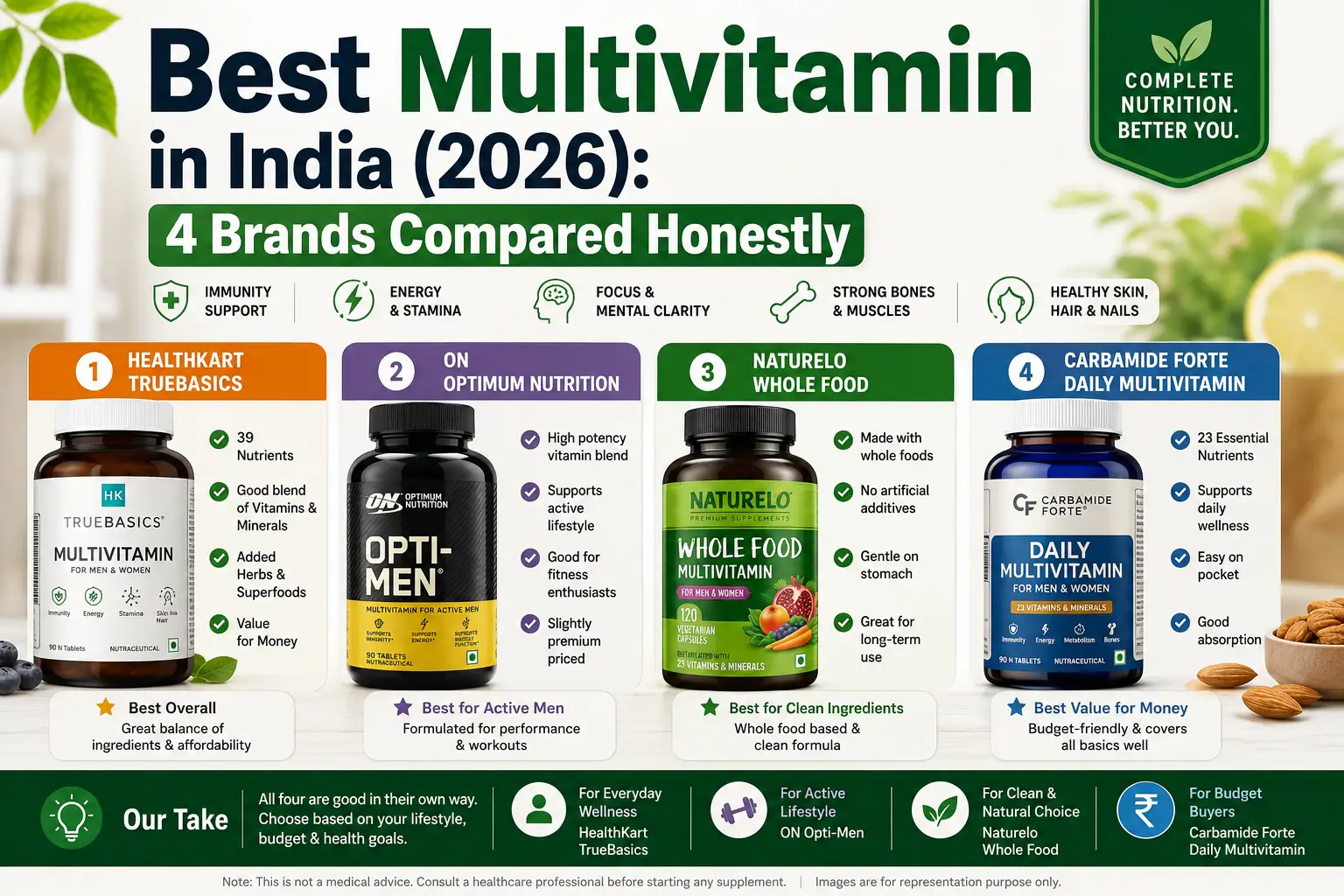
Best Multivitamin in India (2026): 4 Brands Compared Honestly
Centrum, Revital, HK Vitals and MuscleBlaze MB-Vite compared on what is actually in them — plus the honest answer to whether you need a multivitamin at all.