How to Start Running for Beginners — 0 to 5K Training Plan (Without Overexertion)
A simple beginner-friendly guide to start running safely, build stamina, avoid injury, and complete your first 5K without burnout — step-by-step schedule included.

Introduction
Running is one of the easiest and most powerful exercises for fat loss, stamina improvement, heart health and overall fitness. You don't need a gym membership or expensive equipment — just a pair of good running shoes and the road beneath your feet.
But beginners often make these mistakes:
❌ Running too fast on Day 1
❌ Feeling breathless and quitting immediately
❌ Knee pain due to wrong technique
❌ Expecting instant stamina improvement
The goal is not to run faster — but to run longer, pain-free and consistently. This detailed guide will help you go from 0 to 5 KM confidently, even if you've never run before.
Why Running is Perfect for Beginners
✔ Burns calories efficiently — Supports fat loss and weight management
✔ Strengthens cardiovascular system — Better heart & lung health
✔ Builds stamina & energy — Daily tasks become easier
✔ Improves mental health — Reduces stress, anxiety & depression
✔ Tones muscles — Especially legs, core and glutes
✔ Zero equipment needed — Most accessible form of exercise
Running = physical transformation + mental clarity + emotional balance.
Before You Start — Essential Preparation
1. Get Proper Running Shoes
Invest in lightweight running shoes with good cushioning. Avoid running in slippers, sandals or worn-out sneakers. Good shoes prevent knee pain and injuries.
📖 Read Also:
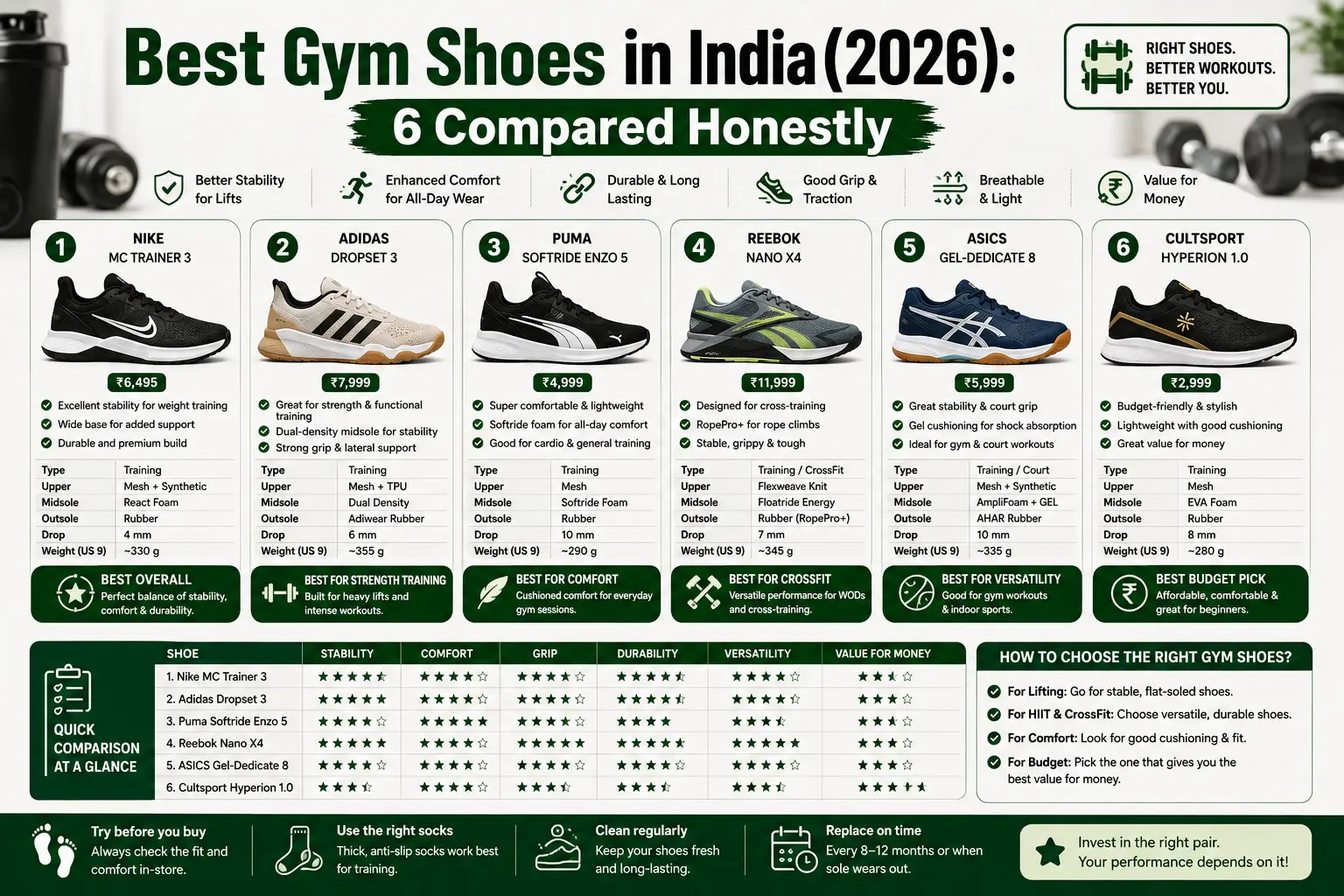
Best Gym Shoes in India — 6 ComparedIf the same pair has to cover gym sessions too, this covers where a running shoe stops working — and the four running options compared on rating data.
2. Warm-Up is Mandatory (5-7 minutes)
Never skip warm-up. Do these before every run:
• Ankle rotation (10 each side) • High knees (30 seconds) • Leg swings (10 each leg) • Slow jog in place (1 minute) • Calf stretch (20 seconds each)
3. Choose Your Running Location
Prefer outdoor running if possible — parks, tracks or quiet streets are ideal. Outdoor running is better than treadmill for beginners as it builds natural balance and strength.
If you would rather run without carrying your phone, that needs a watch with built-in GPS — not the connected-GPS kind most budget trackers ship with, which borrows your phone's signal and therefore still requires the phone.
📖 Read Also:
Best Fitness Tracker in India — 4 ComparedBuilt-in GPS is the one spec that decides whether you can leave your phone at home. Two of the four picks have it, two do not.
📖 Read Also:
Monsoon Fitness India: How to Stay Active in the Rainy SeasonOutdoor running plans hit a wall the moment monsoon arrives — here's how to keep your 0-to-5K progress going indoors without losing the habit.
4. Start Slow — Stamina First, Speed Later
Running is 70% breathing control and 30% leg strength. Focus on breathing rhythm, not speed.
Running Technique for Beginners
Posture
• Head up, eyes forward • Chest open • Shoulders relaxed • Slight forward lean from ankles
Stride
• Short, quick steps • Land mid-foot, not heel • Don't overstride • Light, quiet footfalls
Breathing
• Inhale 2 steps, Exhale 2 steps • OR Nose in, Mouth out • Never hold breath • Find your rhythm
Complete 6-Week Training Plan: 0 to 5K
This progressive plan uses the proven run-walk method. You'll gradually increase running time while decreasing walk breaks.
Week 1 — Build the Habit (Goal: Just Start Moving)
← Swipe to compare →
| Day | Activity |
|---|---|
| Monday | 20 min brisk walk |
| Tuesday | Walk 5 min + Jog 1 min (repeat 4 times) |
| Wednesday | Rest or light stretching |
| Thursday | Walk 10 min + Jog 1 min (repeat 3 times) |
| Friday | Walk 5 min + Jog 1 min (repeat 4 times) |
| Saturday | Yoga or light mobility exercises |
| Sunday | Relaxed walk 25-30 min |
Week 2 — Run-Walk Intervals (Goal: Breathe Smoothly)
Monday/Wednesday/Friday:
• Week 2 Start: Walk 5 min + Jog 2 min (repeat 4 times)
• Week 2 End: Walk 5 min + Jog 3 min (repeat 4 times)
Other days: Light walk, stretching or complete rest
Week 3 — Build Stamina (Goal: Continuous Jogging Tolerance)
Monday: Jog 4 min + Walk 2 min (repeat 3 times)
Wednesday: Jog 5 min + Walk 2 min (repeat 3 times)
Friday: Jog 6 min + Walk 2 min (repeat 3 times)
Focus on maintaining steady breathing, not speed
Week 4 — Reduce Walking (Goal: Longer Run Blocks)
Monday: Jog 7 min + Walk 1 min (repeat 3 times)
Wednesday: Jog 8 min + Walk 1 min (repeat 3 times)
Friday: Jog 10 min + Walk 1 min (repeat 2 times)
Most people start seeing real stamina improvement this week!
Week 5 — Nearing 5K (Goal: Continuous Running)
Monday: Run 12-15 min continuously
Wednesday: Run 18 min continuously
Friday: Run 20-22 min continuously
Run at a pace where you can still talk in short sentences. Slow is okay!
Week 6 — Your First 5K Achievement! 🎉
Goal: Run 30-35 minutes without stopping (approximately 5 kilometers)
• Choose a day when you feel fresh
• Run at a slow, conversational pace
• If you feel tired, walk for 1 minute, then continue
Congratulations! You are now a 5K runner! 🏃♂️🏃♀️
Cooldown Routine (Never Skip This!)
After every run, spend 5-10 minutes cooling down. This prevents injury and muscle soreness.
✔ Walk slowly for 2-3 minutes
✔ Calf stretch (30 sec each leg)
✔ Quadriceps stretch (30 sec each)
✔ Hamstring stretch (30 sec each)
✔ Hip flexor stretch
✔ Deep breathing (2 minutes)
Cooldown prevents knee pain, shin splints & muscle stiffness.
Nutrition for Runners
Before Running (30-60 min before)
• 1 Banana • 2-3 Dates with nuts • Black coffee (optional) • Small oats bowl
After Running (Within 30 min)
• Protein source: Paneer/Soya/Eggs/Dal • Fruit for quick energy • Hydrate well (water + electrolytes) • Avoid junk food
Important: Never run on a completely empty stomach or immediately after a heavy meal.
Common Running Mistakes to Avoid
❌ Running too fast initially — Leads to burnout and discouragement
❌ Overstriding — Causes knee pain and injuries
❌ Running daily without rest — Body needs recovery days
❌ Wrong or worn-out shoes — Major cause of injuries
❌ Skipping warm-up/cooldown — Increases injury risk significantly
❌ Expecting instant results — Stamina building takes time and patience
Track Your Progress
Use running apps to stay motivated and monitor improvement:
Strava
Community + tracking
Nike Run Club
Guided runs + plans
Adidas Running
Goal setting + stats
Track: Distance • Pace • Duration • Heart Rate (if available) • Weekly progress
Final Motivation
Running transforms not just your body, but your entire mindset. It teaches discipline, builds confidence, and proves that consistent effort creates real change. You don't need to be fast. You don't need to be perfect. You just need to start.
Focus on:
🏃 Showing up consistently, not running fast
🏃 Building stamina slowly, not overnight
🏃 Enjoying the process, not just the goal
🏃 Progress over perfection, always
Conclusion
Running changes body, mind and lifestyle — once it becomes a habit. You don't need to run fast or long from Day 1. Start slow, breathe well, build stamina gradually and complete your first 5K proudly. This journey builds confidence more than fitness. Every run becomes a reminder of your growth.
Put on your shoes. Step outside. Your Day 1 begins whenever you decide. The road is waiting. 🏃♂️💪
📖 You Might Also Like:
Frequently Asked Questions
How should a complete beginner start running in India?
Beginners should start with walk-run intervals, not continuous running. Begin with 1 minute running alternated with 2 minutes walking for 20 minutes, 3 days per week. Gradually increase the running intervals over 8–10 weeks until you can run continuously for 30 minutes. This approach prevents injury and builds cardiovascular fitness progressively.
How long does it take to go from 0 to 5K running?
Most beginners can complete a 5K run (without stopping) in 8–10 weeks following a structured plan like Couch to 5K (C25K). The training involves 3 sessions per week with a mix of running and walking. By week 8, most people can run 30 consecutive minutes, which covers approximately 4–5 km depending on pace.
What is the best time to run for weight loss in India?
Morning runs (before breakfast) and evening runs (post 5 PM when temperatures drop) are most popular in India. Morning runs on an empty stomach burn slightly more fat directly. Evening runs are often faster and more enjoyable due to lower body temperature and cooler weather. Both are equally effective for fat loss over time.
Do I need special running shoes to start?
Good running shoes are highly recommended — they significantly reduce injury risk. You do not need expensive shoes, but you need shoes designed for running with proper cushioning and support. Indian options like Adidas Duramo, Asics Gel-Nimbus (mid-range), or even Decathlon Kalenji shoes (INR 1500–3000) provide adequate support for beginner runners.
How many calories does running 5K burn?
Running 5K burns approximately 300–400 calories for an average 65–70 kg Indian adult (roughly 60–80 calories per kilometre). Heavier individuals burn more. The exact amount varies with pace and terrain. Consistent running combined with diet is more effective for fat loss than running alone — running tends to increase appetite.
Related Reading
Free Tools to Help You
Put this article into action — use our free calculators to get your personalized numbers.
Was this article helpful?
Want More Tips Like This?
Join 1,000+ readers getting weekly fitness, diet, and wellness tips + FREE meal plan
No spam, ever. Unsubscribe anytime.

About the Author: Ashwani
Fitness influencer and wellness writer helping Indians build healthier lifestyles.
Read more about us →Comments
Leave a Comment
Your email will not be published. Comments are reviewed before appearing.
You Might Also Like
Continue your wellness journey

20 min read
Home Gym Under ₹5000 in India (2026): What to Buy
You do not need a ₹50,000 setup or a gym membership to get fit at home. This guide builds a complete, functional home gym for under ₹5000 — prioritised by impact, with trusted Indian brands, available on Amazon.in and Flipkart, suited to Indian apartments and budgets. Updated June 2026.
15 min read
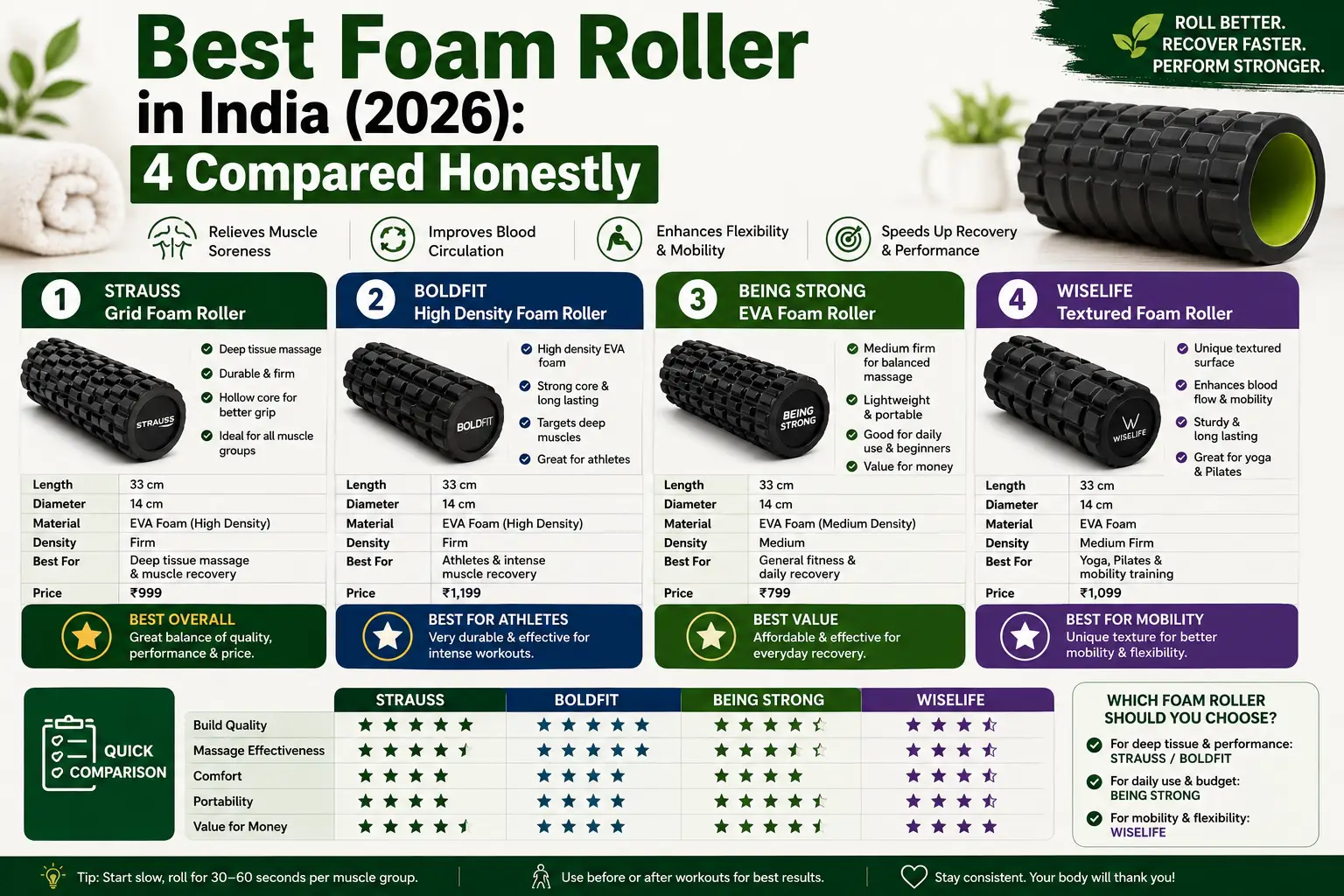
Best Foam Roller in India (2026): 4 Compared Honestly
Boldfit and Strauss foam rollers compared on density, size and rating data — plus what foam rolling actually does for sore muscles, and what it definitely does not.
17 min read
Best Gym Shoes in India (2026): 6 Compared Honestly
Most Indians buy a running shoe for the gym. Here is exactly when that is fine, when it costs you, and six options compared — from a ₹1,500 Campus to the Nike Metcon.