Pilates for Beginners in India: What It Is, Benefits & How to Start at Home
Pilates is not just a Western fitness trend — it is one of the most effective low-impact workouts for core strength, posture, back pain relief, and toning. Here is everything an Indian beginner needs to know to start Pilates at home today.

What Is Pilates — And Why Is All of India Talking About It?
If you have been scrolling Instagram or YouTube recently, you have almost certainly seen Pilates. It seems like everyone from Bollywood celebrities to your neighbour's daughter has started doing it.
And it is not just a trend. Pilates is a structured exercise method developed by Joseph Pilates in the 1920s that focuses on controlled movements, breath, and core strength. In 2025, search interest for Pilates in India hit an all-time high — and for very good reason.
Pilates is ideal for:
- People with desk jobs who have back pain or poor posture
- Women looking for low-impact toning (especially post-pregnancy)
- Anyone who finds HIIT or running too intense
- People recovering from injuries
- Those who want to complement their existing gym or yoga routine
It requires zero equipment. You need only a mat and some floor space.
Pilates vs Yoga — What Is the Difference?
This is the most common question Indian beginners ask. Both are low-impact, both improve flexibility, and both can be done at home. But they are fundamentally different.
← Swipe to compare →
| Factor | Pilates | Yoga |
|---|---|---|
| Origin | Germany/America (1920s) | India (ancient) |
| Primary focus | Core strength, posture, controlled movement | Flexibility, breath, mindfulness, spirituality |
| Breathing style | Ribcage expansion (lateral breathing) | Diaphragmatic (belly breathing) |
| Best for | Back pain, toning, rehabilitation | Stress relief, flexibility, mental wellness |
| Sweat level | Moderate — feels gentle but burns | Varies widely |
| Equipment | Mat only (or Reformer machine) | Mat only |
The honest answer: Both are excellent. Many people do both — Pilates for core and body composition, yoga for flexibility and stress.
If you have chronic back pain, start with Pilates before yoga. Pilates specifically targets spinal stability and the deep core muscles that support your lower back.
7 Evidence-Based Benefits of Pilates
1. Stronger Core — Without Crunches
Pilates does not target the six-pack abs you see in magazines. It trains the deep core muscles — the transverse abdominis, multifidus, and pelvic floor — that wrap around your spine like a corset.
These muscles are responsible for every movement you make. Strengthening them reduces lower back pain, improves balance, and makes all other exercises more effective.
2. Fixes Posture and Back Pain
For desk workers and students who spend 8-10 hours sitting, posture deterioration is inevitable. Pilates directly addresses:
- Rounded shoulders (kyphosis)
- Forward head posture (tech neck)
- Lower back compression
Multiple studies show Pilates reduces chronic lower back pain more effectively than general exercise alone.
3. Full Body Toning Without Bulk
Pilates creates what fitness professionals call long, lean muscle tone. It works your arms, legs, glutes, and core simultaneously through resistance and controlled movement — without adding bulk.
This makes it particularly popular among Indian women who want to tone up without looking overly muscular.
4. Improved Flexibility and Joint Health
Unlike static stretching, Pilates moves your joints through their full range of motion under light resistance. Over 4-6 weeks, most beginners notice significantly improved flexibility in the hips, hamstrings, and thoracic spine.
5. Weight Loss Support
Pilates alone will not burn calories like running or HIIT. However, it supports weight loss through:
- Building lean muscle (which raises resting metabolism)
- Improving mind-body connection (leads to more mindful eating)
- Reducing stress hormones that cause fat storage around the belly
A 45-minute intermediate Pilates session burns approximately 200-400 calories depending on intensity.
6. Hormonal and Menstrual Health
Pilates is one of the most recommended exercises for women with PCOS because it reduces cortisol levels, improves insulin sensitivity, and strengthens the pelvic floor without spiking stress hormones the way intense cardio can.
7. Better Athletic Performance
Pilates is used by professional cricketers, footballers, and dancers to improve core stability, reduce injury risk, and enhance movement efficiency. The reason India's sports culture is rapidly adopting Pilates is simple: it makes you better at every other physical activity.
8 Beginner Pilates Exercises You Can Do at Home
No equipment needed. Just a yoga mat or folded blanket.
The Hundred (Core Activation)
How to do it:
- Lie on your back, knees bent, feet flat on the floor
- Curl your head and shoulders slightly off the mat (chin to chest)
- Extend your arms straight alongside your hips, hovering a few inches off the mat
- Pump your arms up and down in small, controlled pulses — inhale for 5 pumps, exhale for 5 pumps
- Complete 10 breath cycles (100 pumps total)
What it works: Deep core, hip flexors, shoulder stability
If lifting your head causes neck strain, keep your head on the mat for the first 2 weeks. The core benefit is the same.
Single Leg Stretch (Core + Hip Flexors)
How to do it:
- Lie on your back, lift both knees to tabletop position
- Curl head and shoulders off the mat
- Draw your right knee to your chest while extending your left leg out straight (45 degrees from the floor)
- Switch legs in a controlled, alternating rhythm — 10 reps each side
Spine Stretch Forward (Flexibility + Posture)
How to do it:
- Sit tall with legs extended straight in front, slightly wider than hip-width
- Inhale to prepare, then exhale as you round forward — imagine your spine making a "C" curve
- Reach your hands toward your feet, drawing your belly button back
- Inhale to sit tall again. Repeat 5-8 times.
Pelvic Curl / Bridge (Glutes + Lower Back)
How to do it:
- Lie on your back, knees bent, feet flat — hip-width apart
- Exhale and slowly peel your spine off the mat — tailbone first, then lower back, then mid-back
- Hold at the top for 2 counts
- Slowly lower back down, vertebra by vertebra
- Repeat 8-10 times
Cat-Cow Stretch (Spinal Mobility)
How to do it:
- Come to hands and knees (tabletop position)
- Inhale: let your belly drop toward the floor, chest and tailbone lift (Cow)
- Exhale: round your spine to the ceiling, chin tucking toward chest (Cat)
- Move slowly and with full breath. Repeat 8-10 cycles.
Side-Lying Leg Lifts (Outer Hips + Glutes)
How to do it:
- Lie on your side, body in a straight line
- Keep your bottom leg slightly bent for balance
- Slowly lift your top leg to hip height — toes flexed
- Lower with control. Repeat 10-12 times, then switch sides.
Plank Hold (Full Body Stability)
How to do it:
- Come to a forearm plank position — elbows under shoulders
- Maintain a straight line from head to heels
- Hold for 20-30 seconds to start, building up to 60 seconds
Swan Prep (Back Extension + Posture Fix)
How to do it:
- Lie on your stomach, hands under your shoulders
- Gently press through your palms to lift your chest off the mat — only as high as is comfortable
- Keep your elbows slightly bent, shoulder blades drawing back and down
- Hold for 2-3 counts, lower with control. Repeat 5 times.
Sample 20-Minute Beginner Pilates Routine
← Swipe to compare →
| Exercise | Reps/Duration |
|---|---|
| Cat-Cow Stretch | 8 slow cycles |
| Pelvic Curl / Bridge | 10 reps |
| The Hundred | 60-100 pumps |
| Single Leg Stretch | 10 reps each side |
| Spine Stretch Forward | 6 reps |
| Side-Lying Leg Lifts | 12 each side |
| Swan Prep | 5 reps |
| Plank Hold | 2 x 30 seconds |
Do this routine 3-4 times per week. Within 3-4 weeks, you will notice improved core strength and reduced back tension.
How to Progress Beyond Beginner Level
After 4-6 weeks of consistent practice, you can advance by:
- Increasing reps — from 10 to 15 repetitions per exercise
- Adding resistance — a resistance band around the thighs for leg work
- Trying intermediate exercises — Rolling Like a Ball, Scissors, Double Leg Stretch, Teaser
- Following structured online programs — YouTube channels like Move With Nicole, Lottie Murphy, or Pilates Anytime offer free beginner-to-intermediate progressions
📖 Read Also:
5 Best Resistance Bands for Home Workout in India (2026)A light loop band is the cheapest way to add the resistance mentioned above for leg work, without needing a Reformer machine or studio membership.
Pilates Reformer: You may have seen the spring-loaded machine in Pilates studios. Reformer Pilates is more expensive (₹600-1,500 per class in Indian cities) but offers more resistance variation. It is not necessary — mat Pilates delivers the same core benefits.
Who Should Be Careful With Pilates
Pilates is extremely safe for most people. However, consult your doctor before starting if you have:
- Recent spinal surgery or disc herniation
- Severe osteoporosis
- Pregnancy (certain modifications are required — prenatal Pilates is a separate specialisation)
- Active inflammation or joint injury
If you have mild back pain, Pilates is usually recommended — but start gently and avoid any movement that causes sharp pain.
Pilates vs HIIT vs Gym — Which Is Best for Weight Loss?
← Swipe to compare →
| Method | Calorie Burn | Muscle Toning | Sustainable Long-Term | Injury Risk |
|---|---|---|---|---|
| Pilates | Low-Moderate | High | Very High | Very Low |
| HIIT | High | Moderate | Moderate | Moderate |
| Weight Training | Moderate | Very High | High | Low-Moderate |
| Yoga | Low | Moderate | Very High | Very Low |
Verdict for Indians: The combination that works best for most Indian beginners is Pilates + walking + diet. Pilates builds the foundation, walking provides calorie burn, and diet does the heavy lifting for weight loss.
Conclusion
Pilates is not a celebrity fad. It is one of the most scientifically supported, injury-safe, and practically effective exercise methods available — and it costs nothing to start.
Start with three sessions per week. Use the 20-minute routine above for the first month. Track how your back feels, how your posture changes, and how your core engages during everyday activities.
The changes will surprise you.
You Might Also Like:
Frequently Asked Questions
Is Pilates effective for weight loss in India?
Pilates supports weight loss indirectly — it burns 170–250 calories per hour (less than cardio) but builds lean muscle, improves posture, and strengthens the deep core muscles that other exercises miss. For best weight loss results, combine Pilates 2–3 times per week with a calorie-controlled diet and some cardio.
Can I do Pilates at home without any equipment?
Yes — mat Pilates requires no equipment and is completely effective. The entire system is based on body weight resistance and controlled movement. A yoga mat is the only essential item. Many excellent free Pilates videos exist on YouTube specifically for Indian beginners with body-weight-only programmes.
What is the difference between Pilates and yoga?
Yoga focuses on flexibility, breathing, and mental wellbeing using static poses held for extended periods. Pilates emphasises core strength, controlled movement, and body alignment using dynamic exercises. Both improve posture and flexibility, but Pilates provides a more structured muscular strengthening workout, while yoga offers more stress relief and spiritual elements.
How many days per week should a beginner practice Pilates?
Beginners should do Pilates 2–3 days per week with rest days between sessions. Unlike light yoga, Pilates uses significant muscular effort — especially for the core — and muscles need 48 hours to recover. After 4–6 weeks, you can increase to 4 days per week if your body tolerates it well.
How long before I see results from Pilates?
Practitioners often notice improved posture and core awareness within 2–3 weeks. Visible strength improvements and a more toned appearance typically take 6–8 weeks of consistent practice. The founder of Pilates famously said "In 10 sessions you'll feel the difference, in 20 you'll see the difference, and in 30 others will see the difference."
Free Tools to Help You
Put this article into action — use our free calculators to get your personalized numbers.
Was this article helpful?
Want More Tips Like This?
Join 1,000+ readers getting weekly fitness, diet, and wellness tips + FREE meal plan
No spam, ever. Unsubscribe anytime.

About the Author: Ashwani
Fitness influencer and wellness writer helping Indians build healthier lifestyles.
Read more about us →Comments
Leave a Comment
Your email will not be published. Comments are reviewed before appearing.
You Might Also Like
Continue your wellness journey

26 min read
Monsoon Fitness India (2026): Home Workout & Diet Guide
Monsoon in India kills most fitness routines. Skipped gym days, muddy roads, low motivation, and seasonal infections derail months of progress. Here is your complete guide to stay fit, build immunity, and actually thrive during the Indian rainy season — workouts, diet, calorie data, and a 4-week progressive plan.
15 min read
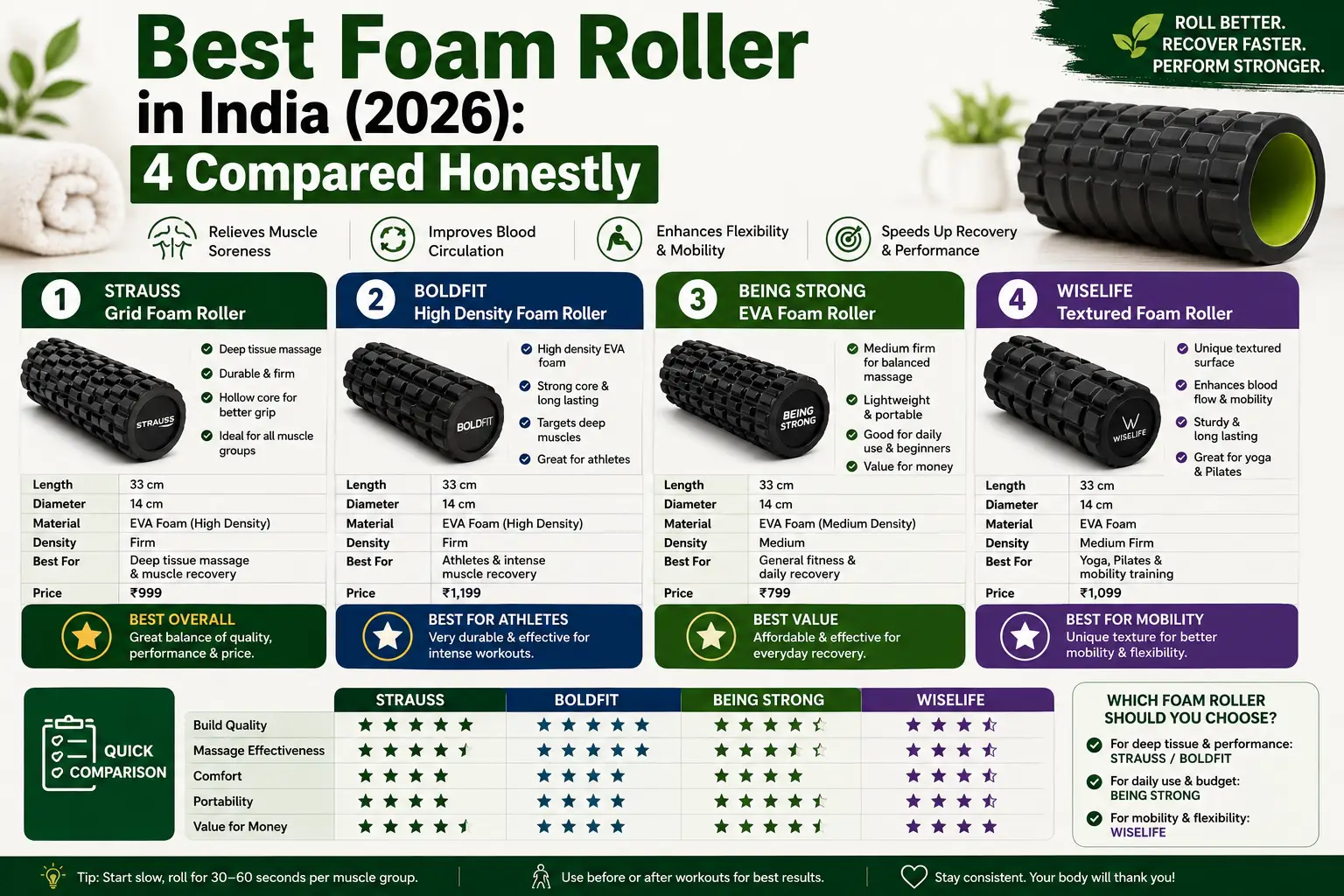
Best Foam Roller in India (2026): 4 Compared Honestly
Boldfit and Strauss foam rollers compared on density, size and rating data — plus what foam rolling actually does for sore muscles, and what it definitely does not.
17 min read
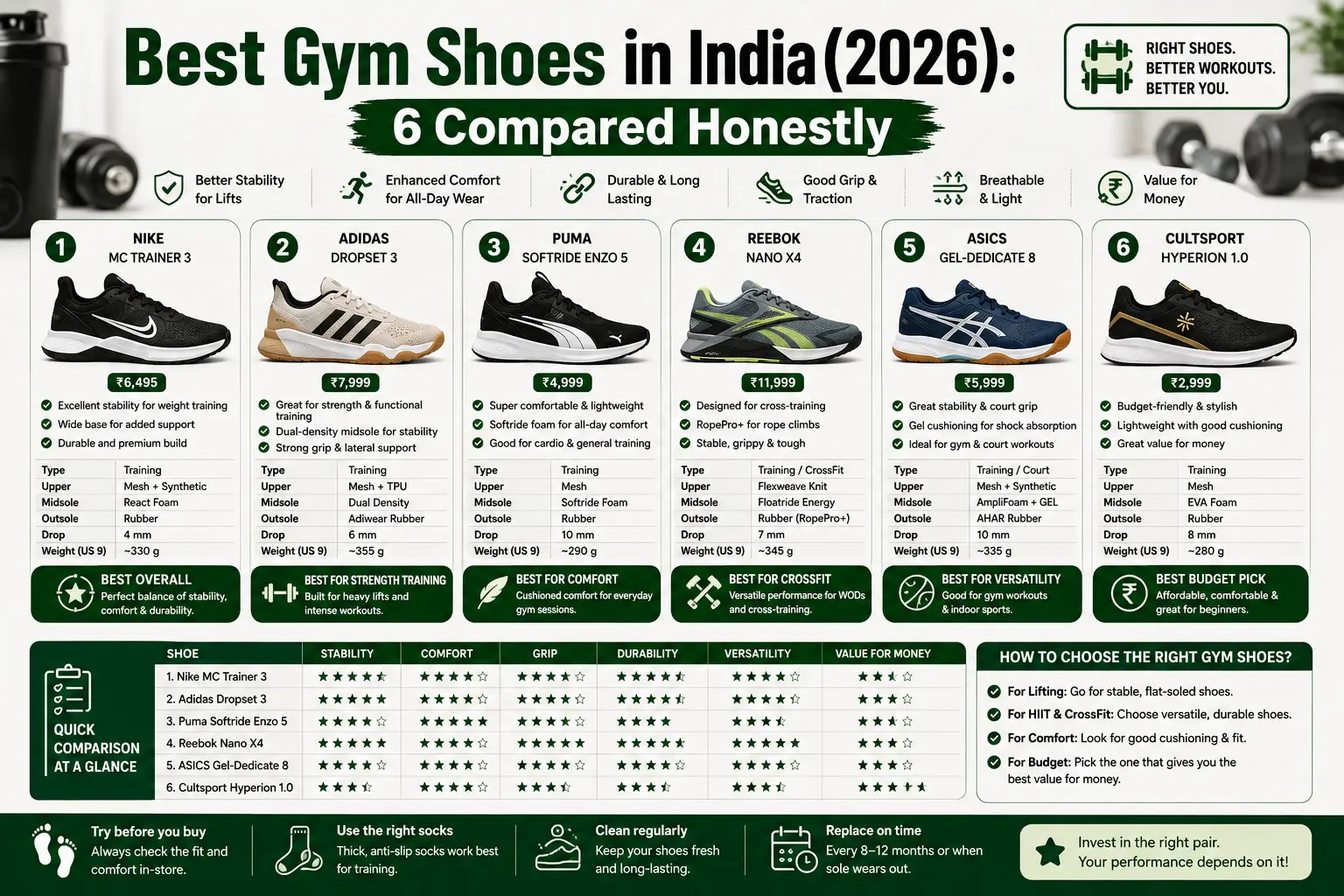
Best Gym Shoes in India (2026): 6 Compared Honestly
Most Indians buy a running shoe for the gym. Here is exactly when that is fine, when it costs you, and six options compared — from a ₹1,500 Campus to the Nike Metcon.