Best Pull-Up Bar for Home in India: Doorway vs Wall-Mounted, 6 Compared
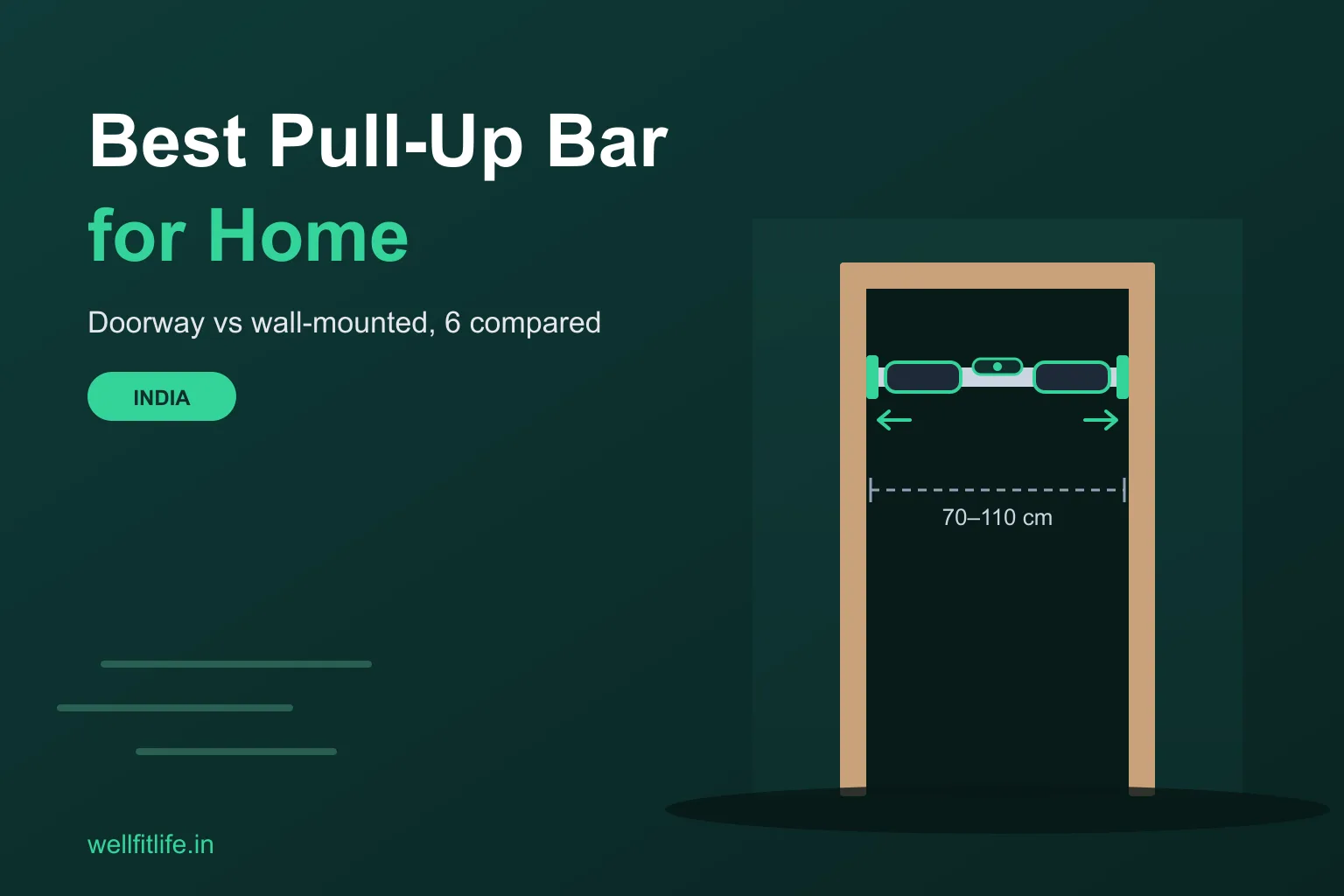
Six pull-up bars for home, compared on what actually holds you up: mount type, frame width range, stated load, grip positions, drilling and warranty, plus why the kg on the box is not the number that matters.
Affiliate Disclosure: As an Amazon Associate I earn from qualifying purchases. This post contains affiliate links. If you buy through them, we may earn a small commission at no extra cost to you — this never affects our recommendations. We only suggest products we believe in. Read our full affiliate disclosure.
Quick Answer
For most homes, buy the Cockatoo Pull-Master. It is a no-screw doorway bar that fits frames from 70 to 100 cm, and its listing states a locking mechanism, a 200 kg maximum load and a 6-month warranty. It is the only doorway bar here with a warranty stated on the listing. If you own the wall and want a bar that does not depend on a door frame, the Protoner wall-mounted chin-up bar gives you three grip positions and a 120 kg rating, but it has to be drilled in.
Cockatoo Pull-Master Doorway Pull-Up Bar — No Screws, 70–100 cm, 200 kg
A no-screw doorway pull-up bar with a locking mechanism, adjustable from 70 to 100 cm, with a 200 kg maximum load and padded grips, per the listing. 6-month warranty.
Check Price on AmazonBefore you order anything, measure the inside width of your door frame. A bar that does not cover your width will not fit, whatever else it offers.
A pull-up bar is the cheapest way to train your back at home. Push-ups, squats and lunges cover most of the body, but pulling your own weight is the one movement that bodyweight training on the floor cannot really replace. The listings, though, sell these bars on one number, the kg rating, and that number is not what keeps the bar in the doorway.
This guide compares six bars across the two types you can realistically fit in an Indian home, doorway and wall-mounted, and explains why ceiling bars did not make the list.
How this guide was put together: I do not own any of these six bars, so you will not find "I tested each of these" claims here. What follows is a specification comparison built from each product's Amazon India listing, and the brand's own store where it gives the same spec. Where a listing does not state something, the table says so rather than guessing. How we source claims and where AI is used is set out in our editorial policy.
The kg on the Box Is Not What Holds You Up
Almost every "no screw" or "no drill" pull-up bar on Amazon India is a pressure-fit telescopic rod. You twist the bar to lengthen it until the rubber pads at each end press hard against the two sides of the door frame. Nothing hooks over anything. The bar stays up because of friction between those pads and your frame.
That means two separate things have to hold:
- The bar itself, which is what the kg rating describes.
- The grip between the end pads and your frame, which depends on your frame's material, finish and how tightly the bar is fitted. No listing can rate that for you.
The clearest example is the Sportneer bar in this guide. Its listing states that the tube is built to support 200 kg, but that the manual's maximum user load is 135 kg, and that the bar's capacity "also depends on the usage environment". It also notes that using the bar at a longer extension may reduce the load. Most listings give you only the bigger number.
Two more things to know when you compare ratings:
- One listing can sell several ratings. Some brands sell 100 kg, 200 kg and 300 kg versions under a single listing with one shared set of reviews. The reviews do not tell you which version each buyer had.
- A higher number does not fix a weak frame. A 200 kg bar on a hollow door frame or a tiled surface is less safe than a 100 kg bar on solid wood.
What this means in practice: choose a bar whose width range puts your frame near the middle, not at full extension; fit it to a solid frame; and test it with a dead hang, feet just off the floor, before your first pull-up.
Measure Before You Buy
← Swipe to compare →
| Check | What to look for | Why it matters |
|---|---|---|
| Inside width of the frame | Measure wall to wall inside the frame, at the height you will fit the bar | The bar's range must cover it. Better if your width sits mid-range. |
| Frame material | Solid wood or solid masonry | The Sportneer listing says to avoid ceramic tiles, glass and non-solid door frames |
| Frame depth | Enough flat surface for the end pads | Sportneer says the frame must be wider than the anti-slip pads at each end |
| Wall (wall-mounted bars only) | Solid brick, concrete or solid cement | The Hashtag Fitness listing names hollow brick, honeycomb brick, drywall and sandwich panels as unsuitable |
| Clearance | Room above the bar for your head and below for your feet | You need to get your chin over the bar and hang without your feet touching the floor |
If you are not sure what your wall is made of, ask your building's maintenance office or a local mason before drilling.
Doorway, Wall-Mounted or Ceiling?
← Swipe to compare →
| Type | Drilling | Suits | The catch |
|---|---|---|---|
| Doorway (pressure-fit) | No | Renters, anyone who wants to take it down after training | Depends on your frame's grip; usually one straight bar |
| Wall-mounted | Yes, into a solid wall | Owners who want a fixed bar and more grip options | Permanent holes; wrong wall type means unsafe anchors |
| Ceiling-mounted | Yes, into the ceiling | Garages and rooms with timber joists | Rare in Indian homes; see below |
If you rent, the doorway type is usually the only practical option. If you own the wall and the bar will stay up, a wall-mounted bar removes the frame from the equation and gives you a neutral grip.
Which Pull-Up Bar Suits You
← Swipe to compare →
| If this is you | The one to look at | What you have to accept |
|---|---|---|
| You want one safe default for a doorway | Cockatoo Pull-Master | The listing does not name its grip positions |
| You want the most honest load rating | Sportneer | A narrower 75–94 cm range and no stated warranty |
| You want the spec confirmed by the brand too | Lifelong LLPB05 | No warranty term stated on the listing |
| Your frame is wider than most | Slovic 200 kg | No warranty term stated on the listing |
| You own the wall and want three grips | Protoner wall-mounted bar | Drilling, and a 120 kg rating |
| You also want dips | Hashtag Fitness 3-in-1 | Drilling into a solid wall only, and the heaviest unit here |
The Six Compared
← Swipe to compare →
| Model | Mount | Max load (as listed) | Width range | Grips | Drilling | Warranty (as listed) |
|---|---|---|---|---|---|---|
| Cockatoo Pull-Master | Doorway, pressure-fit | 200 kg | 70–100 cm | Listed as multiple grip positions, not named | No | 6 months |
| Sportneer | Doorway, pressure-fit | 135 kg user max* | 75–94 cm | One long single bar | No | Not stated |
| Lifelong LLPB05 | Doorway, pressure-fit | 200 kg | 74–97 cm | Single bar | No | Not stated |
| Slovic 200 kg | Doorway, pressure-fit | 200 kg | 72–110 cm | Single bar | No | Not stated |
| Protoner wall-mounted | Wall | 120 kg | n/a (38-inch bar) | 3: narrow, wide, neutral | Yes | Not stated |
| Hashtag Fitness 3-in-1 | Wall | 199.58 kg (440 lb) | n/a | Pull-up bar plus dip handles; grips not named | Yes | Not stated |
*Sportneer states a 200 kg structural rating for the tube and a 135 kg maximum user load in the manual. This table uses the user limit.
Specifications are from each product's Amazon India listing on 25 October 2026; Lifelong's and Protoner's match their own stores. No prices here: they move with every sale, so check the live price on each card.
The Reviews
1. Cockatoo Pull-Master — Best Overall
The Pull-Master leads because its listing answers the questions that matter for a doorway bar, and it is the only doorway bar here that states a warranty. It is a no-screw pressure-fit bar with a locking mechanism, adjustable from 70 to 100 cm, with a stated 200 kg maximum load. The listing describes padded grips and lists multiple grip positions among its features, and the bar comes off the frame when you are done.
What to weigh: the listing says "multiple grip positions" but does not say which. Expect a straight bar, not a neutral grip.
Buy this if: you want a doorway bar with a stated warranty and a width range that covers most frames.
Cockatoo Pull-Master Doorway Pull-Up Bar — No Screws, 70–100 cm, 200 kg
A no-screw doorway pull-up bar with a locking mechanism, adjustable from 70 to 100 cm, with a 200 kg maximum load and padded grips, per the listing. 6-month warranty.
Check Price on Amazon2. Sportneer — Clearest Safety Spec
No other listing here explains its load rating as plainly. Sportneer gives a 200 kg structural rating for the 2 mm outer and 1.5 mm inner steel tubes, a 135 kg maximum user load from the manual, and a tested instantaneous load of 337.5 kg, which it describes as a 2.5× safety factor. It also tells you where not to fit it: avoid ceramic tiles, glass and non-solid door frames, and make sure the frame is wider than the end pads.
The bar has a 360-degree dual gear lock at both ends, spirit levels on both ends and large PVC end pads. The handlebar is one long anti-slip cotton grip rather than two foam sections.
What to weigh: the 75–94 cm range is the narrowest here, so measure first. No warranty term is stated on the listing.
Buy this if: you want to know exactly what the bar is rated for, and your frame sits inside 75–94 cm.
Sportneer Doorway Pull-Up Bar — No Screws, 75–94 cm, 135 kg User Limit
A no-screw doorway bar adjustable from 75 to 94 cm, with a 360-degree dual gear lock, spirit levels at both ends and one long anti-slip grip, per the listing. The manual's maximum user load is 135 kg; the tube is rated for 200 kg. No warranty term is stated.
Check Price on Amazon3. Lifelong LLPB05 — Spec Confirmed by the Brand
The LLPB05 is a no-screw doorway bar for frames from 74 to 97 cm, with a 200 kg maximum load, a locking mechanism to stop it loosening, end caps that press against the frame and a non-slip handlebar. Lifelong's own store lists the same model with the same 74–97 cm range and 200 kg load, so the spec does not rest on the Amazon listing alone. Lifelong says the bar becomes more stable as the load increases.
What to weigh: no warranty term is stated on the Amazon listing. Its range starts at 74 cm, so check a narrow frame against it.
Buy this if: you want a mid-range doorway bar from a brand whose own store confirms the spec.
Lifelong LLPB05 Doorway Pull-Up Bar — No Screws, 74–97 cm, 200 kg
A no-screw doorway pull-up bar for frames from 74 to 97 cm, with a 200 kg maximum load, a locking mechanism and a non-slip handlebar, per the listing and Lifelong's own store. No warranty term is stated on the listing.
Check Price on Amazon4. Slovic 200 kg — Best for Wide Frames
This is the widest-reaching bar here: 72 to 110 cm. If your frame is wider than the 94–100 cm the others top out at, it is the one doorway bar in this guide that may still fit. It is a no-screw pressure-fit bar with a built-in level meter to help you fit it straight, anti-skid grips and a stated 200 kg maximum load.
Slovic also sells a 100 kg version that covers 62–100 cm. That one suits narrower frames; this one suits wider ones.
What to weigh: no warranty term is stated on the listing. If your frame is near 110 cm, you would be using the bar near full extension, which is where pressure-fit bars are weakest.
Buy this if: your frame is close to or wider than 100 cm.
Slovic Doorway Pull-Up Bar [200 KG] — No Screws, 72–110 cm
A no-screw doorway pull-up bar adjustable from 72 to 110 cm, the widest range in this guide, with a built-in level meter, anti-skid grips and a 200 kg maximum load, per the listing. No warranty term is stated.
Check Price on Amazon5. Protoner Wall-Mounted Chin-Up Bar — Best Wall-Mounted
The Protoner is the pick if you own the wall and want a bar that does not depend on a door frame. It is a solid one-piece steel bar with a 38-inch top rod on 20-inch pillars that hold it away from the wall, and three grip positions: narrow, wide and neutral. A neutral grip, with palms facing each other, is the one the doorway bars here do not offer.
The box includes ab straps and the mounting hardware: eight M8 screws and two 3-inch screws with bolts. It is made in India, rated for 120 kg, and Protoner's own store lists the same spec.
What to weigh: it has to be drilled into a solid wall, and its 120 kg rating is lower than the doorway bars' stated figures. No warranty term is stated.
Buy this if: you own the wall, the bar is going to stay up, and you want a neutral grip.
Protoner Wall-Mounted Chin-Up Bar with Ab Straps — 3 Grips, 120 kg
A one-piece steel wall-mounted bar with a 38-inch top rod, 20-inch pillars and three grip positions (narrow, wide, neutral), with ab straps and mounting hardware included, per the listing. 120 kg maximum load. Needs drilling into a solid wall. No warranty term is stated.
Check Price on Amazon6. Hashtag Fitness 3-in-1 — Pull-Up Bar Plus Dips
The Hashtag Fitness unit combines a wall-mounted pull-up bar with a dip station, with a padded back and arm support. The listing describes pull-ups, chin-ups, dips and leg raises, and gives a maximum load of 440 lb (199.58 kg).
It is also the one listing here that spells out which walls are safe: concrete brick, solid cement, solid red brick and solid tile walls; not hollow brick, honeycomb brick, drywall or sandwich panels. That is useful advice for any wall-mounted bar, not just this one.
What to weigh: at 8 kg it is the heaviest unit here and needs a solid wall. The listing does not name the pull-up grip positions or state a warranty term.
Buy this if: you want dips and leg raises as well as pull-ups, from one fixed unit.
HASHTAG FITNESS 3-in-1 Wall-Mounted Pull-Up Bar and Dip Station
A wall-mounted pull-up bar and dip station with a padded back and arm support, for pull-ups, chin-ups, dips and leg raises, with a 440 lb (199.58 kg) maximum load, per the listing. For solid brick or concrete walls only. No warranty term is stated.
Check Price on AmazonWhy No Ceiling-Mounted Bar?
Ceiling bars are common in guides written for homes with timber ceiling joists. Most Indian homes have a reinforced concrete (RCC) slab instead, so a ceiling bar needs concrete anchors set by someone who knows what they are drilling into. A bar fixed to the ceiling also hangs high, so it needs a long drop to reach.
When this guide was written, the ceiling-mounted bars on Amazon India were either designed for joists spaced 12–24 inches apart or were generic listings with only a handful of ratings. None met the bar for a recommendation here. If your ceiling is the only option, have a mason confirm the slab and fit the anchors.
Can't Do a Pull-Up Yet?
Most beginners cannot, and the bar is still worth buying. Build up in this order:
- Dead hang: hang with straight arms, feet off the floor. Work up to 30 seconds.
- Scapular pulls: from a dead hang, pull your shoulders down and back without bending your elbows.
- Negatives: step or jump to the top position, then lower yourself as slowly as you can.
- Band-assisted pull-ups: loop a long resistance band over the bar and put a knee or foot in it. The band takes part of your weight. Our resistance band guide covers full-length pull-up assist bands.
Our home workout guide shows where pull-ups fit into a full weekly routine.
Who Should Not Buy a Doorway Bar
- Hollow or glass doors, and frames clad in ceramic tile. The Sportneer listing rules these out; the pads need a solid surface to grip.
- Frames outside the bar's range. Do not force a bar beyond its maximum extension.
- Anyone who cannot check the fit before each session. A pressure-fit bar can loosen over time; test it with a dead hang every time.
If your doorways rule a doorway bar out and you can drill, choose a wall-mounted bar. If you cannot drill either, a set of resistance bands looped around your feet still gives you seated rows, which train the same back muscles without a bar.
Frequently Asked Questions
Are no-screw pull-up bars safe?
They can be, on the right frame. A no-screw bar is held by pressure and friction against the door frame, so it is only as safe as the frame and the fit. Use it on solid wood or solid masonry, keep it within its width range, tighten it fully, and test it with a dead hang before each session.
What door width does a pull-up bar fit?
It depends on the bar. In this guide the ranges are 70–100 cm (Cockatoo), 75–94 cm (Sportneer), 74–97 cm (Lifelong) and 72–110 cm (Slovic 200 kg). Measure your frame's inside width and pick a bar where your width sits near the middle of its range.
100 kg, 150 kg or 200 kg: which capacity do I need?
Read the rating as the bar's strength, not a guarantee of how much your frame will hold. Choose a rating comfortably above your body weight, and give more weight to a listing that explains its rating. Sportneer, for example, states a 135 kg user limit even though the tube is rated for 200 kg.
Doorway or wall-mounted: which is better?
Doorway if you rent or want to take the bar down; wall-mounted if you own the wall and want a fixed bar with more grip options. The Protoner wall bar, for example, has narrow, wide and neutral grips; the doorway bars here are mostly one straight bar.
Can I fit a pull-up bar on a tiled or marble door frame?
The Sportneer listing says to avoid ceramic tiles and glass, and to use a solid door frame. Smooth, hard cladding gives the end pads less to grip. If your frame is clad, consider a wall-mounted bar fixed into solid masonry instead.
Will a doorway pull-up bar damage my door frame?
Pressure-fit bars do not need screws, so there are no holes. The end pads press hard against the frame, though, and on soft wood or fresh paint they can leave marks. Check the frame after the first few sessions.
Is a pull-up bar safe for kids?
Several bars here are sold for kids and adults. An adult should fit the bar, check it before each use, and supervise children while they use it.
Can I use a resistance band with a pull-up bar?
Yes. Looping a full-length band over the bar for assisted pull-ups is one of the most common ways to build up to your first unassisted rep. See our resistance band guide for pull-up assist bands.
Final Word
Measure your frame first, then choose the type. For most doorways, the Cockatoo Pull-Master is the safest start: a 70–100 cm range, a locking mechanism and the only stated warranty among the doorway bars here. Choose the Sportneer if you want the most honest load rating, the Lifelong if you want the spec confirmed by the brand too, and the Slovic 200 kg if your frame is wide. If you own the wall, the Protoner gives you a neutral grip, and the Hashtag Fitness 3-in-1 adds dips.
For the rest of a home setup, our home gym guide covers what to buy first, and the exercise cycle guide covers low-impact cardio.
📖 Read Also:
Best Resistance Bands in India: Top 5 ComparedFull-length pull-up assist bands, loop bands and tube sets compared, including which band to start with if you can't do a pull-up yet.
Free Tools to Help You
Put this article into action — use our free calculators to get your personalized numbers.
Was this article helpful?
Want More Tips Like This?
Join 1,000+ readers getting weekly fitness, diet, and wellness tips + FREE meal plan
No spam, ever. Unsubscribe anytime.

About the Author: Ashwani
Fitness enthusiast and wellness writer. I research and write about home workout equipment and supplements — so you can make informed decisions without wasting money.
Read more about us →Comments
Leave a Comment
Your email will not be published. Comments are reviewed before appearing.
You Might Also Like
Continue your wellness journey
20 min read
Best Exercise Cycle for Home in India: 6 Compared on Resistance, Flywheel and Load
Six exercise cycles for home, compared on the specs that decide how they ride and how long they last: magnetic vs friction resistance, flywheel weight, user limit, seat adjustment and warranty.
18 min read
Best Treadmill Under ₹15,000 in India: 6 Compared on Motor, Speed and Load
Six motorised treadmills under ₹15,000, compared on the specs that decide whether a home treadmill lasts: continuous vs peak motor power, top speed, user weight, running area and warranty.
17 min read
Amazon Great Indian Festival 2026: Home Gym Deals Worth Buying (and What to Skip)
The Great Indian Festival started on 8 October 2026. The percentage off on a fitness listing is measured against MRP, which is a legal ceiling rather than a real price, so that number tells you very little. What tells you whether a deal is real is the price history and the bank offer. Here is the short list of home gym equipment worth buying in the sale, and how to check each deal before you pay.