Diabetes-Friendly Indian Diet Plan 2026: What to Eat, Avoid & 7-Day Meal Plan
Managing blood sugar with Indian food — what to eat, what to avoid, smart food swaps, blood sugar target chart, and a complete 7-day meal plan using regular Indian kitchen ingredients.

Medical Safety Note: This article is for general educational purposes only and is not a substitute for professional medical advice, diagnosis, or treatment. If you are pregnant, managing a condition like diabetes, PCOS, or thyroid disorder, or taking medication, please consult a qualified doctor or registered dietitian before changing your diet, supplements, or exercise routine.
If you have been diagnosed with Type 2 diabetes or prediabetes, the first advice you probably heard was: "Stop eating rice. Stop eating sugar. Stop eating everything you love."
That advice is incomplete — and often counterproductive. When people feel they cannot eat anything familiar, they either follow a miserable diet for two weeks and quit, or they change nothing at all.
The truth: Indian food can absolutely be diabetes-friendly. You need to understand what raises your blood sugar, what stabilises it, and how to structure your plate. This guide gives you that — practically, using ingredients already in your kitchen.
📖 Read Also:
Indian Diet Plan for Weight Loss: The Complete 2026 GuideFor the broader weight-loss framework behind portion structuring and blood-sugar-friendly eating, see our complete Indian diet plan guide.
Medical Disclaimer: This article provides general dietary guidance and is not a substitute for medical advice. Diabetes management varies significantly from person to person. If you are on diabetes medication or insulin, dietary changes can affect your dosage. Always work with your doctor or a registered dietitian before making significant changes.
Quick Answer: Diabetes-Friendly Indian Diet
← Swipe to compare →
| Do This | Avoid This |
|---|---|
| Eat dal, sabzi, curd with every meal | Large portions of white rice or maida |
| Choose multigrain or ragi roti | Packaged juices, cold drinks, sweetened chai |
| Eat whole fruits (with skin where possible) | Fruit juices — removes all fibre |
| Pair carbs with protein and fibre always | Eating carbs alone (plain rice, roti with only pickle) |
| Walk 10 minutes after every meal | Sitting immediately after meals |
| Eat 5 smaller meals, not 2 large ones | Skipping meals and then overeating |
Blood Sugar Targets — What Numbers to Aim For
Before changing your diet, know your targets. These are the standard guidelines for people managing Type 2 diabetes:
← Swipe to compare →
| Test | Normal Range | Diabetic Target | Pre-Diabetic Range |
|---|---|---|---|
| Fasting blood sugar | 70–99 mg/dL | 80–130 mg/dL | 100–125 mg/dL |
| Post-meal (2 hours after eating) | Below 140 mg/dL | Below 180 mg/dL | 140–199 mg/dL |
| HbA1c (3-month average) | Below 5.7% | Below 7% | 5.7–6.4% |
Check with your doctor for your personal targets — they may differ based on your age, medications, and other health conditions.
How Blood Sugar Works — Simple Explanation
When you eat carbohydrates, your body breaks them into glucose. This glucose enters your blood. Your pancreas releases insulin to move glucose from blood into cells for energy.
In Type 2 diabetes, cells do not respond to insulin properly — glucose stays in the blood, causing high blood sugar.
The goal of a diabetes-friendly diet is not to eliminate carbs. It is to choose carbs that raise blood sugar slowly and steadily — not sharply and suddenly. This is where food choices make the biggest difference.
The measure of how fast a food raises blood sugar is called the Glycaemic Index (GI):
← Swipe to compare →
| GI Range | Category | Examples |
|---|---|---|
| 0–55 | Low GI ✅ | Dal, vegetables, most fruits, oats, brown rice |
| 56–69 | Medium GI ⚠️ | Whole wheat roti, basmati rice, banana |
| 70+ | High GI 🔴 | White rice, white bread, watermelon, maida products |
The Diabetes-Friendly Indian Plate
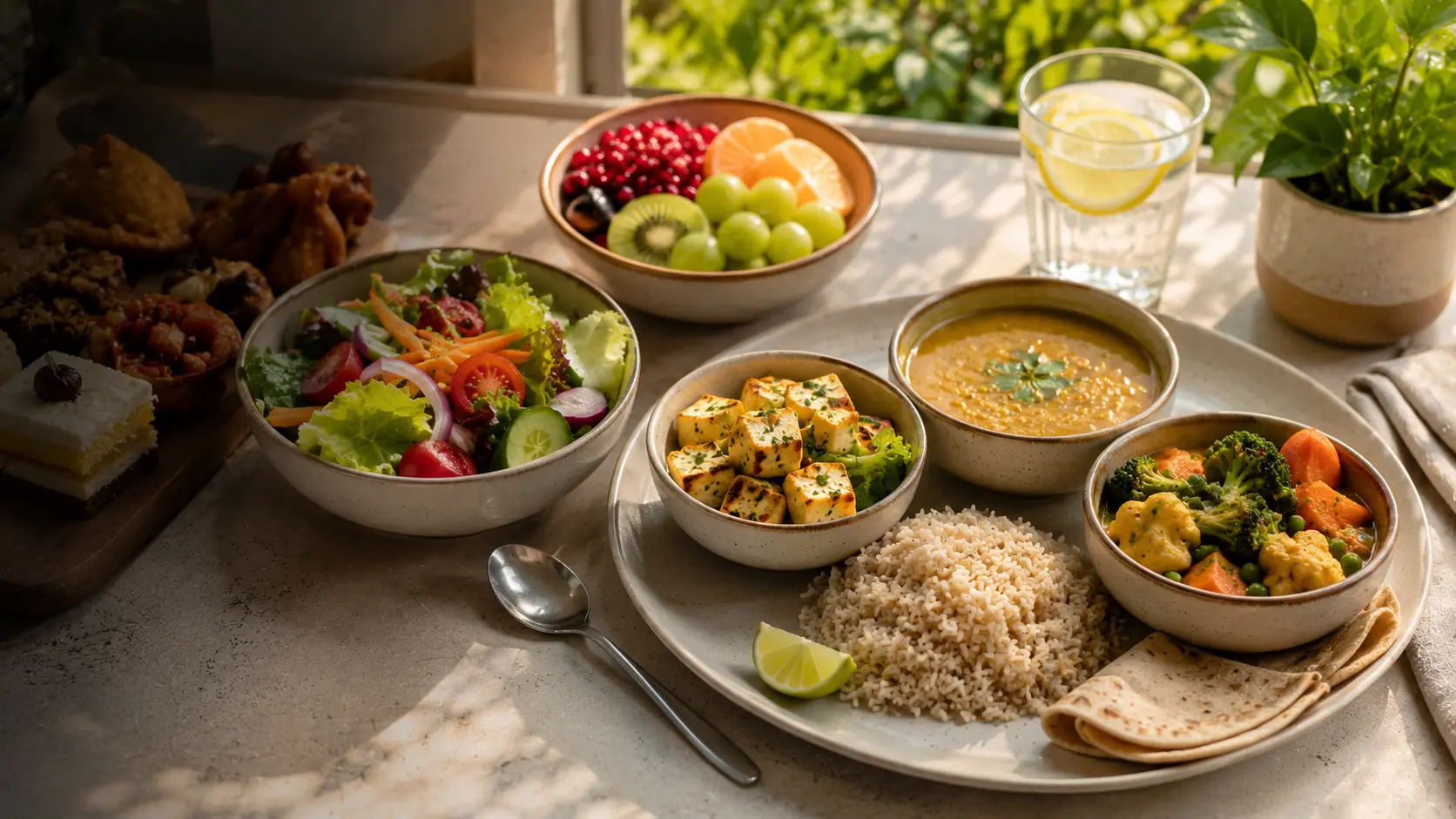
Instead of counting numbers, build every meal as a plate divided into three sections:
← Swipe to compare →
| Plate Section | What to Fill It With | Quantity |
|---|---|---|
| 50% | Vegetables + Salad — sabzi, raita, palak, bhindi, lauki, tori, cucumber | Half the plate |
| 25% | Protein — dal, paneer, curd, egg, chicken, fish, sprouts, rajma | Quarter of the plate |
| 25% | Complex Carbs — roti (atta), brown rice, jowar, bajra, oats | Quarter of the plate |
This ratio keeps blood sugar stable while keeping you full and satisfied — without counting a single calorie.
Foods That Help Control Blood Sugar
These are regular Indian kitchen ingredients — not expensive imports:
← Swipe to compare →
| Food | Why It Helps | How to Include |
|---|---|---|
| Methi (Fenugreek seeds) | Slows carb absorption, improves insulin sensitivity | Soak 1 tsp overnight, eat seeds in morning; add to paratha dough |
| Karela (Bitter gourd) | Contains compounds that mimic insulin action | Karela sabzi, small quantity of karela juice |
| Dalchini (Cinnamon) | May improve insulin response | Add to tea, oats, warm milk — ½ tsp per day |
| Whole dal (with skin) | High fibre, slow glucose release | Moong, masoor, chana dal — with skin preferred |
| Curd / Dahi | Probiotics improve gut health and glucose metabolism | With every meal as raita or plain |
| Amla (Indian Gooseberry) | Rich in Vitamin C, reduces blood sugar spikes | Raw, as pickle, or amla juice (small quantity) |
| Nuts (Almonds, Walnuts) | Healthy fats slow sugar absorption | 5–8 pieces as snack, or paired with carbs |
| Green leafy vegetables | Very low carbs, high fibre and micronutrients | Palak, methi saag, sarson — daily if possible |
| Jamun (Indian Blackberry) | Contains jamboline — traditionally used to manage blood sugar | Seasonal — eat whole fruit, not juice |
| Oats | Very low GI (55), high beta-glucan fibre | Breakfast — oats porridge or oats chilla |
Foods to Reduce (Not Necessarily Eliminate)
The goal is not to never eat these again — it is to understand their impact and consume them strategically:
← Swipe to compare →
| Food | Issue | Smarter Alternative |
|---|---|---|
| White rice (large portions) | High GI (72) — spikes blood sugar fast | Half portion + extra dal and sabzi; or switch to brown rice |
| Maida-based foods | Refined carb, zero fibre — fastest sugar spike | Whole wheat, ragi, or jowar alternatives |
| Sugary beverages | Liquid sugar enters blood with no buffering | Plain water, buttermilk, green tea, black coffee |
| Fried snacks (samosa, pakora) | Refined carbs + saturated fat — double blood sugar hit | Roasted chana, makhana, air-fried versions |
| Sweets and mithai | Very high sugar, minimal protein/fibre | One small piece on festivals — not daily |
| Sweetened chai (2 spoons sugar × 4 cups) | 128+ sugar calories per day, invisible | Switch to ½ spoon or none — takes 2 weeks to adjust |
| Potato in every sabzi | High GI starchy vegetable | Replace with lauki, tori, bhindi, palak in daily sabzi |
Smart Food Swaps
Small swaps make a meaningful difference without overhauling your entire diet:
← Swipe to compare →
| Instead Of | Try This | Why |
|---|---|---|
| White rice (2 cups) | 1 cup rice + extra dal and sabzi | Less carb, same volume, more protein and fibre |
| Wheat roti only | Multigrain or ragi roti | Lower GI, more fibre and micronutrients |
| Chai with 2 spoons sugar | Chai with ½ spoon or no sugar | Saves 80+ calories and a blood sugar spike — 4x per day |
| Packaged fruit juice | Whole fruit with skin | Fibre slows sugar absorption significantly |
| Biscuits with tea | Roasted chana or makhana | Protein + fibre instead of maida + sugar |
| Deep-fried snacks | Air-fried or roasted versions | Same taste, fraction of the oil |
| White bread toast | Multigrain or ragi bread | Lower GI, more fibre |
| Plain rice for dinner | Dal khichdi (rice + moong dal combined) | Protein + fibre in the same dish, lower overall GI |
7-Day Diabetes-Friendly Indian Meal Plan
This uses regular Indian food — nothing expensive or hard to find.
Day 1 — Monday
← Swipe to compare →
| Time | Meal | What to Eat |
|---|---|---|
| 7:00 AM | Early morning | Warm water + 1 tsp soaked methi seeds |
| 8:00 AM | Breakfast | Moong dal chilla (2) + green chutney + 1 cup tea (½ tsp sugar) |
| 11:00 AM | Mid-morning | 6 almonds + 1 small guava |
| 1:00 PM | Lunch | 2 multigrain roti + moong dal + bhindi sabzi + cucumber salad + 100g curd |
| 4:00 PM | Evening snack | Roasted makhana (1 small cup) |
| 7:30 PM | Dinner | 1 roti + palak paneer (minimal oil) + salad |
| 9:00 PM | Before bed | Warm turmeric milk (no sugar, 150ml) |
Day 2 — Tuesday
← Swipe to compare →
| Time | Meal | What to Eat |
|---|---|---|
| 7:00 AM | Early morning | Warm water + lemon |
| 8:00 AM | Breakfast | Oats porridge (40g oats + low-fat milk) + 1 boiled egg |
| 11:00 AM | Mid-morning | 1 apple (with skin) + 5 walnuts |
| 1:00 PM | Lunch | ½ cup brown rice + rajma (small bowl) + tori sabzi + curd |
| 4:00 PM | Evening snack | Roasted chana (small handful) + chaas (200ml, no salt) |
| 7:30 PM | Dinner | 2 roti + mixed vegetable sabzi (lauki, carrot, peas) + dal |
Day 3 — Wednesday
← Swipe to compare →
| Time | Meal | What to Eat |
|---|---|---|
| 7:00 AM | Early morning | Warm water + soaked methi seeds |
| 8:00 AM | Breakfast | Besan chilla (2, with spinach and onion) + mint chutney |
| 11:00 AM | Mid-morning | 1 pear + 6 almonds |
| 1:00 PM | Lunch | 2 roti + chana dal + lauki sabzi + salad |
| 4:00 PM | Evening snack | Moong sprouts chaat (½ cup, lemon + chaat masala) |
| 7:30 PM | Dinner | 1 roti + karela sabzi + 1 bowl masoor dal + salad |
Day 4 — Thursday
← Swipe to compare →
| Time | Meal | What to Eat |
|---|---|---|
| 7:00 AM | Early morning | Warm water + amla juice (small glass) |
| 8:00 AM | Breakfast | Ragi dosa (2) + sambar (½ bowl) + coconut chutney |
| 11:00 AM | Mid-morning | 1 guava + 5 almonds |
| 1:00 PM | Lunch | Dal khichdi (½ cup rice + moong dal, cooked together) + curd + salad |
| 4:00 PM | Evening snack | Makhana (roasted, small bowl) |
| 7:30 PM | Dinner | 2 jowar roti + palak dal + cucumber raita |
Day 5 — Friday
← Swipe to compare →
| Time | Meal | What to Eat |
|---|---|---|
| 7:00 AM | Early morning | Warm water + ½ tsp cinnamon in water |
| 8:00 AM | Breakfast | Egg bhurji (2 eggs, minimal oil) + 1 multigrain roti |
| 11:00 AM | Mid-morning | 1 small orange (whole, not juice) + 6 walnuts |
| 1:00 PM | Lunch | 2 roti + chole (small portion) + bhindi sabzi + salad |
| 4:00 PM | Evening snack | Roasted chana (small handful) + green tea |
| 7:30 PM | Dinner | 1 roti + methi sabzi + moong dal + salad |
Day 6 — Saturday
← Swipe to compare →
| Time | Meal | What to Eat |
|---|---|---|
| 7:00 AM | Early morning | Warm water + soaked methi seeds |
| 8:00 AM | Breakfast | Vegetable oats upma (40g oats + vegetables) + buttermilk |
| 11:00 AM | Mid-morning | 1 pear + 5 almonds |
| 1:00 PM | Lunch | ½ cup brown rice + sambar + beans sabzi + curd |
| 4:00 PM | Evening snack | Sprouted moong salad (small bowl) |
| 7:30 PM | Dinner | 2 bajra roti + palak paneer (less oil) + salad |
Day 7 — Sunday
← Swipe to compare →
| Time | Meal | What to Eat |
|---|---|---|
| 7:00 AM | Early morning | Warm water + lemon |
| 8:30 AM | Breakfast | Moong dal idli (3) + sambar + green chutney |
| 11:30 AM | Mid-morning | 1 apple + 6 almonds |
| 1:30 PM | Lunch | 2 multigrain roti + dal makhani (lighter version, less butter) + salad |
| 4:00 PM | Evening snack | Roasted makhana or roasted chana |
| 7:30 PM | Dinner | Dal khichdi + curd + cucumber salad |
| 9:00 PM | Before bed | Warm turmeric milk (no sugar) |
This is a framework — not a strict prescription. Swap meals within the same structure: carb + protein + vegetable at every meal, moderate portions, and no eating carbs alone. Adapt to your preferences and what is available.
Fruits and Diabetes: What Is Actually Safe
"Can I eat fruits?" is one of the most asked questions. The answer: yes — but choose wisely and eat whole fruit, not juice.
Better Choices — Low GI Fruits
← Swipe to compare →
| Fruit | GI | Safe Portion |
|---|---|---|
| Jamun (Indian Blackberry) | 25 | 10–15 berries |
| Guava | 28 | 1 medium |
| Apple (with skin) | 36 | 1 small |
| Pear | 38 | 1 medium |
| Strawberry | 41 | 10–12 pieces |
| Orange (whole) | 43 | 1 medium |
| Papaya | 60 | ½ cup |
Limit These — High GI or High Sugar Fruits
← Swipe to compare →
| Fruit | Issue | How to Have |
|---|---|---|
| Mango | High sugar, GI 51–60 (but large portions spike fast) | 2–3 slices occasionally |
| Banana (ripe) | High GI (62+) when very ripe | Half a small banana, less ripe |
| Chiku (Sapota) | Very high sugar | Avoid during active sugar management |
| Watermelon | GI 72 despite low calories | Very small portion, paired with nuts |
| Grapes | High sugar per cup | 10–12 grapes maximum |
| Any fruit as juice | Removes all fibre | Always eat whole fruit |
Rule of thumb: Eat one fruit at a time. Pair it with 5–6 nuts to slow absorption. Never drink fruit juice.
5 Daily Habits That Help More Than Any Diet Plan
1. Walk 10 Minutes After Every Meal
This single habit reduces post-meal blood sugar spikes by 15–25%. It requires no equipment, no gym, and no extra time beyond a short after-meal walk. This is one of the most evidence-supported diabetes management habits available.
2. Eat Vegetables and Dal Before Your Roti or Rice
When you eat sabzi and dal first, the fibre slows how quickly the roti or rice raises your blood sugar. Same meal, same food, different order — measurably different blood sugar response.
3. Never Skip Meals
Skipping meals causes low blood sugar, followed by intense hunger, followed by overeating, followed by a spike. Consistent, timely meals — 3 main meals and 1–2 snacks — keep blood sugar stable through the day.
4. Prioritise 7–8 Hours of Sleep
Poor sleep directly increases insulin resistance. Even a single night of disrupted sleep can raise fasting blood sugar the next morning. Sleep is as important as diet and medication in diabetes management.
5. Manage Stress Actively
Cortisol (the stress hormone) raises blood sugar directly — even when you have not eaten. Deep breathing, daily walks, adequate rest, and reducing chronic stress are not lifestyle extras — they are part of diabetes management.
📖 Read Also:
Free Calorie and Nutrition CalculatorTrack your meals, calculate portion sizes, and understand your daily calorie and carbohydrate needs — especially useful for managing blood sugar through diet.
Prediabetes vs Type 2 Diabetes: Is the Diet the Same?
The dietary principles are very similar, but prediabetes allows more flexibility:
← Swipe to compare →
| Factor | Prediabetes | Type 2 Diabetes |
|---|---|---|
| Carb restriction needed | Moderate — reduce refined carbs | More strict — portion control at every meal |
| White rice | Reduce portion significantly | Switch to brown rice or avoid |
| Reversal possible? | ✅ Yes — with diet + exercise + weight loss | Partially — HbA1c can reach near-normal |
| Medication needed | Often not yet | Usually prescribed |
| Exercise urgency | High | Very high |
For prediabetes: The same 7-day plan above works well. The key difference — you have a window to reverse the condition entirely through diet, exercise, and modest weight loss (5–10% of body weight). This window closes once full Type 2 develops.
📖 Read Also:
Roti vs Rice for Weight Loss and Diabetes — Which Is Better?Complete comparison of roti and rice for blood sugar management — glycaemic index, fibre, portion guidance, and a goal-based verdict.
FAQ
What Indian foods are best for controlling blood sugar?
The best Indian foods for blood sugar control are karela (bitter gourd), methi (fenugreek), dal and whole legumes, low-GI vegetables like spinach and bhindi, millets (jowar, bajra, ragi), curd, and jamun. These are high in fibre and protein, which slow glucose absorption and prevent spikes.
Can a diabetic Indian eat rice and roti?
Yes — in controlled portions. Half a cup of rice or 1–2 small rotis per meal, paired with generous dal and vegetables, is manageable for most diabetics. Brown rice, hand-pounded rice, or ragi and jowar rotis are better alternatives. Read our full guide on roti vs rice for diabetes.
What should a diabetic Indian eat for breakfast?
Good diabetic Indian breakfasts include moong dal chilla, oats porridge, besan cheela, ragi dosa with sambar, or egg bhurji with multigrain toast. Always include protein (dal, eggs, paneer) at breakfast — it blunts the morning glucose rise and keeps you full until lunch.
Is millet good for diabetics in India?
Yes — millets like bajra, jowar, and ragi have a lower GI than white rice and wheat and are higher in fibre. They cause a slower, more gradual blood sugar rise. Replacing 1–2 meals per day with millet-based foods (ragi roti, jowar bhakri, bajra khichdi) is an excellent blood sugar management strategy.
How many meals per day should a diabetic eat?
Three balanced meals with 1–2 small healthy snacks — total 5 meals per day — is better than 2 large meals. Smaller, more frequent meals prevent large blood sugar spikes and crashes. Consistent meal timing also helps regulate insulin response throughout the day.
Can prediabetes be reversed with diet?
Yes — this is one of the most important and underappreciated facts in diabetes management. Multiple large studies including the Indian Diabetes Prevention Programme show that diet changes + exercise + modest weight loss (5–10% of body weight) can prevent progression from prediabetes to Type 2 diabetes in up to 58% of cases. This window does not remain open indefinitely — act early.
Is banana good or bad for diabetics?
Bananas in moderation — particularly less ripe bananas — are acceptable for most diabetics. Very ripe bananas have a higher GI (up to 62) than unripe ones (around 42). Limit to half a small banana, pair with nuts or curd, and monitor your own blood sugar response. Never eat as juice.
The Bottom Line
Managing diabetes with Indian food is not about deprivation — it is about being smart with what you already eat. You can have roti. You can have rice (smaller portions). You can have chai (less sugar). You can enjoy festivals (just not the entire mithai box).
The combination of the right food structure, 10-minute after-meal walks, consistent sleep, stress management, and your prescribed medication gives you control over your blood sugar — not the other way around.
Smart plate. Regular movement. Consistent medication. That is how you take charge.
References
The guidance in this article is based on the following peer-reviewed research and public health guidance. Always discuss changes to your diet, supplements, or medication with a qualified doctor or registered dietitian.
- World Health Organization. Diabetes — Fact Sheet
- Low Glycemic Index Diets on Glycemic and Lipid Control Across Diverse Populations: A Systematic Review and Meta-Analysis (2026)
- Diabetes Prevention Program Research Group. Reduction in the incidence of type 2 diabetes with lifestyle intervention or metformin. N Engl J Med (2002)
- National Institute of Nutrition (ICMR), Hyderabad — Dietary Guidelines for Indians
- World Health Organization. Healthy Diet — Fact Sheet
Free Tools to Help You
Put this article into action — use our free calculators to get your personalized numbers.
Was this article helpful?
Want More Tips Like This?
Join 1,000+ readers getting weekly fitness, diet, and wellness tips + FREE meal plan
No spam, ever. Unsubscribe anytime.

About the Author: Ashwani
Fitness influencer and wellness writer helping Indians build healthier lifestyles.
Read more about us →Comments
Leave a Comment
Your email will not be published. Comments are reviewed before appearing.
You Might Also Like
Continue your wellness journey
33 min read
Indian Diet Plan for Weight Loss: The Complete 2026 Guide
Most Indians gain weight not from indulgence but from not knowing their portions. This complete Indian diet plan covers calorie targets, 7-day meal charts, 1200 and 1500 calorie plans, vegetarian options, and the 10 mistakes keeping you stuck — updated June 2026.

24 min read
1200 Calorie Indian Diet Plan (2026): 7-Day Veg & Non-Veg Meal Plan for Weight Loss
Complete 1200 calorie Indian diet plan for weight loss — non-veg and veg breakfast options with exact calories, 7-day meal plans, Indian food calorie chart, and safe diet guidelines.

14 min read
Indian Festive Eating: Enjoy Diwali & Navratri Without Weight Gain
Diwali sweets, Navratri fasting, Holi bhaang, Eid biryani — Indian festivals are built around food. Most people gain 2–4 kg every festive season and spend months trying to undo it. This guide shows you how to genuinely enjoy every festival without the guilt or the weight gain.